
White Hawkweed (Hieracium albiflorum)
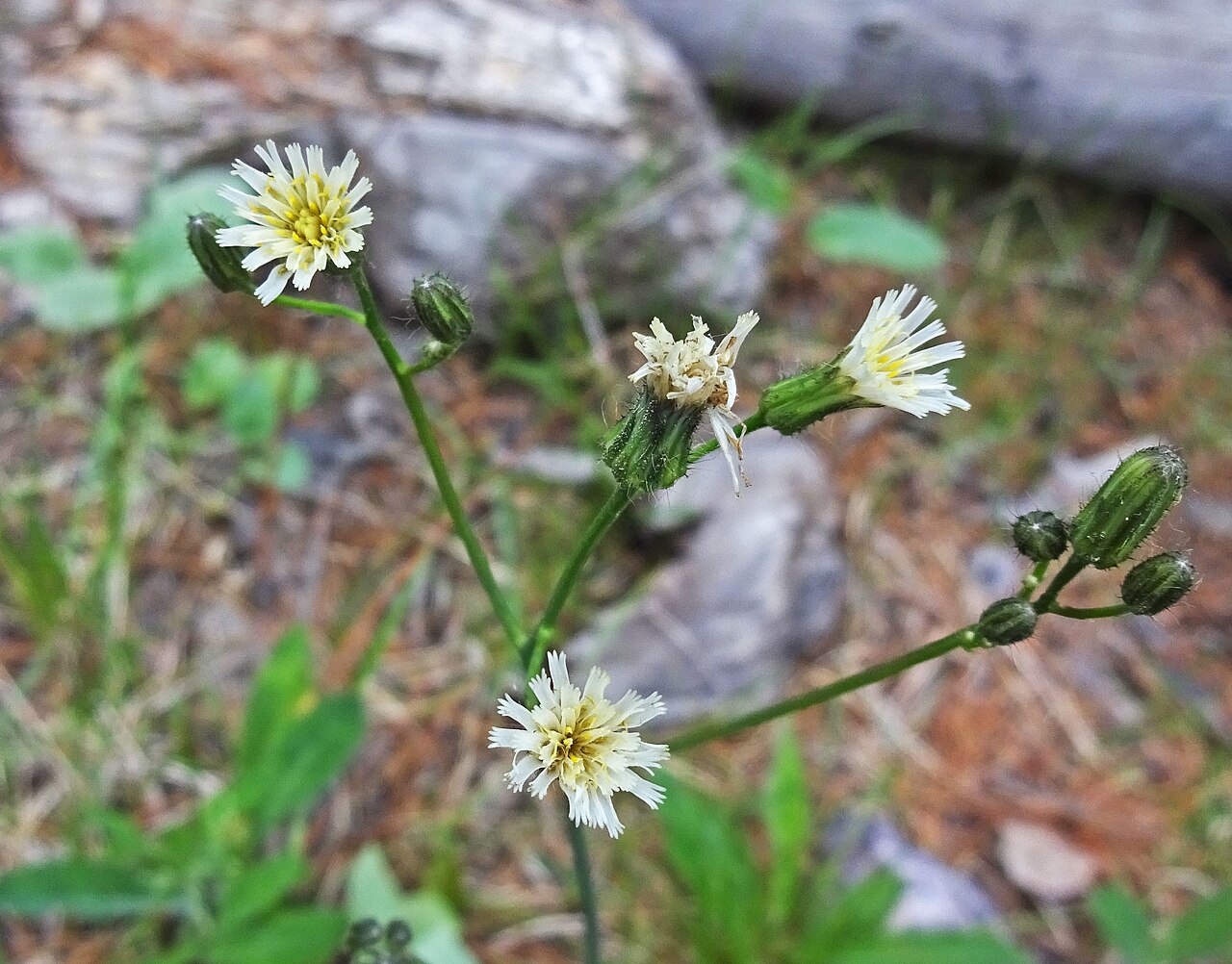
Hieracium albiflorum, known as White Hawkweed or white-flowered hawkweed, is a native perennial wildflower of open conifer forests, clearings and mountain meadows in western North America. A member of the aster family (Asteraceae), it forms a rosette of soft, hairy leaves and sends up slender, branching stems 1 to 3 feet tall that carry many small, white, dandelion-like flower heads from early summer into late summer. Some botanists place it in the segregate genus Chlorocrepis, as Chlorocrepis albiflora.
White hawkweed is one of the few hawkweeds in North America with white flowers, and it is a true native. That matters, because several European hawkweeds, especially orange hawkweed and meadow hawkweed, are aggressive invasive weeds across the West. Unlike those, white hawkweed does not spread by runners or form dense mats. It grows as scattered single plants or small groups among native grasses, shrubs and wildflowers.
It is an easy plant to overlook, but its airy sprays of small white flowers brighten shady forest floors and roadside openings throughout the mountains, from Alaska and the Yukon south to the Sierra Nevada and the Rockies. In a native garden it suits woodland edges and informal plantings under pines and Douglas-firs.
Identification
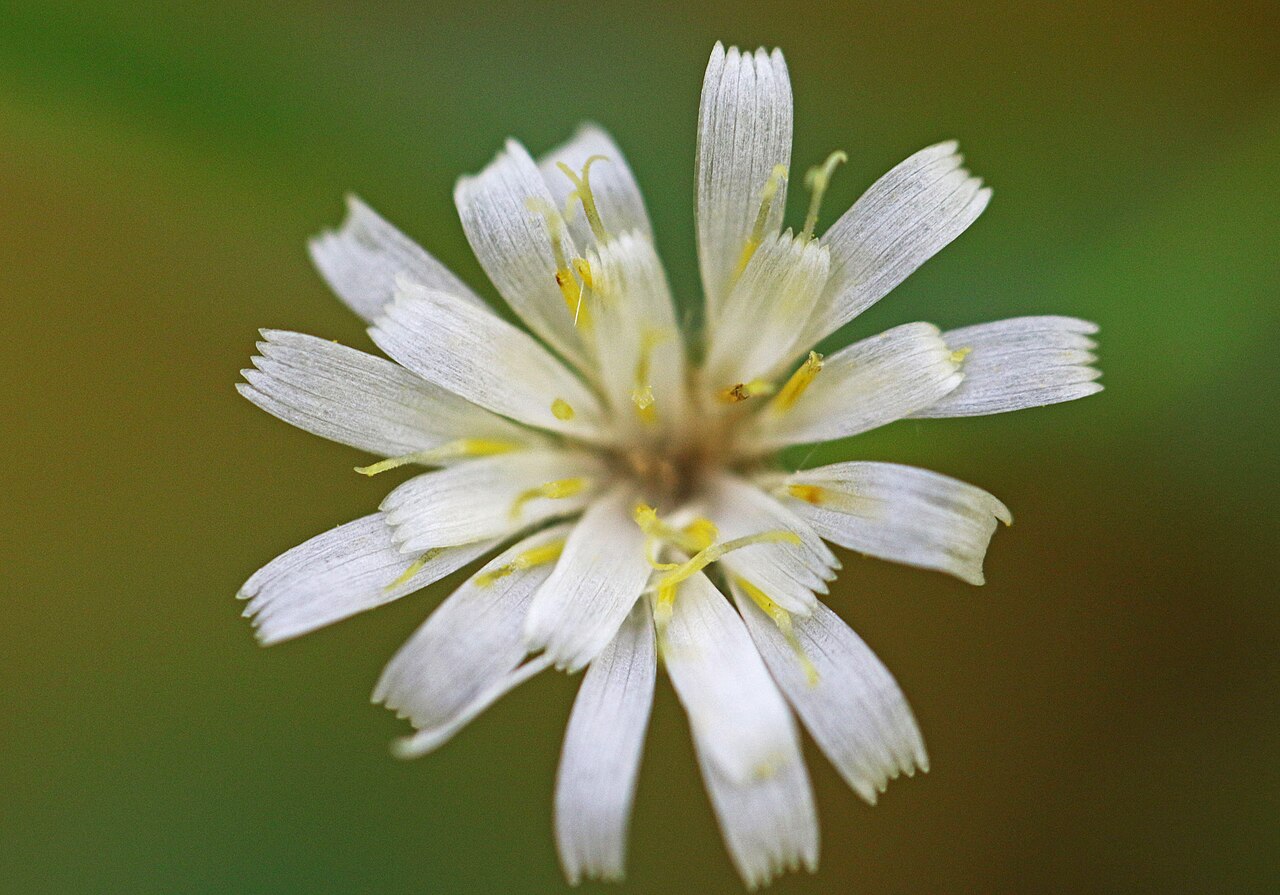
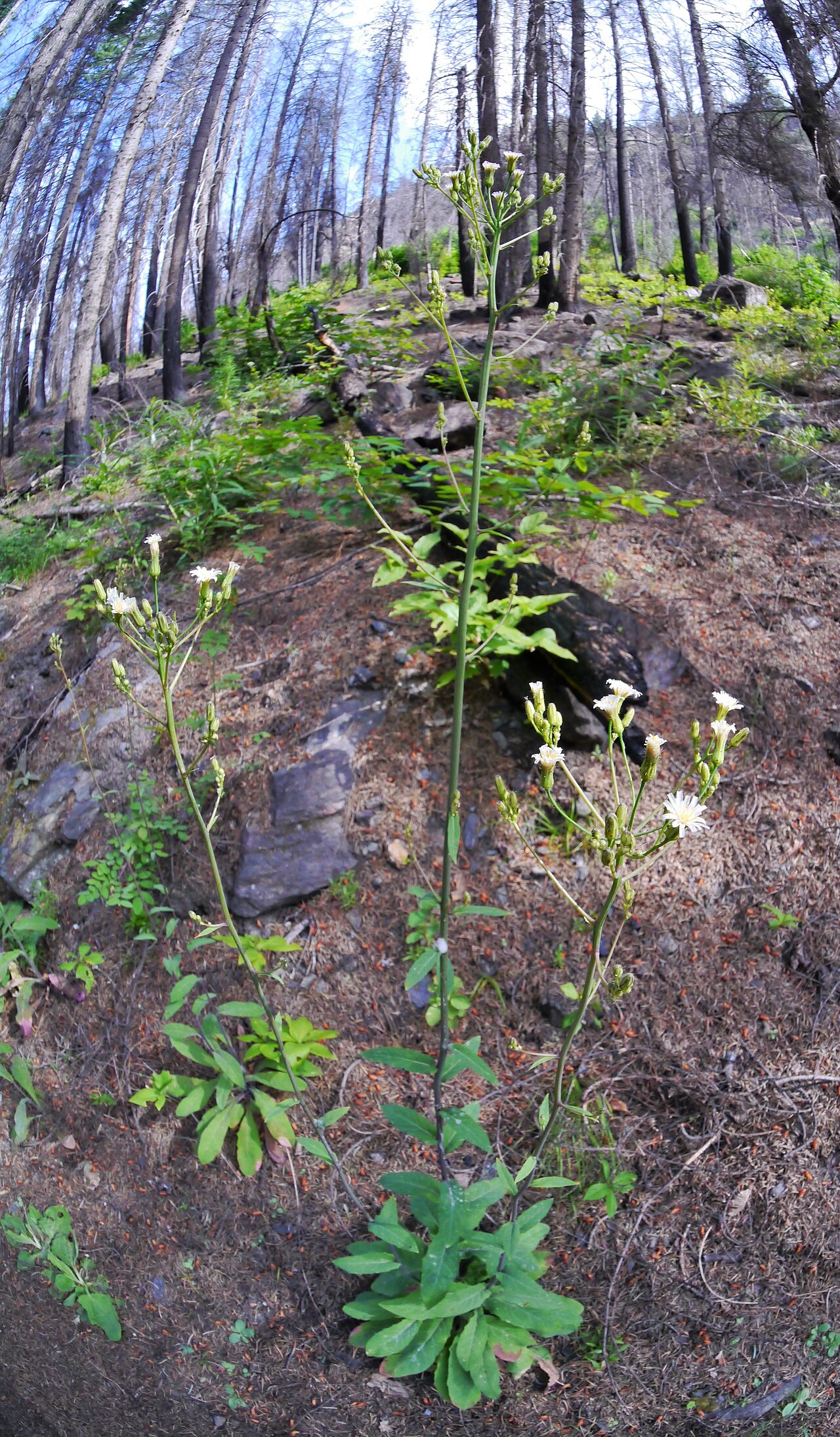
Look for a rosette of hairy, green leaves at the base of a slender, mostly leafless stem topped by an open, branching cluster of small white flower heads with no ray-and-disk structure, only strap-shaped florets.
Growth Habit
White hawkweed grows from a short, stout rootstock. Each plant forms a basal rosette and one or a few upright, slender stems, typically 1 to 1 1/2 feet tall and sometimes up to 3 feet. It has no stolons (above-ground runners), which helps separate it from the invasive orange and meadow hawkweeds. Like other hawkweeds, the stems and leaves contain a milky sap.
Leaves
The basal leaves are oblong to oblanceolate, about 2 to 6 inches long, with smooth or slightly wavy edges. They are covered, especially on the lower part of the plant, with long, soft, white hairs. The stem bears only a few leaves, which become small and narrow upward.
Flowers
The flower heads are small, about 1/2 inch across, and grow in an open, branching cluster (panicle) at the top of the stem. Each head is made of white to creamy white, strap-shaped (ligulate) florets, without separate ray and disk flowers, like a small white dandelion. Bloom time is roughly June to August, from May at low elevations to September in the high country.
Seeds
The fruits are small, ribbed, dark achenes (cypselae), each topped with a tuft of tan to dirty-white bristles that carry it on the wind.
Look-alikes
Orange hawkweed (Pilosella aurantiaca) has bright orange-red flowers and spreads by runners, and meadow hawkweed (Pilosella caespitosa) has yellow flowers and runners; both are invasive European plants. Native yellow-flowered western hawkweeds, such as slender hawkweed (Hieracium gracile) and houndstongue hawkweed (H. cynoglossoides), have yellow flowers. In the East, rattlesnakeweed (H. venosum) has yellow flowers and purple-veined leaves. White-flowered yarrow and pearly everlasting grow in similar places but have very different flower heads and leaves.
Quick Facts
| Scientific Name | Hieracium albiflorum |
| Family | Asteraceae (aster family) |
| Plant Type | Herbaceous perennial wildflower |
| Mature Height | 1–3 ft |
| Mature Spread | 6–12 in |
| Growth Rate | Moderate |
| Sun Exposure | Part shade to full sun |
| Water Needs | Low to medium |
| Soil Type | Well-drained loam, sandy or gravelly forest soil |
| Soil pH | Acidic to neutral (about 5.0–7.0) |
| Bloom Time | June–August (May–September) |
| Flower Color | White to creamy white |
| Fall Color | None notable |
| Fruit | Small achenes with tan bristles |
| Deer Resistant | Moderately; occasionally grazed |
| USDA Hardiness Zones | 3–8 |
Native Range
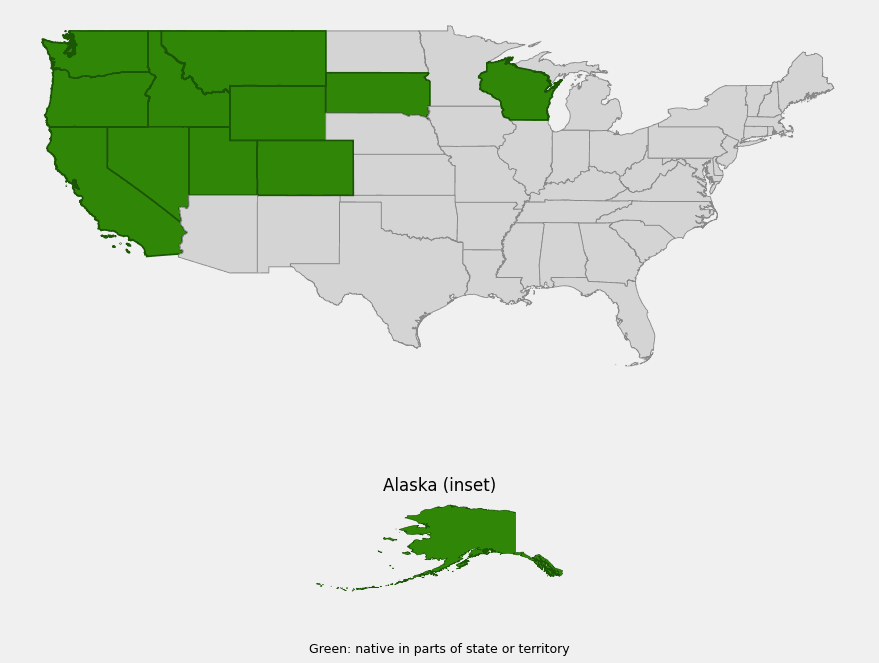
White hawkweed is a western North American native. USDA PLANTS records it as native in 12 states, including Alaska, and in Canada from Yukon, the Northwest Territories and British Columbia east across Alberta, Saskatchewan and Manitoba, with a record from Quebec. Its core range runs from southeast Alaska and the Yukon south through British Columbia, Washington, Oregon, Idaho and western Montana to the Sierra Nevada of California and the Rocky Mountains of Wyoming, Utah and Colorado.
It grows on both sides of the Cascades in Oregon and Washington, in the Coast Ranges and the drier interior forests. In Nevada it is uncommon, and NatureServe ranks it as imperiled there. In South Dakota it grows in the Black Hills. The USDA record for Wisconsin is an outlying record, far east of the main range; it is not known from the neighboring states.
Typical habitats are dry to moist, open coniferous and mixed forests, including Douglas-fir, ponderosa pine, lodgepole pine and fir forests, as well as clearings, forest edges, mountain meadows, recent burns, logged areas and roadsides. It grows from near sea level in the Pacific Northwest to subalpine elevations in the Rockies and Sierra Nevada.
📋 Regional plant lists featuring White Hawkweed: Idaho, Eastern Oregon & Eastern Washington · Montana & Wyoming · Michigan, Wisconsin & Eastern Minnesota · Utah & Western Colorado · Alaska · North Dakota, South Dakota & Western Minnesota · Western Oregon & Western Washington · California & Nevada
Growing & Care Guide
White hawkweed is a modest, low-maintenance native for woodland gardens in the West. It is seldom sold by nurseries, so it is usually grown from seed or encouraged where it already appears. Do not dig plants from the wild.
Light
Part shade to full sun. In nature it often grows in the dappled light of open pine and fir forests and along forest edges, and it handles more sun in cool, high-elevation gardens.
Soil & Water
Give it well-drained loam or sandy to gravelly soil, ideally with some leaf litter or conifer duff, as on a forest floor. It tolerates dry summers once established and needs little or no supplemental water in most western mountain gardens. Avoid heavy, constantly wet soil.
Planting Tips
Sow seed or set out young plants in fall or early spring among other woodland natives, such as heartleaf arnica, twinflower, snowberry and huckleberries. Its airy flower stems look best in loose groups at the edge of a path or under open trees, where the small white flowers show against darker foliage.
Pruning & Maintenance
Little care is needed. Cut back the dry flower stems in fall or leave them for winter interest. It is not weedy and does not need to be controlled, but make sure you are growing the native white-flowered species and not one of the invasive orange or yellow hawkweeds, which should never be planted.
Propagation
Grow it from seed sown in fall, or give stored seed a few weeks of cold, moist stratification before sowing in spring. Press the seed lightly onto the soil surface. Established rosettes can also be carefully divided in early spring.
Landscape Uses
- Woodland gardens: airy white flowers for dappled shade under conifers
- Forest-edge and meadow plantings: mixes with native grasses and wildflowers
- Native alternative to invasive hawkweeds: the native hawkweed to choose for western gardens
- Post-fire and disturbed-site restoration: establishes naturally on burns and clearings
- Pollinator gardens: summer flowers for small bees and flies
Wildlife & Ecological Value
White hawkweed is a small but widespread part of western forest plant communities.
For Pollinators
Its small flower heads attract small native bees, hover flies and other flies, and occasionally small butterflies. Because it blooms through midsummer, it adds to the supply of nectar and pollen on the forest floor.
For Birds
Small seed-eating birds may take the seeds, and the insects that visit the plant feed forest birds raising young in summer.
For Mammals
Deer and elk may graze the leaves and flower stems, but it is not known as an important browse plant.
Ecosystem Role
White hawkweed is one of the native wildflowers that appear in forest openings after fire, logging or windthrow, helping to cover and hold bare soil. Native hawkweeds like it are also part of the plant community that land managers aim to protect from invasion by orange and meadow hawkweed.
Cultural & Historical Uses
The genus name Hieracium comes from the Greek hierax, “hawk.” An old story held that hawks ate the plants or their sap to sharpen their eyesight, which also gave the group the common name hawkweed. The species name albiflorum simply means “white-flowered.”
Hawkweeds are a notoriously difficult group for botanists. Many species reproduce by seeds that form without pollination (apomixis), producing countless slightly different forms. White hawkweed is easier than most, thanks to its white flowers, and some botanists separate it and a few relatives into the genus Chlorocrepis.
In the West, “hawkweed” is often a warning word, because invasive orange and meadow hawkweeds are listed as noxious weeds in several states. White hawkweed is a reminder that the genus also includes native species that belong in western forests and should be left in place when weeds are controlled.
Frequently Asked Questions
Is white hawkweed invasive?
No. White hawkweed is native to western North America. It does not spread by runners and grows as scattered plants. The invasive hawkweeds in the West are European species, such as orange hawkweed and meadow hawkweed.
How can I tell white hawkweed from invasive hawkweeds?
White hawkweed has white flowers and no runners. Orange hawkweed has orange-red flowers, and meadow hawkweed has yellow flowers; both spread by above-ground runners and form dense patches.
Where does white hawkweed grow?
It grows in open conifer forests, clearings, meadows, burns and roadsides from Alaska and the Yukon south to California, Colorado and the Black Hills of South Dakota.
When does white hawkweed bloom?
Mostly from June to August, starting earlier at low elevations and continuing into September in the mountains.
Can I grow white hawkweed in my garden?
Yes, in a woodland or forest-edge garden in the West with well-drained soil and part shade. It is rarely sold, so start it from seed and never dig wild plants.

Looking for a nursery that carries White Hawkweed?
Browse our native plant nursery directory: Alaska · California · Colorado · Idaho · Montana · Nevada · Oregon · South Dakota & Utah · Washington · Wisconsin & Wyoming
