
Purple Milkweed (Asclepias purpurascens)
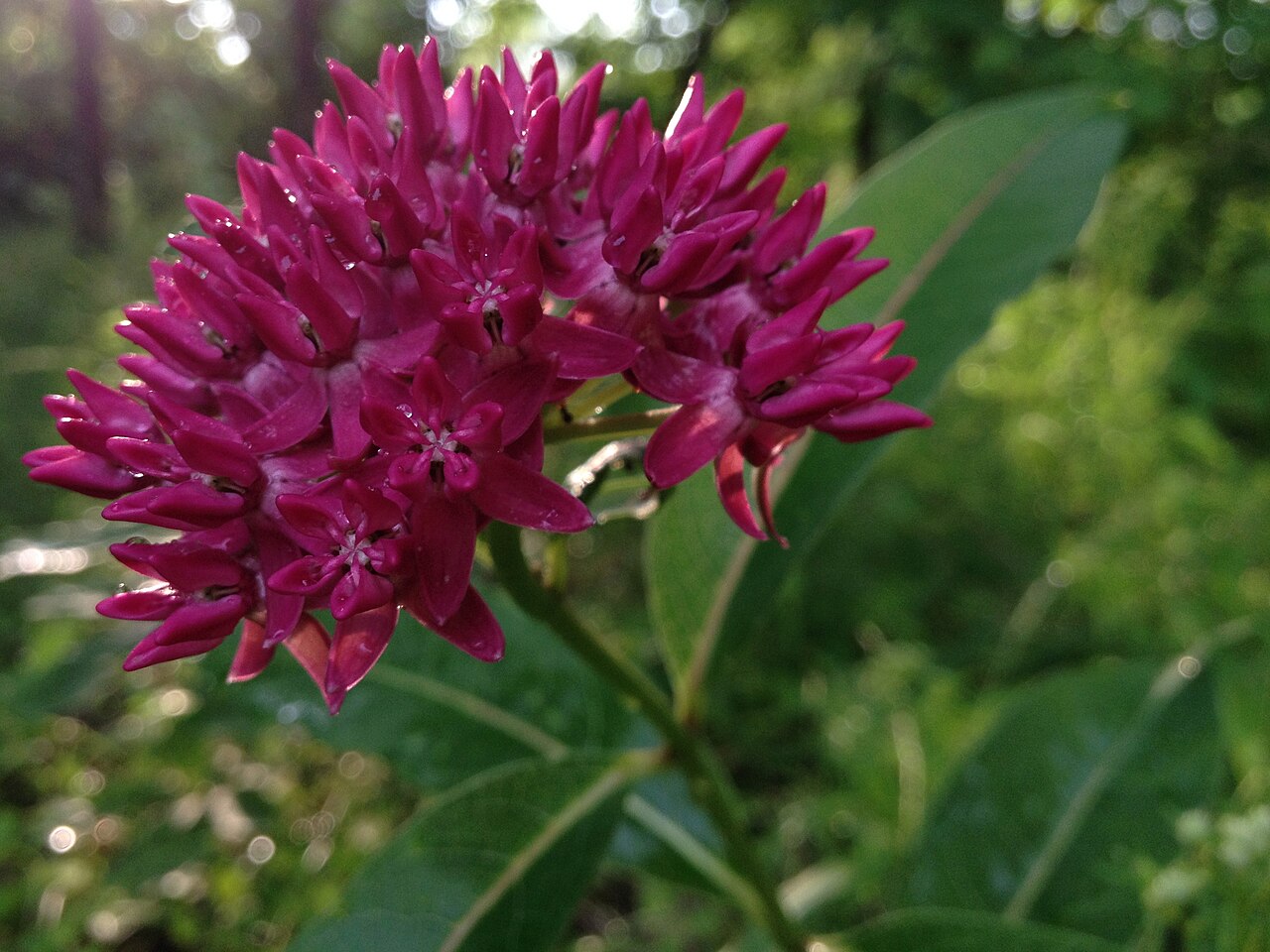
Asclepias purpurascens, known as Purple Milkweed, has the richest flower color of any milkweed in eastern North America: dense, rounded clusters of deep magenta to wine-purple blossoms that open in late spring and early summer. It is a sturdy, upright perennial 2 to 3 feet tall, with broad, opposite leaves and milky sap, and it belongs to the dogbane family (Apocynaceae), which now includes the former milkweed family.
Purple milkweed is a plant of edges and openings: oak savannas, open woodlands, woodland borders, thickets and the sunny margins of prairies. It is widespread, from New England and southern Ontario to the Great Plains and south to Georgia and eastern Texas, yet it is uncommon to rare almost everywhere. Several states list it as endangered or of special concern, and it has disappeared from many places where open oak woodlands have grown up into dense forest.
Like all milkweeds it is a host plant for the monarch butterfly and a magnet for bees and butterflies. For gardeners it offers milkweed benefits in a better-behaved package than common milkweed, with spectacular color for a lightly shaded woodland edge. This guide covers how to tell it apart, where it grows, how to grow it, and an important safety note about its toxic sap.
Identification
Out of bloom, purple milkweed is easily mistaken for common milkweed, which it closely resembles in leaves and habit. In flower the color settles it, and a few details of leaves, stems and pods help at other times of year.
Stems & Leaves
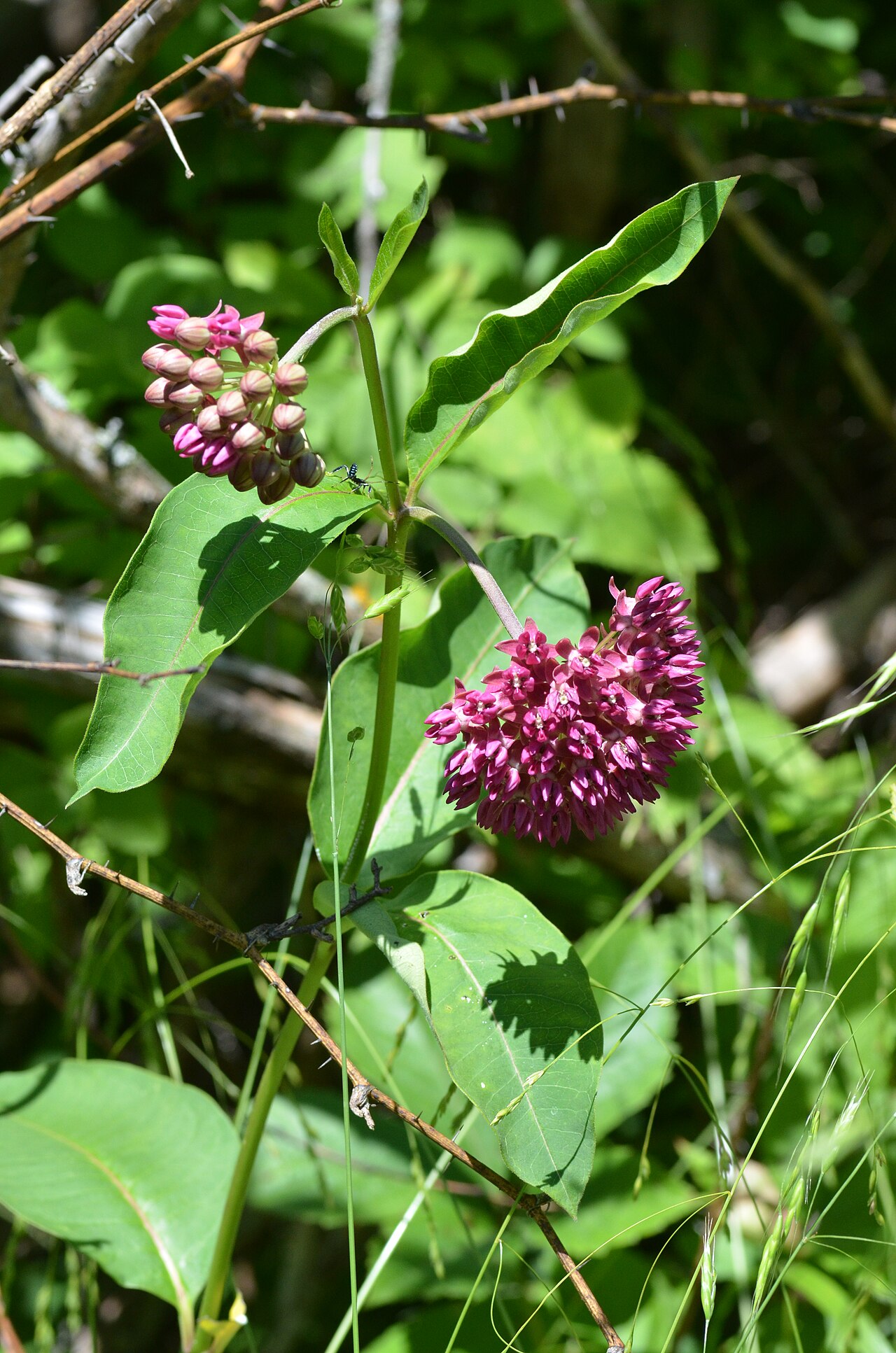
Each plant produces one or a few stout, usually unbranched stems 2 to 3 feet tall (occasionally to 4 feet), with milky sap. The leaves are opposite, broadly oval to elliptic, 3 to 6 inches long, with smooth edges and a pointed tip. They are dark green and nearly hairless above and paler with fine, soft hairs beneath. Compared with common milkweed, the leaves are usually narrower toward the tip and the stems are smoother and less woolly.
Flowers
The flowers are arranged in one to a few rounded umbels, usually at or near the top of the stem, each 2 to 3 inches across and containing up to several dozen flowers. Each flower has the typical milkweed structure: five reflexed petals and a central crown of five upright hoods. In purple milkweed both are deep magenta, rose-purple or reddish purple, darker than the dusty pink of common milkweed or the clear pink of swamp milkweed. Flowers are fragrant and open from late May to July, depending on latitude.
Seed Pods
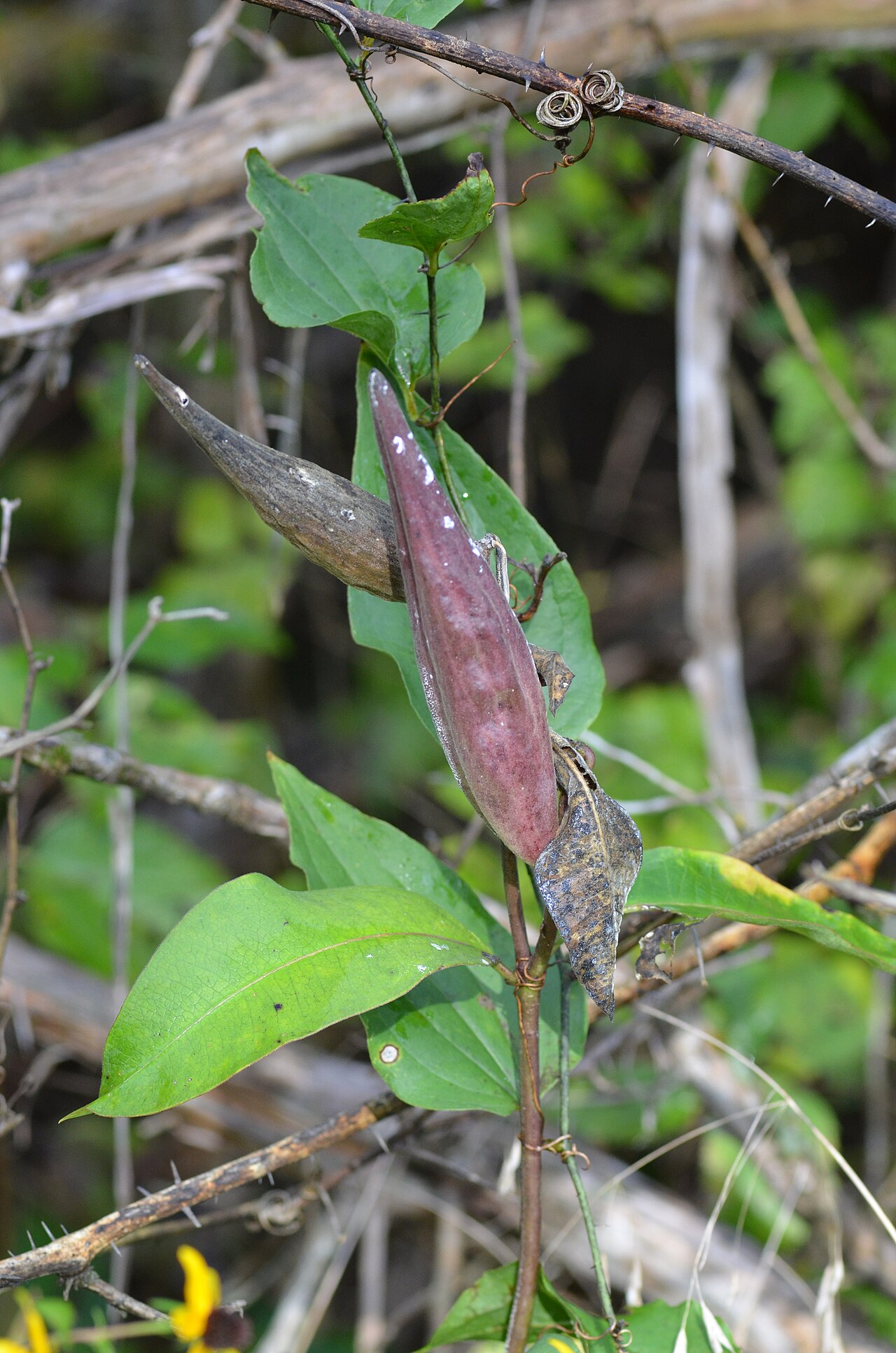
Pollinated flowers form spindle-shaped follicles 4 to 6 inches long, held upright on down-curved stalks. They are smooth and finely downy, without the soft spines or warts typical of common milkweed pods. In late summer and fall they split along one side to release flat brown seeds, each carrying a tuft of silky white hairs that catches the wind.
Roots
Purple milkweed grows from a deep, thick taproot with a woody crown, and it spreads only slowly by short rhizomes. It does not run aggressively across a bed the way common milkweed does.
Look-alikes
Common Milkweed (A. syriaca) has dusty pink to pale mauve flowers, often several umbels along the upper stem, warty pods and a running habit. Swamp Milkweed (A. incarnata) has narrow, lance-shaped leaves, smaller pink flowers in branched clusters and grows in wet places. Red milkweed (A. rubra) of Coastal Plain bogs has narrower leaves and rose to lavender flowers.
Quick Facts
| Scientific Name | Asclepias purpurascens |
| Family | Apocynaceae (dogbane family; formerly Asclepiadaceae) |
| Plant Type | Herbaceous perennial |
| Mature Height | 2–3 ft (occasionally to 4 ft) |
| Mature Spread | 1–1½ ft |
| Growth Rate | Slow to establish; long-lived once settled |
| Sun Exposure | Full sun to part shade |
| Water Needs | Low to moderate; drought tolerant once established |
| Soil Type | Well-drained loam, sandy or rocky soil; also clay loam |
| Soil pH | About 5.5–7.5 |
| Bloom Time | Late May–July |
| Flower Color | Deep magenta, rose-purple to wine red |
| Fall Color | Leaves yellow before dying back |
| Fruit | Smooth, downy pods 4–6 in long with silky-tufted seeds |
| Deer Resistant | Yes; the bitter, toxic sap deters browsing |
| USDA Hardiness Zones | 3–8 |
Native Range
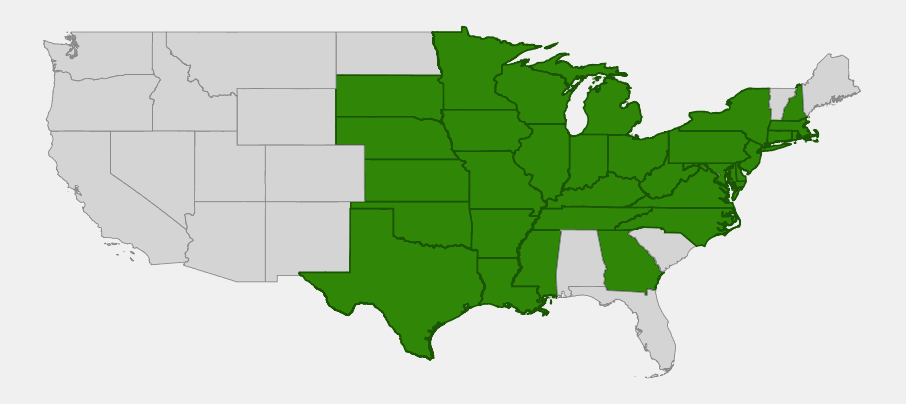
Purple milkweed is native to eastern and central North America. USDA PLANTS records it from southern New England and New York west through the Great Lakes states to Minnesota, South Dakota, Nebraska and Kansas, and south to North Carolina, Georgia, Mississippi, Arkansas, Oklahoma, Louisiana and Texas. In Canada it is known only from southern Ontario, where it is rare. Records from Texas, Louisiana and South Dakota are outlying ones at the edges of the range, and its center of abundance is the Ohio Valley, the Ozarks and the lower Midwest.
Across this range it is a plant of open oak woods and savannas, woodland edges and openings, thickets, roadside banks and the brushy margins of prairies, usually on well-drained soils. It is described by the Lady Bird Johnson Wildflower Center as an indicator of oak-hickory savanna. Because those partly shaded, fire-maintained habitats have declined, purple milkweed is now uncommon to rare in most states.
In New England it is rare: Go Botany lists it as special concern in Connecticut, endangered in Massachusetts, and historical in New Hampshire and Rhode Island, and the Wildflower Center notes that it is endangered in Wisconsin as well. USDA PLANTS also shows a Maine record, but Go Botany treats it as absent from Maine, so Maine is left off the map on this page.
📋 Regional plant lists featuring Purple Milkweed: New York, Pennsylvania & Northern New Jersey · Ohio & Indiana · Michigan, Wisconsin & Eastern Minnesota · Kentucky & Tennessee · Nebraska, Kansas & Eastern Colorado · Connecticut, Massachusetts & Rhode Island · New Hampshire, Maine & Vermont · Maryland, Virginia & West Virginia · Delaware, Southern New Jersey & Long Island · Illinois, Iowa & Missouri · Alabama, Georgia & Mississippi · North & South Carolina · Arkansas, Louisiana, Eastern Oklahoma & Eastern Texas · North Dakota, South Dakota & Western Minnesota
Growing & Care Guide
Purple milkweed is less common in nurseries than common or swamp milkweed, and it has a reputation for being slow and a little fussy to establish. Once a plant settles in, though, it is long-lived and needs almost no care. Its main requirements are good drainage, some sun, and patience while the taproot develops.
Light
Grow it in full sun to part shade. It does especially well in the bright, dappled light of a woodland edge or open oak canopy, where it gets sun for at least half the day. In deep shade it grows weakly and flowers little.
Soil & Water
Purple milkweed prefers well-drained loam, sandy or rocky soil and tolerates clay loam if it does not stay waterlogged. Average moisture is ideal, and established plants handle summer dry spells well thanks to their deep taproot. Avoid poorly drained, soggy sites, which lead to crown rot, and skip fertilizer.
Planting Tips
Plant young, pot-grown plants in spring or early fall and handle the root ball gently; milkweeds resent having their taproots disturbed, so choose the final location carefully. Space plants 18 to 24 inches apart. Seedlings often take two or three years to bloom, and new plants may look sparse in their first year while the root grows.
Pruning & Maintenance
Little maintenance is needed. Leave the stems standing through summer so monarch caterpillars can finish feeding, and let pods ripen if you want seed. Mark the location, because the plant emerges late in spring and is easy to damage while weeding. Aphids (often the bright orange oleander aphid) sometimes cluster on stems; they rarely harm the plant and feed lady beetles and other predators.
Propagation
Grow it from seed. Sow seeds outdoors in fall, or give them 30 to 60 days of cold, moist stratification in the refrigerator before sowing in spring. Sow in deep pots to allow for the taproot and transplant while young. Collect pods just as they begin to split, before the fluffy seeds blow away. Because purple milkweed is rare in many states, use nursery or garden-grown seed rather than collecting from small wild populations, and never dig wild plants.
Landscape Uses
- Monarch and butterfly gardens: a host plant for monarch caterpillars and a strong nectar plant for adult butterflies
- Woodland edges and savanna gardens: suits the dappled light along oak woods and shrub borders where many milkweeds struggle
- Pollinator borders: its dark flowers attract bumble bees, other native bees, butterflies and moths
- Oak savanna restoration: a characteristic forb for restoring open oak woodlands and savannas within its range
- Deer-resistant plantings: its bitter, toxic sap means deer rarely browse it
Wildlife & Ecological Value
Purple milkweed supports a rich community of insects, as milkweeds do, and its blooms come at a time when monarchs and many native bees are active.
For Pollinators
The fragrant flowers attract bumble bees, honey bees and other native bees, butterflies such as swallowtails, fritillaries, skippers and monarchs, as well as moths and beetles. The Wildflower Center notes its special value to native bees and bumble bees. Milkweed pollen is packaged in paired, sticky pollen sacs (pollinia) that clip onto the legs of visiting insects, so only larger, stronger visitors pollinate the flowers effectively.
For Birds
Birds rarely eat milkweed seeds, but some, including orioles and goldfinches, use the silky seed fibers or stem fibers in nests, and insect-eating birds forage on the many insects the plants attract.
For Mammals
Mammals generally avoid purple milkweed because of its bitter, toxic sap. Deer and rabbits seldom browse it.
Ecosystem Role
Purple milkweed is a host plant for the monarch butterfly, whose caterpillars feed only on milkweeds and store the plant’s cardiac glycosides as a defense against predators. It also supports milkweed specialists such as the red milkweed beetle, milkweed tussock moth and large and small milkweed bugs. Its presence often signals a remnant of open oak woodland or savanna that has kept some light at ground level.
Cultural & Historical Uses
Linnaeus described Asclepias purpurascens in 1753. The genus name honors Asklepios, the Greek god of medicine, and the epithet purpurascens means “becoming purple,” a reference to the flower color.
Milkweeds were widely used by Native American peoples, who made strong cordage from the stem fibers and used various species medicinally. The Lady Bird Johnson Wildflower Center notes that the milky juice of purple milkweed has been used to remove warts. Because the plant is toxic, these uses are of historical interest only.
Safety note: all parts of purple milkweed contain cardiac glycosides and are poisonous if eaten, especially in quantity. Symptoms can include vomiting, weakness and an irregular heartbeat. The milky sap can irritate skin and is painful in the eyes, so wear gloves when handling broken stems, wash your hands afterward, and keep children and pets from chewing on the plant. Livestock usually avoid it unless other forage is scarce.
Frequently Asked Questions
Is purple milkweed good for monarchs?
Yes. Like all native milkweeds it is a host plant for monarch caterpillars, and its flowers supply nectar to adult monarchs and many other butterflies.
How is purple milkweed different from common milkweed?
Purple milkweed has deep magenta to wine-purple flowers, usually in one or two clusters at the top of the stem, smooth downy pods, and a slow, clumping habit. Common milkweed has paler pink flowers, warty pods and spreads aggressively by underground runners.
Is purple milkweed poisonous?
Yes. All parts contain cardiac glycosides and are toxic to people, pets and livestock if eaten. The sap can also irritate skin and eyes. Wear gloves when handling cut stems and wash your hands afterward.
Does purple milkweed spread?
Only slowly. It grows from a deep taproot and forms modest clumps, with occasional seedlings. It is much better behaved in a garden than common milkweed.
Why is purple milkweed rare?
Its preferred habitat, open oak woodlands, savannas and sunny woodland edges, has declined as fire has been suppressed and woodlands have grown dense and shady. It is listed as rare or endangered in several states, including Massachusetts and Wisconsin.

Looking for a nursery that carries Purple Milkweed?
Browse our native plant nursery directory: Arkansas · Connecticut, Delaware & Georgia · Illinois, Indiana, Iowa & Kansas · Kentucky, Louisiana, Maryland, Massachusetts, Michigan, Minnesota, Mississippi & Missouri · Nebraska, New Hampshire, New Jersey, New York, North Carolina, Ohio & Oklahoma · Pennsylvania, Rhode Island, South Dakota, Tennessee, Texas & Virginia · West Virginia & Wisconsin

