
Whitebark Raspberry (Rubus leucodermis)
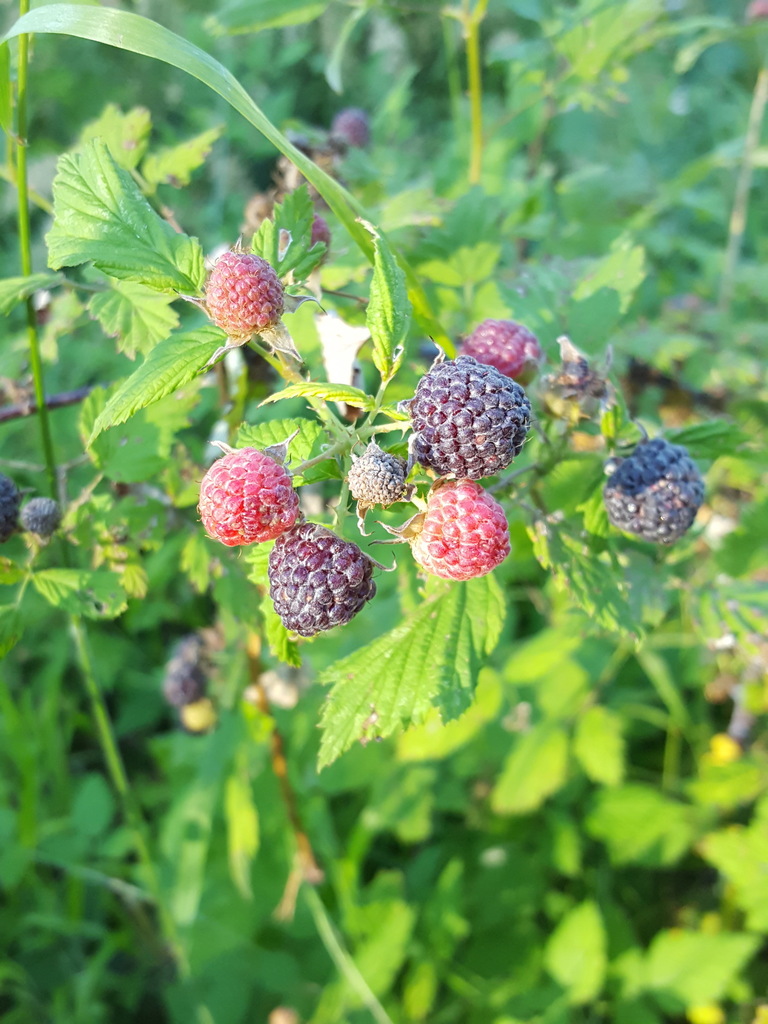
Rubus leucodermis, known as Whitebark Raspberry, western black raspberry or blackcap, is a native bramble of western North America in the rose family (Rosaceae). It is the western counterpart of the eastern black raspberry (Rubus occidentalis) and grows from British Columbia south through the Pacific states and the Rocky Mountains to Arizona, New Mexico and northern Mexico.
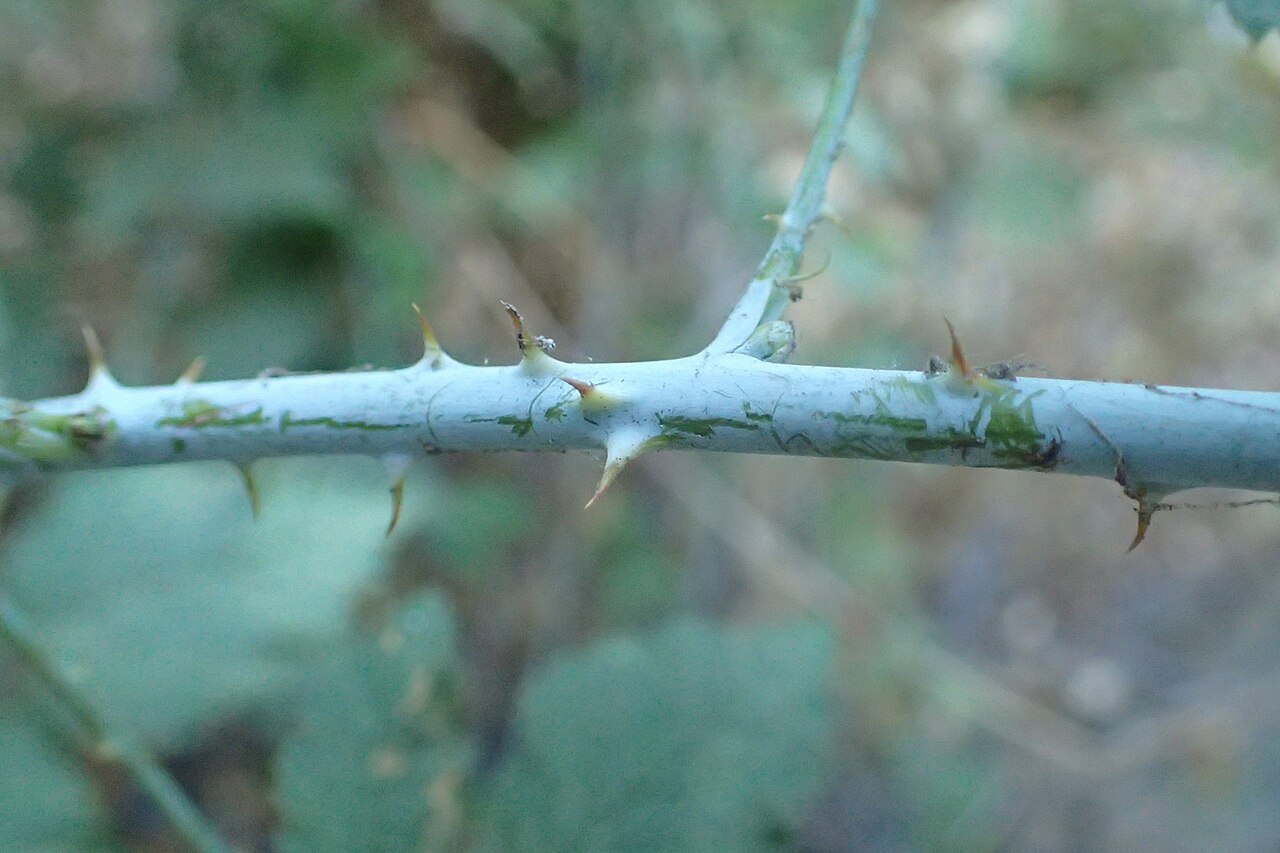
The plant is easy to recognize by its arching canes, which are coated with a chalky, bluish-white bloom and armed with stout, hooked prickles. In late spring it bears small white flowers, and from June to August it produces raspberries that ripen from red to dark purple-black. The berries are sweet, rich and seedy, and they have been gathered for food for thousands of years.
Whitebark raspberry is common in open forests, clearings, burns, canyons and along streams and roads, often coming up after fire or logging. In native gardens it makes a productive, wildlife-friendly hedge or thicket for edges and slopes, as long as you give it room and respect its prickles.
Identification
Look for arching, whitish-blue canes with hooked prickles, leaves of three to five leaflets that are white-woolly underneath, and raspberries that ripen dark purple-black.
Growth Habit
Whitebark raspberry is a deciduous shrub with arching, biennial canes 3 to 6 feet long, occasionally longer. First-year canes (primocanes) grow leaves only; second-year canes (floricanes) bear flowers and fruit and then die. Arching cane tips often root where they touch the ground, forming loose thickets.
Stems
The canes are the best field mark. They are smooth between the prickles and coated with a waxy, whitish to bluish bloom that rubs off, and they carry flattened, hooked prickles. Older canes become reddish-brown or purplish under the bloom.
Leaves
Leaves are alternate and compound, usually with three leaflets (sometimes five on vigorous first-year canes). Leaflets are 1 1/2 to 3 inches long, oval to lance-shaped, with doubly toothed edges. They are green above and covered with dense white wool beneath. The leaf stalks and midribs have small hooked prickles.
Flowers
Small white flowers appear from April to June in clusters of three to ten at the ends of short side shoots. Each is about 1/2 inch across with five narrow white petals that are shorter than the woolly, pointed sepals, so the flowers look rather inconspicuous.
Fruit
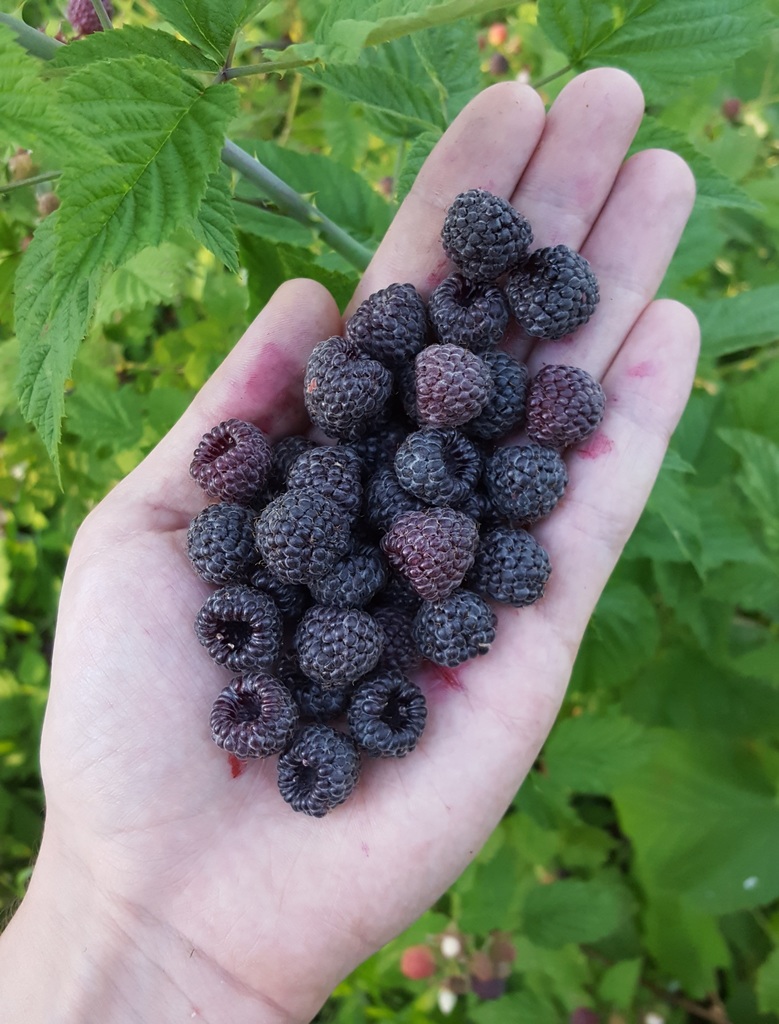
The fruit is a domed raspberry about 1/2 inch wide, made up of many small drupelets. It ripens from June to August, turning red and then dark purple to nearly black; some plants bear reddish or yellowish fruit. Like all raspberries, it pulls off the core and is hollow inside.
Look-alikes
Black raspberry (R. occidentalis) is very similar but native to the East. Red raspberry (R. idaeus) has bristly, not whitish, canes and red fruit. Invasive Himalayan blackberry (R. armeniacus) has thick, angled, green canes, five leaflets and solid blackberries that keep their core. Thimbleberry and salmonberry have large showy flowers and are unarmed or weakly bristly.
Quick Facts
| Scientific Name | Rubus leucodermis |
| Family | Rosaceae (rose family) |
| Plant Type | Deciduous shrub (bramble) |
| Mature Height | 3–6 ft |
| Mature Spread | 3–8 ft; forms thickets |
| Growth Rate | Fast |
| Sun Exposure | Full sun to part shade |
| Water Needs | Low to medium |
| Soil Type | Well-drained loam, sandy, gravelly or rocky soil |
| Soil pH | About 5.5–7.5 |
| Bloom Time | April–June |
| Flower Color | White |
| Fall Color | Yellow to reddish leaves; whitish canes in winter |
| Fruit | Dark purple-black raspberries, June–August |
| Deer Resistant | Low; deer browse leaves and young canes |
| USDA Hardiness Zones | 5–9 |
Native Range
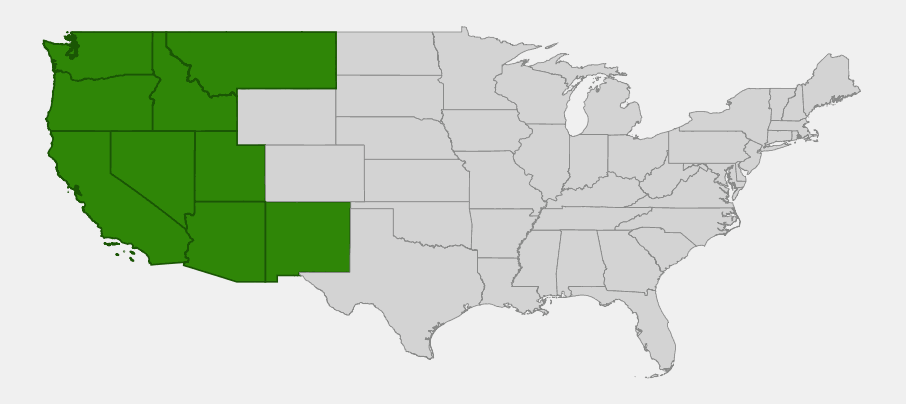
Whitebark raspberry is native to western North America, from southern British Columbia south through Washington, Oregon and California, east through Idaho and western Montana, and south in the mountains of Nevada, Utah, Arizona and New Mexico into northern Mexico. USDA PLANTS lists it as native in Arizona, California, Idaho, Montana, Nevada, New Mexico, Oregon, Utah and Washington. USDA also lists Alaska, but most floras put its northern limit in southern British Columbia and there are no confirmed Alaska occurrences, so Alaska is not treated as part of the native range here.
It is most common west of the Cascades and in the Coast Ranges, Klamath Mountains and Sierra Nevada, and it also grows east of the Cascades in Washington and Oregon and in the northern Rocky Mountains. In the Great Basin and Southwest it is more local, mainly in moist mountain canyons such as the Spring Mountains of Nevada and the high country of Arizona.
Its typical habitat is open or disturbed ground in and near forests: clearings, burns, logged areas, rocky slopes, talus, canyon bottoms, stream banks, forest edges and roadsides, from near sea level to subalpine elevations.
📋 Regional plant lists featuring Whitebark Raspberry: Western Oregon & Western Washington · Idaho, Eastern Oregon & Eastern Washington · California & Nevada · Arizona & New Mexico · Utah & Western Colorado · Montana & Wyoming
Growing & Care Guide
Whitebark raspberry is offered by some native plant nurseries in the West and is easy to grow. Treat it like any raspberry: give it sun, decent drainage and a place where its spreading, prickly canes are welcome.
Light
Full sun to part shade. Plants fruit best with at least half a day of sun.
Soil & Water
It grows in most well-drained soils, from rich loam to rocky, gravelly ground. Once established it tolerates summer drought, especially in part shade, but regular water during flowering and fruiting gives bigger crops. Avoid waterlogged soil.
Planting Tips
Plant in fall or early spring, 3 to 4 feet apart, along a fence, at a woodland edge, or on a slope where a thicket is welcome. Keep it away from paths because of the prickles. A simple wire or post support makes picking easier.
Pruning & Maintenance
Each cane lives two years. After harvest, cut the canes that fruited down to the ground and leave the strongest new canes for next year. Tip back long new canes in late summer to encourage side branches that will carry fruit. Wear sturdy gloves.
Propagation
Propagate by tip layering: in late summer, bury the tip of a new cane a few inches deep, and it will root by fall or the next spring. Seed also works after cold, moist stratification, but germination is slow and uneven.
Landscape Uses
- Edible gardens: sweet, rich black raspberries in summer
- Wildlife hedges and thickets: food and dense, prickly cover for birds and small mammals
- Woodland edges and clearings: fills sunny gaps at the forest edge
- Slope and burn restoration: fast cover on disturbed, rocky or burned ground
- Pollinator gardens: spring flowers visited by native bees
Wildlife & Ecological Value
Like other native brambles, whitebark raspberry is a big wildlife plant, providing flowers, fruit and protective cover in one.
For Pollinators
The white flowers are visited by bumble bees, mason bees, sweat bees and other native bees, as well as honey bees and flies.
For Birds
Thrushes, robins, waxwings, grosbeaks, tanagers, jays, quail and grouse eat the berries. The prickly thickets give nesting cover and protection for small birds.
For Mammals
Black bears, foxes, chipmunks, squirrels and other mammals eat the fruit. Deer and elk browse the leaves and young canes, and rabbits shelter in the thickets.
Ecosystem Role
Whitebark raspberry is an early colonizer after fire, logging and landslides. It sprouts from buried seed and spreading canes, helping hold soil and feeding wildlife while forests regrow.
Cultural & Historical Uses
Whitebark raspberries were an important wild fruit for many Indigenous peoples of the Pacific Northwest, California and the interior West. The berries were eaten fresh, mashed and dried into cakes for winter, and young peeled shoots were eaten in spring. Leaves and roots were used in teas and traditional medicines.
The species name leucodermis comes from Greek words meaning “white skin,” for the whitish canes. The name was coined by the Scottish botanist David Douglas, who collected widely in the Pacific Northwest in the 1820s, and was formally published by John Torrey and Asa Gray.
Wild blackcaps are still gathered by hikers and foragers across the West, and some gardeners grow it as a regionally adapted alternative to cultivated black raspberries.
Frequently Asked Questions
Are whitebark raspberries edible?
Yes. The ripe dark purple-black berries are sweet and good fresh, in jam or in baking. Make sure of the identification before eating any wild fruit.
How is whitebark raspberry different from black raspberry?
They are close relatives with similar fruit. Whitebark raspberry (R. leucodermis) is native to the West, and black raspberry (R. occidentalis) is native to the East.
Why are the canes white?
The canes are covered with a waxy bloom that gives them a whitish-blue color, which is the source of the common name and the species name.
Will whitebark raspberry spread?
Yes. Cane tips root where they touch the ground, forming thickets. Prune out unwanted canes and remove rooted tips each year to keep it in bounds.
When does whitebark raspberry fruit?
The berries ripen from June to August, depending on elevation and latitude.

Looking for a nursery that carries Whitebark Raspberry?
Browse our native plant nursery directory: Arizona · California · Idaho · Montana · Nevada & New Mexico · Oregon · Utah · Washington

