
American Black Currant (Ribes americanum)
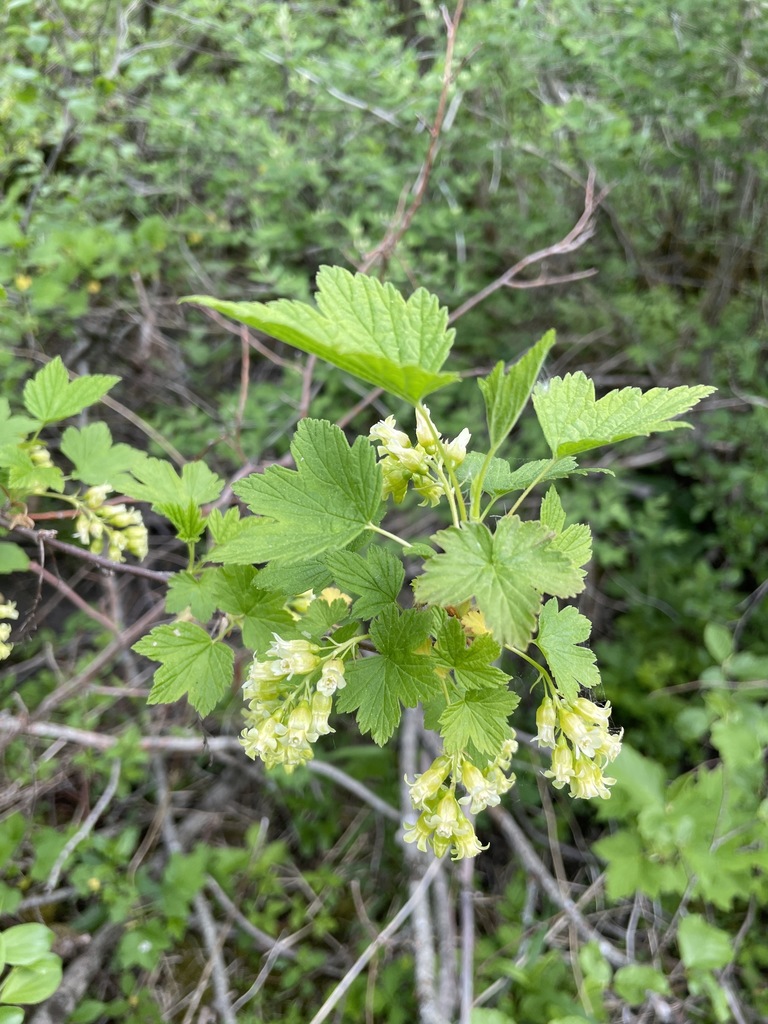
Ribes americanum, known as American Black Currant or wild black currant, is a thornless, medium-sized shrub of wet woods, swamps, streambanks and moist thickets across the northern United States and southern Canada. It grows about 3 to 5 feet tall, with three- to five-lobed, maple-like leaves dotted with tiny golden resin glands, drooping clusters of creamy yellow, bell-shaped flowers in spring, and edible black berries in mid to late summer.
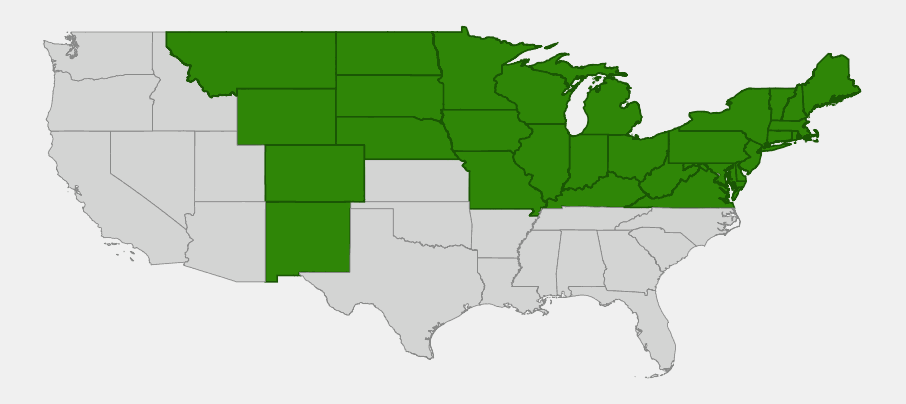
It belongs to the currant and gooseberry family (Grossulariaceae) and is the native relative of the cultivated European black currant (Ribes nigrum). Its range runs from New England and the Mid-Atlantic west through the Great Lakes and the Upper Midwest to the northern Great Plains, reaching the Rocky Mountains in Montana, Wyoming, Colorado and northern New Mexico. In fall the leaves often turn shades of red, purple and yellow, making it one of the more colorful native shrubs for wet ground.
American black currant is a valuable early-season nectar source for bees and its berries feed many birds and mammals. Like other Ribes, it is an alternate host of white pine blister rust, a disease of five-needle pines, and some states and localities restrict planting currants and gooseberries. This guide covers how to identify it, where it grows, how to grow it in a rain garden or wet woodland edge, and its value to wildlife.
Identification
American black currant is easy to recognize as a currant from its lobed leaves, lack of thorns and hanging clusters of flowers or berries. To tell it from other black-fruited currants, check the leaf glands, the bracts and the flowers.
Growth Habit
It is a multi-stemmed, upright to spreading shrub, usually 3 to 5 feet tall and wide, occasionally taller. The stems have no prickles or spines, and young twigs are often finely hairy and dotted with yellow glands. The older bark is gray-brown to blackish. Plants can sucker and layer to form loose thickets in wet ground.
Leaves
The alternate leaves are 1.5 to 3 inches wide, roundish in outline, with three to five pointed, toothed lobes, much like a small maple leaf. Both surfaces, and especially the underside, are sprinkled with tiny, shiny, yellow to golden resin dots that are visible with a hand lens. Crushed leaves have a strong, musky scent typical of black currants.
Flowers
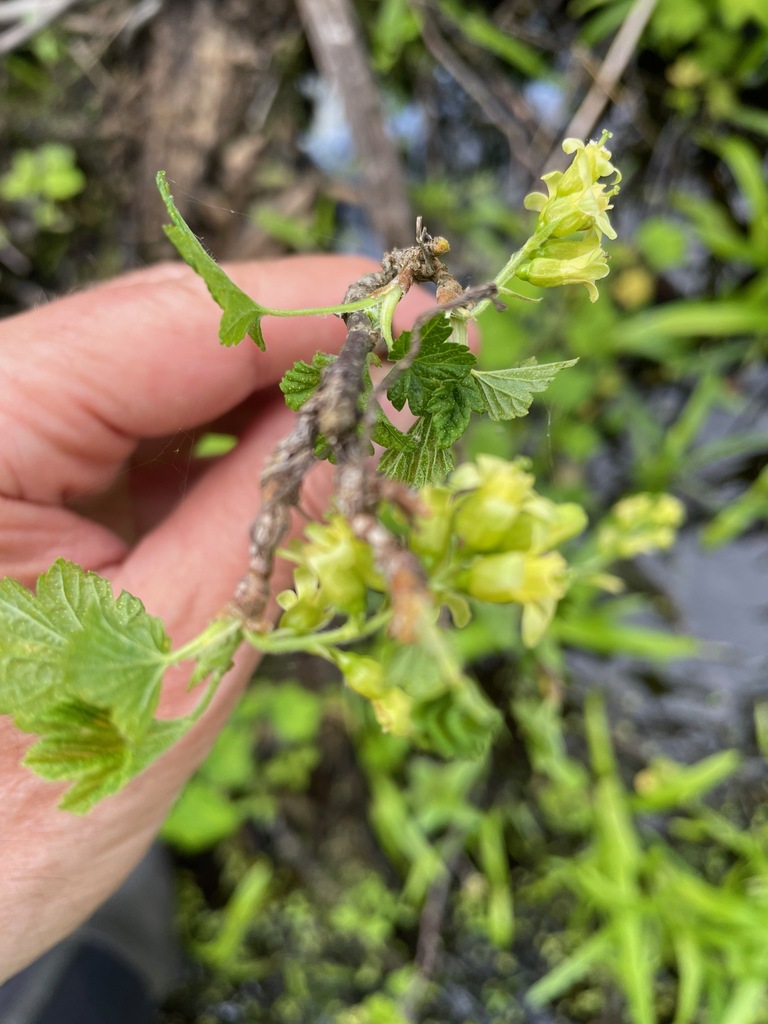
In spring, as the leaves expand, the shrub produces drooping racemes, 1.5 to 3 inches long, of 6 to 15 or more flowers. Each flower is about 1/3 inch long, tubular to bell-shaped and creamy white to pale yellow or greenish yellow, with small petals inside spreading sepals. At the base of each flower stalk is a narrow, leafy bract that is usually longer than the stalk itself, a good field mark. Bloom time is mainly April to June.
Fruit
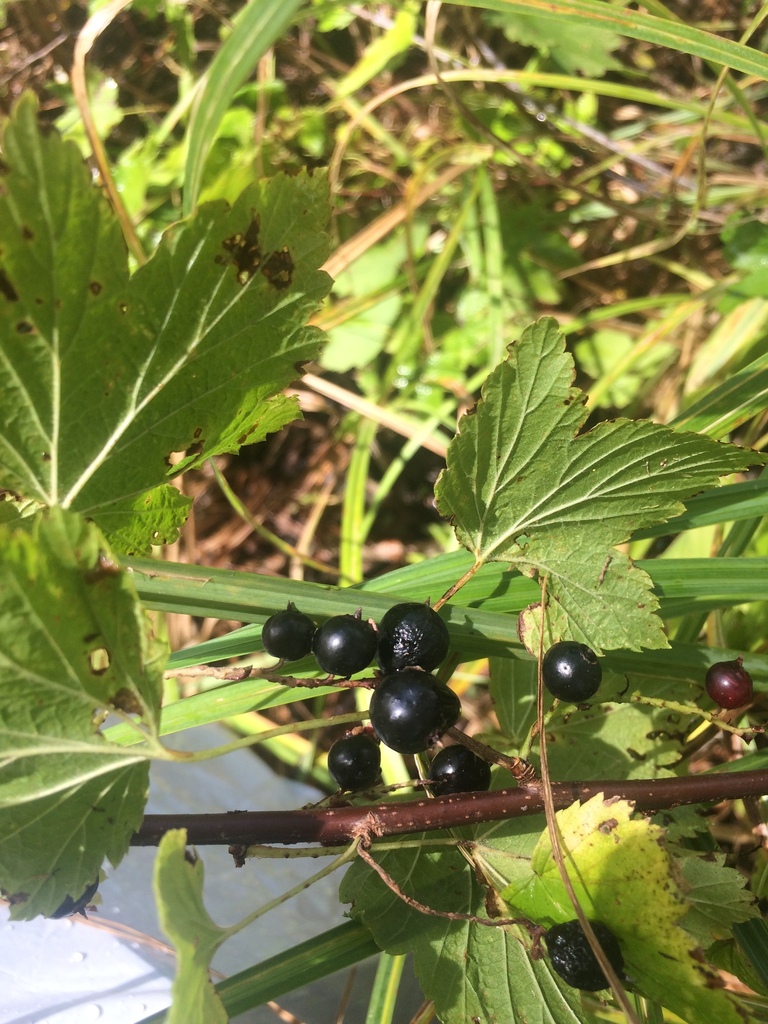
The fruits are smooth, round, glossy black berries about 1/4 to 3/8 inch across, ripening in July and August. They have a persistent dried flower at the tip and contain many small seeds. They are edible, with a tart, somewhat musky black-currant flavor.
Look-alikes
The cultivated European black currant (Ribes nigrum), which occasionally escapes, has glands mainly on the underside of the leaves and very short bracts. Northern black currant (Ribes hudsonianum) of the North and West has white, upright flower clusters and a stronger, unpleasant odor. Skunk currant (Ribes glandulosum) has red, bristly fruit, and buffalo currant and golden currant have bright yellow, clove-scented flowers. Gooseberries have spines at the leaf nodes.
Quick Facts
| Scientific Name | Ribes americanum Mill. |
| Family | Grossulariaceae (currant and gooseberry family) |
| Plant Type | Deciduous, thornless shrub |
| Mature Height | 3–5 ft |
| Mature Spread | 3–5 ft |
| Growth Rate | Moderate to fast |
| Sun Exposure | Full sun to part shade |
| Water Needs | Moderate to high; tolerates wet soil |
| Soil Type | Moist to wet loam, muck or sandy soils; streambanks, swamps and floodplains |
| Soil pH | About 5.5–7.5 |
| Bloom Time | April–June |
| Flower Color | Creamy white to pale yellow-green |
| Fall Color | Red, purple and yellow |
| Fruit | Smooth, glossy black berries, July–August; edible |
| Deer Resistant | Moderately; browsed occasionally |
| USDA Hardiness Zones | 2–7 |
Native Range
American black currant has a broad range across the northern half of the United States and southern Canada. USDA PLANTS lists it as native from Maine and the rest of New England south to Delaware, Maryland, Virginia, West Virginia and Kentucky, west through Ohio, Indiana, Illinois, Missouri and Iowa to Minnesota, the Dakotas and Nebraska, and in the Rocky Mountain states of Montana, Wyoming, Colorado and New Mexico. In Canada it ranges from New Brunswick and Nova Scotia west to Alberta.
It is most common in the Great Lakes states, the Upper Midwest and the northeastern states. In the Rockies it reaches the western edge of its range, where it grows in moist valley bottoms, along streams and in wetlands, such as the wetlands around Bozeman, Montana, and along the Front Range foothills of Colorado; New Mexico populations are scarce and confined to the north. In the Mid-Atlantic and Appalachian states it is less frequent and grows mainly in cool, wet sites.
Typical habitats include swamps and wet woods, alder and willow thickets, streambanks and floodplain forests, fens, wet meadows, lake shores and moist ravines. It tolerates periodic flooding and saturated soil, and it is often found in partial shade at the edges of wetlands and under openings in deciduous forest.
📋 Regional plant lists featuring American Black Currant: New York, Pennsylvania & Northern New Jersey · Ohio & Indiana · Montana & Wyoming · Michigan, Wisconsin & Eastern Minnesota · Kentucky & Tennessee · Nebraska, Kansas & Eastern Colorado · Connecticut, Massachusetts & Rhode Island · New Hampshire, Maine & Vermont · Maryland, Virginia & West Virginia · Delaware, Southern New Jersey & Long Island · Illinois, Iowa & Missouri · North Dakota, South Dakota & Western Minnesota
Growing & Care Guide
American black currant is a tough, adaptable shrub for wet or moist spots, and it is widely available from native plant nurseries in the Northeast and Midwest. Before planting, check state and local rules: because Ribes can host white pine blister rust, some states and counties restrict or prohibit planting currants and gooseberries, especially near white pine stands.
Light
It grows in full sun to part shade. Plants in sun flower and fruit more heavily and have brighter fall color, while those in shade are looser and more open. It tolerates the dappled shade of wetland edges and woodland openings well.
Soil & Water
Plant it in moist to wet, reasonably fertile soil. It tolerates seasonal flooding, saturated soil and heavy clay, which makes it a good choice for rain gardens, swales and pond edges. It also grows in average garden soil if watered during dry spells, but it is not drought tolerant.
Planting Tips
Plant container stock in spring or fall, spacing shrubs about 3 to 4 feet apart for a hedge or thicket. Mulch to keep the roots cool and moist. Combine it with other wetland shrubs such as dogwoods, willows and elderberries for a layered, wildlife-friendly planting. Keep it away from white pines if blister rust is a local concern.
Pruning & Maintenance
Prune in late winter by removing a few of the oldest stems at ground level every year or two; currants fruit best on younger wood. Remove suckers if you want to keep the shrub compact. Watch for powdery mildew and leaf spot in humid summers, and for currant sawfly larvae, which can strip leaves in early summer.
Propagation
It roots easily from hardwood cuttings taken in late winter, and from softwood cuttings in early summer. Low branches often layer naturally where they touch the soil. Seed from ripe berries should be cleaned and given a period of cold, moist stratification over winter before it will germinate.
Landscape Uses
- Rain gardens and swales: thrives in seasonally wet soil and tolerates flooding
- Wetland edge and streambank restoration: a native shrub of swamps, floodplains and stream corridors
- Edible landscapes: tart, edible black berries for jams and baking
- Wildlife and bird gardens: early bee flowers and summer fruit for birds
- Informal hedges and fall color: thornless, with red and purple fall foliage
Wildlife & Ecological Value
American black currant offers flowers early in spring, fruit in summer and dense cover in wetland edges, which makes it a valuable shrub for wildlife.
For Pollinators
The flowers open in spring when relatively few shrubs are blooming, and they are visited by bumble bees, mining bees and other native bees, as well as flies. Currants and gooseberries are larval host plants for several moths and for comma butterflies such as the gray comma (Polygonia progne).
For Birds
The berries are eaten by many songbirds, including American robins, gray catbirds, brown thrashers, cedar waxwings and thrushes, as well as ruffed grouse. The dense, thornless thickets give cover and nesting sites for small birds in wet woods and thickets.
For Mammals
Black bears, raccoons, foxes, chipmunks and other mammals eat the fruit. White-tailed deer and moose browse the twigs and leaves at times, and rabbits may nibble young stems.
Ecosystem Role
As a shrub of streambanks, floodplains and wetland edges, American black currant helps stabilize soil and slow runoff. It is also an alternate host of white pine blister rust, a fungus introduced from Eurasia that alternates between five-needle pines and Ribes, which is why it has been the target of eradication campaigns in the past.
Cultural & Historical Uses
The genus name Ribes is an old name for currants, possibly derived from an Arabic word for a sour-tasting plant. The species name americanum distinguishes this native species from the European black currant. It was described by the English botanist Philip Miller in 1768.
Indigenous peoples across its range gathered the berries, eating them fresh or dried and mixing them into pemmican, and some groups used the roots or stems medicinally. Settlers also gathered wild black currants for jams and jellies. The fruit is high in pectin and makes a dark, flavorful jam, though it is tarter and more musky than cultivated black currants.
In the early twentieth century, white pine blister rust arrived in North America on imported pine seedlings. Because the fungus must pass through currants or gooseberries to infect pines, the federal government and many states ran large programs to pull up wild Ribes near white pine forests. Most of those programs have ended, and rust-resistant pines and better understanding of the disease have changed the picture, but some state and local restrictions remain.
Frequently Asked Questions
Are American black currant berries edible?
Yes. The ripe black berries are edible, tart and somewhat musky. They are best cooked into jams, jellies, syrups or baked goods. Be sure of your identification before eating any wild fruit.
Does American black currant have thorns?
No. Unlike gooseberries, currants such as American black currant have no spines or prickles on the stems.
Can I plant American black currant near white pines?
Check your state and local rules first. Currants are alternate hosts of white pine blister rust, and some states or counties restrict planting Ribes, especially near white pine stands.
Does American black currant grow in wet soil?
Yes. It naturally grows in swamps, floodplains and along streams, and it tolerates seasonal flooding, making it a good rain garden shrub.
How is it different from the cultivated black currant?
The European black currant (Ribes nigrum) is a larger-fruited garden species. American black currant has resin dots on both leaf surfaces, long bracts at the base of each flower stalk, and smaller, tarter berries.

Looking for a nursery that carries American Black Currant?
Browse our native plant nursery directory: Colorado, Connecticut & Delaware · Illinois, Indiana & Iowa · Kentucky, Maine, Maryland, Massachusetts, Michigan, Minnesota, Missouri & Montana · Nebraska, New Hampshire, New Jersey, New Mexico, New York, North Dakota & Ohio · Pennsylvania, Rhode Island, South Dakota, Vermont & Virginia · West Virginia, Wisconsin & Wyoming

