
American Columbo (Frasera caroliniensis)
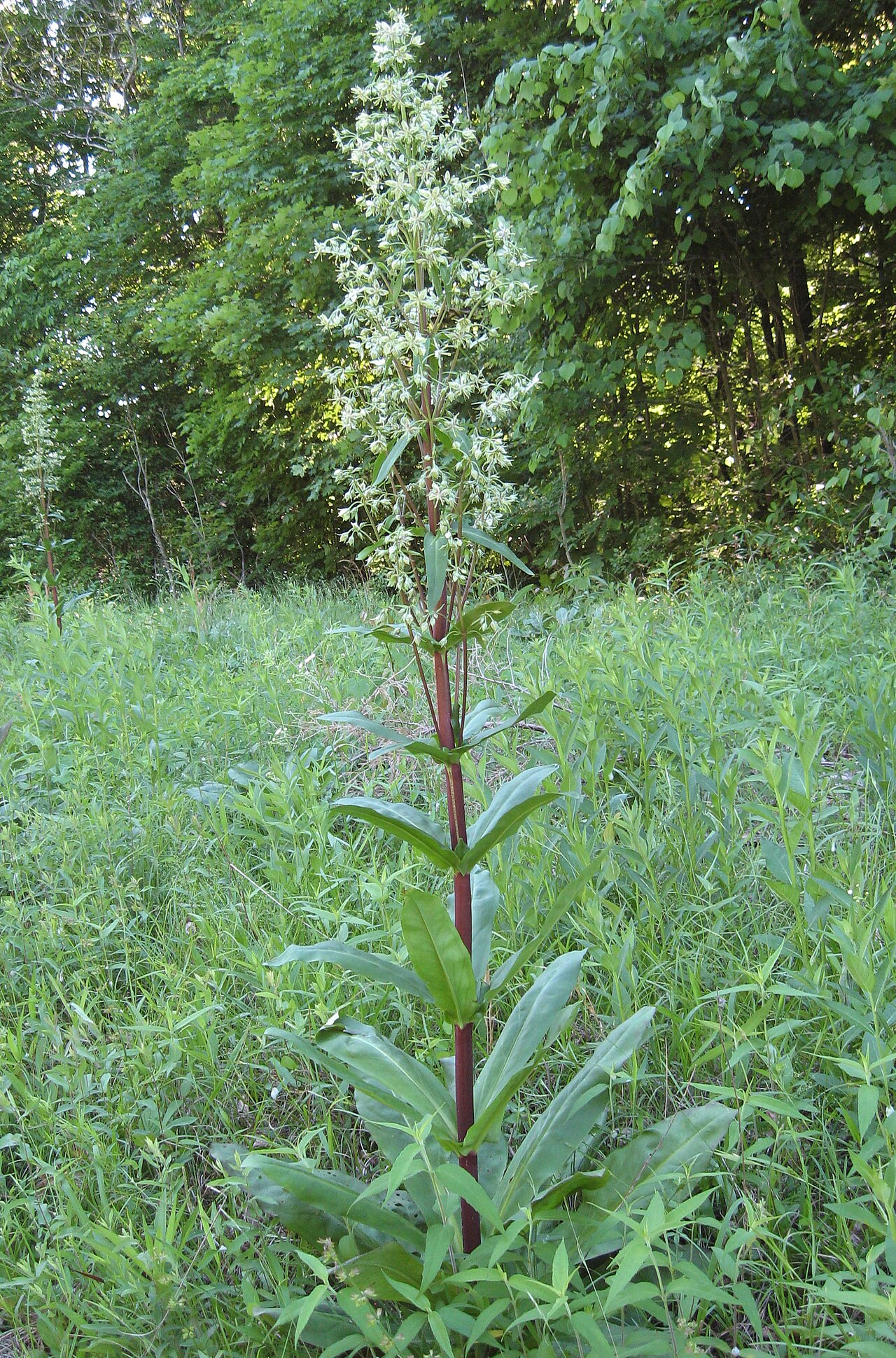
Frasera caroliniensis, known as American Columbo, is a remarkable wildflower of the gentian family (Gentianaceae) that grows in open woods, glades and woodland edges across the eastern and central United States, from New York, Michigan and southern Ontario south to Georgia, Mississippi and Oklahoma.
It is famous for its unusual life history. A plant lives for several to many years as a low rosette of large, smooth leaves on the forest floor. Then, once it has stored enough energy in its thick, yellow taproot, it sends up a single, stately flowering stalk 3 to 8 feet tall, covered with whorls of leaves and hundreds of pale, purple-dotted, four-petaled flowers. After flowering and setting seed, the plant dies. Botanists call this a monocarpic perennial.
American columbo is uncommon across much of its range and rare at its northern edges. It is rarely sold and hard to transplant, so it is best appreciated in the wild. This guide covers how to identify it in all its stages, where it grows, how it can be grown from seed, and its value for wildlife.
Identification
American columbo looks very different in its two stages. Learn to recognize both the leafy rosette and the tall flowering stalk.
Basal Rosette
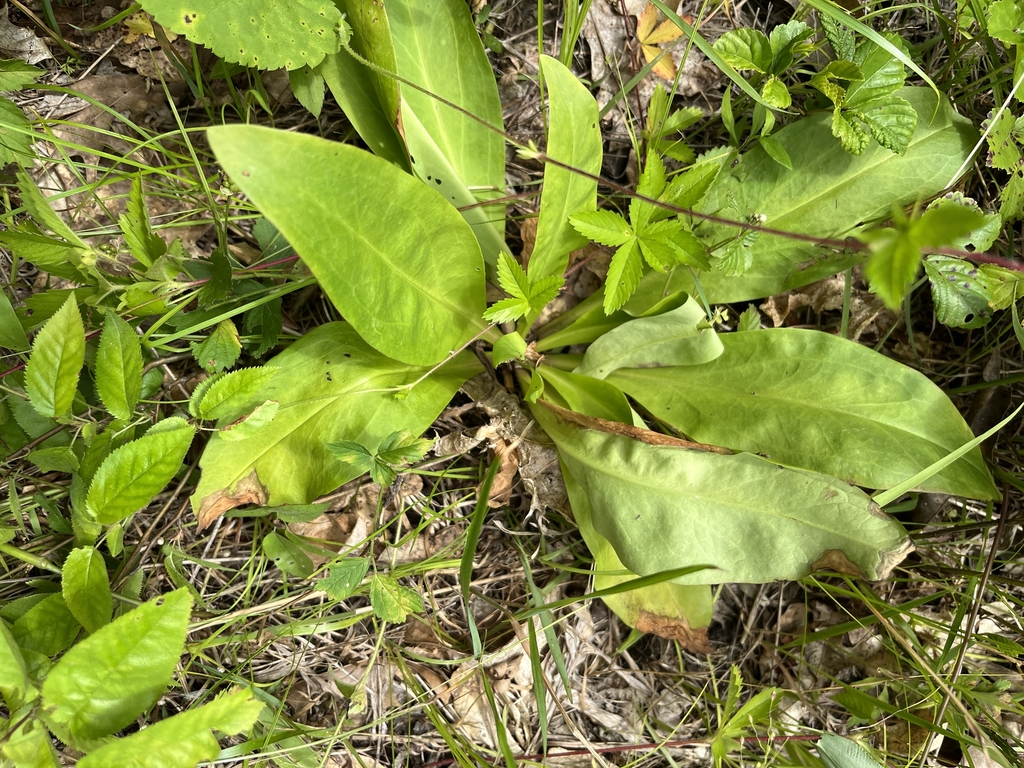
For most of its life it is a rosette of 4 to 10 or more smooth, hairless, oblong to lance-shaped leaves, up to about 12 to 16 inches long, lying flat or arching on the ground. The leaves are light green, often with a pale or whitish narrow margin. They usually appear in late winter or early spring and wither by late summer, when the rosette can look like a scattered ring of brown leaves.
Flowering Stalk
In the year it flowers, the plant produces one stout, hollow, unbranched stalk 3 to 8 feet tall. The stem leaves grow in whorls, usually of four, and get smaller toward the top. The upper part of the stalk becomes a large, pyramid-shaped branching cluster of flowers.
Flowers
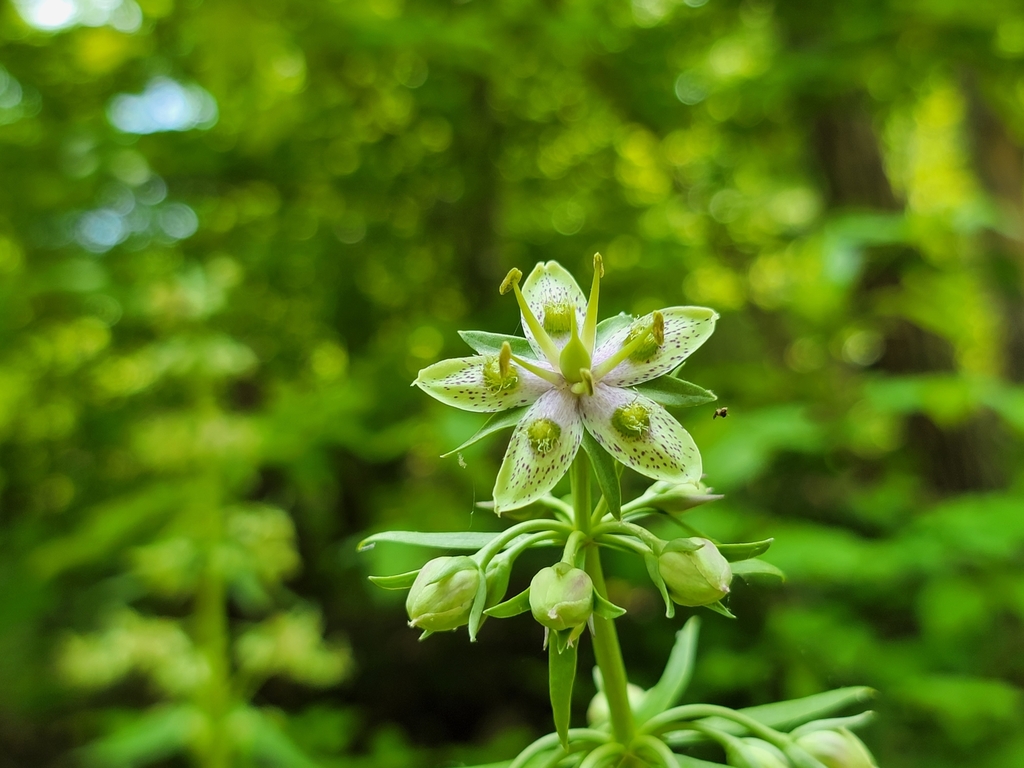
The flowers are about 1 inch across, with four spreading petals that are greenish-white to pale yellow, finely dotted with purple. Each petal has a large, round, fringed nectar gland near its base, a distinctive feature of Frasera. They bloom mainly from May to July.
Fruit & Seeds
After flowering the plant forms flattened, oval capsules about 1/2 to 3/4 inch long, which split to release flat, winged seeds in late summer and fall. The dry stalk often stands into winter, then the plant dies.
Look-alikes
The rosettes are sometimes mistaken for those of tobacco, common mullein or prairie dock, but those have hairy or rough leaves, while columbo leaves are smooth and hairless. The tall stalk with whorls of four leaves and four-petaled, purple-dotted flowers is unlike any other eastern wildflower. Its relatives, the gentians and rose gentians, are much smaller plants.
Quick Facts
| Scientific Name | Frasera caroliniensis Walter |
| Family | Gentianaceae (gentian family) |
| Plant Type | Monocarpic herbaceous perennial with a thick taproot |
| Mature Height | Rosette 1 ft; flowering stalk 3–8 ft |
| Mature Spread | 1–2 ft |
| Growth Rate | Slow (many years to flower) |
| Sun Exposure | Part shade to full sun |
| Water Needs | Low to medium |
| Soil Type | Well-drained loam, clay or rocky soils; often calcareous |
| Soil pH | About 6.0–7.5 |
| Bloom Time | May–July |
| Flower Color | Greenish-white to pale yellow with purple dots |
| Fall Color | None; leaves wither by late summer |
| Fruit | Flat oval capsules with winged seeds |
| Deer Resistant | Moderately (bitter); rosettes are sometimes browsed |
| USDA Hardiness Zones | 5–8 |
Native Range
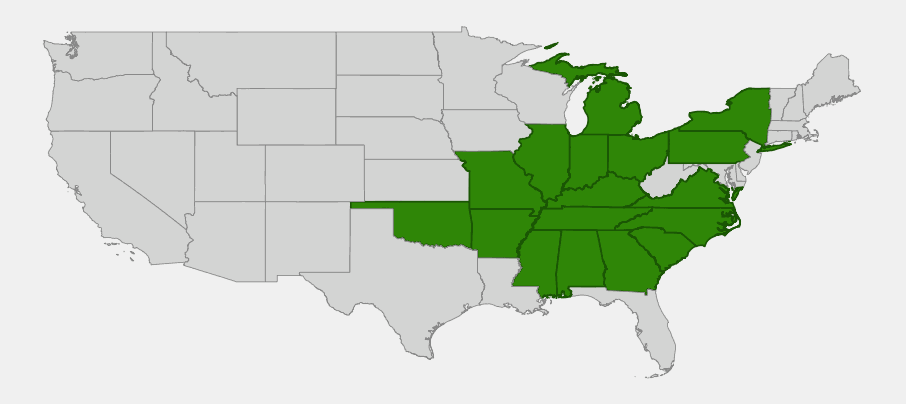
American columbo is native to eastern North America. USDA PLANTS lists it for Alabama, Arkansas, Georgia, Illinois, Indiana, Kentucky, Michigan, Mississippi, Missouri, New York, North Carolina, Ohio, Oklahoma, Pennsylvania, South Carolina, Tennessee and Virginia, and it also grows in southern Ontario, Canada.
It is most frequent in the Ohio and middle Mississippi valleys, in states such as Kentucky, Tennessee, Indiana, Ohio, Illinois and Missouri, and in the southern Appalachians. Toward the edges of its range, in New York, Pennsylvania, Michigan, Ontario, Oklahoma and the Deep South, it is scattered and rare, and it is protected in some states.
It grows in dry to moist open deciduous woods, especially oak and oak-hickory woodlands, as well as woodland edges, savannas, glades, barrens, prairie remnants and roadside banks, often on limestone or other calcium-rich soils. It favors the dappled light of open woods more than deep shade.
📋 Regional plant lists featuring American Columbo: New York, Pennsylvania & Northern New Jersey · Ohio & Indiana · Michigan, Wisconsin & Eastern Minnesota · Kentucky & Tennessee · Maryland, Virginia & West Virginia · Delaware, Southern New Jersey & Long Island · Illinois, Iowa & Missouri · Alabama, Georgia & Mississippi · North & South Carolina · Arkansas, Louisiana, Eastern Oklahoma & Eastern Texas
Growing & Care Guide
American columbo is rarely available from nurseries and can take many years to flower, so it is a plant for patient gardeners and woodland restorations. Never dig it from the wild: its long taproot is easily damaged, transplanted wild plants usually die, and it is rare in several states.
Light
Grow it in part shade to dappled sun, as in an open oak woodland or a woodland edge. It can grow in fuller sun in prairie-like settings if the soil is not too dry.
Soil & Water
It prefers well-drained loam, clay-loam or rocky soil, often neutral to slightly alkaline. It tolerates dry summer conditions once established because of its deep taproot. Avoid soggy or constantly wet soil.
Planting Tips
Sow seed where you want the plants to grow, or plant small nursery-grown seedlings in a spot where they can stay undisturbed for many years. Mark the location, because the rosettes disappear by late summer.
Pruning & Maintenance
No pruning is needed. Keep competing weeds and invasive shrubs away from rosettes. After a plant flowers, leave the stalk to drop its seeds before removing it.
Propagation
Grow it from seed. Sow fresh seed outdoors in fall so it gets several months of cold, moist conditions over winter, or cold-stratify it in the refrigerator before spring sowing. Germination can be slow and irregular, and seedlings take several to many years to reach flowering size.
Landscape Uses
- Woodland gardens: a dramatic, tall accent in the year a plant flowers
- Woodland and savanna restoration: a characteristic plant of open oak woods and glades
- Pollinator plantings: abundant nectar for bees and other insects in early summer
- Nature study: a fascinating example of a long-lived plant that flowers only once
- Wild areas: a plant to look for on woodland walks in the Ohio Valley and Ozarks
Wildlife & Ecological Value
When American columbo flowers, a single stalk can carry hundreds of flowers, a rich source of nectar and pollen in early summer.
For Pollinators
The open, saucer-shaped flowers with their large nectar glands are visited by a variety of bees, including bumble bees, honey bees and smaller native bees, as well as wasps, flies and beetles.
For Birds
Birds are not major users of the plant, though insect-eating birds forage on the tall stalks, which attract many insects when in flower.
For Mammals
Deer and rabbits sometimes browse the rosettes, although the bitter compounds in the plant may discourage heavy feeding.
Ecosystem Role
Because each plant flowers only once after years of growth, the number of flowering stalks in a population can vary greatly from year to year. In some years many plants bloom together, and in others very few do. This makes columbo populations an interesting subject for long-term study of plant life histories.
Cultural & Historical Uses
The genus Frasera honors John Fraser, a Scottish botanist and plant collector who explored the southeastern United States in the late 1700s. The species was described by Thomas Walter in his Flora Caroliniana (1788), from plants in the Carolinas, which explains the name caroliniensis. Some botanists have placed it in the related genus Swertia, as Swertia caroliniensis.
The name American columbo comes from its thick, bitter, yellow root, which was used in the 1800s as a substitute for calumba (columbo) root, a bitter tonic imported from Africa from an unrelated plant. Herbalists used it as a bitter tonic for digestion.
Like many bitter roots, it can cause stomach upset if taken in quantity, and it should not be used as a home remedy. Wild populations should never be dug for their roots.
Frequently Asked Questions
Does American columbo really die after it flowers?
Yes. It is monocarpic: a plant lives for several to many years as a rosette, flowers once on a tall stalk, sets seed and then dies.
How long does it take American columbo to flower?
It varies with growing conditions. Plants usually spend several years, and often many more, as rosettes before they have stored enough energy to flower.
When does American columbo bloom?
Mainly from May to July, with tall stalks of greenish-white, purple-dotted flowers.
Can I grow American columbo in my garden?
Yes, from seed, with patience. Give it part shade and well-drained soil, sow seed in fall, and do not expect flowers for several years. Never dig wild plants.
Why is it called American columbo?
Its bitter yellow root was once used as a substitute for calumba (columbo) root, a bitter tonic imported from Africa.

Looking for a nursery that carries American Columbo?
Browse our native plant nursery directory: Alabama & Arkansas · Georgia · Illinois & Indiana · Kentucky, Michigan, Mississippi & Missouri · New York, North Carolina, Ohio & Oklahoma · Pennsylvania, South Carolina, Tennessee & Virginia

