
Narrowleaf Vervain (Verbena simplex)
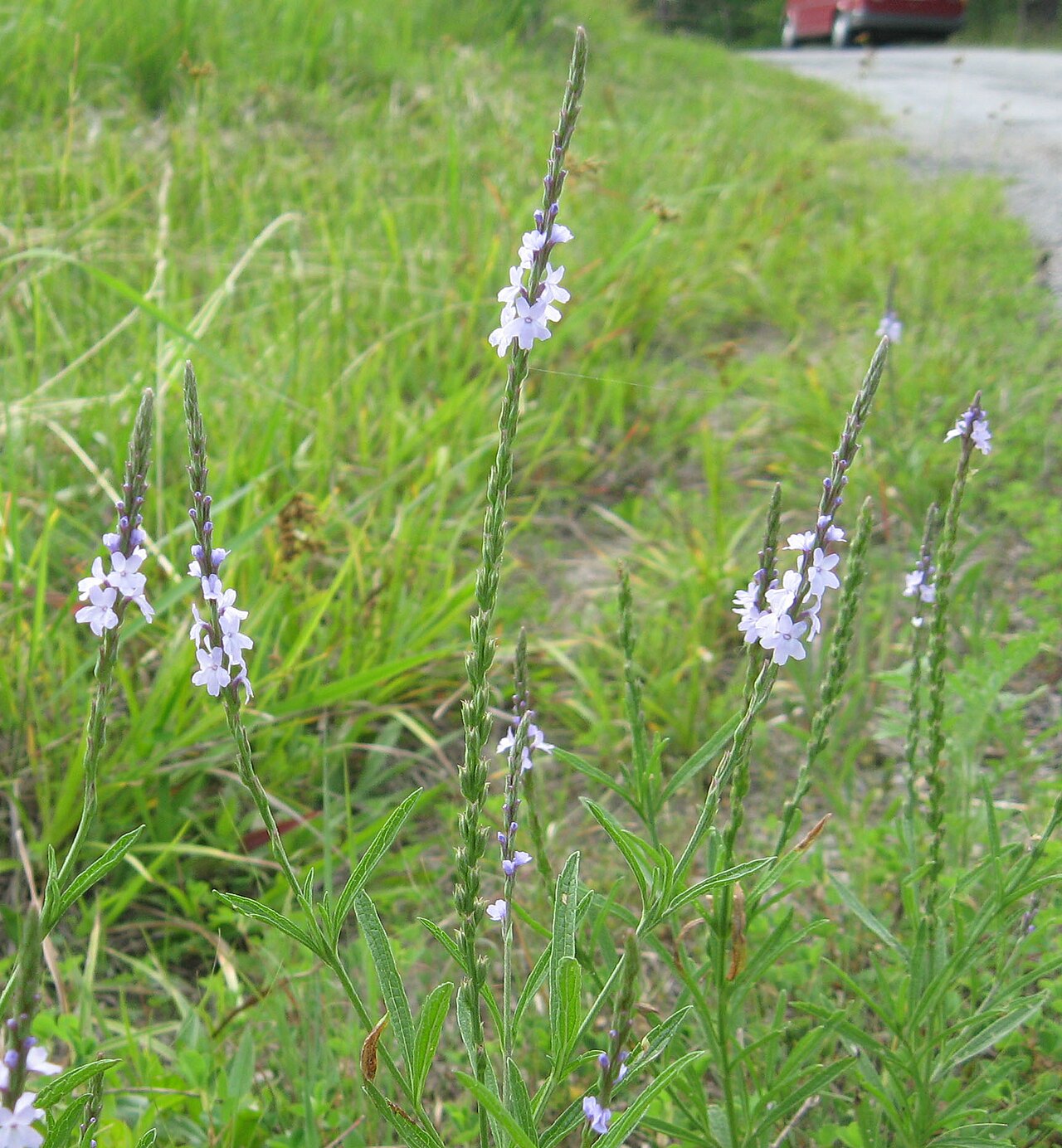
Verbena simplex, known as Narrowleaf Vervain or narrow-leaved vervain, is a small, upright perennial wildflower of the verbena family (Verbenaceae). It grows 8 inches to about 2 feet tall, with stiff stems, narrow, lance-shaped leaves and slender spikes of small lavender to pale purple (occasionally white) flowers from late spring through summer. It is native to much of the eastern and central United States and southern Ontario.
This is a plant of dry, open, often rocky ground: limestone glades, thin prairies, barrens, sandplains, rocky open woods, quarries, roadsides and railroad embankments. It is common in the Ozarks, the Ohio Valley and the Midwest, but rare toward the edges of its range. It is listed as endangered in Massachusetts and New Jersey and as a species of special concern in Connecticut, Minnesota and Wisconsin. Older books may list it as Verbena angustifolia.
Narrowleaf vervain is a modest but useful plant for sunny, dry gardens, rock gardens and small prairie plantings. It stays short and tidy, tolerates poor soil and drought, and attracts bees and small butterflies. It is also a host plant for the common buckeye butterfly. Buy nursery-grown plants or seed, and never dig plants from the wild, especially where they are rare.
Identification
Look for a short vervain with one to a few stiff, slender flower spikes and very narrow, stalkless leaves with only a few small teeth.
Growth Habit
Narrowleaf vervain grows from a short, woody base as a few erect stems, usually 8 to 24 inches tall (rarely to 30 inches), unbranched or with a few upright branches above. The stems are four-angled, as in other vervains, and smooth or slightly rough with short hairs.
Leaves
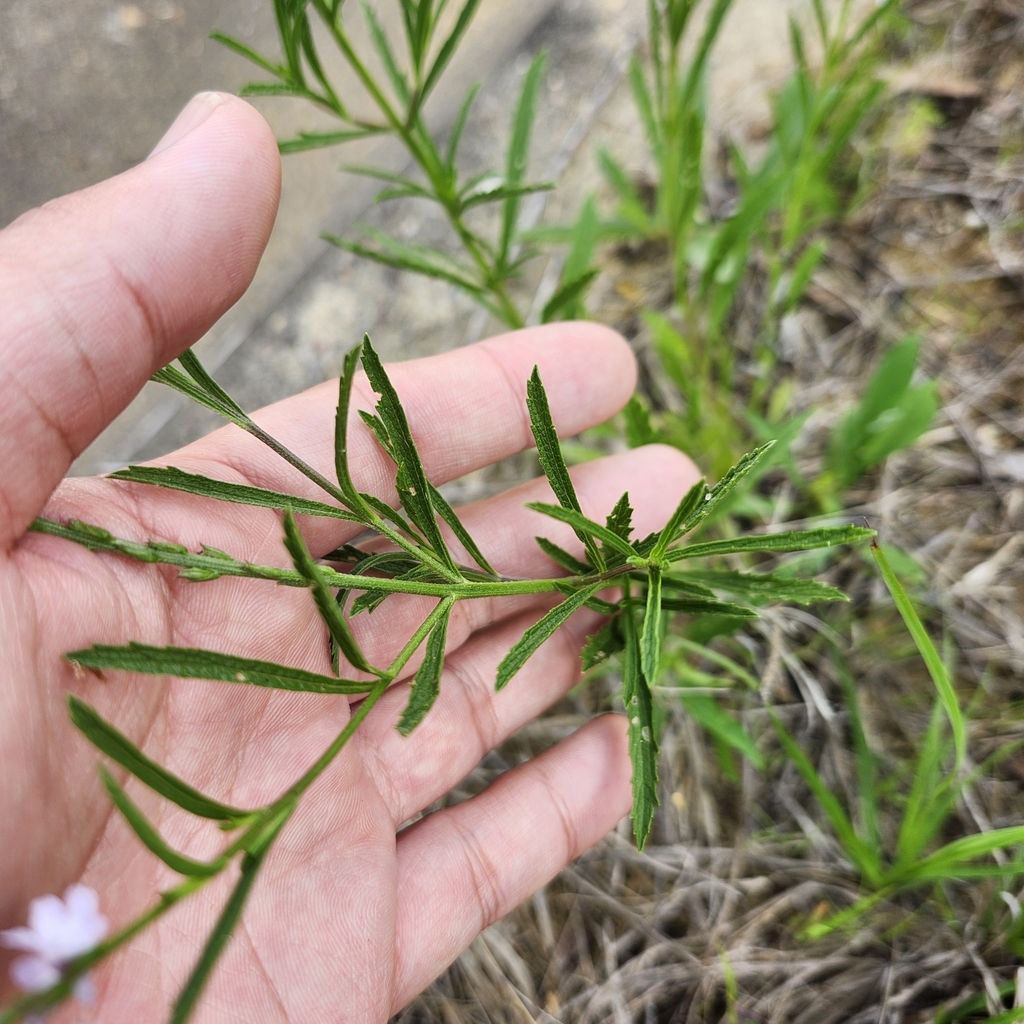
The leaves are opposite, 1 1/4 to 4 inches long but only 1/8 to 1/2 inch wide, linear to narrowly lance-shaped, and taper to a stalkless base. The edges have a few small, widely spaced teeth, mostly on the upper half. They are dark green and slightly rough, with a prominent midrib.
Flowers
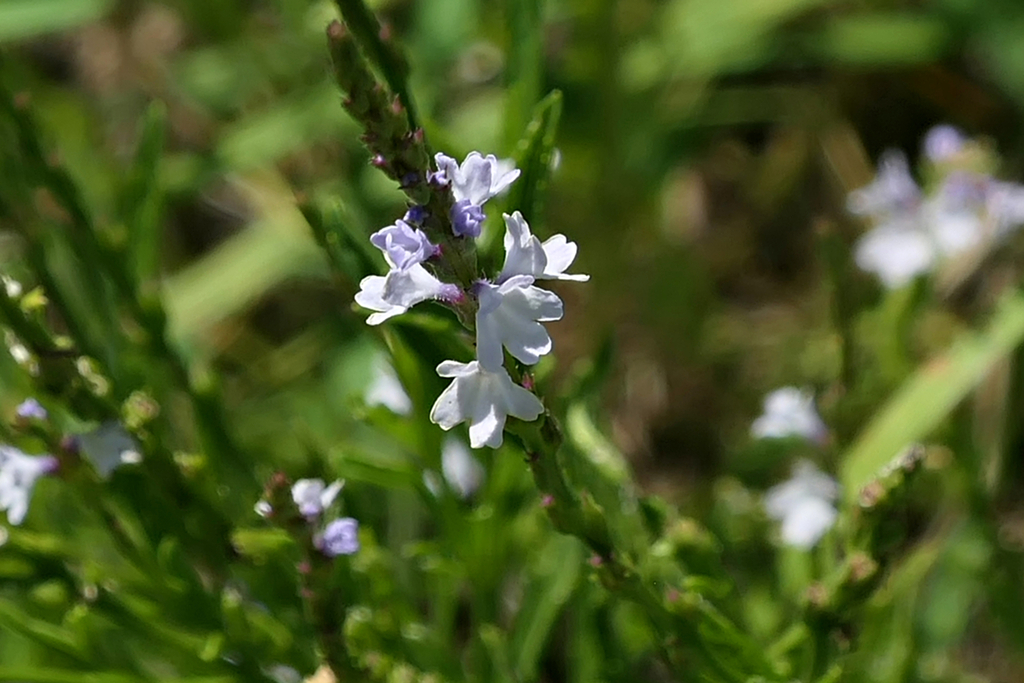
The flowers are borne in one to three (rarely more) slender, stiff spikes at the stem tips, 2 to 8 inches long. Each flower is about 1/4 inch across, tubular with five slightly unequal, spreading lobes, and lavender to pale bluish-purple or sometimes white. As in other vervains, only a ring of a few flowers opens at a time, starting at the bottom of the spike and moving upward from late May or June into August.
Fruit & Seeds
Below the open flowers, the calyces close around the developing fruit, which splits into four small, narrow brown nutlets. The fruiting spike becomes long and densely overlapped with old calyces.
Look-alikes
Hoary vervain (Verbena stricta) is taller, densely hairy and has broad, oval leaves and larger, deeper purple flowers. Blue vervain (V. hastata) is a tall plant of wet ground with branched, candelabra-like clusters of many thin spikes and broader, often three-lobed leaves. Rose vervain (Glandularia canadensis) is sprawling, with deeply cut leaves and flat-topped clusters of larger pink-purple flowers.
Quick Facts
| Scientific Name | Verbena simplex |
| Family | Verbenaceae (verbena family) |
| Plant Type | Short-lived herbaceous perennial wildflower |
| Mature Height | 8–24 in |
| Mature Spread | 6–12 in |
| Growth Rate | Moderate |
| Sun Exposure | Full sun to light shade |
| Water Needs | Low; drought tolerant |
| Soil Type | Dry, rocky, gravelly or sandy; thin soils over limestone |
| Soil pH | Neutral to alkaline (about 6.5–8.0); tolerates slightly acid sand |
| Bloom Time | Late May–August |
| Flower Color | Lavender to pale purple, occasionally white |
| Fall Color | None notable |
| Fruit | Four small brown nutlets |
| Deer Resistant | Moderately; bitter foliage |
| USDA Hardiness Zones | 4–8 |
Native Range
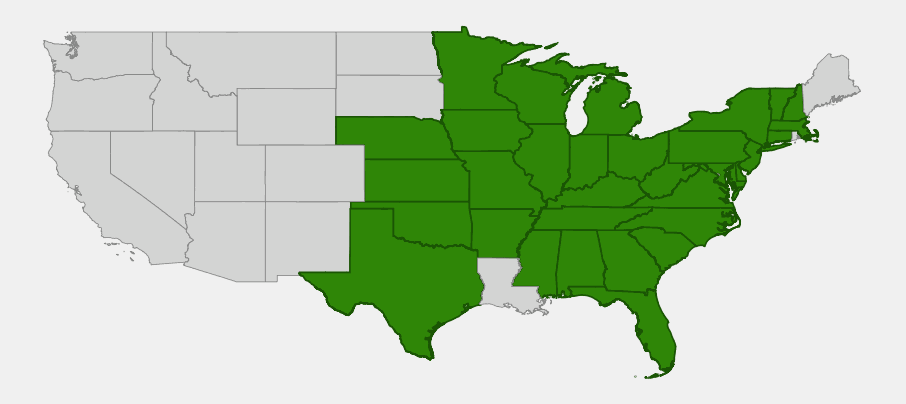
Narrowleaf vervain is native to central and eastern North America. USDA PLANTS lists it as native in 32 states and the District of Columbia, from Minnesota, Nebraska and Kansas south to Texas and east to Florida, the Carolinas, New York and southern New England, and in Ontario in Canada; it has also been reported from southern Quebec.
It is most common in the Ozarks and the Interior Low Plateaus of Kentucky and Tennessee, across the Midwest from Ohio to Missouri and Iowa, and in eastern Oklahoma and eastern Texas. It becomes rare toward the edges of its range. In New England, Go Botany lists it as native in Connecticut, Massachusetts and Vermont, but very rare and declining; the Connecticut and Vermont populations are considered historical. An old New Hampshire report is based on specimens without locality information and is considered doubtful. In Florida it is known only from a single county, an outlying record at the southern edge of its range. In Minnesota it reaches its northern limit in a few dry prairies and rock outcrops in the south of the state.
Typical habitats are open, dry, sunny places with thin soil: limestone and dolomite glades, cedar glades, dry and hill prairies, sandplains and barrens, rocky open woods and bluff tops, and disturbed ground such as gravel roadsides, quarries, pastures and railroad embankments. It often grows where limestone is close to the surface.
📋 Regional plant lists featuring Narrowleaf Vervain: New York, Pennsylvania & Northern New Jersey · Ohio & Indiana · Michigan, Wisconsin & Eastern Minnesota · Kentucky & Tennessee · Nebraska, Kansas & Eastern Colorado · Connecticut, Massachusetts & Rhode Island · New Hampshire, Maine & Vermont · Maryland, Virginia & West Virginia · Delaware, Southern New Jersey & Long Island · Illinois, Iowa & Missouri · Alabama, Georgia & Mississippi · North & South Florida · North & South Carolina · Arkansas, Louisiana, Eastern Oklahoma & Eastern Texas
Growing & Care Guide
Narrowleaf vervain is easy to grow if you give it what it has in the wild: sun, sharp drainage and little competition. It is a short-lived perennial that keeps itself going by self-seeding.
Light
Full sun is best. It tolerates light shade, but it flowers less and gets crowded out when taller plants close in, which is one reason it has declined in parts of its range.
Soil & Water
Plant it in dry to medium, well-drained soil: gravelly, rocky, sandy or thin clay soils all work, and it does well over limestone. Rich, moist garden soil makes it floppy and short-lived. Once established it needs no watering except in extreme drought.
Planting Tips
Use it at the front of a sunny border, in a rock garden or gravel garden, on a dry slope, or in a short-grass prairie planting with little bluestem and sideoats grama. Space plants about a foot apart. Avoid planting it among tall, aggressive perennials or dense grasses that will shade it out.
Pruning & Maintenance
Leave the spikes standing after flowering so the plant can drop seed, and cut the old stems back in late winter. In a prairie planting, occasional burning or mowing in late winter or early spring keeps the surrounding vegetation open.
Propagation
Grow it from seed. Seeds germinate better after 30 to 60 days of cold, moist stratification; sow outdoors in fall or stratify in the refrigerator before spring sowing, and press the seed lightly into the surface. Seedlings often bloom in their second year. Plants will self-sow in open, gravelly spots.
Landscape Uses
- Rock and gravel gardens: a short, drought-tolerant perennial for thin soil
- Prairie plantings: fits short-grass and glade plantings
- Pollinator gardens: long summer bloom for bees and small butterflies
- Front of the border: neat, upright spikes that stay under 2 feet
- Restoration: glades, barrens and dry prairie restorations
Wildlife & Ecological Value
Although small, narrowleaf vervain blooms for weeks in midsummer and is part of the rich wildflower community of glades and dry prairies.
For Pollinators
The flowers are visited by small bees, including sweat bees and specialist vervain bees, as well as skippers and small butterflies that sip nectar from the narrow tubes.
For Birds
Seed-eating birds such as sparrows and juncos pick the small nutlets from the old spikes in fall and winter.
For Mammals
The bitter leaves are seldom eaten by deer or rabbits, although livestock may graze it in pastures.
Ecosystem Role
Narrowleaf vervain is a larval host plant for the common buckeye butterfly (Junonia coenia), and the verbena moth and other insects feed on vervains. It is an indicator of open, thin-soiled habitats such as glades and barrens, which need fire or other disturbance to stay open.
Cultural & Historical Uses
The genus name Verbena is an old Latin name for sacred plants and herbs used in religious rites. The species name simplex means “simple” or “unbranched,” a reference to its usually unbranched stems and single flower spikes.
Vervains have a long history in folk medicine in Europe and North America, and several Native American nations used native vervains as medicines. These uses are traditional, and vervain should not be used as a home remedy without expert advice.
In New England and the northern Midwest, narrowleaf vervain is a conservation concern. Many historical sites have been lost to development, quarrying and the closing in of open habitats by trees and shrubs, and botanists now find it at only a small fraction of its recorded locations in New England.
Frequently Asked Questions
How tall does narrowleaf vervain grow?
Usually 8 inches to 2 feet, making it one of the shortest native vervains and a good choice for the front of a border or a rock garden.
Is narrowleaf vervain a perennial?
Yes, but it is fairly short-lived. It keeps going in gardens by self-seeding in open, gravelly spots.
Does narrowleaf vervain need limestone?
No, but it often grows over limestone in the wild and does well in neutral to alkaline soils. It also grows on dry sand and gravel.
What butterflies use narrowleaf vervain?
It is a larval host for the common buckeye, and its flowers are visited by skippers and small butterflies as well as many bees.
Is narrowleaf vervain rare?
It is common in the Midwest and Ozarks but rare at the edges of its range. It is endangered in Massachusetts and New Jersey and a species of special concern in Connecticut, Minnesota and Wisconsin.

Looking for a nursery that carries Narrowleaf Vervain?
Browse our native plant nursery directory: Alabama & Arkansas · Connecticut, Delaware, Florida & Georgia · Illinois, Indiana, Iowa & Kansas · Kentucky, Maryland, Massachusetts, Michigan, Minnesota, Mississippi & Missouri · Nebraska, New Hampshire, New Jersey, New York, North Carolina, Ohio & Oklahoma · Pennsylvania, South Carolina, Tennessee, Texas, Vermont & Virginia · West Virginia & Wisconsin

