
Burk’s Southern Pitcher Plant (Sarracenia rosea)
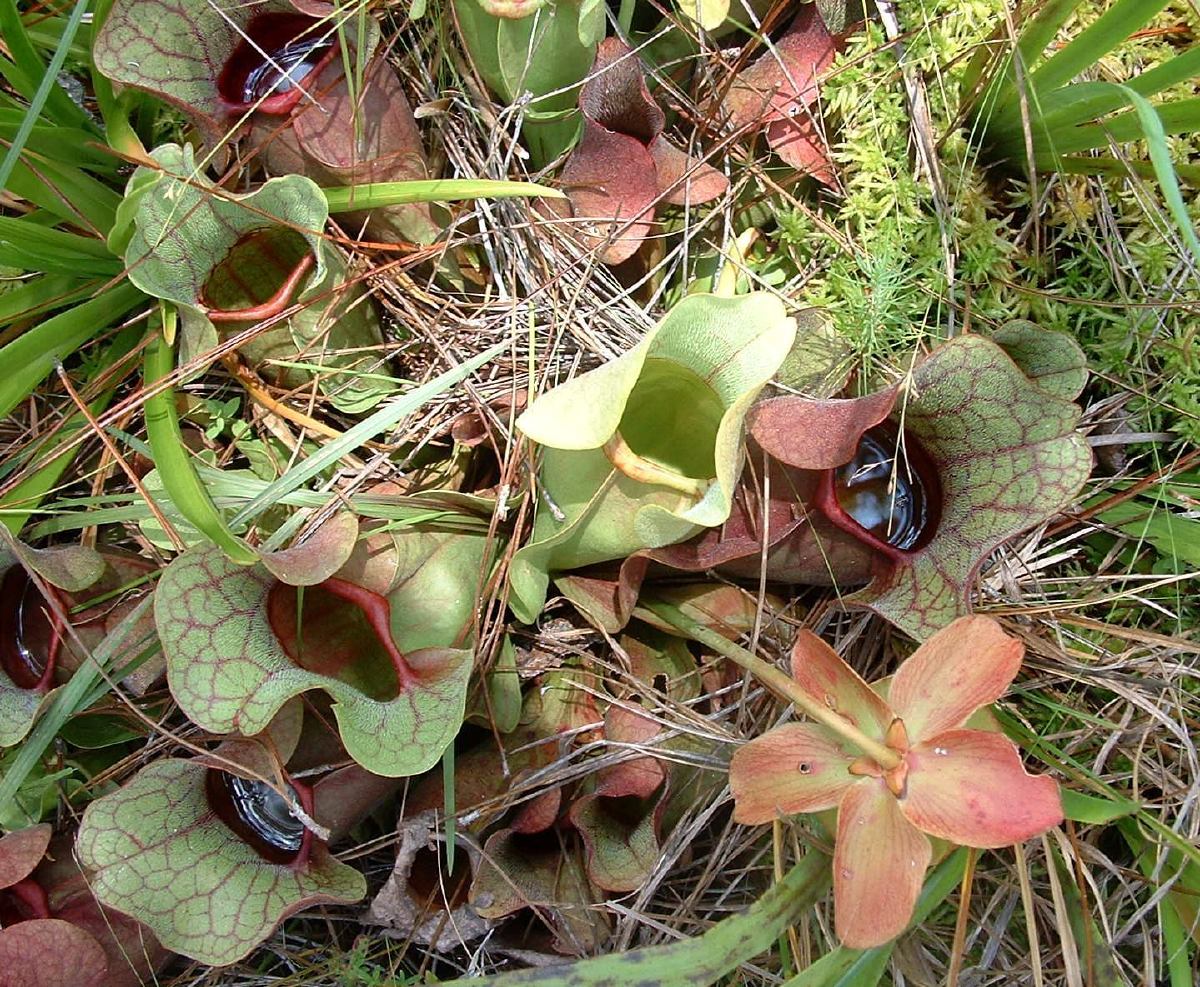
Sarracenia rosea, known as Burk’s Southern Pitcher Plant or rose pitcher plant, is a carnivorous perennial of the Gulf Coastal Plain. Its leaves are short, plump, open-mouthed pitchers that lie in a low rosette on the ground, green to deep red and netted with red veins. The pitchers fill with rainwater and trap insects that fall in. In spring it produces striking, nodding flowers with rose-pink petals on stalks above the leaves.
It was long treated as a southern form of the purple pitcher plant (Sarracenia purpurea), first as S. purpurea var. burkii and then, since 1999, as a separate species. It differs from the northern plant in its pink rather than maroon petals, its larger, more upright, wavy-edged hoods, and its range, which is limited to the Florida Panhandle and the coastal plains of southern Alabama and Mississippi.
It grows in wet longleaf pine savannas, seepage bogs and the edges of boggy streams, habitats that depend on frequent fire and have mostly been lost to development, drainage and fire suppression. It can be grown in a bog garden, but plants must come from nurseries that propagate them. Never collect pitcher plants from the wild.
Identification
Look in Gulf Coast bogs for low rosettes of short, fat, red-veined pitchers lying close to the ground, each with an upright, wavy hood, and in spring for nodding pink flowers.
Growth Habit
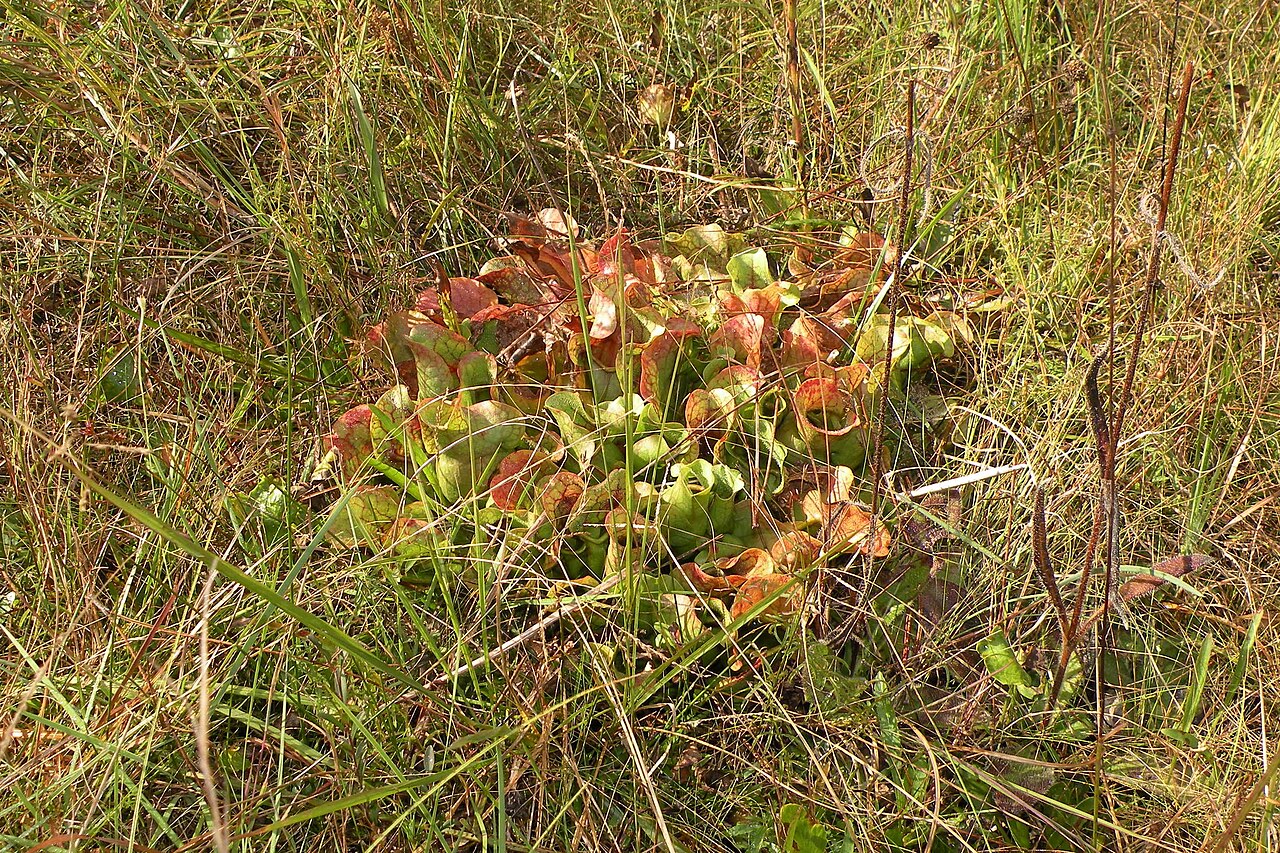
Burk’s southern pitcher plant is a perennial that grows from a short, branching underground stem (rhizome). Each crown produces a rosette of pitchers that lie on the ground or rise at an angle, with the mouths facing upward. Over time, crowns branch and form small clumps. The pitchers stay green through winter and are replaced gradually as new ones form in spring and summer.
Leaves (Pitchers)
The pitchers are about 4 to 12 inches long, curved and swollen, with a broad wing along the front and a wide mouth. The hood is large, upright and kidney-shaped, with wavy edges, and does not cover the mouth, so rainwater collects inside. The outside is green to yellow-green, netted with red to purple veins, and plants in full sun can turn almost entirely red. The inner surface of the hood bears stiff, downward-pointing hairs that guide insects into the pitcher. In the northern purple pitcher plant, the hood is smaller and tends to be more hairy inside.
Flowers
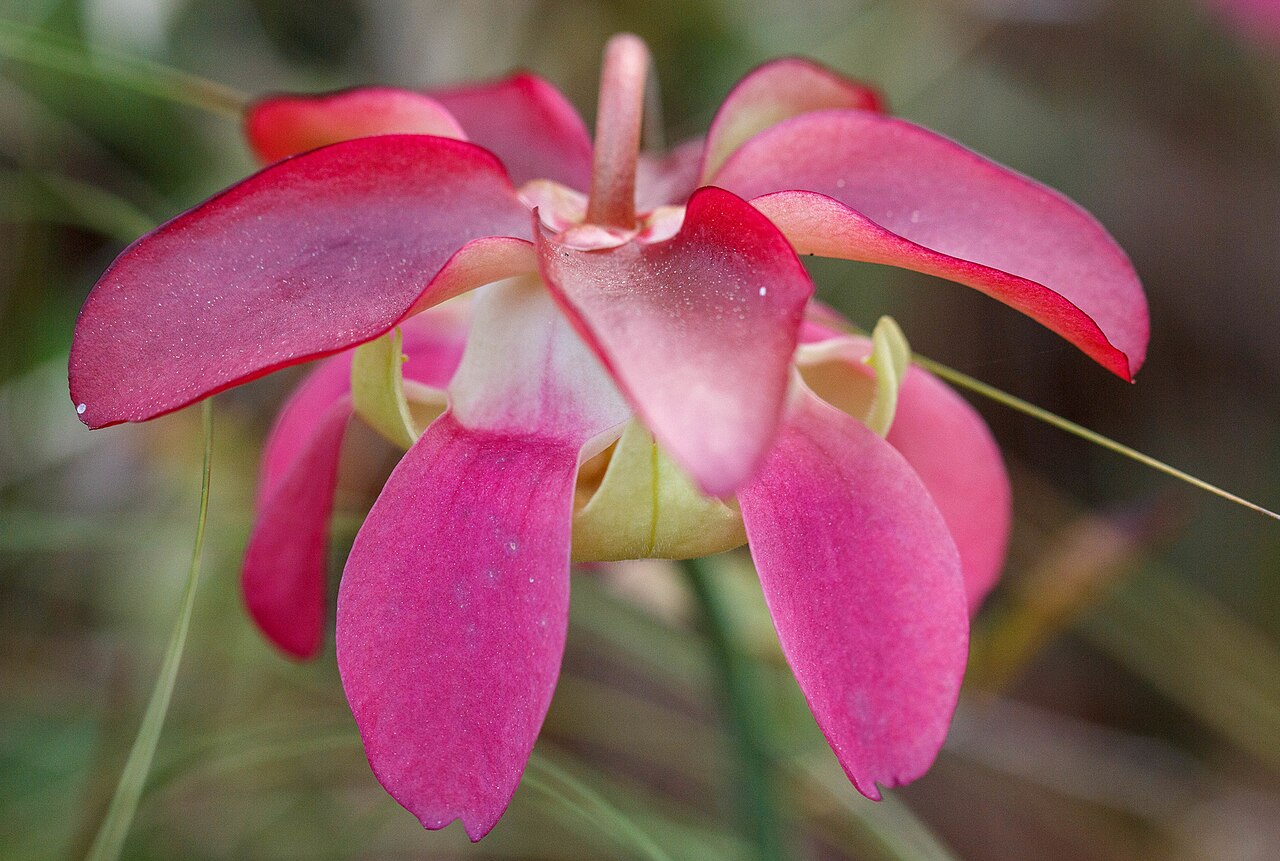
The flowers appear in spring, usually March and April, before or with the new pitchers. Each nodding flower sits alone on a leafless stalk that rises above the pitchers. It has five sepals, five rose-pink to pale pink petals and an unusual umbrella-shaped style that hangs below the center of the flower. The flowers of the northern purple pitcher plant are maroon or dark red.
Fruit & Seeds
After flowering, the umbrella-like style remains on the stalk while a round capsule ripens beneath it. The capsule splits in late summer or fall and releases many tiny seeds, which fall near the parent plant.
Look-alikes
The parrot pitcherplant also has low, lying pitchers, but its hoods are closed and beak-like, curving over the mouth, and its flowers are dark red. Hooded pitcher plant and yellow pitcher plant have tall, upright, narrow pitchers and yellow flowers. White pitcher plant has tall pitchers with white tops and red flowers. Wild hybrids between these species are common in the Gulf Coast bogs where several grow together.
Quick Facts
| Scientific Name | Sarracenia rosea (syn. S. purpurea var. burkii) |
| Family | Sarraceniaceae (pitcher plant family) |
| Plant Type | Carnivorous evergreen perennial |
| Mature Height | 4–12 in (flower stalks to about 18 in) |
| Mature Spread | 8–18 in |
| Growth Rate | Slow |
| Sun Exposure | Full sun |
| Water Needs | High; constantly moist to wet |
| Soil Type | Acidic, nutrient-poor sandy peat or sphagnum |
| Soil pH | Strongly acidic (about 4.0–5.5) |
| Bloom Time | March–April |
| Flower Color | Rose-pink |
| Fall Color | Pitchers redden in sun and cool weather |
| Fruit | Round capsule with many tiny seeds |
| Deer Resistant | Yes |
| USDA Hardiness Zones | 7–9 |
Native Range
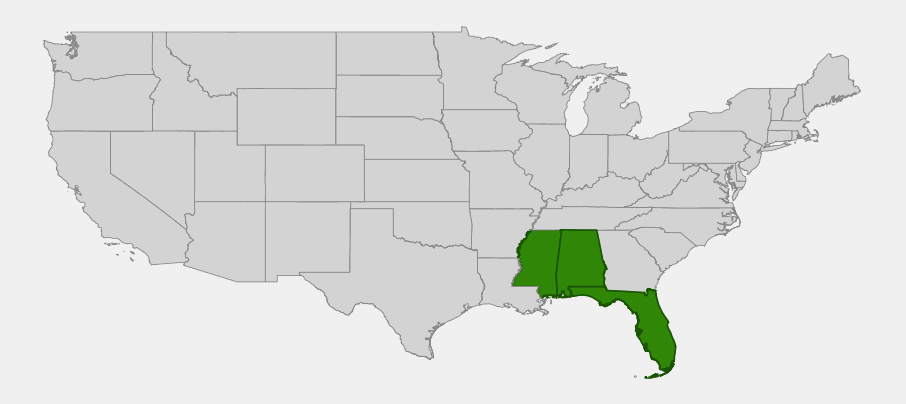
Burk’s southern pitcher plant is native only to the eastern Gulf Coastal Plain. USDA PLANTS lists it from Alabama, Florida and Mississippi, where it grows in the Florida Panhandle and the coastal plains of southern Alabama and southern Mississippi. It is not found in Canada. In the USDA database, its symbol (SARO) currently carries an odd label for an unnamed hybrid, but the range and description match this species.
In Florida it grows from the Apalachicola National Forest and the bogs of the central Panhandle west toward Pensacola. In Alabama and Mississippi it is found in the lower coastal plain near the Gulf. The northern purple pitcher plant (S. purpurea) is a separate species that ranges from the Southeast’s northern edge through the Northeast, the Great Lakes and Canada.
It grows in full sun in wet, open, fire-maintained habitats: longleaf pine savannas and flatwoods, hillside seepage bogs, boggy streamheads and the margins of ponds and bays. Many of these bogs have been drained, planted with pines or overgrown by shrubs without fire, and the best remaining populations are on public lands such as Apalachicola National Forest.
📋 Regional plant lists featuring Burk’s Southern Pitcher Plant: North & South Florida · Alabama, Georgia & Mississippi
Growing & Care Guide
Burk’s southern pitcher plant is one of the easier pitcher plants to grow in a bog garden or container in the South, as long as its basic needs are met: full sun, constant moisture, acidic, nutrient-poor soil and pure water. Buy only nursery-propagated plants from reputable carnivorous plant growers. Never collect pitcher plants from the wild, where their bogs are already disappearing.
Light
Full sun, at least six hours a day. In shade the pitchers grow weak and green and the plant declines.
Soil & Water
Plant in a mix of peat moss or sphagnum and coarse sand or perlite, with no fertilizer, compost or garden soil. Keep it wet at all times, ideally by setting containers in a tray of water. Use rainwater or distilled water, because tap water with dissolved minerals harms the roots over time.
Planting Tips
Grow it in a container or in a lined bog garden (a pond liner with a few drainage holes near the top, filled with peat and sand). It is evergreen and tolerates the light frosts of its native range. Do not fertilize: the plant gets its nutrients from the insects it catches.
Pruning & Maintenance
Cut off brown, dead pitchers at the base in late winter or early spring, before new growth starts. In the wild, fire does this job. Remove grasses and weeds that start to shade the pitchers.
Propagation
Divide large clumps by separating rhizome sections in late winter or early spring. Seeds need several weeks of cold, moist stratification and are sown on the surface of moist peat; seedlings take several years to reach flowering size.
Landscape Uses
- Bog gardens: a low, colorful pitcher plant for the front of a bog
- Containers: grows well in a pot set in a tray of rainwater
- Rain gardens: only in permanently wet, acidic, sunny spots
- Education: a hands-on example of a carnivorous native plant
- Savanna restoration: part of the wet pine savanna plant community
Wildlife & Ecological Value
Burk’s southern pitcher plant is a predator and a home: its pitchers trap insects, and the water inside supports its own small community of animals.
For Pollinators
The spring flowers are pollinated mainly by bumblebees and other large bees, which enter under the umbrella-shaped style and pick up pollen as they leave. The nodding flowers keep the trap leaves and the pollinators apart in time and space, because the flowers open in early spring, before most new pitchers form.
For Birds
Birds are not major visitors, but small birds sometimes pick insects from pitchers. The open savannas it shares with longleaf pine support birds such as Bachman’s sparrows and brown-headed nuthatches.
For Mammals
Mammals rarely eat the tough pitchers. The plant is not browsed much by deer.
Ecosystem Role
Ants, flies, beetles and other small insects drown in the rainwater in the pitchers and are broken down by enzymes, bacteria and tiny animals that live in the water, including mosquito and midge larvae, some of which live only in pitcher plants. The released nutrients feed the plant, which grows in soils that are very poor in nitrogen and phosphorus. Its survival depends on frequent fire, which keeps shrubs and trees from shading the bog.
Cultural & Historical Uses
The genus Sarracenia is named for Michel Sarrazin, a French physician and naturalist in New France (Quebec) who sent specimens of the northern pitcher plant to Europe around 1700. The species name rosea means “rose-colored,” for the pink petals.
The plant was first described in 1993 as Sarracenia purpurea var. burkii by pitcher plant expert Donald Schnell; the name honors botanist C. John Burk. In 1999 it was described as a separate species, S. rosea, by Robert Naczi and colleagues. The common name keeps Burk’s name.
Some botanists still treat it as a variety or subspecies of the purple pitcher plant, so it may appear under older names in field guides and nursery catalogs. This page is separate from our purple pitcher plant page, which covers the northern species.
Frequently Asked Questions
How is Burk’s southern pitcher plant different from purple pitcher plant?
It has pink rather than maroon petals, larger and more upright wavy-edged hoods, and grows only on the Gulf Coast in Florida, Alabama and Mississippi. The purple pitcher plant ranges from the northern Southeast to Canada.
Is it carnivorous?
Yes. Its pitchers collect rainwater, and insects that fall in drown and are digested to supply the plant with nutrients.
Can I collect pitcher plants from the wild?
No. Never collect them. Buy only nursery-propagated plants from reputable carnivorous plant growers. Collecting from the wild damages already rare bog populations and is illegal on public land.
How do I grow Burk’s southern pitcher plant?
Give it full sun, constantly wet acidic peat and sand, rainwater or distilled water, and no fertilizer. It is well suited to a bog garden or container in zones 7 to 9.
When does Burk’s southern pitcher plant bloom?
In spring, usually March and April, with nodding pink flowers on stalks above the pitchers.

Looking for a nursery that carries Burk’s Southern Pitcher Plant?
Browse our native plant nursery directory: Alabama · Florida · Mississippi

