
Cinnamon Willowherb (Epilobium coloratum)
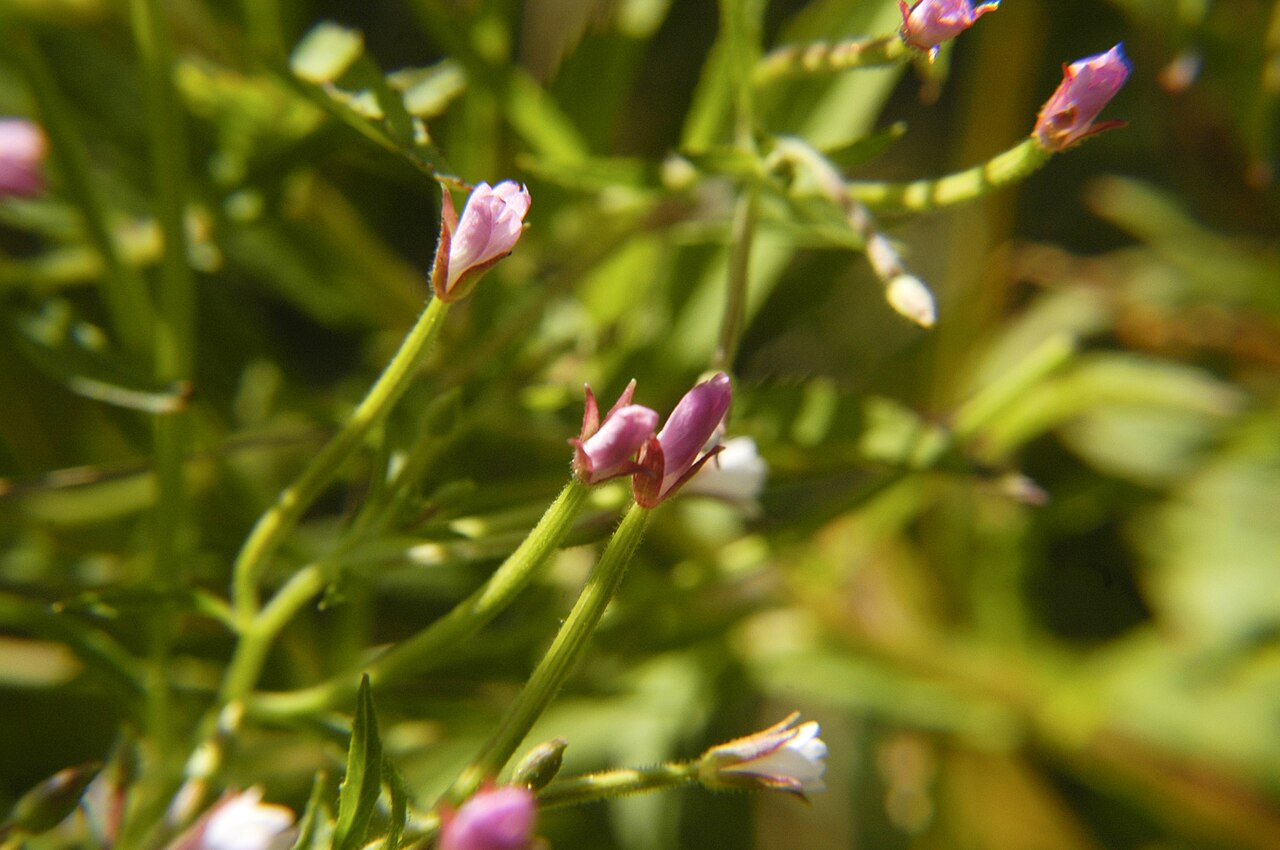
Epilobium coloratum, known as Cinnamon Willowherb, purpleleaf willowherb or eastern willowherb, is a bushy, many-branched perennial in the evening primrose family (Onagraceae). It grows 1 to 3 feet tall, with narrow, willow-like, finely toothed leaves that are often tinged or spotted with purple, and from midsummer to fall it bears many tiny pink to white flowers at the tips of long, slender seed pods.
Cinnamon willowherb is native across eastern and central North America, from Nova Scotia, Quebec and Ontario south to Georgia and west to the Dakotas, Kansas, Oklahoma and eastern Texas. It is a plant of wet, sunny places: marshes, wet meadows, fens, seeps, stream banks, pond edges, ditches and wet roadsides.
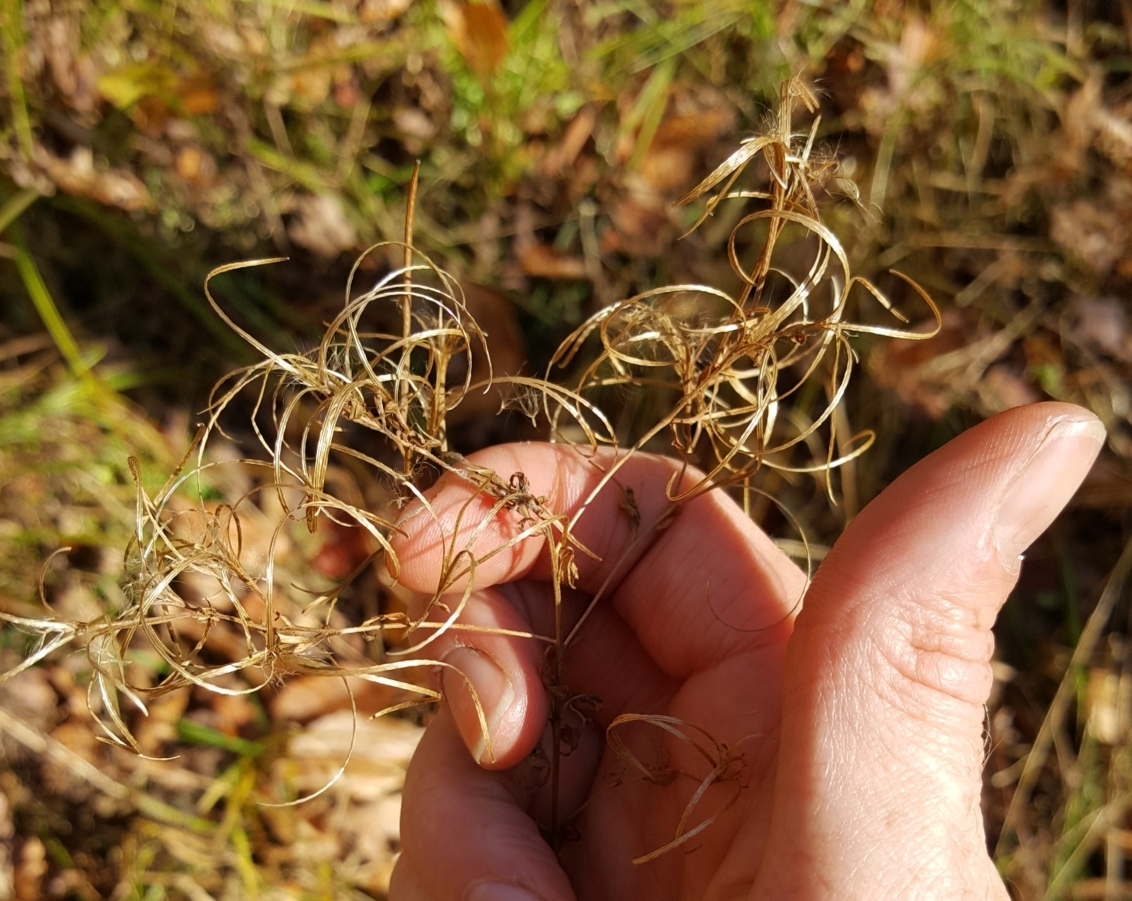
The plant is named for its seeds, which carry tufts of cinnamon-brown hairs that drift away on the wind in fall. In the fall the leaves and stems often turn red or purple. It is not a showy garden flower, but it is a useful native for rain gardens, pond edges and wet meadows, and it feeds small pollinators late in the season.
Identification
Look for a bushy, branched plant of wet places with narrow, toothed, often purplish leaves, tiny four-petaled pink or white flowers at the ends of long, thin pods, and cinnamon-colored seed fluff in fall.
Growth Habit
Cinnamon willowherb is a perennial that grows from a short rootstock and forms small leafy rosettes at the base in fall, which overwinter and produce new stems the next year. The stems are 1 to 3 feet tall and much branched in the upper half, giving the plant a bushy shape. The stems have lines of fine, curved hairs running down from the leaf bases.
Leaves
The leaves are mostly opposite, lance-shaped, 2 to 6 inches long and 1/4 to 1 inch wide, with short stalks and finely toothed edges. They are often purple-tinged or dotted with purple, especially later in the season, which gives the plant the name purpleleaf willowherb. In fall the whole plant may turn red or purple.
Flowers
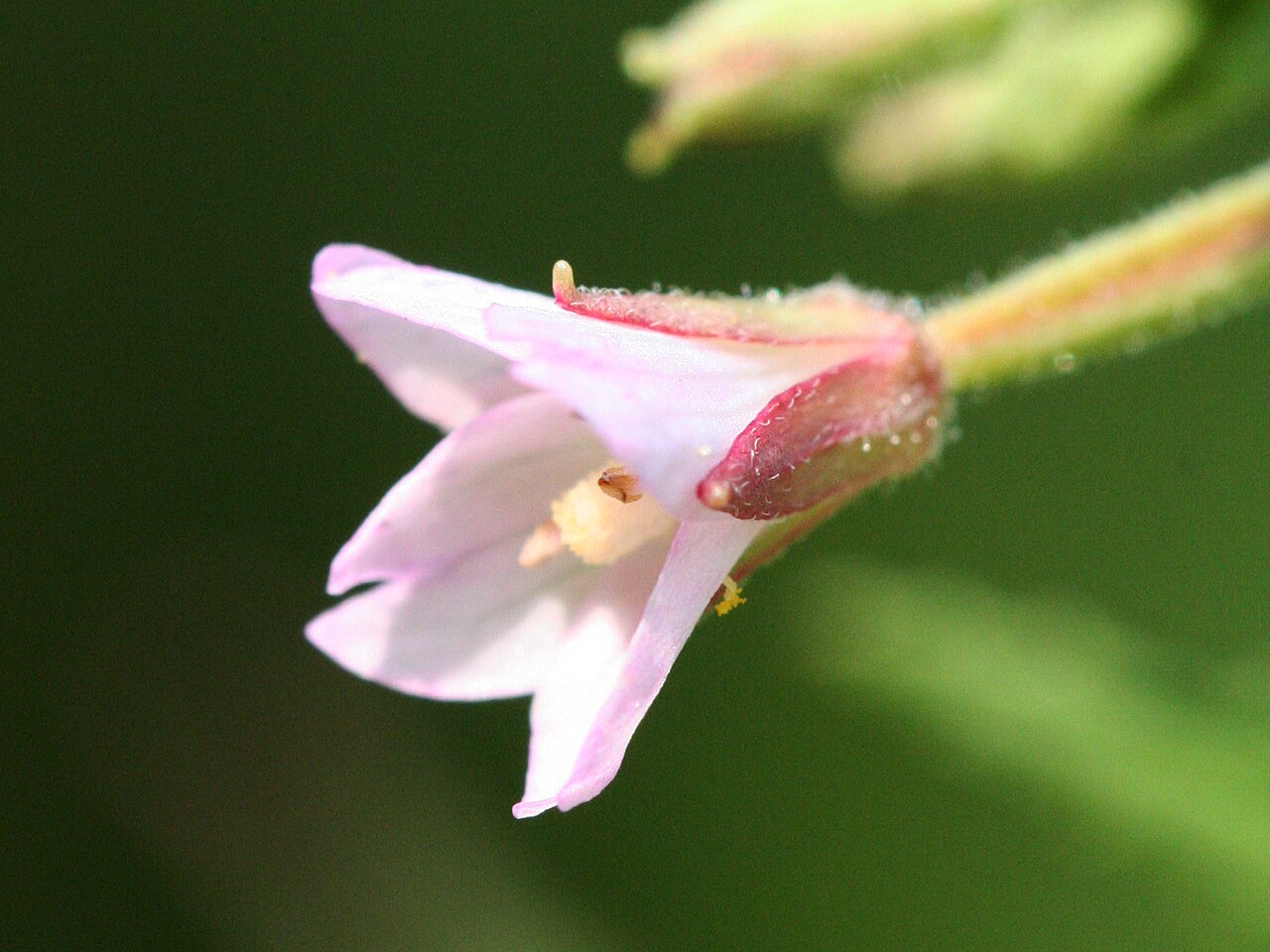
The flowers are small, about 1/8 to 1/4 inch across, with four pink, pale pink or white petals, each notched at the tip, and a four-lobed or club-shaped stigma. They grow singly in the upper leaf axils at the end of a long, thin ovary, so the flower appears to sit on top of a stalk. Flowering runs from July to October.
Fruit & Seeds
The fruit is a slender capsule 1 1/2 to 2 1/2 inches long that splits into four parts when ripe. Each tiny seed has a tuft of cinnamon-brown to tan hairs (a coma). This cinnamon color is the best way to tell this species from the similar northern willowherb, whose seed tufts are white.
Look-alikes
Fringed willowherb (Epilobium ciliatum) is very similar, but it has white seed tufts, less-branched stems and leaves with fewer purple spots. Marsh willowherbs (E. leptophyllum and E. palustre) have very narrow, untoothed leaves with rolled edges. Fireweed is much taller, with large, bright magenta flowers in a long spike.
Quick Facts
| Scientific Name | Epilobium coloratum |
| Family | Onagraceae (evening primrose family) |
| Plant Type | Herbaceous perennial |
| Mature Height | 1–3 ft |
| Mature Spread | 1–2 ft |
| Growth Rate | Fast |
| Sun Exposure | Full sun to part shade |
| Water Needs | High; moist to wet soil |
| Soil Type | Wet loam, clay, muck or sand |
| Soil pH | Slightly acidic to slightly alkaline (about 5.5–7.5) |
| Bloom Time | July–October |
| Flower Color | Pale pink to white |
| Fall Color | Red to purple foliage |
| Fruit | Long, slender capsules; seeds with cinnamon-brown tufts |
| Deer Resistant | Moderately |
| USDA Hardiness Zones | 3–8 |
Native Range
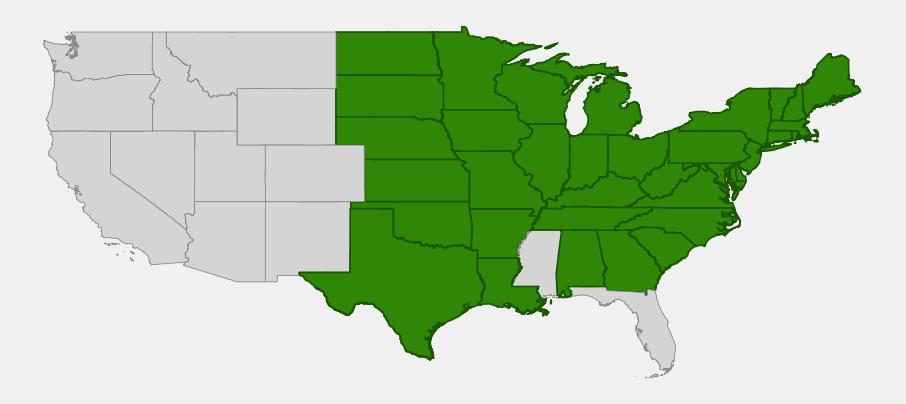
USDA PLANTS lists cinnamon willowherb as native in 35 states, from Maine, Vermont and Minnesota south to Georgia, Alabama and Louisiana, and west to North and South Dakota, Nebraska, Kansas, Oklahoma and eastern Texas. In Canada it is native in Ontario, Quebec, New Brunswick and Nova Scotia.
It is common through the Northeast, the Mid-Atlantic, the Great Lakes, the Midwest and the Appalachians, and it becomes scattered toward the Gulf Coast and the western edge of its range in the Great Plains.
It grows in open, wet places: wet meadows and prairies, marshes, fens, seeps, swamps and their edges, stream and river banks, lakeshores, ditches and wet roadsides. It often appears in disturbed wet ground, such as along drainage ditches and in wet clearings.
📋 Regional plant lists featuring Cinnamon Willowherb: New York, Pennsylvania & Northern New Jersey · Ohio & Indiana · Michigan, Wisconsin & Eastern Minnesota · Kentucky & Tennessee · Nebraska, Kansas & Eastern Colorado · Connecticut, Massachusetts & Rhode Island · New Hampshire, Maine & Vermont · Maryland, Virginia & West Virginia · Delaware, Southern New Jersey & Long Island · Illinois, Iowa & Missouri · Alabama, Georgia & Mississippi · North & South Carolina · Arkansas, Louisiana, Eastern Oklahoma & Eastern Texas · North Dakota, South Dakota & Western Minnesota
Growing & Care Guide
Cinnamon willowherb is a modest wildflower best suited to wet, naturalistic plantings. It is sometimes included in native wetland and rain garden seed mixes, and it often appears on its own in wet ground.
Light
Full sun to part shade. It flowers best in sun and grows taller and looser in shade.
Soil & Water
It needs consistently moist to wet soil and tolerates seasonal flooding, mucky soil and heavy clay. It does poorly in dry soil.
Planting Tips
Use it in rain gardens, swales, pond and stream edges, wet meadows and wetland restorations, along with sedges, rushes and other wet-soil wildflowers. Its airy, branched form fills gaps between bolder plants such as swamp milkweed and blue vervain.
Pruning & Maintenance
Little care is needed. It self-sows readily in moist, open ground, so remove seedlings where they are not wanted, or cut the stems back before the pods split if you want to limit spread. Its red and purple fall color is attractive, so you may want to leave the stems until late fall.
Propagation
Grow it from seed, which needs light to germinate: sow it on the surface of moist soil in fall or spring. It also spreads by its small basal rosettes, which can be separated and replanted.
Landscape Uses
- Rain gardens and swales: thrives in wet, periodically flooded soil
- Pond and stream edges: fills in between sedges and rushes
- Wet meadow restoration: a common native forb of open wetlands
- Pollinator gardens: late-summer flowers for small bees and flies
- Fall color: red and purple stems and leaves in autumn
Wildlife & Ecological Value
Cinnamon willowherb blooms late in the season in wet meadows and marshes, when it provides food for small insects, and it is a host plant for several native moths.
For Pollinators
The tiny flowers are visited by small bees, including sweat bees, as well as flower flies and other small insects. Willowherbs are larval host plants for several sphinx moths and other moths, including caterpillars of the white-lined sphinx in some areas.
For Birds
Small seed-eating birds may eat the seeds, and the dense branched stems give some cover in wet meadows.
For Mammals
Deer and rabbits browse it lightly. It is not an important food plant for mammals.
Ecosystem Role
As a quick-growing native of wet, open ground, cinnamon willowherb helps cover bare mud along streams and ditches and holds soil in place, and it adds late-season flowers to wetland plant communities.
Cultural & Historical Uses
The genus name Epilobium comes from Greek words meaning “upon a pod,” because the flower sits at the top of the long, pod-like ovary. The species name coloratum means “colored,” referring to the purplish color of the leaves and stems.
The common name willowherb refers to the narrow, willow-like leaves found on many species in the genus. “Cinnamon” describes the brown hairs on the seeds, which are the most reliable way to identify this species.
Several willowherbs, including this one, have been used in traditional herbal medicine, but there is little modern research on their safety, and wild plants should not be used as home remedies.
Frequently Asked Questions
Why is it called cinnamon willowherb?
Its seeds have tufts of cinnamon-brown hairs, and its narrow leaves look like willow leaves.
How can I tell cinnamon willowherb from fringed willowherb?
Look at the seed hairs in late summer or fall: they are cinnamon-brown in cinnamon willowherb and white in fringed willowherb. Cinnamon willowherb is also more branched and has more purple-spotted leaves.
Does cinnamon willowherb need wet soil?
Yes. It grows naturally in marshes, wet meadows, stream banks and ditches, and it does best in consistently moist or wet soil.
When does cinnamon willowherb bloom?
From July to October, with flowers continuing to open as the long seed pods develop.
Is cinnamon willowherb weedy?
It reseeds readily in wet, open ground and can appear on its own in ditches and wet garden beds, but it is a native plant and is easy to pull where not wanted.

Looking for a nursery that carries Cinnamon Willowherb?
Browse our native plant nursery directory: Alabama & Arkansas · Connecticut, Delaware & Georgia · Illinois, Indiana, Iowa & Kansas · Kentucky, Louisiana, Maine, Maryland, Massachusetts, Michigan, Minnesota & Missouri · Nebraska, New Hampshire, New Jersey, New York, North Carolina, North Dakota, Ohio & Oklahoma · Pennsylvania, Rhode Island, South Carolina, South Dakota, Tennessee, Texas, Vermont & Virginia · West Virginia & Wisconsin

