
Native Elms (Ulmus)
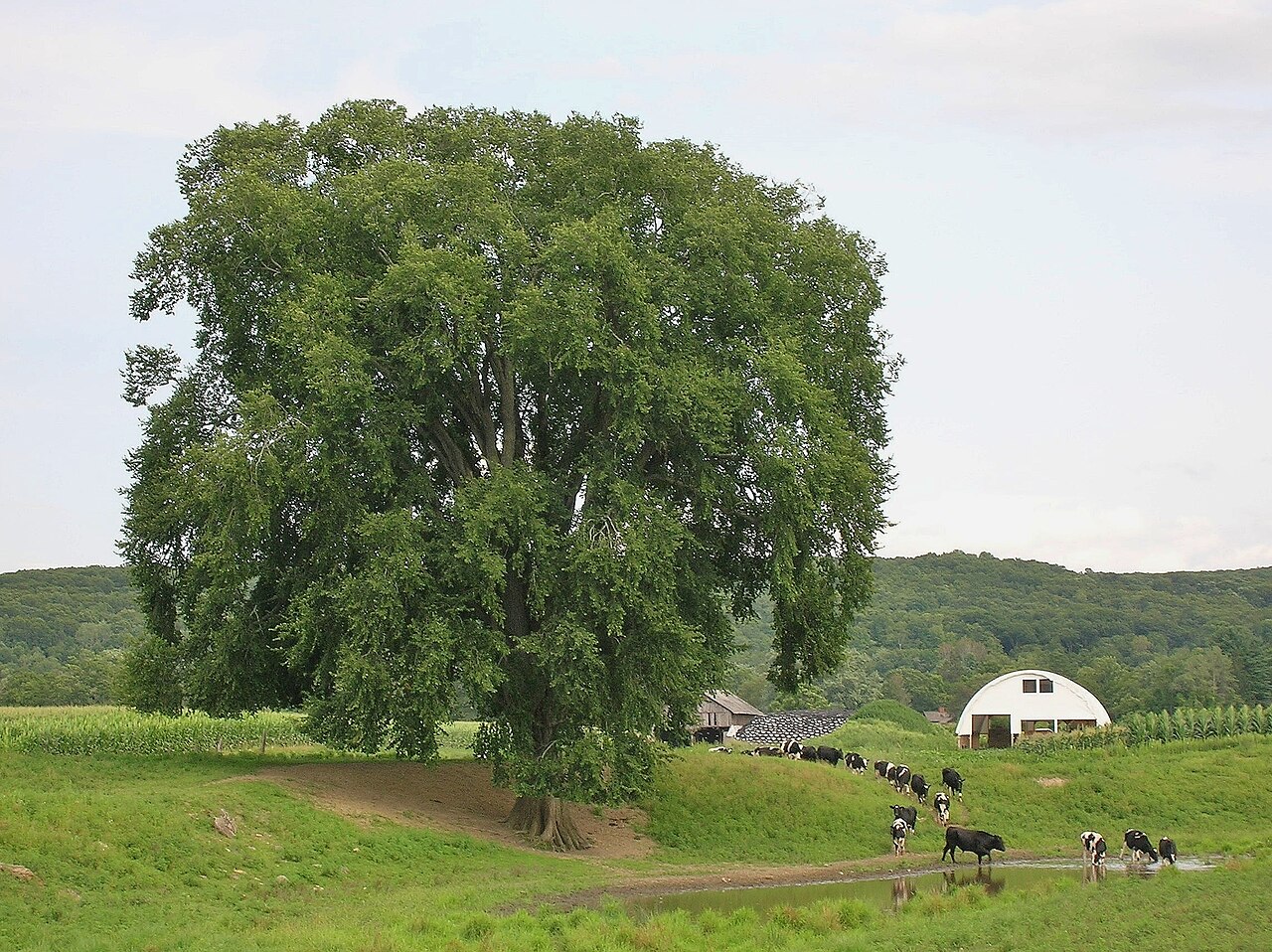
Elms (genus Ulmus) are deciduous trees with lopsided, toothed leaves and round, papery seeds that ripen in spring. Six species are native to the United States, all of them in the eastern two-thirds of the country: American elm, slippery elm, rock elm, winged elm, cedar elm and September elm. A seventh close relative, water elm or planertree (Planera aquatica), grows in southern swamps. No elm is native west of the Great Plains, although Siberian elm now grows wild across much of the West.
For most of American history, “elm” meant one tree: the American elm, whose tall, arching vase shape lined Main Streets from New England to the Dakotas. Dutch elm disease, which reached the United States around 1930, killed most of those street trees, and nurseries filled the gap with Asian elms and hybrid cultivars. That is why the elms sold today, and the ones recommended in many tree lists, are often not native at all. Chinese elm, Siberian elm, the European field elm (Ulmus minor) and many columnar or “disease-resistant” hybrid elms all come from Europe or Asia.
This guide covers the six native species, how to tell them from the common imported elms, and which elms to plant if you want a tree that belongs to your region. If you came here from a list that recommends “elm” for New York or a columnar elm for a California street, the short answer is this: in New York, the native choices are American, slippery and rock elm; in California, no elm is native, and the columnar elms sold there are nursery selections of non-native parentage.
Identification
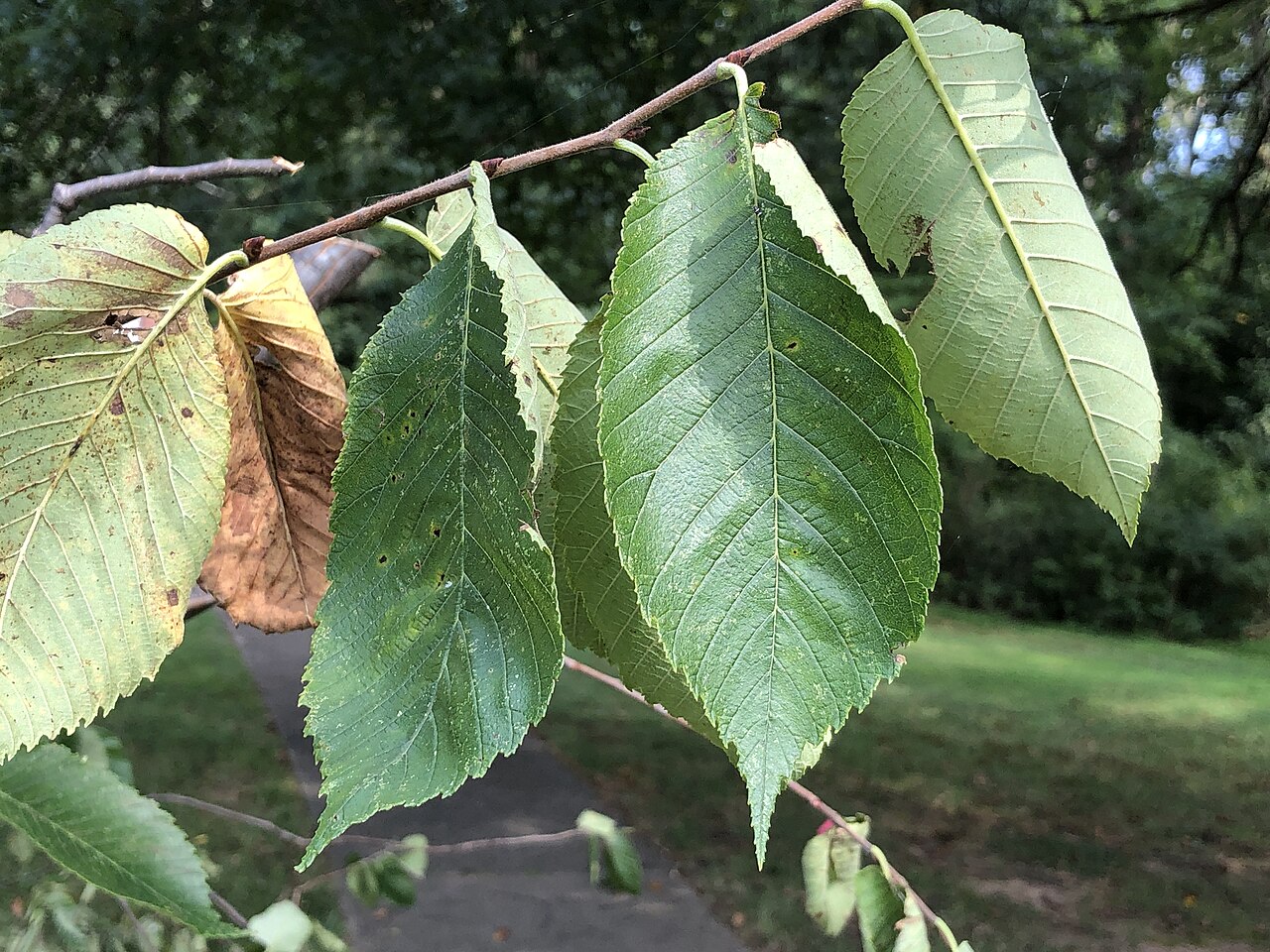
Elms are recognizable as a group by a few features that hold for nearly every species. Leaves are alternate, simple, usually doubly toothed (large teeth with smaller teeth on them) and have an uneven base, with one side of the blade joining the stalk lower than the other. The side veins run straight and parallel from the midrib to the edge, like the teeth of a comb. Twigs zigzag slightly from bud to bud.
Bark & Stems
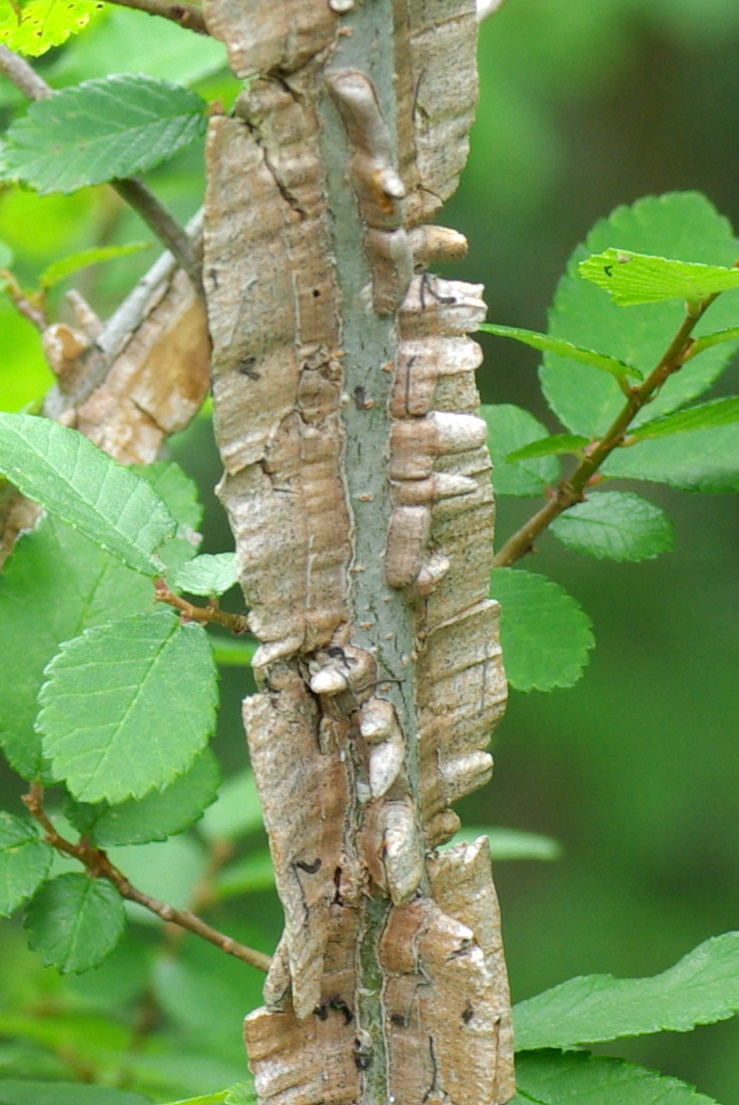
Mature bark is gray and furrowed into flat-topped, interlacing ridges. In American elm, a slice of bark shows alternating layers of reddish-brown and creamy white, which helps separate it from slippery elm (bark layers all brown) and from rock elm. Winged elm and cedar elm often grow two flat, corky “wings” along their twigs, and rock elm develops irregular corky ridges on older twigs. The inner bark of slippery elm is famously mucilaginous and slick when chewed or wet.
Leaves
Leaf size and texture separate the species. American and slippery elm have the largest leaves, about 4 to 6 inches long; slippery elm leaves feel like coarse sandpaper on top when stroked in either direction, while American elm leaves are smooth to slightly rough in only one direction. Rock elm leaves are similar in size but less lopsided. Winged elm has narrow leaves 1 to 3 inches long, and cedar elm has the smallest leaves of all, only 1 to 2 inches, stiff and rough. Most native elms turn a clear yellow in fall.
Flowers
Elm flowers are small, reddish-green and wind-pollinated, without petals. Four species, American, slippery, rock and winged elm, bloom in late winter or early spring before the leaves open, hanging in tassel-like clusters on long stalks (American elm) or tight clusters (slippery elm). Cedar elm and September elm are the two native fall-blooming elms, flowering in late summer and early fall. Among imported elms, Chinese elm also blooms in fall, which is one quick way to tell it apart from Siberian elm.
Fruit & Seeds
The fruit is a samara: a single seed surrounded by a flat, papery wing. American elm samaras are round to oval, about half an inch long, notched at the tip and fringed with fine hairs around the edge. Slippery elm samaras are larger, without a fringe, with a hairy seed in the center. Rock elm, winged elm, cedar elm and September elm samaras are hairy all over or fringed. Spring-flowering elms drop their seeds in late spring, often in huge numbers; cedar and September elm ripen seed in fall.
Quick Facts
| Genus | Ulmus |
| Family | Ulmaceae (Elm family) |
| U.S. Native Species | 6 (American, slippery, rock, winged, cedar and September elm); about 30–40 species worldwide |
| Growth Forms | Deciduous trees; most are medium to large shade trees |
| Mature Height | About 40–60 ft for winged and cedar elm; 60–80 ft or more for American and rock elm |
| Mature Spread | Roughly 30–60 ft; American elm has a broad vase-shaped crown |
| Growth Rate | Moderate to fast |
| Sun Exposure | Full Sun to Part Shade |
| Water Needs | Average to moist; cedar and winged elm are drought tolerant |
| Soil Type | Adaptable; floodplain loams, clay and limestone soils |
| Bloom Time | Late winter to early spring (four species); late summer to fall (cedar and September elm) |
| Flower Color | Inconspicuous reddish-green tassels |
| Fall Color | Mostly yellow |
| Fruit | Flat, round papery samaras |
| Wildlife Value | Host plant for question mark and mourning cloak butterflies; seeds eaten by finches and squirrels |
| Deer Resistant | No; young trees are browsed |
| USDA Hardiness Zones | About 3–9, depending on species |
Native Range
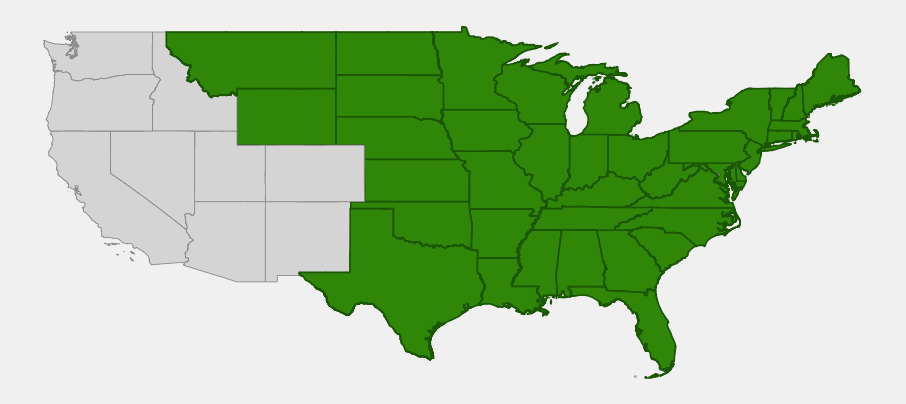
Native elms belong to the eastern deciduous forest and the river valleys of the Great Plains. American elm has by far the widest range, from Maine and Florida west to the Dakotas, eastern Montana, the edge of northeastern Wyoming, western Oklahoma and central Texas. On the Plains it follows rivers and creeks into otherwise treeless country, alongside cottonwood, green ash and hackberry. Slippery elm covers nearly the same territory but stops short of peninsular Florida and the western Plains.
The other four species have smaller ranges. Rock elm is a tree of the Great Lakes and upper Mississippi Valley, from Minnesota and Wisconsin east through Michigan, Ohio and Indiana to New York and Vermont (where it is rare) and south to Tennessee and Missouri. Winged elm is a southern tree, common from Virginia to Florida and west to Missouri, Oklahoma and Texas. Cedar elm is the elm of Texas, Oklahoma, Arkansas and Louisiana, reaching Mississippi, western Tennessee and northern Florida. September elm is the rarest, scattered on limestone soils in Kentucky, Tennessee, Alabama, Georgia, Arkansas, Mississippi and eastern Oklahoma.
No elm is native to the Rocky Mountain, Great Basin, Southwestern or Pacific states. American elm is planted as far west as California, Oregon, Washington and Colorado, and Siberian elm has become a wild, weedy tree throughout the interior West, but neither is part of the native flora there. Elms are also absent as natives from most of the Colorado Front Range, where the trees along creeks are planted or escaped. The map below shows states where at least one elm is native.
📋 Regional plant lists covering native elm country: New York, Pennsylvania & Northern NJ · Delaware, Southern NJ & Long Island · Connecticut, Massachusetts & Rhode Island · New Hampshire, Maine & Vermont · Maryland, Virginia & West Virginia · North & South Carolina · Georgia, Alabama & Mississippi · Kentucky & Tennessee · Ohio & Indiana · Illinois, Iowa & Missouri · Michigan, Wisconsin & Eastern Minnesota · Dakotas & Western Minnesota · Nebraska, Kansas & Eastern Colorado · Arkansas, Louisiana, E. Oklahoma & E. Texas · South & West Texas · Montana & Wyoming
Native Species
These are the six elms native to the United States, plus their swamp-dwelling cousin. Each name links to our full plant profile.
American Elm (Ulmus americana)
The classic street elm: a tall tree, usually 60 to 80 feet and sometimes over 100, whose trunk divides low into several upright limbs that arch outward into a vase or fountain shape. It grows wild on floodplains and moist slopes across the entire eastern US and up Plains rivers to Montana. Samaras are fringed with hairs, and the tree blooms and seeds before it leafs out. It is the state tree of Massachusetts and North Dakota. Wild trees still sprout freely from seed, but most are killed by Dutch elm disease before they reach full size. Several selections, including ‘Princeton’, ‘Valley Forge’, ‘New Harmony’, ‘Jefferson’ and ‘Prairie Expedition’, were chosen for tolerance of the disease and are the best way to plant a true American elm today.
Slippery Elm (Ulmus rubra)
A medium tree, usually 40 to 60 feet, with a more spreading crown than American elm. The leaves are thick and sandpapery on top, the winter buds are covered in rusty hairs, and the inner bark is slick and gummy, which gives the tree its name. It grows on rich slopes, stream terraces and limestone soils across the East and Midwest. It is also susceptible to Dutch elm disease, though it survives in the woods as small trees.
Rock Elm (Ulmus thomasii)
Also called cork elm. A tall tree, often 60 to 80 feet, with a single straight trunk that runs up through a narrow, oblong crown rather than splitting into a vase. Older twigs develop thick, irregular corky ridges. It grows on dry, rocky ridges and limestone soils as well as moist bottomlands in the Great Lakes states and upper Midwest. Its very hard, tough wood was once logged heavily for ship timbers and tool handles. It is uncommon in the nursery trade.
Winged Elm (Ulmus alata)
A small to medium tree of the South, usually 30 to 50 feet, with small, narrow leaves and two flat corky wings along many twigs. It grows on dry upland woods, old fields and rocky slopes as well as stream banks, and it tolerates poor soil and drought better than most elms. It is a tough, fine-textured shade tree for southern yards. It blooms in late winter.
Cedar Elm (Ulmus crassifolia)
The most common native elm in Texas and one of the best native shade trees for hot, dry cities like Dallas, Austin and San Antonio. It grows 50 to 70 feet with a rounded crown, tiny stiff leaves 1 to 2 inches long and corky twig wings. It blooms in late summer and sets seed in fall. It tolerates heavy clay, alkaline limestone soils, drought and periodic flooding. Leaves turn yellow late in fall.
September Elm (Ulmus serotina)
A rare elm of limestone bluffs, stream banks and glades in the mid-South. It resembles a larger-leaved winged elm, with corky twig wings, but flowers in September and October. It is the least known of the native elms, seldom found in nurseries, and is tracked as rare in several states. Gardeners in Kentucky, Tennessee and northern Alabama can sometimes find it from native-plant specialists.
Water Elm (Planera aquatica)
Not a true elm but a close relative in the same family, water elm or planertree is a small tree of southern cypress swamps and river floodplains. Its leaves look like small elm leaves, but its fruit is a small, warty nut instead of a winged samara. It is worth knowing if you garden near wet bottomland in the Southeast.
Non-Native Look-Alikes
Many of the elms sold in garden centers, and named in older planting lists, are not native anywhere in North America. Some are good street trees; one is a serious invader.
- Siberian elm (Ulmus pumila), from northern China, Mongolia and Siberia. Small, narrow leaves 1 to 3 inches long with nearly even bases and single teeth, spring flowers and round, unfringed samaras produced in enormous numbers. It was widely planted for windbreaks on the Plains and is now invasive across the Great Plains and the interior West, from the Dakotas and Kansas to Colorado, Utah, New Mexico and Arizona, where it crowds out cottonwood and willow along streams. It also hybridizes with native slippery elm. Avoid planting it.
- Chinese elm or lacebark elm (Ulmus parvifolia), from China, Korea and Japan. Small, glossy, single-toothed leaves, fall flowers and beautiful mottled bark that flakes in orange, gray and cream patches. It is a good, disease-resistant street tree, common in California and the South, but it self-seeds in parts of the Southeast and Mid-Atlantic. It is often confused with Siberian elm, which nurseries sometimes sold as “Chinese elm.”
- Field elm or smooth-leaved elm (Ulmus minor) and English elm (traditionally U. procera, now usually treated as a form of U. minor), from Europe. Small, glossy, very lopsided leaves and often heavy root suckering. They were planted in older eastern towns and occasionally persist.
- Wych elm or Scotch elm (Ulmus glabra), from Europe. Very large, rough leaves, sometimes with three points at the tip. The weeping form called Camperdown elm is a cultivar of this species.
- Hybrid and columnar elms. Most modern “disease-resistant” elms are hybrids of Asian and European species: ‘Accolade’ (Japanese × Wilson’s elm), ‘Danada Charm’, ‘Triumph’ and ‘Vanguard’ (Asian-elm hybrids from the Morton Arboretum), ‘New Horizon’ (Siberian × Japanese elm) and ‘Frontier’ (field elm × Chinese elm). Narrow, upright elms sold for street planting, under names such as Danna Spire or other “spire” and “columnar” labels, belong to this group; we could not confirm the parentage of every trade name, so check the scientific name on the nursery tag. If it is not Ulmus americana, rubra, thomasii, alata, crassifolia or serotina, it is not a native elm.
A few quick checks help in the field: if the leaves are smaller than 2 inches, with single teeth and nearly even bases, and the tree is growing in the West or in a vacant lot, it is probably Siberian elm. If the bark peels in colorful puzzle-piece patches, it is Chinese elm. Native elms have double teeth and clearly lopsided leaf bases.
Growing & Care Guide
Light
Elms grow best in full sun, where they develop their characteristic broad crowns. Young slippery and American elms tolerate part shade in the forest understory, but they are fundamentally trees of open floodplains, forest gaps and field edges.
Soil & Water
Native elms are among the most adaptable trees for difficult soils. American and slippery elm thrive in moist, fertile loam but tolerate clay, compaction, seasonal flooding and salt spray. Cedar and winged elm handle heavy clay, shallow limestone soils and long summer droughts once established, which makes them excellent choices for Texas and the South. Rock elm prefers well-drained, often calcareous soils. Water new trees deeply every week or two through their first two summers.
Planting Tips
Plant in spring or fall, from container or balled-and-burlapped stock. Give a mature American elm at least 40 feet of open space; its roots are shallow and wide and can lift pavement near trunks. When buying American elm, choose a named Dutch elm disease–tolerant selection and buy from a nursery that propagates it from cuttings, so you know what you are getting. Mixing elms with other native trees, rather than planting long rows of a single elm, limits the damage if disease arrives.
Pruning & Maintenance
Prune young American elms to a single central leader in their first decade to prevent weak, tight forks later. Do pruning in late fall or winter only. Fresh wounds made in spring and early summer attract the elm bark beetles that carry Dutch elm disease, and extension services advise against pruning elms from about April through August for this reason. Remove and properly dispose of dead elm wood instead of stacking it as firewood, which can harbor the beetles. Elm leaf beetle and elm yellows (a lethal disease spread by leafhoppers) are other problems to watch for; contact your state extension service if a tree wilts or yellows suddenly in summer.
Propagation
Spring-ripening elm seeds (American, slippery, rock and winged) germinate without pretreatment if sown as soon as they fall; they lose viability within weeks if allowed to dry. Fall-ripening cedar and September elm seed should be sown in fall or stratified for spring. Named cultivars are propagated from cuttings.
Landscape Uses
- Large shade and street trees: disease-tolerant American elm selections; cedar elm in Texas and Oklahoma
- Drought-tolerant yard trees for the South: winged and cedar elm
- Floodplain and stream-bank restoration: American and slippery elm
- Prairie windbreaks and shelterbelts: American elm instead of invasive Siberian elm
- Butterfly and wildlife gardens: any native elm, for its butterfly caterpillars and seed-eating birds
Wildlife & Ecological Value
For Pollinators
Elm flowers are wind-pollinated, but honey bees and early native bees collect their pollen in late winter, when little else is blooming. Elm foliage is the more important resource: native elms are larval hosts for question mark and eastern comma butterflies, mourning cloak, and many moths, including the elm sphinx and the double-toothed prominent.
For Birds
Elm seeds ripen in spring, earlier than almost any other tree seed, and are eaten by purple finches, goldfinches, rose-breasted grosbeaks, and other songbirds. Baltimore orioles traditionally hung their woven nests from the drooping branch tips of American elms. Caterpillars on elm foliage feed warblers, vireos and nesting chickadees, and dead and dying elms provide cavities for woodpeckers.
For Mammals
Squirrels and chipmunks eat elm seeds and buds, and deer and rabbits browse young trees and sprouts. Large old elms with hollow trunks provide dens for raccoons and other mammals.
Ecosystem Role
American and slippery elm are core trees of eastern floodplain forests, where they shade stream banks and stabilize soils. On the Great Plains, American elm is one of the few native trees in the riparian strips that cross the prairie. Cedar elm is a dominant tree of Texas bottomlands and limestone woodlands. The loss of mature elms to disease changed the structure of many of these forests, and young native elms remain abundant in them, even if few survive to full size.
Cultural & Historical Uses
The American elm was the most widely planted street tree in the United States from the early 1800s until the mid-1900s. New Haven, Connecticut, became “the Elm City,” and towns from New England to the Midwest planted cathedral-like avenues of elms. Dutch elm disease, a fungal disease carried by bark beetles and first found in Ohio in 1930, killed tens of millions of these trees over the next half century. The loss inspired the push to plant a wider mix of street trees, and decades of research produced the disease-tolerant American elm selections available today.
Elm wood is tough and hard to split because its fibers interlock. It was used for wagon wheel hubs, barrel hoops, boxes, furniture and boat building; rock elm in particular was prized for ship timbers and hockey sticks. The inner bark of slippery elm has a long history of use by Native Americans and settlers, who prepared it as a soothing gruel and poultice. It is still sold as an herbal product, but wild harvesting strips the bark and kills the trees, so it should not be peeled from living trees.
Several historic elms are tied to American history. The Washington Elm in Cambridge, Massachusetts, where George Washington was said to have taken command of the Continental Army in 1775, and the Liberty Tree in Boston, a rallying point before the Revolution, were both elms. Seeds and cuttings of famous survivor elms are still propagated as living memorials.
Frequently Asked Questions
Which elms are native to New York?
American elm, slippery elm and rock elm. Rock elm is rare in New York and found mainly in the western and northern parts of the state. Chinese, Siberian and European field elm (Ulmus minor) are often planted there but are not native.
Is the columnar elm sold for street trees native?
Usually not. Most columnar and “disease-resistant” elm cultivars, including those sold under spire or columnar names, are hybrids of Asian or European elms. Check the scientific name on the tag. A true American elm cultivar will be labeled Ulmus americana, such as ‘Princeton’, ‘Valley Forge’ or ‘New Harmony’.
Are there any elms native to the West Coast?
No. No elm is native to California, Oregon, Washington or any other western state. Siberian elm is naturalized and invasive across much of the interior West, and Chinese and American elms are planted as street trees. In the West, native shade trees such as oaks, maples, cottonwoods or sycamores are better choices.
Can American elms still be planted safely?
Yes, if you choose a disease-tolerant selection, plant it among other kinds of trees, prune only in the dormant season, and watch for wilting in early summer. Tolerant does not mean immune, but trees such as ‘Princeton’ and ‘Valley Forge’ have survived well in trials and city plantings.
How can I tell a native elm from a Siberian elm?
Native elms have leaves 2 to 6 inches long with double teeth and a clearly lopsided base (except the smaller-leaved winged and cedar elm, which have corky twig wings). Siberian elm has small leaves 1 to 3 inches long with single teeth and an almost even base, brittle branches, and seeds that carpet the ground in spring.

Looking for a nursery that carries native elms?
Browse our native plant nursery directory: Alabama & Arkansas · Connecticut, Delaware, Florida & Georgia · Illinois, Indiana, Iowa & Kansas · Kentucky, Louisiana, Maine, Maryland, Massachusetts, Michigan, Minnesota, Mississippi, Missouri & Montana · Nebraska, New Hampshire, New Jersey, New York, North Carolina, North Dakota, Ohio & Oklahoma · Pennsylvania, Rhode Island, South Carolina, South Dakota, Tennessee, Texas, Vermont & Virginia · West Virginia, Wisconsin & Wyoming

