
Native Wild Indigos (Baptisia)
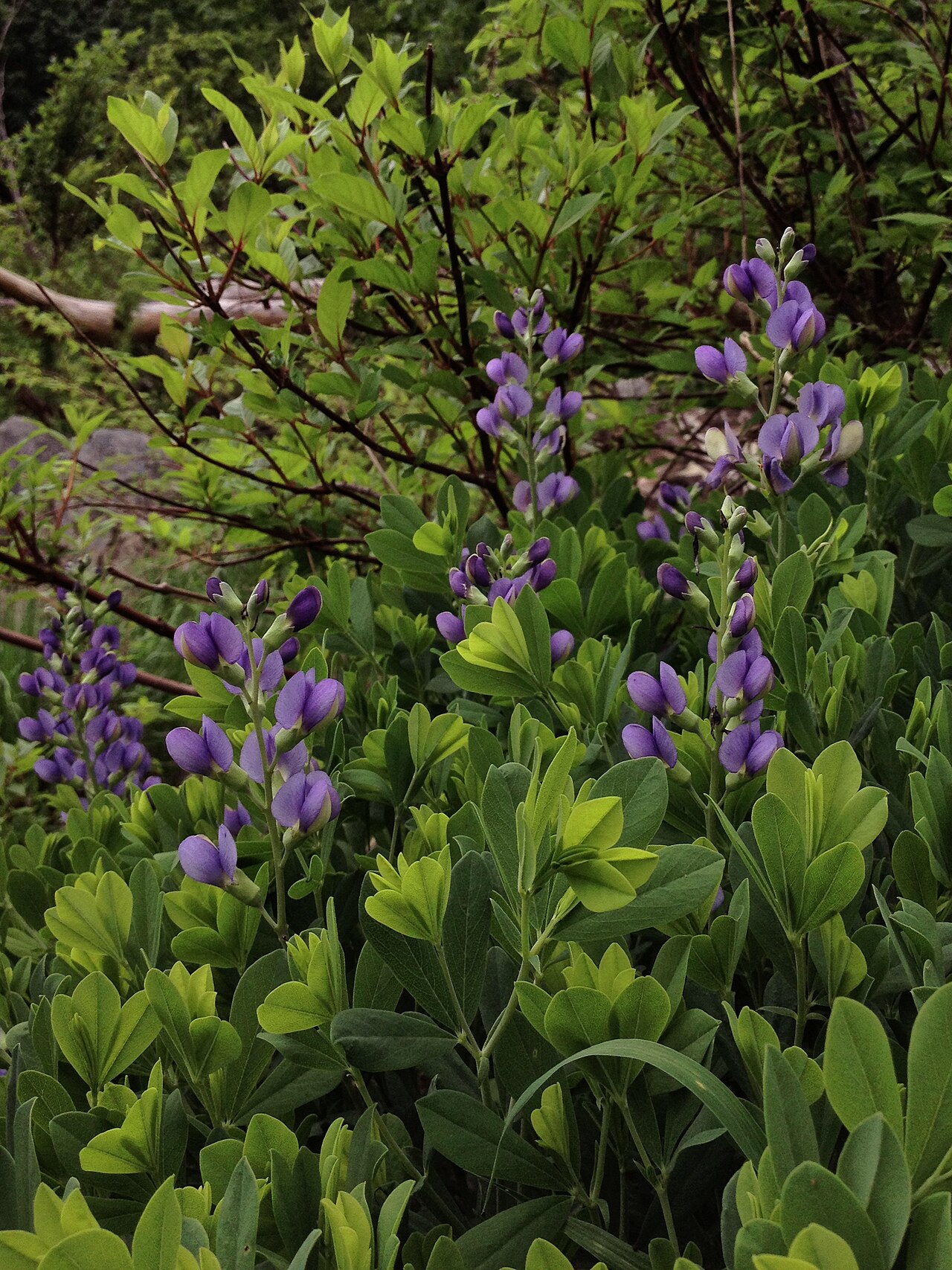
Wild indigos (genus Baptisia), also called false indigos, are long-lived, shrub-like perennials of the pea family. Every species in the genus is native to North America, almost entirely to the eastern and central United States, where about 16 species grow in prairies, open woods, sandhills, pine barrens and river banks. Gardeners know them best as the big, blue-flowered clumps of blue false indigo, but the genus also includes white, cream and bright yellow species.
Baptisias are some of the toughest and longest-lived perennials you can plant. Each one grows from a deep, woody taproot that lets it ride out drought, and a mature clump can stay in the same spot for decades. In spring they send up spikes of pea flowers that feed bumblebees, then hold their tidy, often blue-green foliage all summer and finish with inflated pods that rattle in the wind. Like other legumes, they fix nitrogen with the help of root bacteria, so they need no fertilizer.
The common name comes from history: colonists and earlier Native peoples used some species, especially yellow wild indigo, as a weak substitute for true indigo dye. True indigo (Indigofera) is an unrelated tropical plant. In New England and Maine, the only wild indigo that grows wild is the yellow-flowered Baptisia tinctoria; the blue-flowered plants in Maine gardens are blue false indigo, which is native farther south and west. This guide covers all the main US-native species and how to grow them.
Identification
Wild indigos are easy to recognize once you know them: bushy, rounded clumps of three-part leaves, upright spikes of pea flowers, and swollen pods that turn black. The features below separate them from lupines, golden banners and other pea-family look-alikes.
Stems & Habit
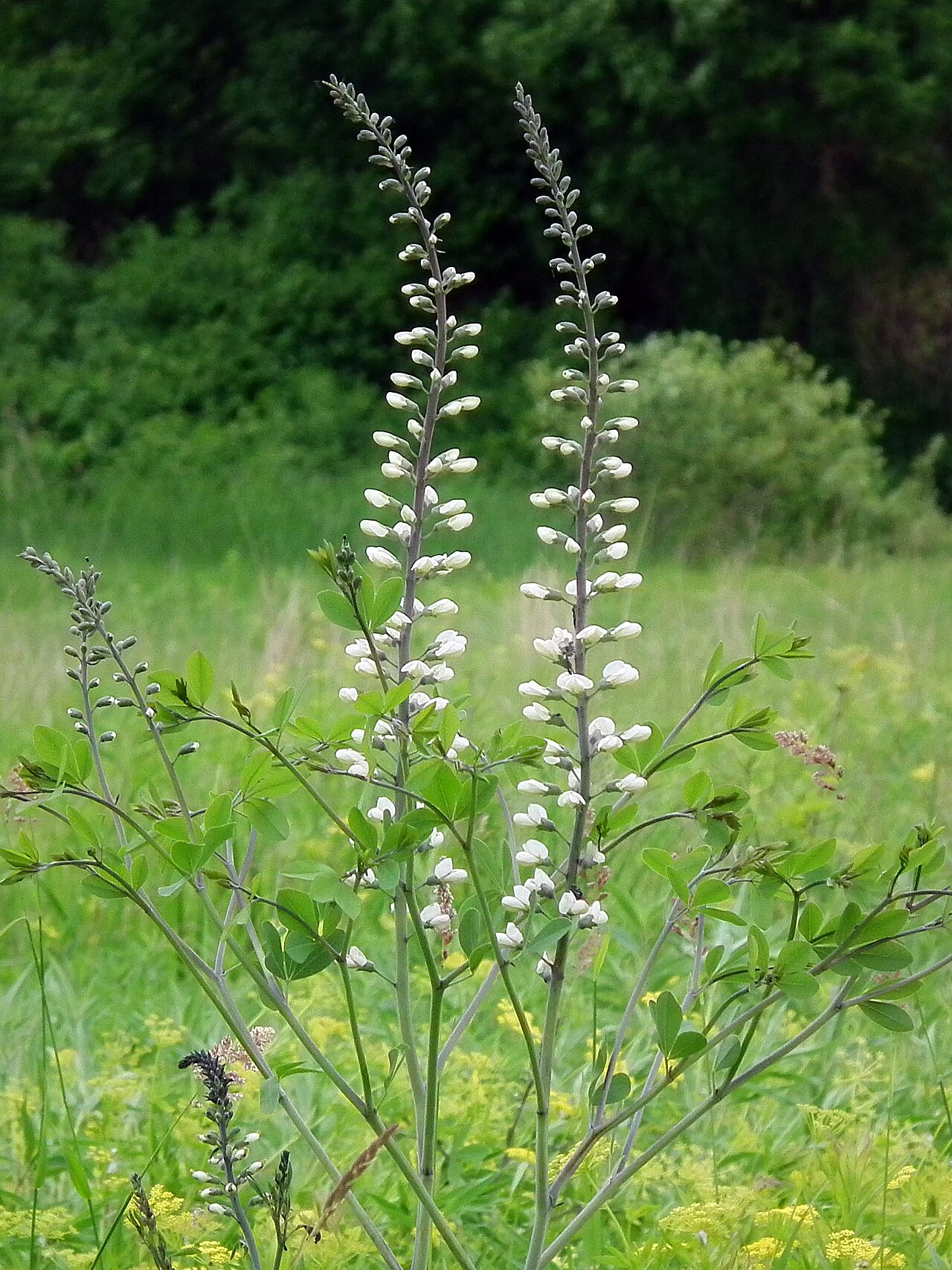
Most species form a bushy, rounded clump 2 to 4 feet tall and wide, with many branching stems arising from a woody crown. Tall white wild indigo can send flower spikes to 5 or 6 feet, while cream wild indigo and some southeastern species stay low and sprawling, under 2 feet. Stems of many species are smooth and covered with a waxy, blue-gray bloom. After frost the stems turn charcoal-black; in yellow wild indigo and white wild indigo, the whole dried top may snap off at the base and tumble across open ground, scattering seed.
Leaves
Leaves are alternate and, in most species, divided into three leaflets like a clover, each leaflet ½ to 3 inches long and often blue-green. A few southeastern species, such as scareweed (B. simplicifolia) and catbells (B. perfoliata), have simple, undivided leaves. This three-part leaf separates wild indigos from lupines, which have fan-shaped leaves with five or more leaflets, and from true indigo, whose leaves have many small leaflets arranged like a feather.
Flowers
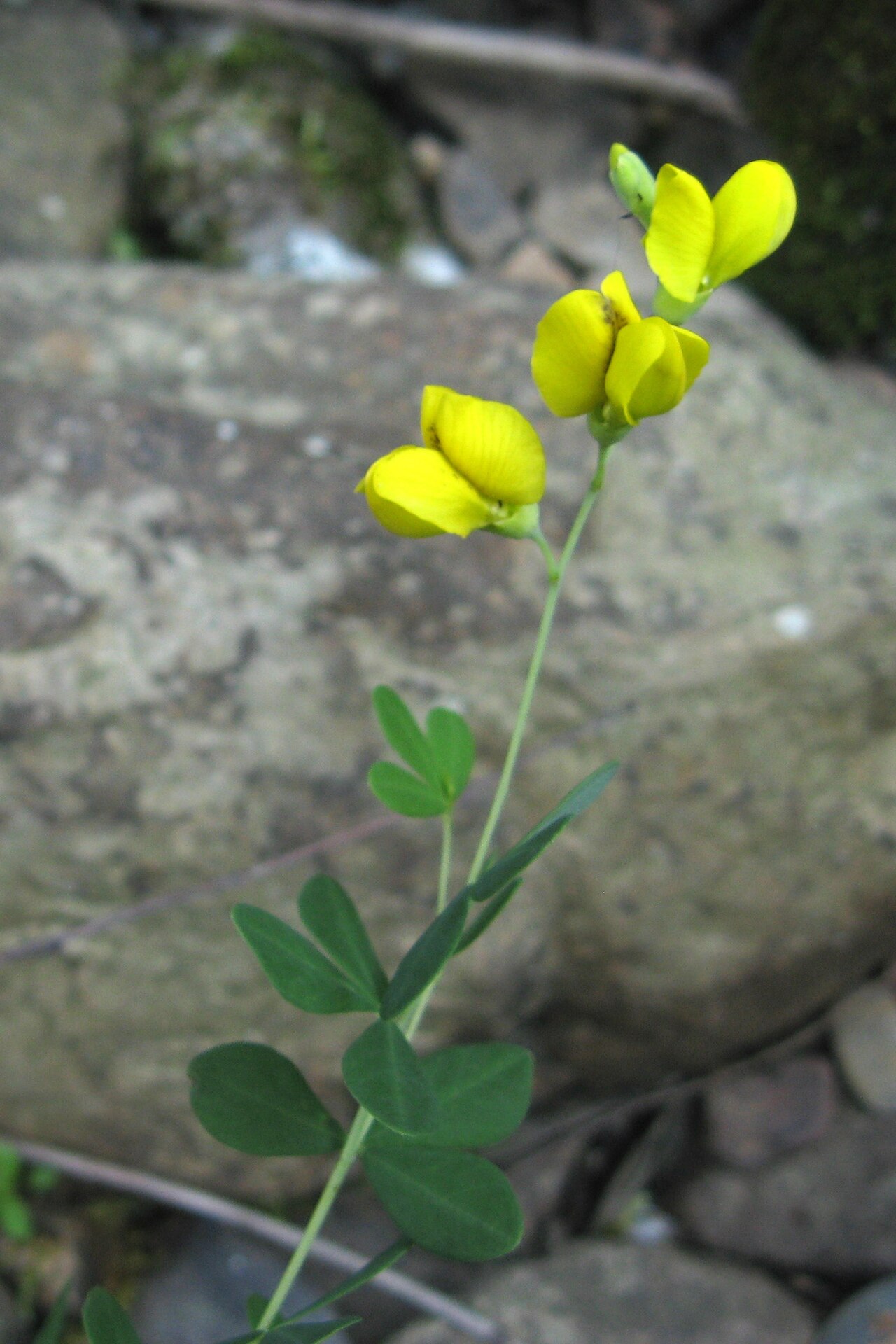
The flowers are typical pea flowers, about ½ to 1 inch long, with a banner petal, two wings and a keel. They are carried in upright or arching spikes (racemes) at the stem tips from April to July, depending on species. Color separates the main groups: indigo-blue to violet in blue false indigo, white in white wild indigo, cream to pale yellow in cream wild indigo, and bright lemon yellow in yellow wild indigo, yellow wild indigo of the south-central states (B. sphaerocarpa) and several southeastern species. Each flower lasts several days, and a clump blooms for two to three weeks.
Pods & Seeds
After flowering, wild indigos form inflated, thick-walled pods, ½ to 2½ inches long, that ripen from green to black or brown. Loose seeds rattle inside, which gives the plants old names such as rattlebush and rattleweed. Pod shape helps with identification: round in B. sphaerocarpa (its name means “round fruit”), small and nearly round in yellow wild indigo, and larger and pointed in blue false indigo. Dried pods are popular in flower arrangements.
Quick Facts
| Scientific Name | Baptisia (about 16 species, all native to North America) |
| Family | Fabaceae (Pea or Legume family) |
| Plant Type | Long-lived, bushy herbaceous perennials with deep taproots |
| Mature Height | 1–4 ft for most species (white wild indigo flower spikes to 5–6 ft) |
| Mature Spread | 2–4 ft |
| Growth Rate | Slow to establish, then moderate |
| Sun Exposure | Full sun to light part shade |
| Water Needs | Low to average; very drought tolerant once established |
| Soil Type | Well-drained sand, loam or clay; tolerates poor, rocky soil |
| Soil pH | Acidic to slightly alkaline (about 5.0–7.5) |
| Bloom Time | April – July, by species (yellow wild indigo into August) |
| Flower Color | Blue to violet, white, cream or yellow |
| Fall Color | Foliage turns charcoal-black after frost |
| Fruit | Inflated, rattling pods that ripen black or brown |
| Deer Resistant | Yes (foliage is bitter and toxic) |
| USDA Hardiness Zones | About 3–9 across the genus |
Native Range
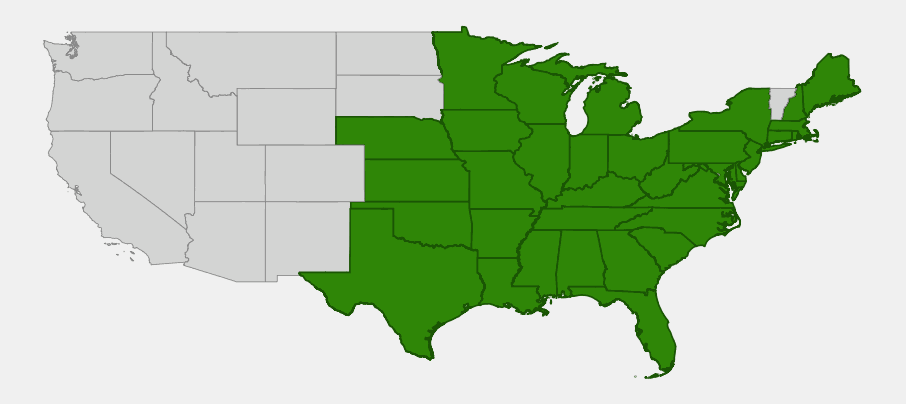
Wild indigos are plants of eastern and central North America. Together, the native species cover every state from Maine and Minnesota south to Florida and Texas and west to Nebraska, Kansas and Oklahoma. A few reach into southern Ontario, but none is native west of the Great Plains. The Southeast, especially the coastal plain from the Carolinas to Florida and Alabama, holds the most species, several of them found nowhere else.
Each widespread species has its own core range. Yellow wild indigo grows in dry, sandy, acidic ground from southern Maine and the Great Lakes to Florida, including the New Jersey Pine Barrens and the sand plains of New England. Blue false indigo grows along rocky river banks and in open woods from Pennsylvania and southern Ohio south to Georgia, with a shorter variety (var. minor) in the prairies of Nebraska, Kansas, Oklahoma and Texas. White wild indigo and cream wild indigo are prairie plants of the Midwest and southern Plains, with eastern and southern varieties on the coastal plain.
Blue false indigo is a popular garden plant far beyond its native range, and it has escaped in New England and some northern states. Those are garden escapes, not native stands. In Maine, only yellow wild indigo is native, and it is rare there, found in a few sandy sites in the far south of the state. The map shows states where at least one wild indigo is native.
📋 Regional plant lists for choosing native wild indigos: New Hampshire, Maine & Vermont · Connecticut, Massachusetts & Rhode Island · New York, Pennsylvania & Northern New Jersey · Delaware, Southern New Jersey & Long Island · Maryland, Virginia & West Virginia · North Carolina & South Carolina · Georgia, Alabama & Mississippi · Kentucky & Tennessee · Ohio & Indiana · Illinois, Iowa & Missouri · Michigan, Wisconsin & Eastern Minnesota · Nebraska, Kansas & Eastern Colorado · Arkansas, Louisiana, Eastern Oklahoma & Eastern Texas · South & West Texas
Native Species
These are the US-native wild indigos most often grown or seen in the wild. Each linked name goes to our full growing guide.
Blue false indigo (Baptisia australis) is the classic garden baptisia: a 3- to 4-foot, shrub-like clump of blue-green leaves with spikes of indigo-blue flowers in late spring. It is native from Pennsylvania and southern Ohio south to Georgia and in the southern Plains, where the shorter variety minor grows. It is hardy to zone 3, adapts to clay, and is the species behind most blue garden cultivars.
Yellow wild indigo (Baptisia tinctoria), also called horseflyweed, is a bushy, finely branched plant 2 to 3 feet tall with small, rounded leaflets and loose clusters of small yellow flowers in early to midsummer. It grows in dry, sandy, acidic soil from southern Maine and the Great Lakes to Florida. It is the native wild indigo for New England gardens and an important host plant for the frosted elfin and wild indigo duskywing butterflies.
White wild indigo (Baptisia alba, including B. lactea) is the tallest species, with smooth, gray-green stems and white flowers on spikes that may reach 5 or 6 feet in early summer. The prairie variety (var. macrophylla, often called B. lactea or B. leucantha) grows from Minnesota and Michigan south to Texas and Louisiana, and var. alba grows on the southeastern coastal plain. It is a parent of many popular hybrids.
Cream wild indigo (Baptisia bracteata, including B. leucophaea) is the first to bloom, in April and May, with drooping, one-sided clusters of large, creamy yellow flowers on a low, spreading plant 1 to 2 feet tall. The prairie variety (var. leucophaea) grows in dry prairies and savannas from Minnesota and Michigan to Texas, and var. bracteata grows in the Southeast.
Yellow wild indigo of the south-central states (Baptisia sphaerocarpa) has bright yellow flowers held upright above the leaves in late spring and round, marble-sized pods. It grows in prairies and open woods of Missouri, Arkansas, Oklahoma, Louisiana and Texas. Its cultivar ‘Screamin’ Yellow’ is one of the showiest yellow baptisias.
Scareweed (Baptisia simplicifolia) is a rare species of sandhills and pine flatwoods in the Florida panhandle, with simple, rounded leaves rather than three leaflets and small yellow flowers in summer.
Nuttall’s wild indigo (Baptisia nuttalliana) is a bushy, yellow-flowered species of prairies and open woods in Arkansas, Louisiana, Oklahoma and east Texas, with small leaflets and flowers tucked along the stems.
Lanceleaf wild indigo (Baptisia lanceolata) grows in sandy pinelands of the southeastern coastal plain from South Carolina to Florida and Alabama. It has narrow, leathery leaflets and yellow flowers in spring.
Catbells (Baptisia perfoliata) of the Georgia and South Carolina sandhills has round, simple leaves pierced by the stem and small yellow flowers, a strange-looking plant often grown by collectors.
Hairy rattleweed (Baptisia arachnifera) is found only in a few counties of southeastern Georgia, in pine flatwoods. It is covered in woolly white hairs and is listed as federally endangered, so it should never be dug from the wild.
Non-Native Look-Alikes
Every Baptisia is native to North America, so any wild indigo you buy comes from native stock. Garden baptisias such as ‘Purple Smoke’ (blue false indigo crossed with white wild indigo), ‘Carolina Moonlight’ and the Decadence series are hybrids between native species, made in gardens and nurseries rather than found in the wild. They feed bumblebees well, though straight species are the best choice for restoration plantings. The plants below are the ones most often confused with wild indigos:
- True indigo (Indigofera tinctoria): A tropical shrub from Asia and Africa, the original source of indigo dye, grown as a cash crop in colonial South Carolina. It has feather-like leaves with many small leaflets and small pink to reddish flowers, very different from the three-part leaves and large flowers of Baptisia. Related weedy indigos, such as hairy indigo (I. hirsuta) and creeping indigo (I. spicata), are naturalized in Florida, and creeping indigo is poisonous to horses.
- Showy rattlebox (Crotalaria spectabilis): An Asian annual with yellow pea flowers and inflated, rattling pods, introduced as a cover crop. It is invasive in the Southeast and toxic to livestock and poultry. Its leaves are simple, and its pods hang along a single upright stalk.
- Scotch broom (Cytisus scoparius): A European shrub with green, nearly leafless stems and bright yellow pea flowers. It is a serious invasive in the Pacific Northwest and California and has spread in parts of the East.
- Lupines (Lupinus): Blue-flowered, but with fan-shaped leaves of five or more leaflets. Garden Russell lupines are non-native hybrids; see our guide to native lupines for the native species, including wild blue lupine.
- Golden banners (Thermopsis): Native yellow-flowered relatives, such as Carolina lupine and prairie thermopsis, with three-part leaves like Baptisia but flat, narrow pods instead of inflated ones.
- False indigo bush (Amorpha fruticosa): Another native “false indigo,” but a woody shrub with feather-like leaves and dense spikes of tiny purple flowers with orange anthers. See our false indigo bush profile.
Growing & Care Guide
Wild indigos are slow starters but almost carefree once settled. Gardeners often describe them with the old saying “first year it sleeps, second year it creeps, third year it leaps.” After that, a single plant can anchor a border for 20 years or more.
Light
Plant in full sun for the sturdiest clumps and the most flowers. Blue false indigo and yellow wild indigo tolerate light part shade, but in more than a few hours of shade the stems grow lanky and flop open after bloom.
Soil & Water
Baptisias tolerate a wide range of soils, from sand to clay, as long as water does not stand around the crown. Blue false indigo and white wild indigo handle heavier, richer soils, while yellow wild indigo, cream wild indigo and the southeastern species prefer lean, sandy or gravelly ground and can rot in rich, wet beds. Water young plants through their first summer. Established plants rarely need watering, thanks to taproots that can go several feet deep. Do not fertilize: like other legumes they make their own nitrogen, and extra fertilizer only makes floppy growth.
Planting Tips
Choose the spot carefully, because baptisias resent being moved once their taproot is established. Plant small container-grown plants in spring or early fall, spacing them 3 to 4 feet apart. Young plants put most of their energy into roots and may show little top growth for a year or two. Mark where you planted them so they are not dug up by mistake in early spring, when shoots appear later than many perennials.
Pruning & Maintenance
No regular pruning is needed. Leave the pods on for winter interest and seed, or cut the stems back by about a third right after flowering for a more compact, rounded shape. If a clump opens up in the center, a peony ring or neighboring plants such as prairie grasses help hold it up. Cut the blackened stems to the ground in late winter. Pests are few; the native baptisia seed pod weevil eats some seeds but does not harm the plant.
Propagation
Grow wild indigos from seed. Collect pods as they turn black in late summer, and check seeds for weevil holes. Nick the hard seed coat with a nail file or soak in hot water overnight, then sow in fall outdoors or in spring after a month of cold, moist stratification. Seedlings bloom in about three years. Division is possible only on young plants, in early spring, with a sharp spade; old clumps rarely survive it.
Landscape Uses
- Perennial borders as a shrub-like backbone with spring flowers and good summer foliage
- Prairie and meadow plantings with little bluestem, butterfly weed and purple coneflower
- Sandy and dry sites such as New England sand plains and coastal gardens, with yellow wild indigo
- Pollinator gardens for early-season bumblebees
- Low-maintenance and deer-resistant plantings, since deer and rabbits leave the bitter foliage alone
- Cut and dried flowers, using fresh spikes in spring and black pods in fall
Wildlife & Ecological Value
Wild indigos are keystone plants of eastern prairies and sandy barrens, feeding specialist insects that few other plants can support.
For Pollinators
The flowers are built for bumblebees, which are heavy enough to open the keel and reach the nectar and pollen. Baptisias bloom in spring and early summer, when queen and worker bumblebees need food to build their colonies. Smaller bees and butterflies visit too but are less effective pollinators.
Butterflies & Moths
Wild indigos are host plants for the caterpillars of the wild indigo duskywing and the frosted elfin, a rare butterfly of sandy barrens that depends on yellow wild indigo and wild lupine in the Northeast. Clouded and orange sulphurs and several moths, including the genista broom moth, also feed on the leaves.
For Birds & Mammals
Few animals eat the foliage, which contains bitter, toxic alkaloids. The dense clumps provide summer cover for ground-nesting birds and small mammals in prairies.
Ecosystem Role
As legumes, wild indigos host nitrogen-fixing bacteria in root nodules, enriching poor, sandy and prairie soils for neighboring plants. Their deep taproots help them survive fire and drought, so they persist for decades in prairies, savannas and pine barrens that burn regularly.
Cultural & Historical Uses
The name Baptisia comes from the Greek baptizein, “to dip” or “to dye,” and the species name tinctoria also means “used for dyeing.” Yellow wild indigo and blue false indigo were used as a blue dye by some Native peoples, including the Cherokee, and by colonists who could not get imported indigo. The dye was weaker than true indigo, and the plants were never an important commercial source.
Yellow wild indigo was called horseflyweed because farmers tucked sprigs into horse harnesses to keep flies away. Several species also had historical uses in folk medicine. All wild indigos contain alkaloids that are toxic to people and livestock, and they should not be eaten or used as home remedies.
Blue false indigo has been grown in European and American gardens since the 1700s. It was named Perennial Plant of the Year in 2010, and since the 1990s botanical gardens and nursery breeders, beginning with ‘Purple Smoke’ from the North Carolina Botanical Garden, have produced dozens of hybrid baptisias from native species.
Frequently Asked Questions
Which wild indigo is native to Maine and New England?
Yellow wild indigo (Baptisia tinctoria) is the only wild indigo native to Maine and most of New England, where it grows in dry, sandy, sunny spots and blooms with small yellow flowers in summer. The blue-flowered wild indigo in northern gardens is blue false indigo, native farther south and west. It grows well in New England gardens and feeds local bumblebees, but it is not part of the native flora there.
Is wild indigo invasive or hard to control?
No. Wild indigos form slow-growing clumps that stay where you plant them, and they do not spread by runners. The only “hard to control” part is moving them: once the taproot is established, they are very difficult to dig up or transplant.
Is Baptisia poisonous?
Yes. All parts contain alkaloids that are toxic to people, pets and livestock if eaten, which is also why deer and rabbits avoid it. Keep children from eating the seeds or pods.
Why isn’t my baptisia blooming?
Young plants often take two or three years to bloom while they build their root system. Too much shade, too much fertilizer or recent transplanting can also reduce flowering. Be patient, give them full sun, and leave them in place.
What is the difference between false indigo and true indigo?
True indigo (Indigofera tinctoria) is a tropical shrub from Asia and Africa and the main historical source of indigo dye. “False” or “wild” indigo refers to native Baptisia species, which gave a weaker blue dye. They are both in the pea family but are not closely related.

Looking for a nursery that carries Native Wild Indigos?
Browse our native plant nursery directory: Alabama & Arkansas · Connecticut, Delaware, Florida & Georgia · Illinois, Indiana, Iowa & Kansas · Kentucky, Louisiana, Maine, Maryland, Massachusetts, Michigan, Minnesota, Mississippi & Missouri · Nebraska, New Hampshire, New Jersey, New York, North Carolina, Ohio & Oklahoma · Pennsylvania, Rhode Island, South Carolina, Tennessee, Texas & Virginia · West Virginia & Wisconsin

