
Hoary Mock Orange (Philadelphus pubescens)
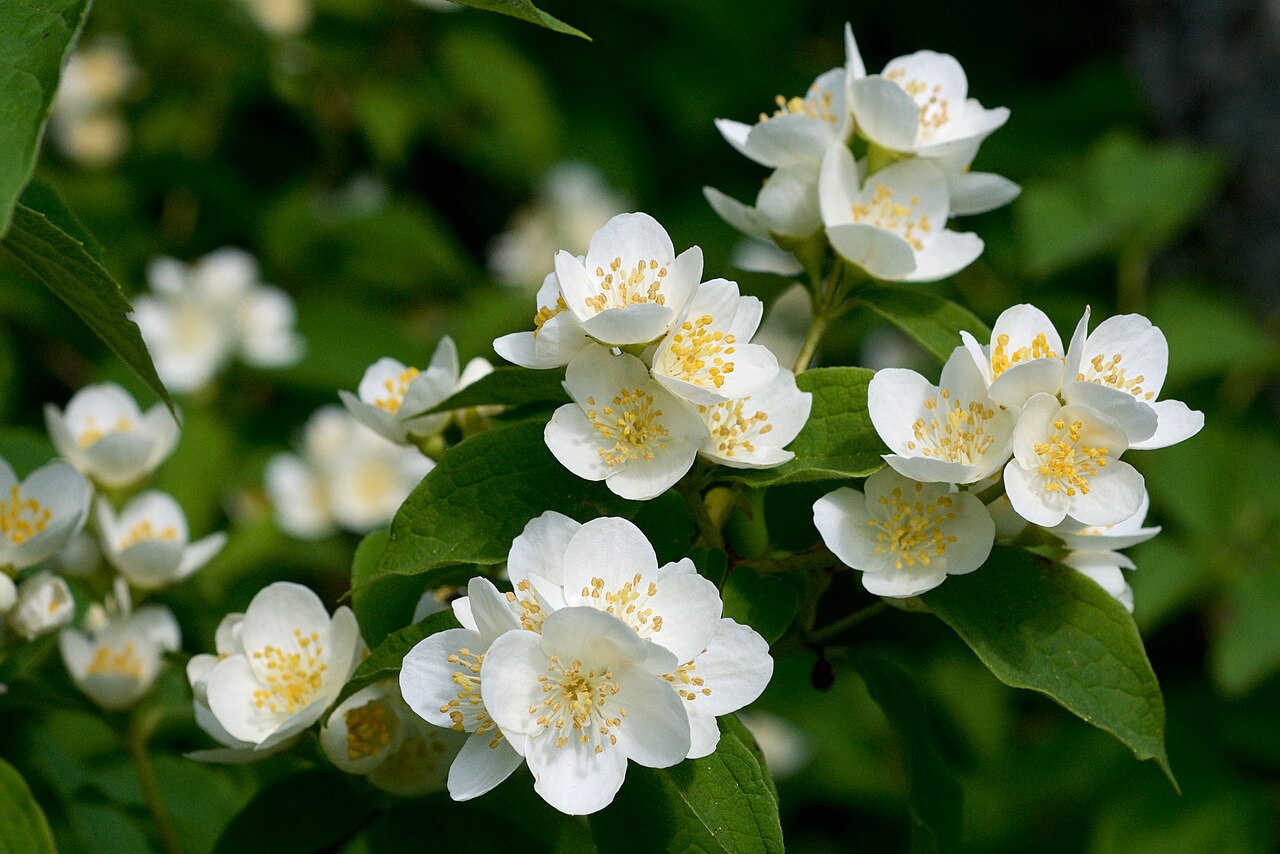
Philadelphus pubescens, the Hoary Mock Orange, is a large deciduous shrub of rocky bluffs and wooded slopes in the south-central United States, from the Ozark and Ouachita Mountains east through Tennessee and Kentucky to northern Alabama and Georgia. In late spring it is covered in clusters of white, four-petaled flowers with bright yellow stamens. “Hoary” refers to the gray hairs on the undersides of its leaves, which set it apart from other eastern mock oranges.
Mock oranges get their name from flowers that resemble orange blossoms, and many species are famous for their fragrance. Hoary mock orange is usually only lightly scented or nearly scentless, but it makes up for it with abundant flowers held in larger clusters than most of its relatives. It is a tough, adaptable, long-lived shrub for sun or light shade.
This guide covers how to identify hoary mock orange, where it grows wild, and how to use it in native gardens as a flowering screen, woodland-edge shrub or replacement for the common, non-native sweet mock orange (P. coronarius).
Identification
Mock oranges (Philadelphus) are shrubs with opposite, simple leaves, peeling brown bark on older stems, and white flowers with four petals and many stamens. Hoary mock orange is identified by its flowers in clusters of usually 5 to 11 at the branch tips, and by the dense, gray, felt-like hairs on the leaf undersides. Compare scentless mock orange (P. inodorus), which has flowers borne singly or in threes and leaves nearly hairless beneath.
Growth Form
A large, upright, multi-stemmed shrub, usually 6 to 12 feet tall and wide, sometimes reaching 15 to 20 feet. The arching branches form a rounded, rather coarse shape. Young twigs are often hairy, and the bark of older stems is gray to brown and peels or flakes in thin strips.
Leaves
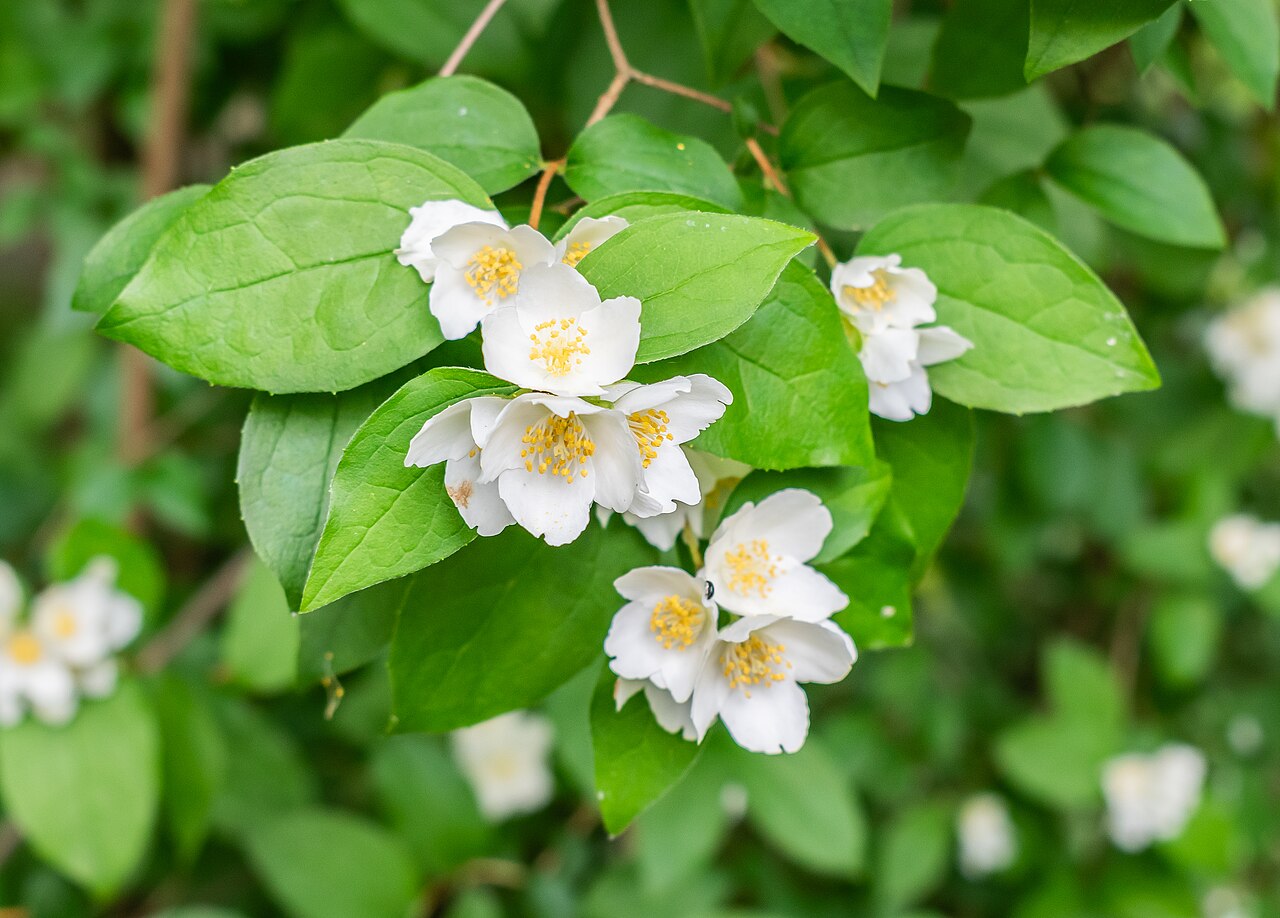
The leaves are opposite, oval to broadly egg-shaped, about 2 to 4 inches long, with a pointed tip and small, widely spaced teeth or nearly smooth edges. They are dark green and slightly rough above and densely covered with soft, gray hairs beneath, giving the underside a pale, “hoary” look. Three to five main veins curve from near the base toward the tip.
Flowers
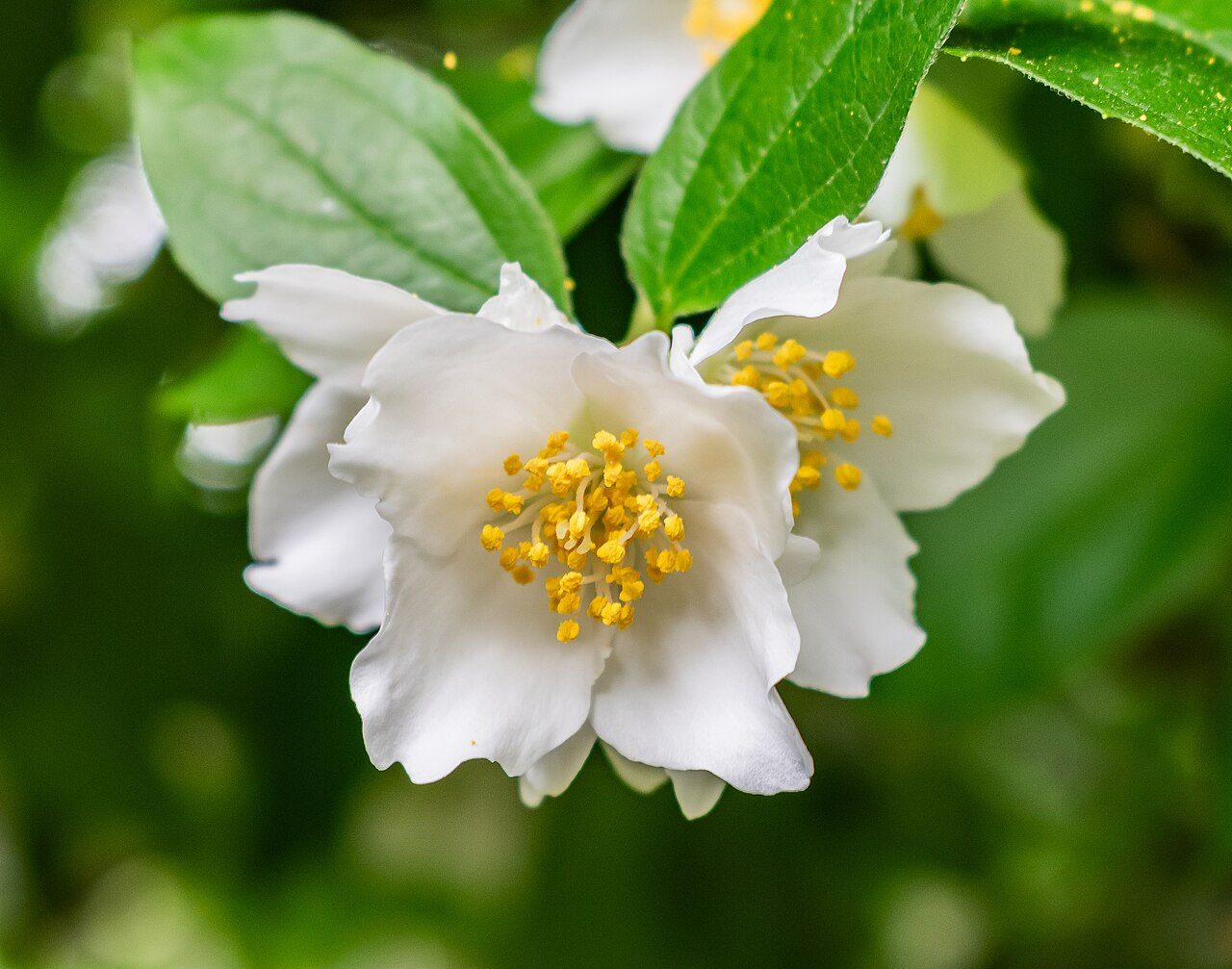
In late spring, mainly May to early June, white flowers about 1 to 1½ inches across open in racemes or clusters, usually of 5 to 11 flowers, at the ends of short side branches. Each flower has four broad, rounded petals and many yellow stamens. The calyx and flower stalks are usually hairy. The fragrance is faint or absent.
Fruit
The fruit is a small, woody, four-parted capsule about ¼ to ⅜ inch long, which ripens brown in late summer and fall and splits to release many tiny seeds. Capsules often remain on the shrub into winter, which helps identify it when it is leafless.
Quick Facts
| Scientific Name | Philadelphus pubescens Loisel. |
| Family | Hydrangeaceae (hydrangea family) |
| Plant Type | Deciduous shrub |
| Mature Height | 6–12 ft (up to 20 ft) |
| Mature Spread | 6–10 ft |
| Growth Rate | Moderate to fast |
| Sun Exposure | Full sun to part shade |
| Water Needs | Low to moderate; drought tolerant once established |
| Soil Type | Well-drained rocky, loamy or clay soils; tolerates limestone |
| Soil pH | Slightly acidic to alkaline (about 6.0–8.0) |
| Bloom Time | Late spring (May–Jun) |
| Flower Color | White |
| Fall Color | Yellowish, not showy |
| Fruit | Small, woody brown capsule |
| Deer Resistant | Moderately |
| USDA Hardiness Zones | 5–8 |
Native Range
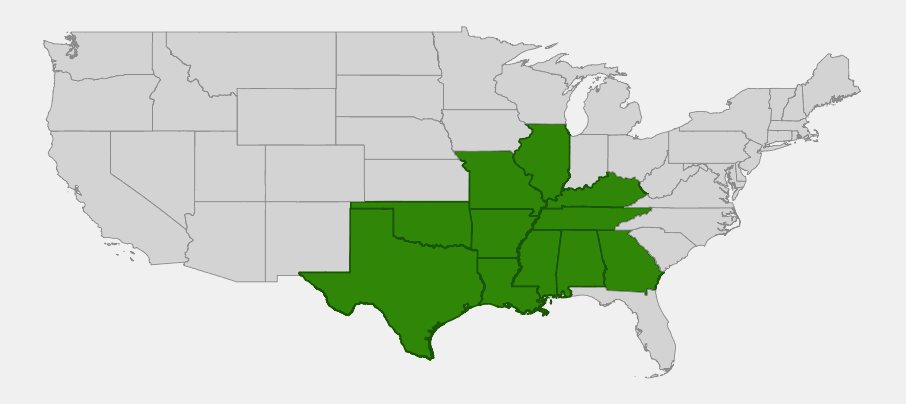
Hoary mock orange is native to the south-central and southeastern United States. Its range centers on the Ozark Plateau and Ouachita Mountains of Arkansas, southern Missouri and eastern Oklahoma, and on the Cumberland Plateau, Ridge and Valley and Interior Low Plateaus of Tennessee and Kentucky, extending to northern Alabama, northwestern Georgia, Mississippi, southern Illinois, Louisiana and Texas. It grows on rocky, wooded slopes, limestone and sandstone bluffs, ledges, cliffs and stream banks.
It is uncommon to rare at the edges of its range and is tracked as a rare plant in several states, including Missouri, Oklahoma, Georgia, Kentucky and Texas, according to NatureServe. Two varieties are often recognized: var. pubescens and var. intectus, which has nearly hairless leaves and is sometimes treated as a separate species.
Because it has long been grown as an ornamental, hoary mock orange has escaped from cultivation in places outside its natural range, and USDA PLANTS records it in states such as Connecticut, Massachusetts, New York, Pennsylvania, Ohio, Virginia and Maryland. NatureServe and other sources treat several of these northeastern records as introductions. USDA also shows an isolated record from Wyoming, far outside its natural range. The map shows its core native states.
📋 Regional plant lists featuring Hoary Mock Orange: Alabama, Georgia & Mississippi · Arkansas, Louisiana, Eastern Oklahoma & Eastern Texas · Illinois, Iowa & Missouri · Kentucky & Tennessee
Growing & Care Guide
Hoary mock orange is an easy, long-lived shrub. It tolerates heat, drought once established, rocky and limestone soils, and some shade, and it has few pest problems. Give it room, because it grows into a large shrub.
Light
Flowering is best in full sun to light shade. It grows well at woodland edges and in the light shade of larger trees, as on its native bluffs, but flowers less in deep shade.
Soil & Water
It adapts to most well-drained soils, from rocky and limestone-rich ground to loam and clay, and from slightly acidic to alkaline. Water regularly the first year. After that it is fairly drought tolerant and needs water only during long dry spells. Avoid constantly wet, poorly drained sites.
Planting Tips
Plant in fall or early spring, spacing plants 6 to 10 feet apart for a screen or hedge. Mulch to keep the roots cool and moist while it establishes. It is hardy in about USDA zones 5 to 8.
Pruning & Maintenance
It flowers on wood grown the previous year, so prune right after flowering, not in winter or early spring. Remove a few of the oldest, thickest stems at the base every year or two to keep the shrub open and vigorous. An old, overgrown shrub can be cut nearly to the ground in late winter to renew it, although it will skip a year of flowering. No fertilizer is usually needed.
Propagation
Softwood cuttings taken in late spring or early summer root readily, as do hardwood cuttings taken in winter. Seed can be sown in fall outdoors or after about 1 to 2 months of cold-moist stratification; the seeds are tiny and should be pressed onto the soil surface, not buried. Plants can also be divided or layered.
Landscape Uses
- Flowering screens and hedges: dense, tall growth and a mass of white flowers
- Woodland edges and slopes: tolerates light shade and rocky, dry soils
- Native alternative: replaces non-native sweet mock orange (P. coronarius) in gardens
- Pollinator gardens: late-spring pollen for bees and other insects
- Limestone and rocky sites: grows naturally on bluffs and ledges
Wildlife & Ecological Value
Hoary mock orange flowers after the main spring rush and before summer blooms, filling a useful gap for insects. Its dense branches provide year-round cover on bluffs and woodland edges.
For Pollinators
The open flowers offer abundant pollen and some nectar. They are visited by native bees, including bumble bees, small sweat bees and mining bees, as well as beetles and flies. The Xerces Society lists it as having special value to native bees.
For Birds
Birds use the dense shrub for cover and nesting. The tiny seeds are of little food value, but insects on the foliage feed songbirds such as warblers and vireos.
For Mammals
Deer browse it occasionally, but it is not a preferred food. Small mammals shelter under its branches on rocky slopes.
Ecosystem Role
On steep bluffs and rocky slopes its roots help hold thin soils in place, and it forms part of the shrub layer in Ozark and Cumberland woodlands, glade edges and bluff communities.
Cultural & Historical Uses
The French botanist Jean-Louis-Auguste Loiseleur-Deslongchamps described Philadelphus pubescens in the early 19th century from plants grown in Europe. American mock oranges were already popular in European gardens by then. The genus name honors Ptolemy II Philadelphus, a king of ancient Egypt, and the species name pubescens means “downy”, for its hairy leaf undersides.
Gardeners have long grown mock oranges for their showy white flowers. The old name “syringa”, still sometimes used for mock oranges, comes from the Greek word for a pipe, because their straight, pithy stems were hollowed out to make pipe stems; the same name was later given to the lilac genus, Syringa, which causes confusion to this day.
Its western relative Lewis’ mock orange (P. lewisii) is the state flower of Idaho. Native peoples used the straight, hard stems of mock oranges for arrows, pipe stems and tools, and the crushed leaves and flowers of some species as a mild soap.
Frequently Asked Questions
Is hoary mock orange (Philadelphus pubescens) fragrant?
Usually only faintly, and some plants are nearly scentless. If fragrance is important, smell plants in flower at a nursery before buying. It is grown mainly for its large clusters of white flowers.
How is hoary mock orange different from sweet mock orange?
Sweet mock orange (P. coronarius) is a fragrant species from southern Europe and western Asia that is widely planted in gardens. Hoary mock orange is native to the south-central United States, has larger clusters of mostly scentless flowers, and has leaves with gray, felt-like hairs beneath.
When should I prune hoary mock orange?
Right after flowering in early summer. It blooms on the previous year’s wood, so pruning in winter or spring removes the flower buds. Thin out a few of the oldest stems at the base every year or two.
Does hoary mock orange grow in shade?
It tolerates part shade and grows naturally on wooded slopes and bluffs, but it flowers best in full sun to light shade.
Is hoary mock orange poisonous?
It is not known as a significant poisonous plant to people or pets. As with most ornamental shrubs, it is not meant to be eaten.

Looking for a nursery that carries Hoary Mock Orange?
Browse our native plant nursery directory: Alabama & Arkansas · Georgia · Illinois · Kentucky, Louisiana, Mississippi & Missouri · Oklahoma · Tennessee & Texas

