
Herbaceous Seepweed (Suaeda maritima)
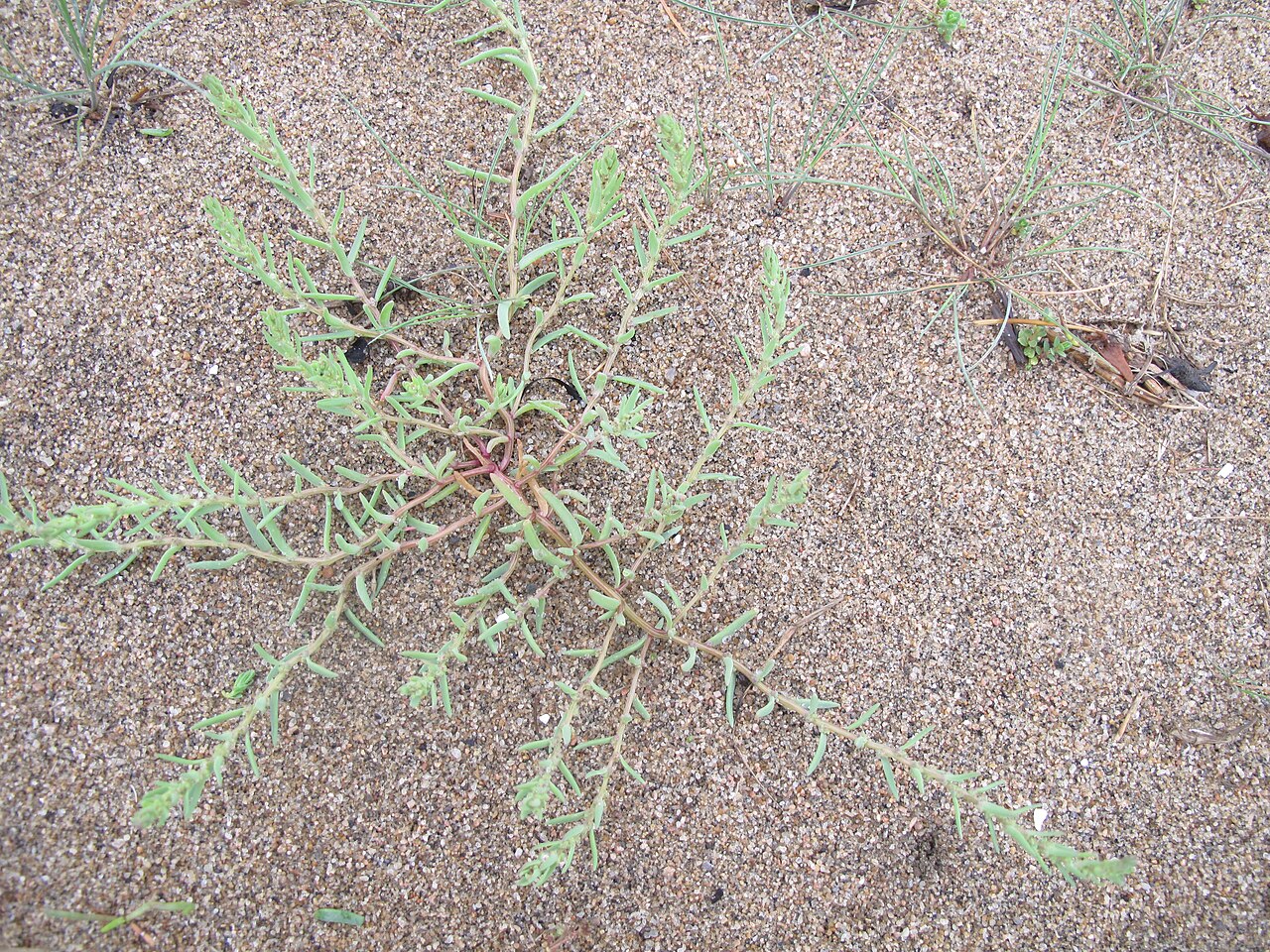
Suaeda maritima, known as Herbaceous Seepweed, herbaceous sea-blite or annual seablite, is a small, fleshy-leaved annual of salt marshes, tidal flats and sandy shores. It belongs to the amaranth family (Amaranthaceae), the group that includes the goosefoots and saltbushes, and it is one of the succulent “salt plants” that can grow where seawater floods the soil twice a day. Its narrow, cylindrical leaves store water and salt, and they turn from blue-green to red or purple as the season ends.
Herbaceous seepweed is found on sea coasts around much of the world, but its story in North America is complicated. Two subspecies grow on the northeastern coast. The low, mat-forming subsp. richii is native to the Gulf of St. Lawrence, the Maritime provinces and northern New England, where it is rare. The taller, more upright subsp. maritima, the typical European form, is considered introduced on the Atlantic coast from Massachusetts to Virginia. This page focuses on the plant as a native of northern New England and Atlantic Canada.
It is not a garden plant in any ordinary sense, but it is worth knowing. It is part of the salt-marsh plant community that protects coastlines, traps sediment and feeds waterfowl, and its native form is a conservation concern in every New England state where it grows. This guide covers how to identify it, where it grows, and how it fits into coastal ecology.
Identification
Seepweeds (Suaeda) are easy to recognize as a group by their fleshy, narrow leaves and inconspicuous green flowers tucked into the leaf axils. Telling the species apart takes a closer look at growth habit, leaf shape and the tiny flowers and seeds.
Stems & Growth Habit
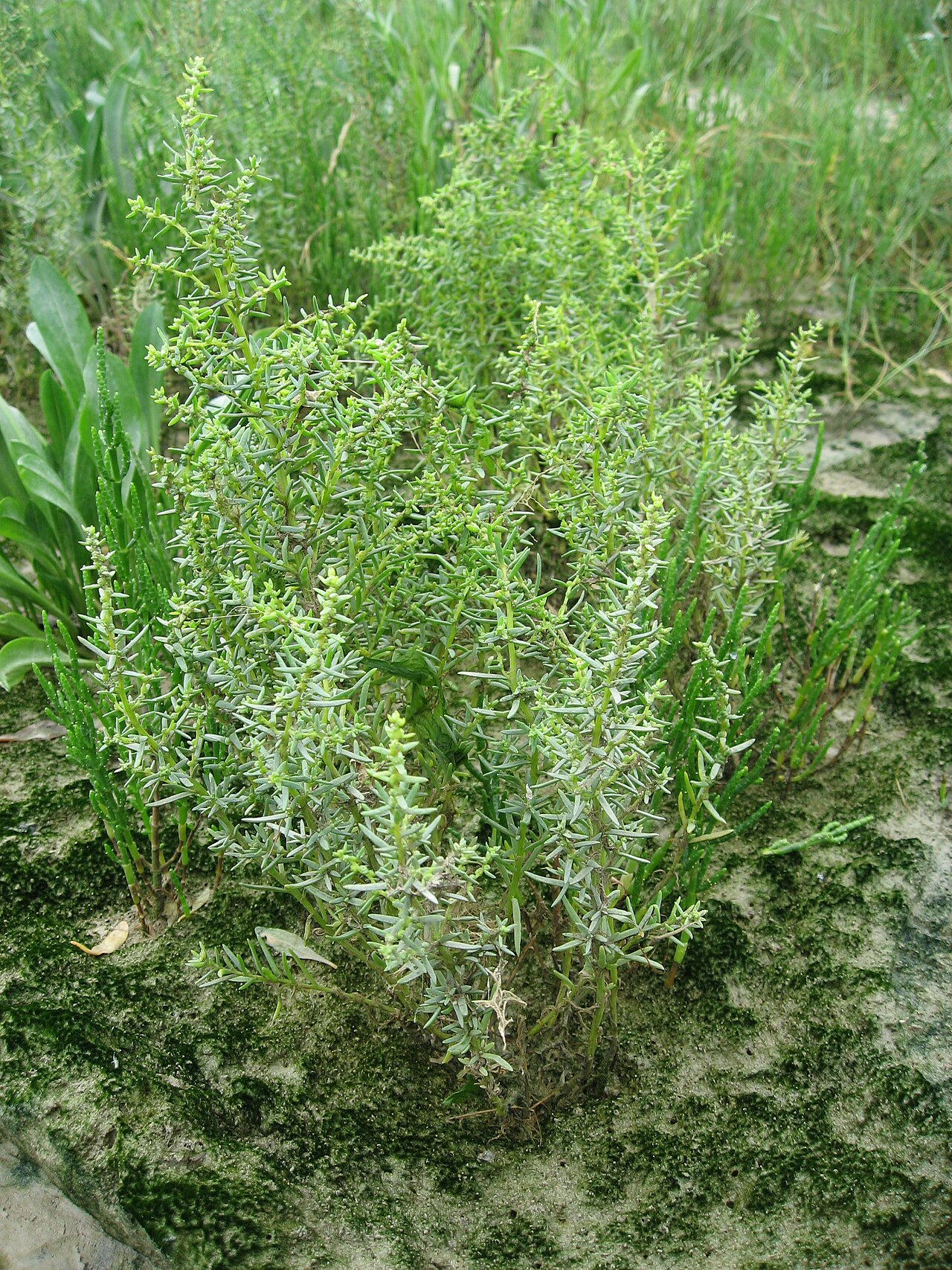
Herbaceous seepweed is an annual. It germinates in spring, grows through summer and dies after setting seed in fall. Plants range from a few inches to about 16 inches tall, sometimes taller in Europe. The native subsp. richii is usually prostrate or low and spreading, forming small mats on gravel and sand, while subsp. maritima is more erect and bushy. Stems branch from the base, are smooth, and are often green at first and reddish later.
Leaves
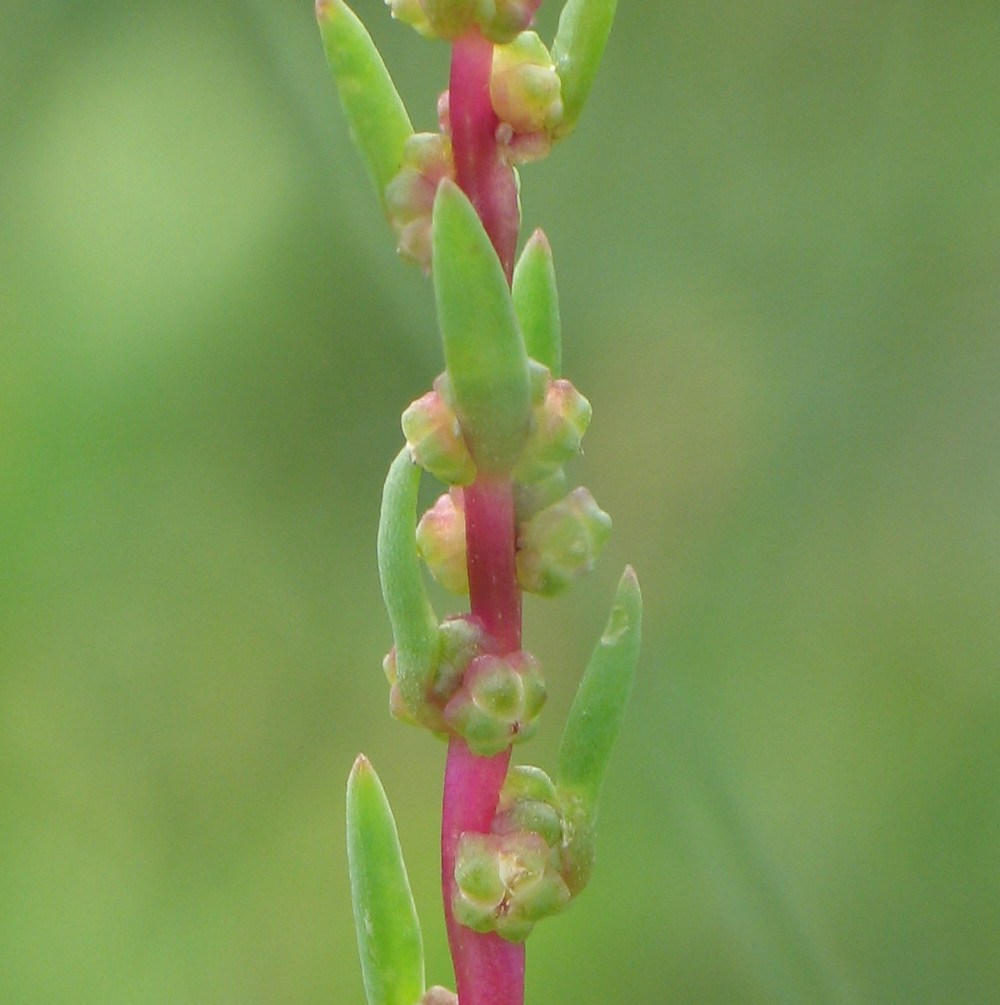
The leaves are alternate, crowded, succulent and nearly round in cross-section, mostly a half inch to about 1½ inches long and only a few millimeters wide, tapering to a blunt or slightly pointed tip. They are blue-green or gray-green with a faint waxy bloom, and they turn red to purple in late summer and fall, especially on plants growing in very salty, sunny spots. Squeezed, a leaf releases salty, watery sap.
Flowers
The flowers are tiny, green and easy to miss: about 2 to 3 millimeters across, in clusters of one to a few in the axils of the upper leaves, which act as leafy bracts. Each flower has five fleshy, hood-like sepals and no petals. Herbaceous seepweed blooms from late summer into fall, mostly August through October in New England.
Seeds
Each flower produces a single seed enclosed in the persistent calyx. The seeds are tiny, round and flattened, and shiny black or brown. Like several other Suaeda species, plants can produce two kinds of seed, which differ in color, size and how quickly they germinate. This helps the population survive in an unpredictable, flooding environment.
Similar Species
Tall seablite (Suaeda linearis) is a taller annual of Atlantic and Gulf coast salt marshes with longer, more pointed leaves. Glassworts (Salicornia) are also succulent salt-marsh annuals, but their jointed stems appear leafless. In the interior and the northern Great Plains, other seepweeds such as Suaeda calceoliformis grow on alkaline flats.
Quick Facts
| Scientific Name | Suaeda maritima (L.) Dumort.; native North American plants are subsp. richii |
| Family | Amaranthaceae (amaranth family; formerly Chenopodiaceae) |
| Plant Type | Succulent annual herb (halophyte) |
| Mature Height | 4–16 in; native subsp. richii often prostrate |
| Mature Spread | 6–18 in |
| Growth Rate | Fast (completes its life cycle in one season) |
| Sun Exposure | Full sun |
| Water Needs | High; tidally flooded or saturated saline soil |
| Soil Type | Saline sand, gravel, mud and peat of salt marshes and shores |
| Soil pH | About 6.5–8.5 |
| Bloom Time | August–October |
| Flower Color | Green (tiny, without petals) |
| Fall Color | Leaves turn red to purple in late summer and fall |
| Fruit | Single tiny black or brown seed enclosed in the calyx |
| Deer Resistant | Yes; rarely browsed |
| USDA Hardiness Zones | Annual; grows on northern coasts roughly in zones 3–7 |
Native Range
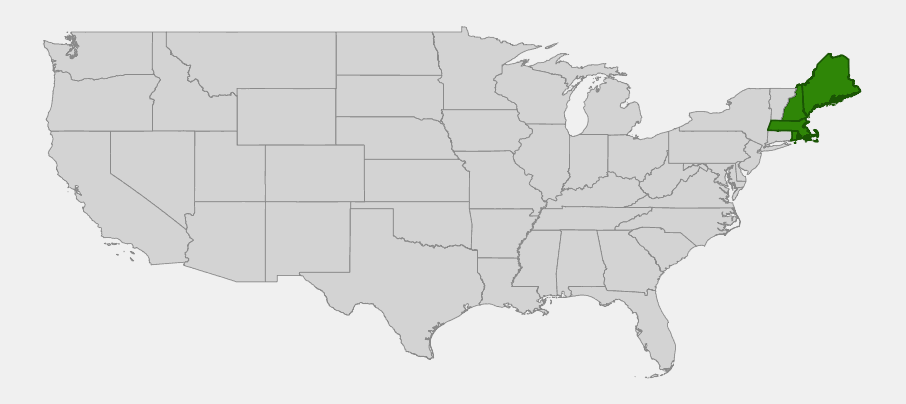
In the United States, the native subsp. richii grows along the coasts of Maine, New Hampshire, Massachusetts and Rhode Island. In Canada it ranges through Quebec on the Gulf of St. Lawrence, New Brunswick, Nova Scotia, Prince Edward Island and Newfoundland. These four New England states make up the native range shown on the map. It is rare in all of them: Go Botany (Native Plant Trust) ranks it extremely rare in Maine, New Hampshire and Rhode Island and rare to uncommon in Massachusetts, and New Hampshire lists it as endangered.
USDA PLANTS lists Suaeda maritima from many more states: Connecticut, New York, New Jersey, Delaware, Maryland, Virginia and Pennsylvania along the coast and tidal rivers, and scattered records from Kentucky, Florida and Washington. Most of these belong to the introduced European subsp. maritima, which is now common in some mid-Atlantic salt marshes, or are adventive inland records. Following the native-status notes in USDA PLANTS and Go Botany, this page treats only the northern New England populations as native.
Outside North America, herbaceous seepweed is widespread on the coasts of Europe, North Africa and western Asia, and it is reported from parts of tropical Asia. It also grows around inland salt lakes and salt springs in Europe.
📋 Regional plant lists featuring Herbaceous Seepweed: Connecticut, Massachusetts & Rhode Island · New Hampshire, Maine & Vermont
Growing & Care Guide
Herbaceous seepweed is not sold as a garden plant, and in New England its native form is rare enough that wild plants and seed should be left alone. It is best appreciated in the field, along salt marshes and beaches in late summer and fall. Restoration projects occasionally work with salt-marsh annuals like this one, always using locally sourced seed under permit.
Light
It needs full, open sun. In the wild it grows on bare or sparsely vegetated patches of marsh and shore where taller grasses cannot shade it.
Soil & Water
Herbaceous seepweed is an obligate wetland plant and a true halophyte. It needs wet, salty soil: sand, gravel or mud flooded by tides or saturated by brackish water. In fresh, ordinary garden soil it is quickly outcompeted, and it has no advantage there. In coastal gardens, a low area that receives salt spray and occasional tidal flooding is the only realistic setting.
Planting Tips
Where it is used in salt-marsh restoration, seed is sown on bare, saline sediment in fall or early spring, matching the natural cycle in which seeds overwinter before germinating. Seed must be collected locally, with permission, from robust populations. Never collect from the rare native populations in Maine, New Hampshire, Massachusetts or Rhode Island without guidance from state botanists.
Pruning & Maintenance
No pruning is needed. Plants die back after seeding. Leaving the dead stems in place lets seeds drop near the parent plants, where the conditions have already proven suitable.
Propagation
Herbaceous seepweed is grown only from seed. Germination is best after a cold, moist period, and many seeds germinate better after the salt in the soil has been diluted by spring rain. Some seeds remain dormant for a year or more, which spreads germination over several seasons.
Landscape Uses
- Salt-marsh restoration: one of the pioneer annuals that colonize bare, salty mud and sand
- Coastal education: an easy example of a succulent salt-tolerant plant to show on marsh walks
- Shoreline stabilization: plants help trap sediment and build up the surface of marshes
- Wildlife habitat: part of the seed-producing plant community that feeds coastal birds
- Edible-plant history: young leaves have been eaten as a salty vegetable in Europe and Asia
Wildlife & Ecological Value
Annual seepweeds are small, but on salt pans and tidal flats they are often among the few plants able to grow at all, which gives them an outsized role in the coastal food web.
For Pollinators
The tiny, petal-less flowers are largely wind-pollinated and self-pollinated, and they offer little to bees. Small flies and other insects visit them occasionally.
For Birds
The small, abundant seeds ripen in fall, just as waterfowl and other migrating birds move along the coast. Ducks, geese, shorebirds and sparrows feed on seepweed and glasswort seeds on marsh edges and beaches.
For Mammals
Muskrats and other marsh mammals eat salt-marsh vegetation, including succulent annuals. Herbaceous seepweed is not an important food for larger mammals.
Ecosystem Role
Herbaceous seepweed is a pioneer on bare, salty sediment. It traps fine sediment and organic matter around its stems, helping build up the marsh surface, and it adds organic matter as it decays each winter. Its presence, along with glassworts and sea-lavender, is a sign of a healthy, regularly flooded salt-marsh zone.
Cultural & Historical Uses
Seepweeds and glassworts have a long history as edible coastal plants. In Europe and Asia, young shoots of Suaeda maritima have been eaten raw or cooked as a salty green, and the plant is still gathered in some regions. In North America, related Suaeda species were used as food and seasoning by several Indigenous peoples, especially in the arid West.
Like glasswort and saltwort, seepweed was once burned to make soda ash (sodium carbonate), which was needed for soap and glass making. The family of plants used for this was so important that the word “alkali” comes from the Arabic al-qaly, the ashes of saltwort plants.
Today, herbaceous seepweed is studied by plant scientists as a model of salt tolerance. Its ability to store sodium in its leaves while keeping its cells functioning has made it a subject of research into salt-tolerant crops. In New England, its native subspecies is mainly of interest to conservation botanists working to protect rare coastal plants.
Frequently Asked Questions
Is herbaceous seepweed native to the United States?
Yes, in part. The low-growing subsp. richii is native to the coasts of northern New England and Atlantic Canada. The taller European subsp. maritima is considered introduced on the mid-Atlantic coast from Massachusetts to Virginia.
Is Suaeda maritima edible?
The young leaves and shoots are edible and have a strong salty flavor, and they have been eaten in Europe and Asia. In New England, though, the native form is rare and protected in several states, so do not harvest it there.
Why do seepweed leaves turn red?
The leaves accumulate red pigments in late summer and fall, particularly under strong sun, high salt levels and cool nights. A red-tinged stretch of salt pan in October is often seepweed or glasswort.
What is the difference between seepweed and glasswort?
Both are succulent salt-marsh annuals in the amaranth family. Seepweed has distinct, narrow, fleshy leaves along its stems. Glasswort (Salicornia) has jointed, fleshy green stems with leaves reduced to tiny scales, so it looks leafless.
Can I grow herbaceous seepweed in my garden?
Not realistically, unless your property includes salt marsh or a shoreline flooded by salt water. It needs saline, wet soil and full sun. For a coastal garden, salt-tolerant perennials such as seaside goldenrod are far more practical.

Looking for a nursery that carries Herbaceous Seepweed?
Browse our native plant nursery directory: Maine & Massachusetts · New Hampshire · Rhode Island

