
Carolina Canarygrass (Phalaris caroliniana)
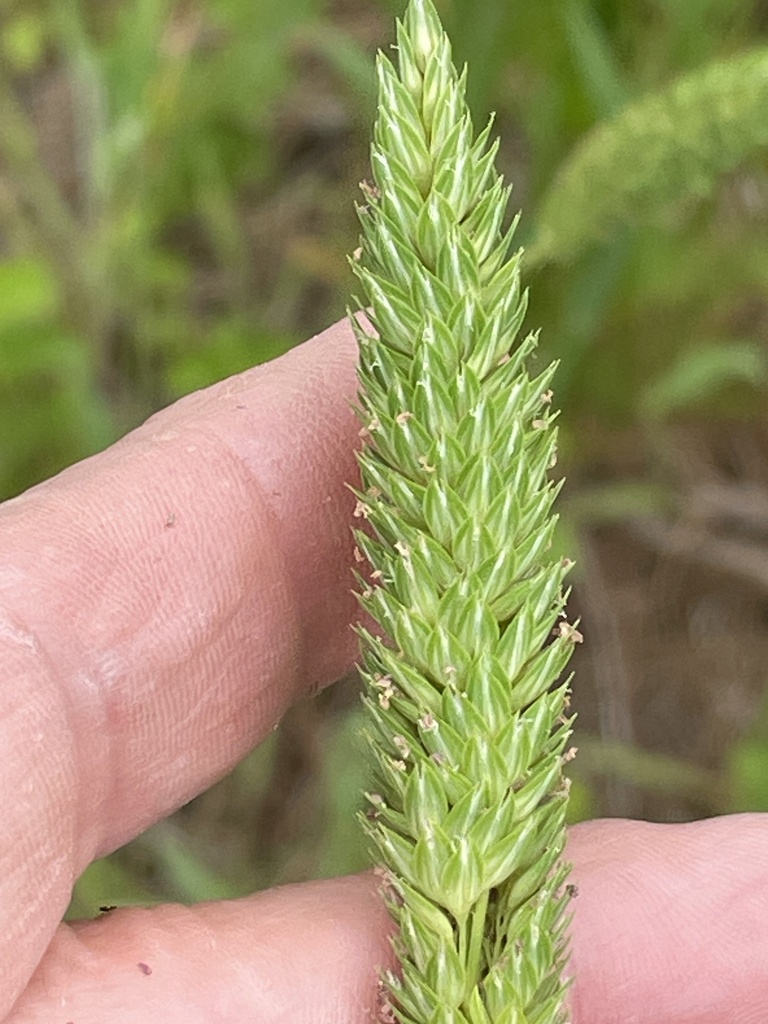
Phalaris caroliniana, Carolina Canarygrass, also called maygrass, is a native cool-season annual grass of the southern United States. It sprouts in fall or winter, grows quickly through the mild months, and in spring sends up stems 1 to 5 feet tall topped with dense, bristly, egg-shaped to cylindrical seed heads that are striped green and white when fresh and ripen to straw-tan. By early summer the plants have shed their seed and died, which is why it is “maygrass” across much of the South.
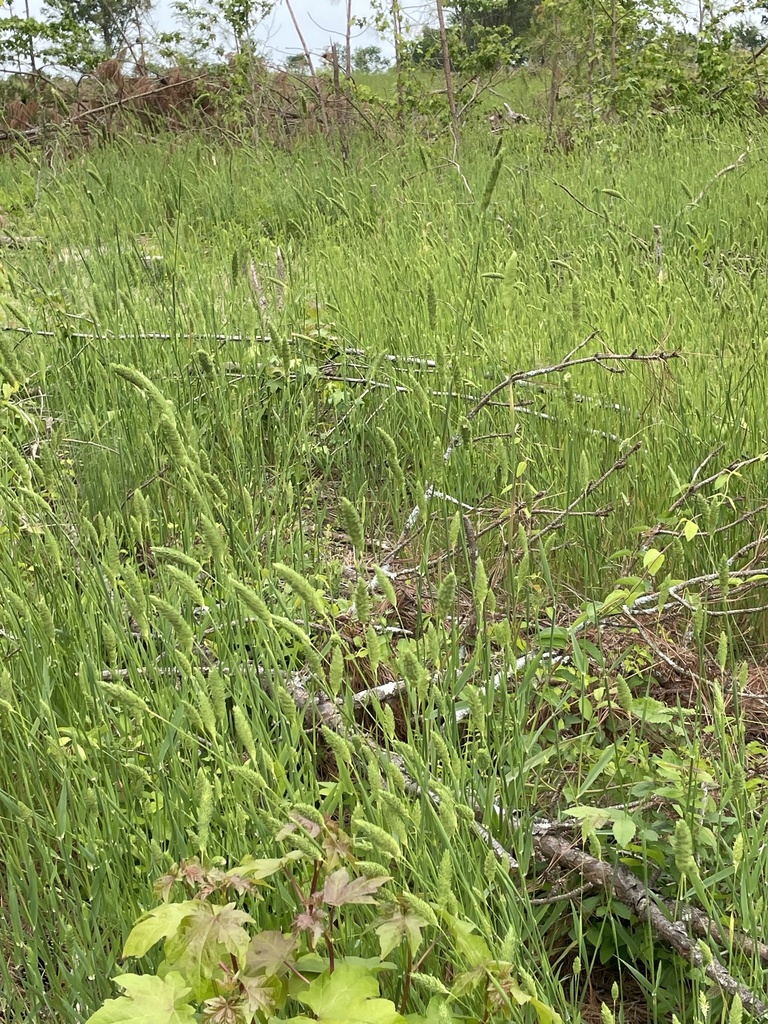
It is a member of the grass family (Poaceae) and a close relative of the canary seed grass of the birdseed trade (Phalaris canariensis) and of reed canarygrass (Phalaris arundinacea), an aggressive wetland grass. Carolina canarygrass behaves very differently from the latter: it is a short-lived annual that grows in moist meadows, creek banks, floodplains, ditches, pastures and roadsides, usually where the ground has been disturbed.
Carolina canarygrass is also one of the most interesting plants in North American archaeology. Its seeds are found in large quantities at prehistoric sites across the Midwest and Southeast, often far outside its present natural range, and archaeologists count maygrass among the crops of the Eastern Agricultural Complex, the native seed crops that Indigenous farmers grew long before maize became important. This guide covers how to identify it, where it grows, how to grow it, and its value to wildlife.
Identification
Carolina canarygrass is easiest to recognize in spring, when its compact, pale, bristly seed heads stand above a loose clump of bright green leaves. In winter it is only a low tuft of leaves that is easy to overlook among other cool-season grasses.
Growth Habit
This is an annual that grows from fibrous roots, with one to many smooth, upright to bent stems arising from the base. Small plants on dry, poor soil may be only 8 to 12 inches tall; plants on rich, moist soil reach 3 feet and occasionally about 5 feet.
Leaves
The flat leaf blades are smooth, shiny bright green, usually 2 to 6 inches long (occasionally longer) and up to about ⅜ inch wide, tapering to a fine point. At the junction of blade and sheath there is a conspicuous membranous ligule, about ⅛ to ¼ inch long and often ragged at the tip. The upper leaf sheaths are often slightly inflated.
Seed Heads
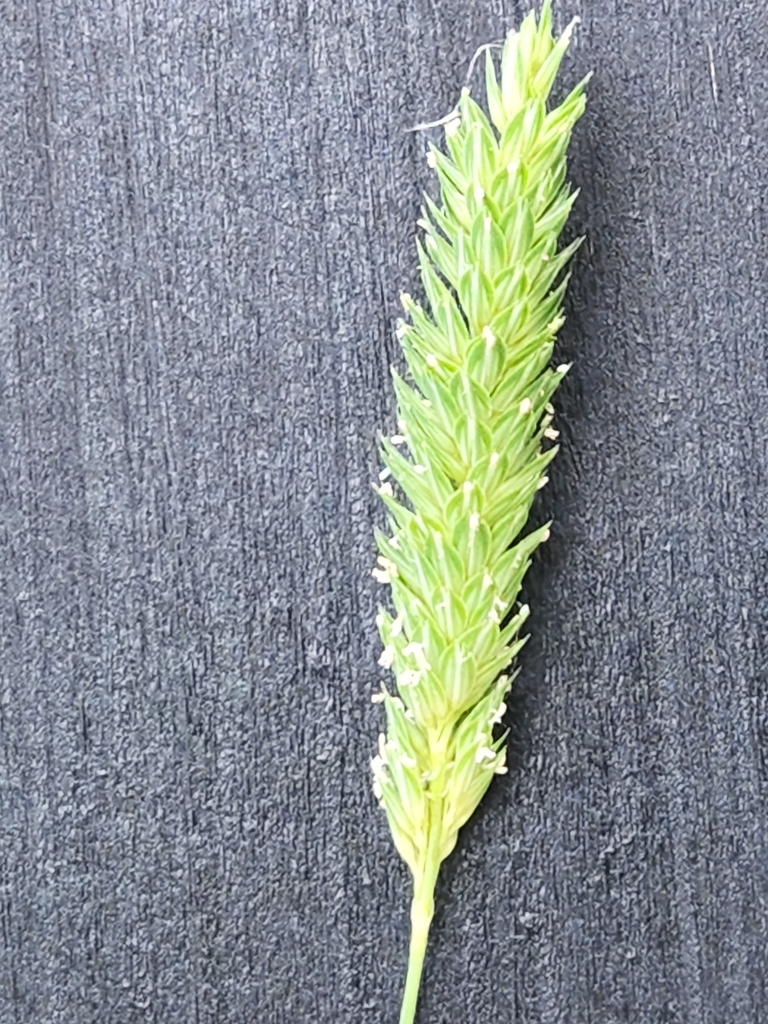
The panicle is dense and spike-like, ovoid to short-cylindrical, about ½ to 3 inches long and less than an inch wide, with the branches hidden. Each spikelet has two broad, keeled glumes with a green wing near the tip, which gives the fresh head its green-and-white striped look. Inside are two tiny sterile florets and one fertile floret, which ripens into a shiny, hairy, brown seed about ⅛ inch long. Heads appear from about March in south Texas and Florida to May or June farther north.
Similar Species
Reed canarygrass is a tall, rhizomatous perennial with an open, branched panicle, not a compact head. Canary seed grass (P. canariensis), a European annual that sprouts from spilled birdseed, has a broader, more strongly variegated head with larger glumes. Little barley (Hordeum pusillum), which grows in the same places at the same time, has a narrow spike with long bristly awns.
Quick Facts
| Scientific Name | Phalaris caroliniana |
| Family | Poaceae (grass family) |
| Plant Type | Cool-season annual grass |
| Mature Height | 1–3 ft (occasionally to 5 ft) |
| Mature Spread | 6–12 in |
| Growth Rate | Fast |
| Sun Exposure | Full sun to part shade |
| Water Needs | Medium to high; moist soils, tolerates periodic flooding |
| Soil Type | Loam, clay and alluvial soils; tolerates disturbed ground |
| Soil pH | About 5.5–8.0 |
| Bloom Time | March–June (seed heads in spring) |
| Flower Color | Green and white, ripening straw-tan |
| Fall Color | None; plants die after seeding in early summer |
| Fruit | Small, shiny, hairy brown grain |
| Deer Resistant | No; young growth is grazed |
| USDA Hardiness Zones | Annual; sprouts in fall in zones 6–10 |
Native Range
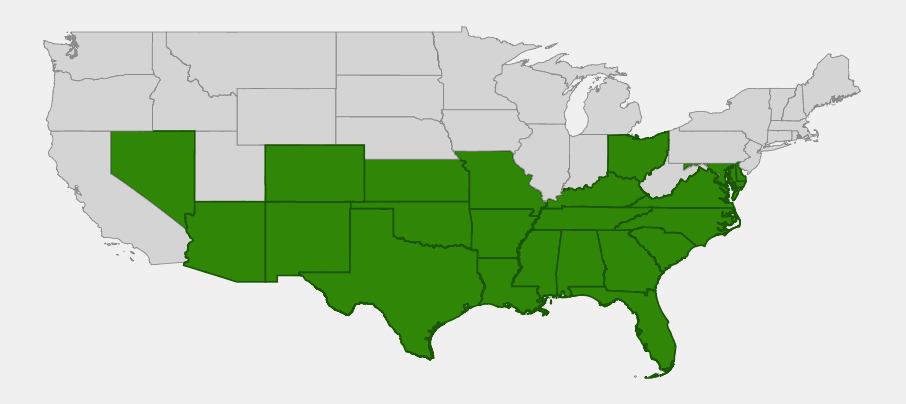
Carolina canarygrass is native across the southern half of the United States. USDA PLANTS records it from the Southeast and the southern Midwest, from Florida and the Carolinas north to Virginia, Maryland and Delaware and west through Kentucky, Tennessee, Ohio, Missouri, Kansas, Oklahoma and Texas. In the Southwest it grows in Arizona and New Mexico, with outlying records in Colorado and Nevada. It also extends south into Mexico.
Records from California and Oregon are generally treated as naturalized introductions rather than part of the native range, and the grass has also spread to Europe, Australia and South America. Because Indigenous farmers once cultivated maygrass, botanists and archaeologists have long debated how far its range was shaped by people. Some northern populations may descend from ancient cultivation, which makes the edges of its native range hard to draw precisely.
It is most common in Texas, Oklahoma and the Gulf and Atlantic coastal states, where it can be abundant in moist pastures, roadside ditches, floodplains and creek bottoms. It favors moist, fairly fertile soils that are disturbed often enough to keep perennial grasses from taking over.
📋 Regional plant lists featuring Carolina Canarygrass: North & South Florida · Alabama, Georgia & Mississippi · North & South Carolina · Maryland, Virginia & West Virginia · Kentucky & Tennessee · Arkansas, Louisiana, Eastern Oklahoma & Eastern Texas · South & West Texas · Illinois, Iowa & Missouri · Ohio & Indiana · Nebraska, Kansas & Eastern Colorado · Delaware, Southern New Jersey & Long Island · Arizona & New Mexico · California & Nevada
Growing & Care Guide
Carolina canarygrass is rarely sold as an ornamental, but it is easy to grow from seed and is of growing interest to native seed-crop enthusiasts, archaeobotanists and restoration practitioners. Treat it like a winter annual: sow in fall, let it grow through winter and spring, and allow it to drop seed before it dies back in early summer.
Light
Full sun gives the strongest growth and heaviest seed set. It tolerates light shade along woodland edges and creek bottoms.
Soil & Water
It does best in moist, moderately fertile loam or clay that stays damp through winter and spring, and it tolerates brief flooding. Because it completes its life cycle before the heat of summer, it does not need summer water. On very dry, poor soil plants stay small.
Planting Tips
Sow seed in fall, from September to November depending on climate, on lightly worked soil, and rake it in to about ¼ inch deep. Seed sprouts with fall rains and cool temperatures. Sow thinly in a bed or drift; plants fill in quickly in spring.
Pruning & Maintenance
No pruning is needed. Let the heads ripen and shatter if you want it to reseed, then pull or mow the dead stems in summer. In a meadow it reseeds into open patches but gives way to perennial grasses as they close in.
Propagation
By seed only. Harvest heads when they turn straw-colored in late spring, dry them, and store the seed cool and dry until fall sowing. Like many winter annuals, it waits for the cool, moist conditions of fall to sprout.
Landscape Uses
- Native seed crop and heritage gardens: a living example of the Eastern Agricultural Complex alongside goosefoot, erect knotweed and little barley
- Wet meadows and floodplain restoration: a fast annual cover for bare, moist soil in its native range while perennials establish
- Wildlife food plots: cool-season green growth and spring seed for birds and grazing animals
- Educational gardens: pairs well with exhibits on Indigenous agriculture and archaeology
Wildlife & Ecological Value
As a cool-season annual, Carolina canarygrass provides green forage in winter and early spring, when few other plants are growing, and a burst of seed in late spring.
For Pollinators
Like most grasses it is wind-pollinated and offers little to bees. It is a larval host for some grass-feeding insects, and its winter growth shelters ground-dwelling insects and spiders.
For Birds
Sparrows, buntings, doves, quail and other seed-eating birds eat the ripe grain in late spring and early summer, and the plants provide cover for ground-nesting birds in moist meadows.
For Mammals
Deer, rabbits, rodents and livestock graze the tender winter and spring growth. Several Phalaris species contain tryptamine alkaloids that can cause “phalaris staggers,” a nervous disorder of grazing livestock, so as a precaution ranchers should avoid letting animals graze heavy, nearly pure stands.
Ecosystem Role
Carolina canarygrass is an opportunist of moist, disturbed ground. It covers bare soil during the wet season, reduces erosion along ditches and creek banks, and then yields space to warm-season plants in summer. Its seed bank lets it reappear wherever floods, grazing or mowing open the ground.
Cultural & Historical Uses
Maygrass is one of the “lost crops” of eastern North America. Seeds have been recovered in quantity from rock shelters, village sites and storage pits across the Midwest and Southeast, from Texas to Indiana and Alabama, some of them roughly 3,000 to 4,000 years old. Many of these sites lie outside the plant’s natural range, which suggests that people carried and planted it. Together with goosefoot, erect knotweed, little barley, sumpweed and sunflower, it formed part of the Eastern Agricultural Complex.
The spring-ripening grain was a valuable early harvest, available months before other seed crops matured. It was probably parched and ground for porridge or flatbreads. Laboratory analyses of maygrass seed show that it is nutritious, with useful amounts of vitamins and minerals. The Wildflower Center notes that the seeds were reputedly eaten by Indigenous peoples of eastern North America before maize arrived.
Today maygrass is grown experimentally by archaeologists and seed savers who are trying to understand how these early crops were domesticated. The species was named by the South Carolina botanist Thomas Walter in his Flora Caroliniana (1788), which is the source of both the scientific and common names.
Frequently Asked Questions
Is Carolina canarygrass invasive?
No. It is a native annual in the southern United States. It can be abundant in moist pastures and roadsides, but it does not spread by rhizomes and fades out as perennial vegetation closes in. Do not confuse it with reed canarygrass (Phalaris arundinacea), an aggressive rhizomatous perennial of wetlands.
Why is it called maygrass?
In much of the South its seed heads ripen in May, when it is one of the most conspicuous grasses along roadsides and in moist fields. After shedding seed, the plants die in early summer.
Can you eat maygrass seed?
Indigenous farmers grew and ate it for thousands of years, and the seed is nutritious. However, related Phalaris species contain alkaloids, the seeds are tiny and hard to clean, and wild plants along roads may be contaminated, so treat it as a historical crop rather than a foraging food.
Is Carolina canarygrass native in California?
Most authorities treat California and Oregon populations as naturalized introductions. Its native range is the southern United States from the Atlantic Coast to Arizona and New Mexico, plus Mexico.
When should I sow Carolina canarygrass?
Sow in fall. The seed germinates with cool fall rains, the plants grow through winter, and the heads ripen in spring. Spring-sown seed usually produces weak plants that flower and die quickly in the heat.

Looking for a nursery that carries Carolina Canarygrass?
Browse our native plant nursery directory: Alabama, Arizona & Arkansas · Colorado, Delaware, Florida & Georgia · Kansas · Kentucky, Louisiana, Maryland, Mississippi & Missouri · Nevada, New Mexico, North Carolina, Ohio & Oklahoma · South Carolina, Tennessee, Texas & Virginia

