
Sea Milkwort (Glaux maritima)
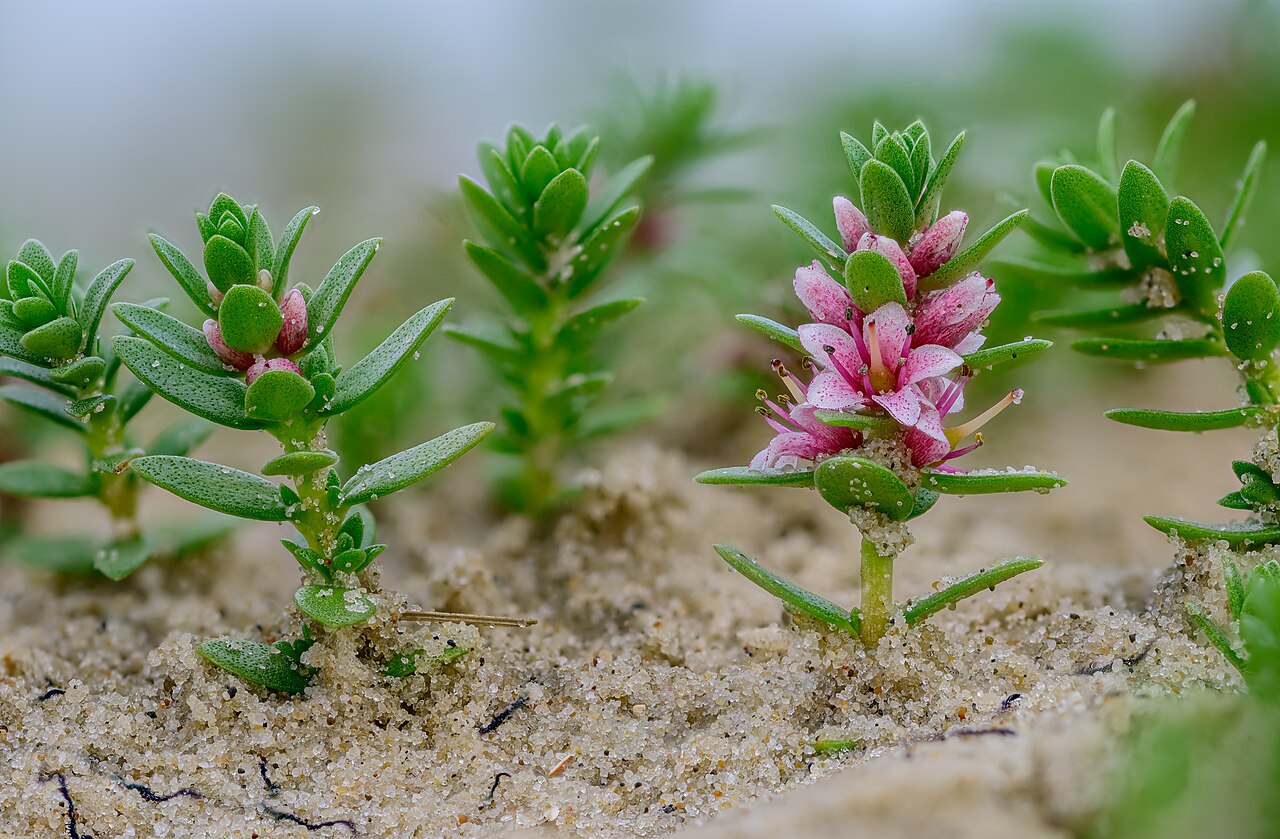
Glaux maritima, known as Sea Milkwort and now often called Lysimachia maritima, is a small, fleshy perennial of salt marshes and salty ground. It grows 2 to 12 inches tall from creeping rhizomes, with paired, succulent, blue-green leaves crowded along the stems, and from late spring to summer it bears tiny pink to white flowers tucked singly into the leaf axils. It is a member of the primrose family (Primulaceae).
For a long time sea milkwort was the only species in the genus Glaux. DNA studies showed that it belongs among the loosestrifes, and many botanists and floras now place it in Lysimachia as Lysimachia maritima, the name used by NatureServe and iNaturalist. USDA PLANTS still lists it as Glaux maritima. Despite its name, it is not related to the milkworts (Polygala) or milkweeds.
Sea milkwort grows on coasts around the Northern Hemisphere, but in North America it is just as much an inland plant: it is common on alkaline and saline flats, lakeshores and wet meadows of the West and northern Plains. It is a plant to recognize in salt marshes and alkali flats rather than a common garden plant.
Identification
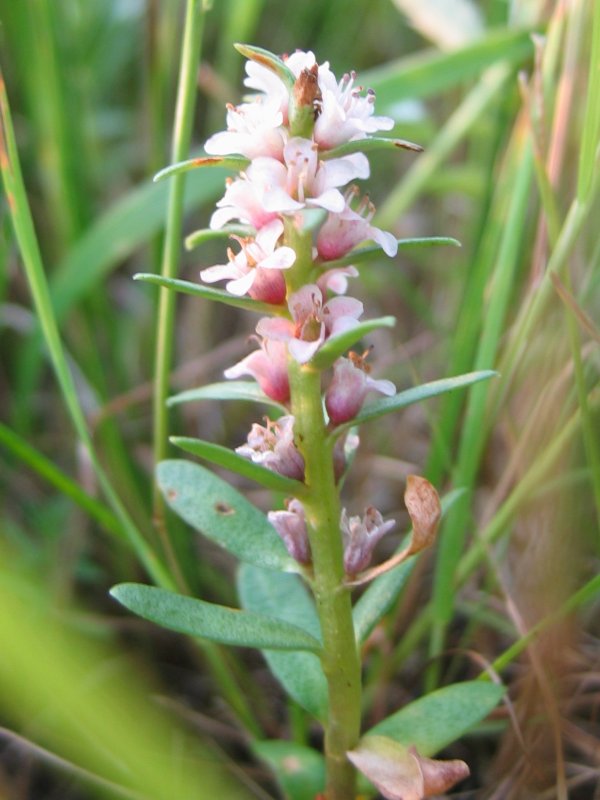
Look for a low, fleshy plant with crowded, paired, stalkless, blue-green leaves and tiny pink or white cup-shaped flowers in the leaf axils, on salty or alkaline wet ground.
Growth Habit
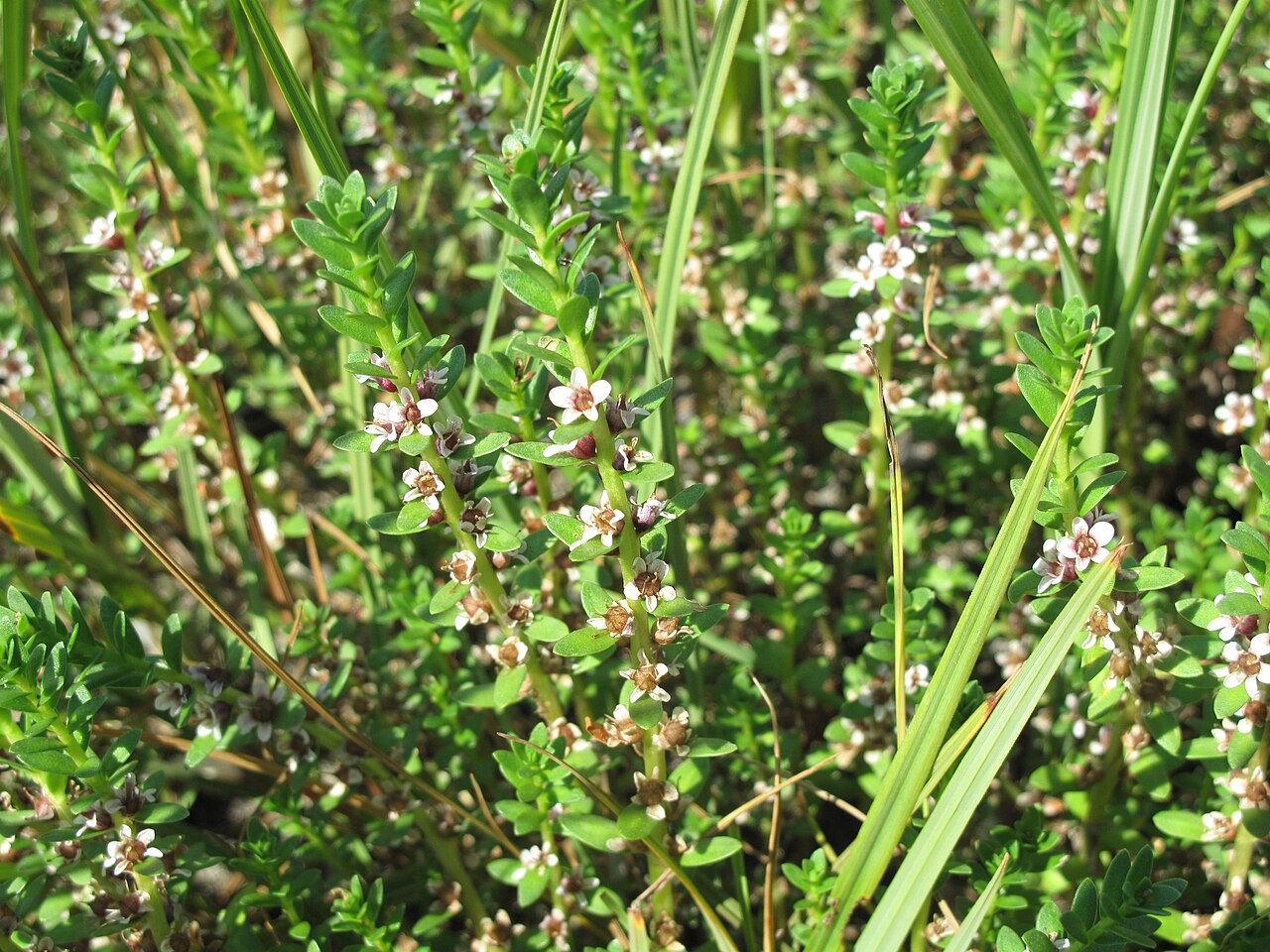
Sea milkwort is a small, hairless perennial that spreads by slender rhizomes and often forms patches or low carpets. Its stems are erect or sprawling, simple or branched, 2 to 12 inches tall, and thickly leafy.
Leaves
The leaves are opposite (sometimes alternate near the top), stalkless, oblong to narrowly oval, about 1/4 to 3/4 inch long, thick and succulent, and smooth-edged. They are often blue-green or gray-green and closely set along the stems.
Flowers
The flowers sit singly in the axils of the middle and upper leaves, on very short stalks. Each is about 1/4 inch across and has no petals: what looks like a corolla is a five-lobed calyx, white, pink or purplish, often darker in the center. Five stamens alternate with the calyx lobes. It blooms from about May to August.
Fruit & Seeds
The fruit is a small, round capsule about 1/8 inch across that splits open at the top into five parts, releasing a few small seeds. Plants also spread by their rhizomes.
Look-alikes
When not in flower, sea milkwort can resemble small chickweeds or sandworts, which have true white petals and rarely grow on salty ground. Glassworts (Salicornia) are also succulent salt-marsh plants but have jointed, leafless-looking stems. Sea plantain has long, narrow basal leaves and flower spikes. Sea milkwort’s crowded, paired, fleshy leaves with tiny pink flowers in the axils are distinctive.
Quick Facts
| Scientific Name | Glaux maritima (syn. Lysimachia maritima) |
| Family | Primulaceae (primrose family) |
| Plant Type | Low, succulent herbaceous perennial; spreads by rhizomes |
| Mature Height | 2–12 in |
| Mature Spread | 6–12 in; patch-forming |
| Growth Rate | Moderate |
| Sun Exposure | Full sun |
| Water Needs | High; moist to wet |
| Soil Type | Saline or alkaline sand, silt, clay or mud |
| Soil pH | Neutral to strongly alkaline (about 7.0–9.0) |
| Bloom Time | May–August |
| Flower Color | White, pink or purplish (sepals) |
| Fall Color | None notable |
| Fruit | Small round capsule |
| Deer Resistant | Unknown; low and seldom noticed |
| USDA Hardiness Zones | 2–8 |
Native Range
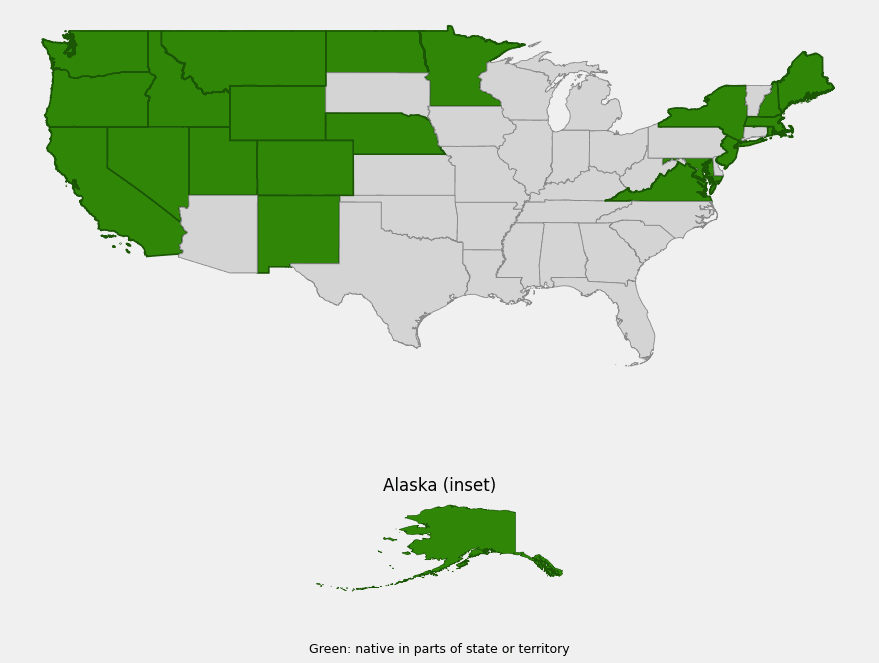
Sea milkwort is circumboreal, growing on coasts and salty inland ground across Europe, Asia and North America. In North America it ranges across Canada, from Newfoundland, the Maritimes and Quebec to British Columbia, Yukon and Nunavut, and through Alaska, along both coasts and inland.
USDA PLANTS lists it as native in Alaska and in Washington, Oregon, California, Nevada, Idaho, Montana, Wyoming, Utah, Colorado, New Mexico, North Dakota, Nebraska, Minnesota, New York, New Jersey, Maryland, Virginia, Massachusetts, Rhode Island, New Hampshire and Maine. In the West and northern Plains it is fairly common on alkaline flats. On the Atlantic coast it is common in Maine salt marshes but becomes rare southward: NatureServe considers it extirpated in New Jersey, known only historically in Rhode Island and Maryland, and of uncertain status in Virginia, so the southern Atlantic records are outlying ones. It is rare (S1) in Minnesota and Nebraska, at the eastern edge of its inland range.
Along the coasts it grows in salt and brackish marshes, on muddy and sandy shores and on the upper edges of beaches. Inland it grows on alkaline and saline flats, around salty lakes and playas, in wet alkaline meadows, near hot springs and along streams in sagebrush country.
📋 Regional plant lists featuring Sea Milkwort: Alaska · California & Nevada · Idaho, Eastern Oregon & Eastern Washington · Western Oregon & Western Washington · Montana & Wyoming · Utah & Western Colorado · Nebraska, Kansas & Eastern Colorado · North Dakota, South Dakota & Western Minnesota · Michigan, Wisconsin & Eastern Minnesota · New York, Pennsylvania & Northern New Jersey · Delaware, Southern New Jersey & Long Island · Maryland, Virginia & West Virginia · Connecticut, Massachusetts & Rhode Island · New Hampshire, Maine & Vermont
Growing & Care Guide
Sea milkwort is rarely sold, but it can be grown as a low groundcover where few other plants will thrive: in salty, alkaline or poorly drained ground, such as a coastal garden, the edge of a salt-affected lawn or a wet, alkaline swale. Grow it from seed or divisions from cultivated plants; never dig wild plants, which are rare in several eastern states.
Light
Full sun. It grows in open marshes and flats and does poorly in shade.
Soil & Water
Moist to wet, alkaline or salty soil of almost any texture, from sand to clay and mud. It tolerates salt spray, occasional tidal flooding and high soil salinity. It does not need salt and will grow in ordinary moist soil, but there it is easily crowded out by taller plants.
Planting Tips
Plant it in a moist, open spot where its low patches won’t be shaded, such as along a path in a coastal garden, around a pond with alkaline water, or in a bioswale that collects road salt. Pair it with salt-tolerant natives such as saltgrass and Baltic rush.
Pruning & Maintenance
No pruning is needed. Keep it moist and weed out taller competitors. It dies back to the ground in winter and regrows in spring from its rhizomes.
Propagation
Divide rhizome clumps in spring, or sow seed in fall or after a few weeks of cold, moist stratification, on the surface of moist soil.
Landscape Uses
- Coastal gardens: a low, salt-tolerant groundcover near the shore
- Salt-affected sites: for roadside swales and soils with road salt or natural alkalinity
- Wetland restoration: part of salt-marsh and alkaline wet-meadow plantings
- Nature study: a distinctive plant to look for on salt marshes and alkali flats
Wildlife & Ecological Value
Sea milkwort is a small but widespread member of salt-marsh and alkali-flat plant communities, places with harsh conditions where only salt-tolerant plants can live.
For Pollinators
Its tiny flowers are visited by small bees and flies, and it is thought to self-pollinate as well. It is not a major nectar plant.
For Birds
Waterfowl and shorebirds feed in the marshes and flats where it grows, and geese may graze it. Its seeds are too few to be an important food.
For Mammals
Livestock and wild grazers eat it along with other plants of saline meadows; it is not toxic but is too small to matter much as forage.
Ecosystem Role
Its creeping rhizomes help bind muddy and sandy soils on shores and flats. As one of relatively few plants tolerant of both salt and alkalinity, it helps cover and stabilize ground where little else grows.
Cultural & Historical Uses
The old genus name Glaux comes from the Greek glaukos, bluish-green, from the color of its leaves. The common name milkwort reflects an old European belief that it increased milk in nursing mothers or livestock, the same belief behind the name of the unrelated milkworts (Polygala).
The move from Glaux to Lysimachia came from DNA studies in the 2000s showing that several small genera, including Glaux, Anagallis (pimpernels) and Trientalis (starflowers), are nested within the loosestrifes. Not all botanists accept the merger, so both names are widely used.
It is one of the few flowering plants that grows on both seacoasts and in the salty basins of the interior West, a pattern shared with plants such as saltgrass and common arrowgrass.
Frequently Asked Questions
Is sea milkwort Glaux maritima or Lysimachia maritima?
Both names refer to the same plant. USDA PLANTS uses Glaux maritima; NatureServe, iNaturalist and many newer floras use Lysimachia maritima after DNA studies placed it among the loosestrifes.
Is sea milkwort a milkweed or a milkwort?
Neither. It is in the primrose family. The name comes from an old belief that it increased milk production.
Where does sea milkwort grow?
On salt marshes and shores of the Atlantic and Pacific coasts and on alkaline flats, salty lakeshores and wet meadows inland, from Alaska to the Great Basin and northern Plains.
Does sea milkwort have petals?
No. Its tiny pink or white flowers are made of five colored sepals; there are no petals.
Can I grow sea milkwort?
Yes, in moist, sunny, salty or alkaline soil where taller plants won’t crowd it out. It is rarely sold, so start it from seed or divisions, and never dig wild plants.

Looking for a nursery that carries Sea Milkwort?
Browse our native plant nursery directory: Alaska · California · Colorado · Idaho · Maine, Maryland, Massachusetts, Minnesota & Montana · Nebraska, Nevada, New Hampshire, New Jersey, New Mexico, New York & North Dakota · Oregon · Rhode Island, Utah & Virginia · Washington · Wyoming

