
Awl-leaf Arrowhead (Sagittaria subulata)
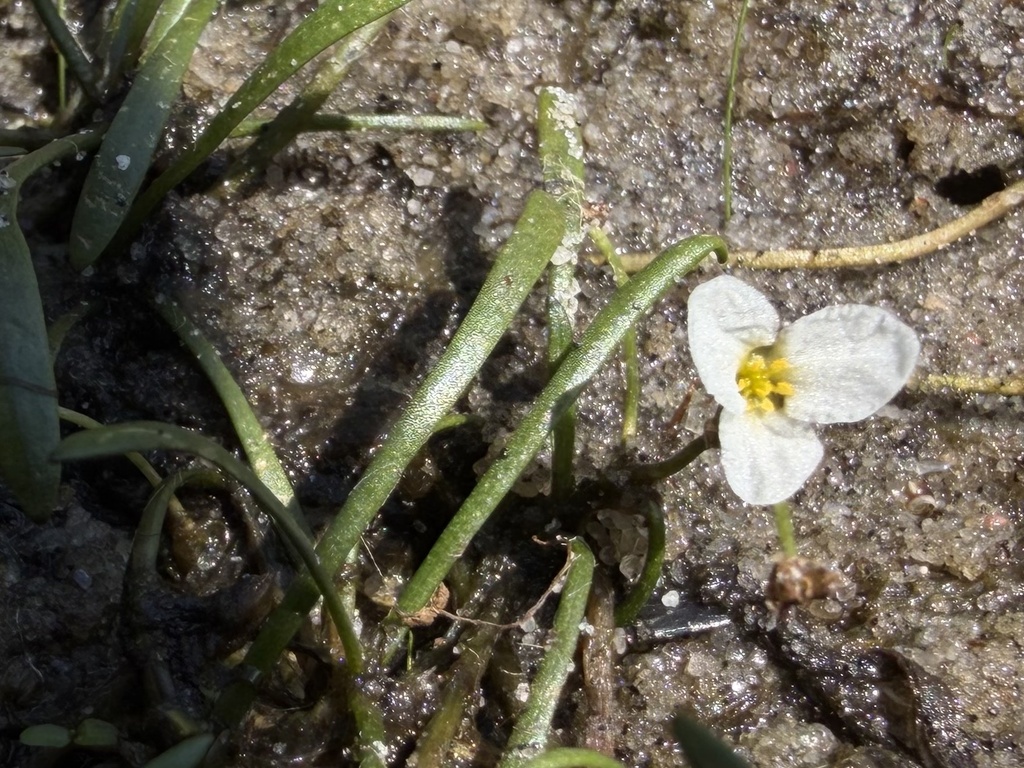
Sagittaria subulata, known as Awl-leaf Arrowhead, narrow-leaved arrowhead or, in the aquarium trade, dwarf sagittaria, is a small aquatic perennial native to the Atlantic and Gulf coasts of the United States. In the wild it grows in shallow fresh and brackish water: tidal mudflats, estuaries, river shores and coastal plain streams. It spreads by runners into carpets of narrow, grass-like leaves, and in summer and fall it opens small white flowers with three rounded petals that float at or just above the water surface.
Unlike its big relatives such as Duck Potato, awl-leaf arrowhead almost never makes arrow-shaped leaves. Its leaves are mostly narrow straps or awl-shaped (tapering, like the shoemaker’s tool), which gives the species its common and scientific names (subulatus means awl-shaped). That compact, grassy habit is also what made it one of the most popular plants in freshwater aquariums worldwide, where it is used as a hardy, easy carpeting plant.
Many aquarists don’t realize that dwarf sagittaria is a native American wildflower, and a rare one in some states. This guide covers how to identify it, where it grows in the wild, how to grow it in ponds and aquariums, and its role in tidal wetlands.
Identification
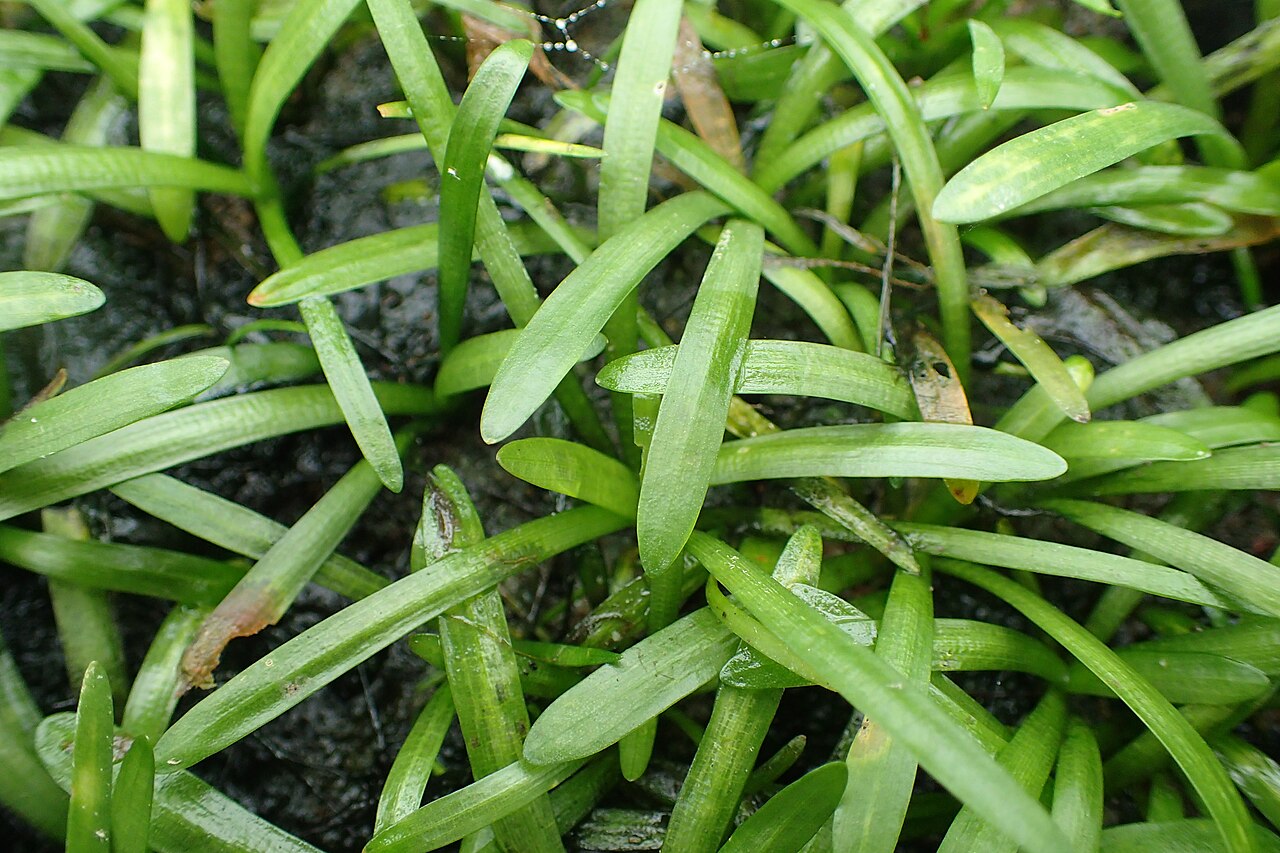
Awl-leaf arrowhead is variable. Its size and leaf shape change with water depth, current and tidal exposure, so plants growing a few yards apart can look quite different. The white three-petaled flowers and the runners connecting rosettes are the most reliable clues.
Leaves
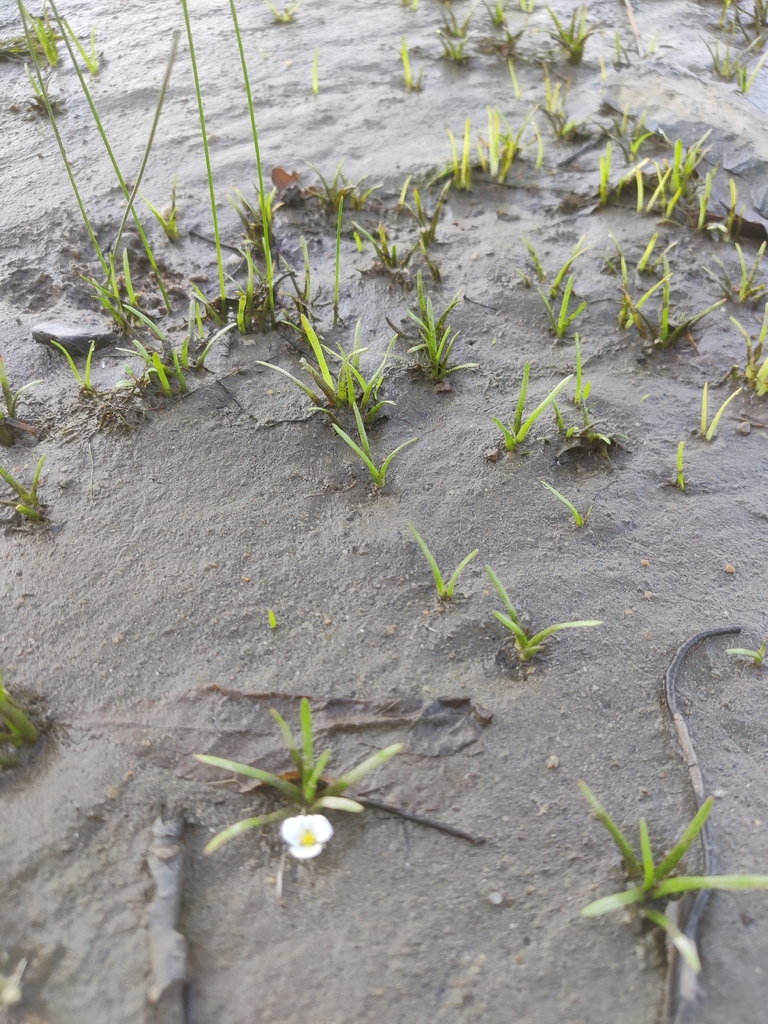
The leaves grow in basal rosettes. Most are linear, flattened or slightly thickened straps without a distinct blade, often called phyllodes. On exposed mudflats and in aquariums they are short, about 1 to 4 inches long. In deeper or flowing water they can grow into ribbons a foot or more long that wave in the current. Occasionally a plant produces a few small, elliptic floating blades at the tips of long stalks, but true arrowhead-shaped leaves are very rare.
Runners & Roots
Plants spread by slender stolons (runners) that root and form new rosettes a few inches away. Over time a single plant can become a dense mat covering several square feet of mud or gravel. The roots are fine and fibrous.
Flowers
Flowering runs from June into November. A slender stalk carries a few whorls of flowers at or just above the water. The lowest flowers are female, on stalks that curve downward after flowering, and the upper flowers are male. Each flower is about a half inch to three-quarters of an inch across, with three white petals, three small green sepals and a yellow-green center of stamens or pistils.
Fruit
Female flowers develop into small, round heads of flattened achenes, each with a tiny beak. The achenes float and are spread by water. Plants also spread widely by fragments and runners carried on tides and currents.
Similar Species
Grass-leaved arrowhead (Sagittaria graminea) is larger, with longer leaves that often develop narrow blades. Tapegrass or eelgrass (Vallisneria americana) has long ribbon leaves but no white three-petaled flowers. Young spikerushes and other grass-like plants on mudflats lack the rosette of flattened leaves.
Quick Facts
| Scientific Name | Sagittaria subulata (L.) Buchenau |
| Family | Alismataceae (water-plantain family) |
| Plant Type | Aquatic herbaceous perennial; carpet-forming by runners |
| Mature Height | 1–6 in when emersed or in aquariums; leaves to 12 in or more in flowing water |
| Mature Spread | Spreads indefinitely by runners into mats |
| Growth Rate | Moderate to fast |
| Sun Exposure | Full sun to part shade; low to moderate light in aquariums |
| Water Needs | Aquatic; shallow water to saturated mud |
| Soil Type | Sand, silt and mud of tidal flats, shores and stream beds |
| Soil pH | About 6.0–7.5 |
| Bloom Time | June–November |
| Flower Color | White with a yellow-green center |
| Fall Color | None; often semi-evergreen underwater |
| Fruit | Small round head of flattened, beaked achenes |
| Deer Resistant | Yes |
| USDA Hardiness Zones | 6–10 |
Native Range
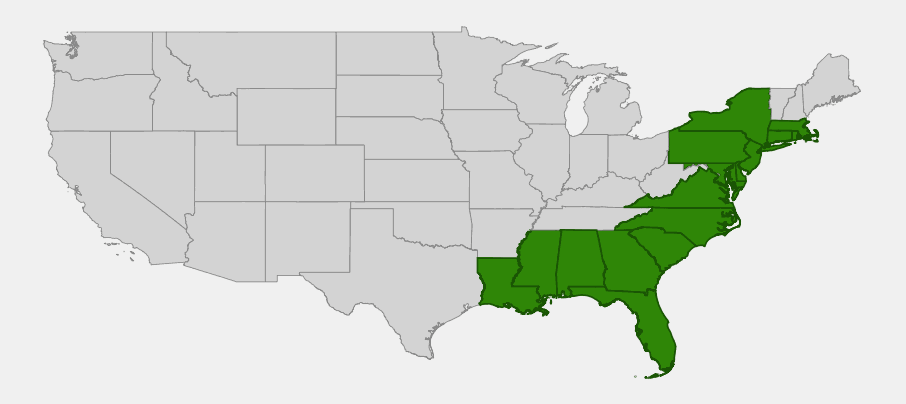
Awl-leaf arrowhead is a coastal species in the United States. USDA PLANTS records it from Massachusetts and Rhode Island south along the Atlantic coast to Florida and west along the Gulf Coast to Mississippi and Louisiana, as well as the District of Columbia. It is especially characteristic of freshwater tidal reaches of large rivers, such as the Hudson, Delaware, Potomac and the rivers of the Chesapeake Bay, where it grows on mudflats exposed at low tide.
Farther south it also grows in clear, sandy coastal plain streams, springs and pond margins, where it is often permanently submerged. Outside the United States it is native in Colombia and Venezuela. USDA also lists a Washington record, but the species is not native there; like populations in the Azores and on Java, it probably came from aquarium or pond releases, so this page leaves it off the native range.
Because it depends on clean, shallow water and natural tidal flats, awl-leaf arrowhead has declined where shorelines have been filled, bulkheaded or polluted. It is listed as endangered in Massachusetts, special concern in Connecticut and rare in Pennsylvania, and it is considered historical in Rhode Island.
📋 Regional plant lists featuring Awl-leaf Arrowhead: Connecticut, Massachusetts & Rhode Island · New Hampshire, Maine & Vermont · New York, Pennsylvania & Northern New Jersey · Delaware, Southern New Jersey & Long Island · Maryland, Virginia & West Virginia · North & South Carolina · Alabama, Georgia & Mississippi · North & South Florida · Arkansas, Louisiana, Eastern Oklahoma & Eastern Texas
Growing & Care Guide
Dwarf sagittaria is easy to grow, whether in an aquarium, a container water garden or the shallow edge of a pond. Aquarium plants are nursery-grown, so they are a good, legal source. Never collect plants from wild populations, particularly in the northern states where it is rare, and never release aquarium plants into natural waters outside its native range.
Light
Outdoors, give it full sun to part shade in shallow water. In aquariums it grows under low to moderate light, though stronger light keeps it short and compact and helps it carpet. In dim tanks the leaves grow taller and thinner.
Soil & Water
In ponds, plant it in sand or loamy soil under 1 to 12 inches of water, or on wet mud at the margin. In aquariums, use sand or fine gravel at least 2 inches deep, ideally with a nutrient-rich layer or root tabs, because the plant feeds mostly through its roots. It tolerates a wide range of water conditions, from soft to moderately hard water, temperatures from about 60 to 82°F, and a little salt. Extra carbon dioxide is helpful in aquariums but not required.
Planting Tips
Separate plantlets and push each into the substrate up to the base of the leaves, spacing them about an inch apart. They will send out runners and fill in. In outdoor ponds, use containers of sandy loam set in shallow water if you want to keep the plant in one place.
Pruning & Maintenance
Little care is needed. To keep a tidy carpet, pull out runners that wander where they are not wanted. Remove yellowing leaves occasionally. In cold climates, sink outdoor containers below the ice line or overwinter a few plants indoors in a tank or bucket.
Propagation
Propagation is easy. Cut the runners and replant the young rosettes once they have a few leaves and roots. In the wild, plants also spread by seed and by fragments carried on the tide.
Landscape Uses
- Aquariums: a hardy, low-maintenance carpeting or foreground plant known as dwarf sagittaria
- Water gardens: a low, grassy edging plant for shallow pond margins and container ponds
- Tidal wetland restoration: native carpet-former for freshwater tidal flats within its range
- Shoreline stabilization: dense mats help hold fine sediment on shores and flats
- Fish habitat: cover for small fish and invertebrates in shallow water
Wildlife & Ecological Value
On tidal mudflats and stream bottoms, carpets of awl-leaf arrowhead play a quiet but important role.
For Pollinators
The small white flowers are visited by small bees, flies and other insects at the water surface, which move pollen from male to female flowers. Plants also spread widely without seed.
For Birds
Ducks and other waterfowl feed on the leaves, seeds and underground parts of arrowheads, and shorebirds and wading birds forage for invertebrates among the mats on exposed mudflats.
For Mammals
Muskrats and beavers eat arrowheads and other aquatic plants, though awl-leaf arrowhead is small and less important than the larger species.
Ecosystem Role
Dense mats slow currents, trap fine sediment and reduce erosion on tidal flats and stream beds. They shelter young fish, snails, aquatic insects and other invertebrates, which in turn feed fish and birds. The plants also take up nutrients from the water and add oxygen during the day.
Cultural & Historical Uses
The genus name Sagittaria comes from the Latin sagitta, arrow, after the arrowhead-shaped leaves of the larger species. Several of those species, especially duck potato, have starchy tubers that were an important food for many Indigenous peoples of North America. Awl-leaf arrowhead is too small to have been a food plant.
Linnaeus first described this plant in the 18th century, placing it in a different genus, and it was moved to Sagittaria by the German botanist Franz Buchenau in the 19th century. Its scientific name and appearance have caused confusion in the aquarium trade, where several similar small Sagittaria have been sold under the same name.
Dwarf sagittaria became a staple of the freshwater aquarium hobby in the 20th century because it is nearly indestructible, tolerates a wide range of water chemistry and spreads quickly. Today it is grown commercially in Asia, Europe and the United States, and it is one of the most widely kept native American aquatic plants in the world.
Frequently Asked Questions
Is dwarf sagittaria native to the United States?
Yes. Dwarf sagittaria (Sagittaria subulata), also called awl-leaf arrowhead, is native to the Atlantic and Gulf coasts from Massachusetts to Louisiana, as well as Colombia and Venezuela.
Is dwarf sagittaria easy to grow in an aquarium?
Yes. It tolerates low to moderate light, a wide range of temperatures and water hardness, and it doesn’t need added carbon dioxide. A nutrient-rich substrate or root tabs help it spread into a carpet.
Why is my dwarf sagittaria growing tall instead of carpeting?
Low light usually makes it stretch upward. Brighter lighting, a nutrient-rich substrate and trimming tall leaves encourage short, spreading growth. Plants grown emersed at the nursery may also take a few weeks to adjust.
Does awl-leaf arrowhead flower?
Yes. In ponds, tidal flats and open-top aquariums it produces small white flowers with three petals at or above the water surface, mainly from early summer to fall.
Can I plant dwarf sagittaria in a natural pond?
Only within its native range, and only with nursery-grown plants. Never release aquarium plants into lakes or streams. Outside its native range it can escape, and it has naturalized in places such as the Azores.

Looking for a nursery that carries Awl-leaf Arrowhead?
Browse our native plant nursery directory: Alabama · Connecticut, Delaware, Florida & Georgia · Louisiana, Maryland, Massachusetts & Mississippi · New Jersey, New York & North Carolina · Pennsylvania, Rhode Island, South Carolina & Virginia

