
Small White Lady’s Slipper (Cypripedium candidum)
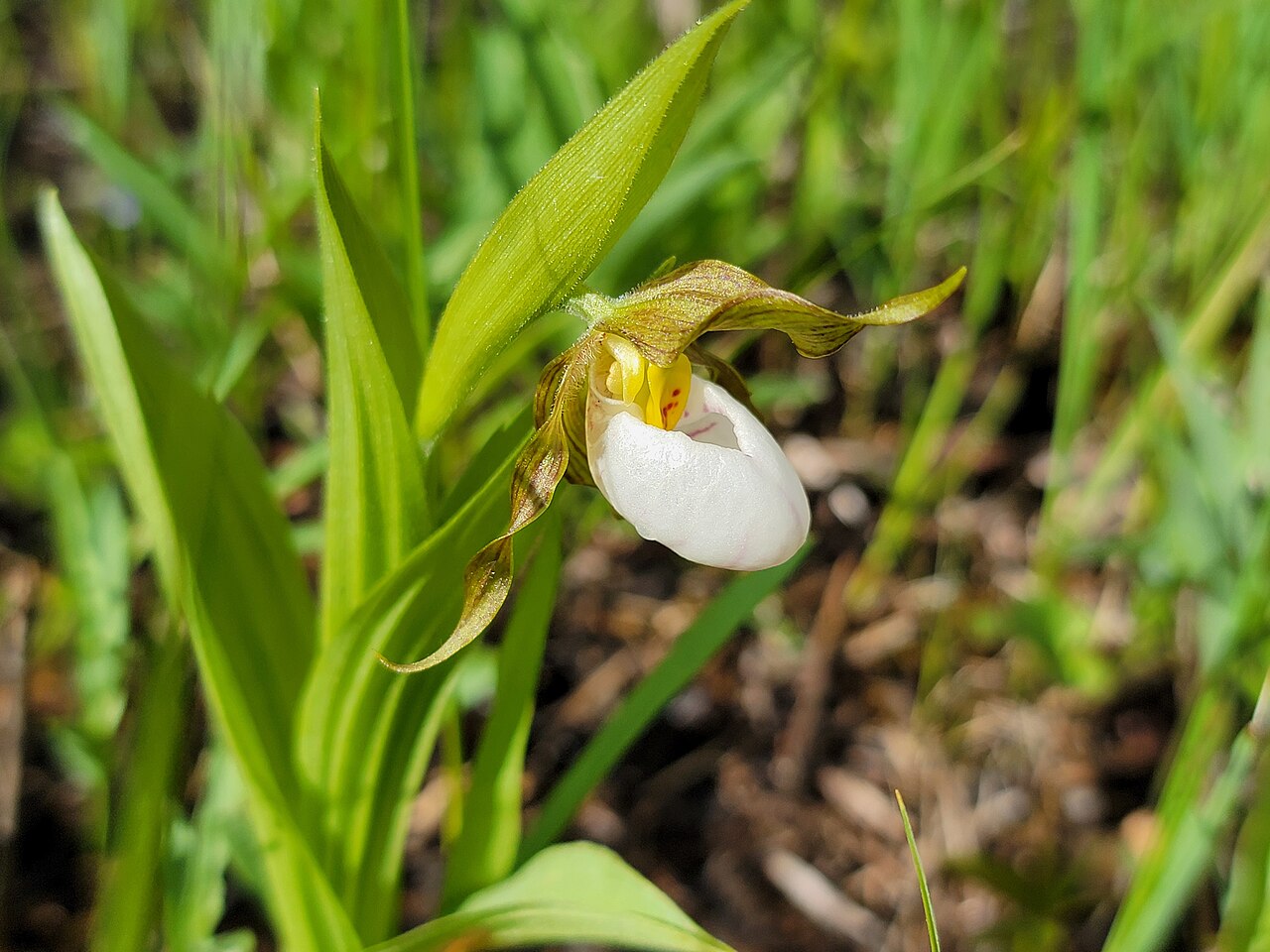
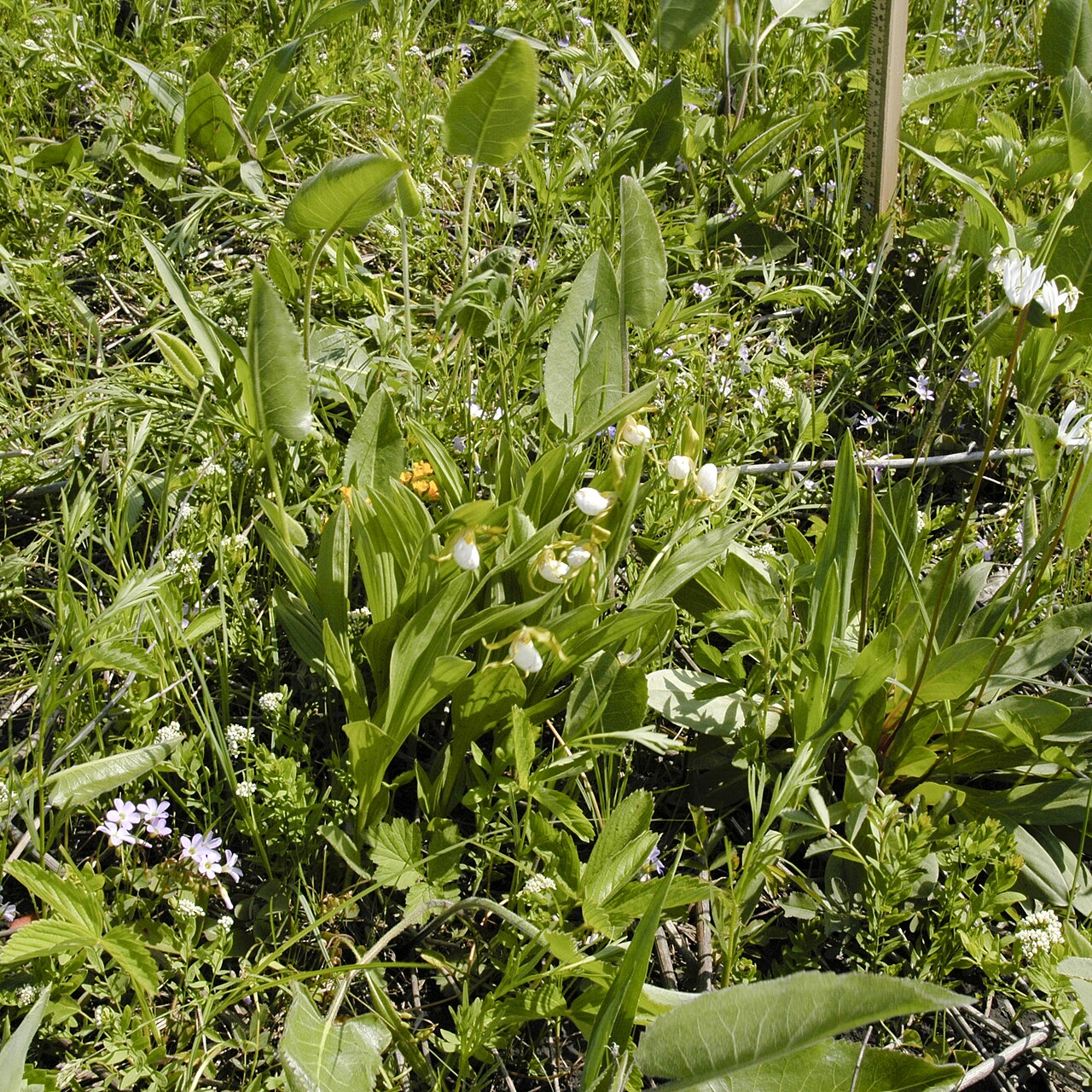
Cypripedium candidum, Small White Lady’s Slipper, also called white lady’s slipper, is one of the smallest slipper orchids in North America. Its stems are only 4 to 16 inches tall, and in May and early June each one carries a single flower with a glossy white pouch, about an inch long, set off by narrow, twisted, greenish-yellow petals streaked with brown. Healthy plants form clumps of a dozen or more stems, and a good colony in bloom is one of the memorable sights of a spring prairie.
It is a plant of wet to moist prairies, sedge meadows and calcareous fens, centered in the Upper Midwest, with Minnesota holding more plants than all other states combined. Because almost all of that habitat has been plowed, drained or overgrown, the species has declined by as much as 90 percent. It is rare and legally protected in many states: it is listed as endangered in Kentucky, Maryland, New Jersey and New York, carries threatened or other special status in many others, is considered extirpated in Pennsylvania, and is listed as threatened in Canada. Like all orchids, it is also covered by CITES Appendix II, which regulates international trade.
Never dig small white lady’s slipper from the wild. Wild plants almost never survive transplanting, collecting them is illegal in many states, and every plant removed harms a population that may already be tiny. This page is mainly an identification and appreciation guide, with notes on the few legal, laboratory-propagated plants that are occasionally sold.
Identification
Small white lady’s slipper is easy to recognize once in flower. Its closest relative, the yellow lady’s slipper, has a yellow pouch, and the two hybridize where they meet.
Stems & Leaves
Each plant grows from a creeping, branching rhizome and sends up one to many erect, hairy stems 4 to 16 inches tall, often in tight clumps. Near the middle of the stem there are three to five alternate, pleated, lance-shaped leaves, 3 to 8 inches long, that clasp the stem and are often held upright, almost sheathing the flower when it first opens.
Flowers
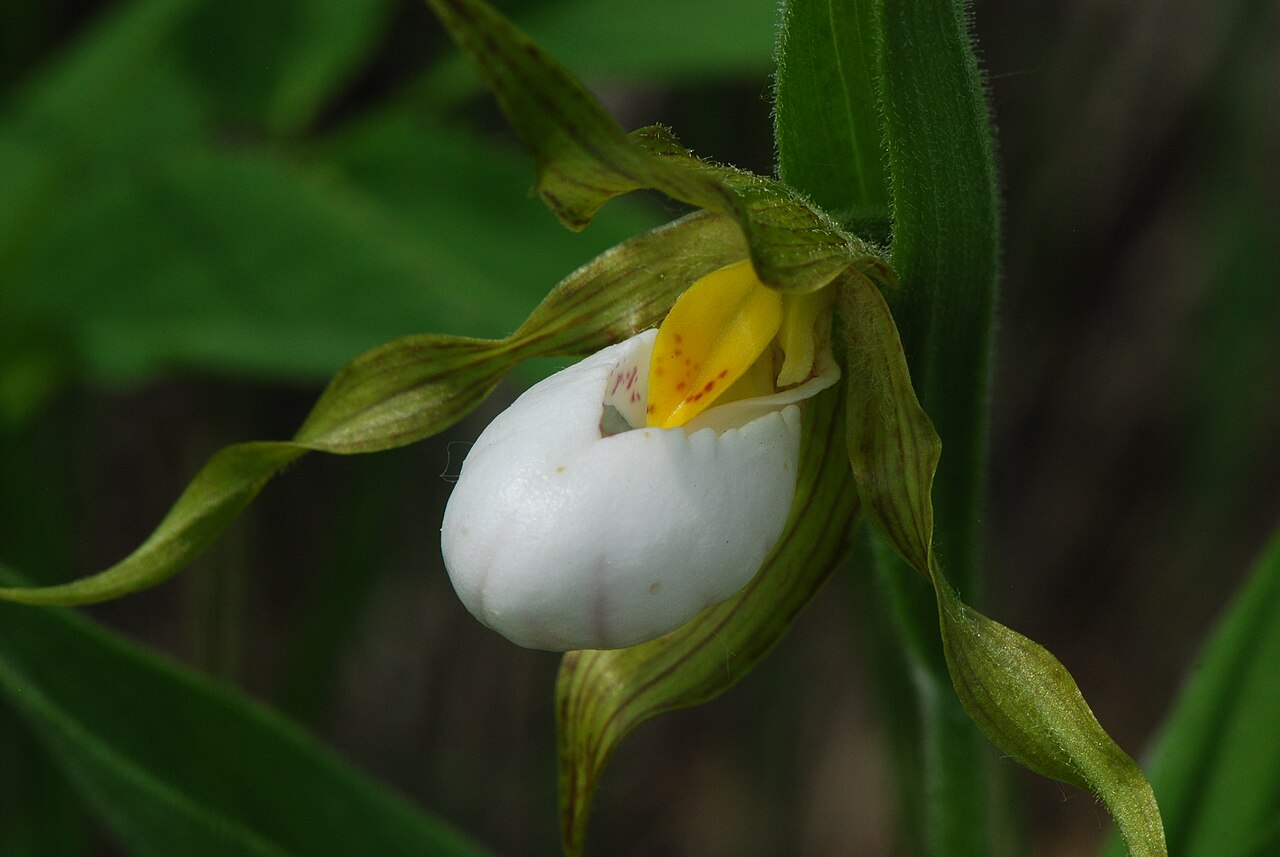
Each stem bears one flower, rarely two, from mid-May to mid-June, often before the leaves are fully expanded. The pouch (lip) is glossy white, about ¾ to 1 inch long, with faint purple veining or spots inside. The upper sepal and the fused lower sepals are greenish-yellow with brown or reddish streaks, and the two narrow side petals are spirally twisted, 1 to 1¾ inches long. A yellow, red-spotted shield (the staminode) covers the opening of the pouch. The flowers have a light, spicy fragrance.
Fruit
After pollination the flower develops into an erect, ribbed capsule about an inch long, which splits in late summer to release thousands of dust-like seeds carried by the wind.
Look-alikes
Yellow lady’s slipper (C. parviflorum) is usually taller with a yellow pouch. Where the two grow together they produce hybrids, C. ×andrewsii, with cream or pale yellow pouches. Showy lady’s slipper (C. reginae) is much larger, with white sepals and a pink-flushed pouch, and mountain lady’s slipper of the West has a white pouch but long, wavy, dark maroon petals.
Quick Facts
| Scientific Name | Cypripedium candidum |
| Family | Orchidaceae (orchid family) |
| Plant Type | Perennial terrestrial orchid, clump-forming from rhizomes |
| Mature Height | 4–16 in |
| Mature Spread | 6–12 in; old clumps larger |
| Growth Rate | Very slow; about 12 years to maturity from seed |
| Sun Exposure | Full sun to light shade |
| Water Needs | High; constantly moist to wet soil |
| Soil Type | Moist, calcareous clay, marl or mineral soils of prairies and fens |
| Soil pH | Neutral to alkaline (about 7.0–8.0) |
| Bloom Time | May–June |
| Flower Color | White pouch; greenish-yellow sepals and petals streaked brown |
| Fall Color | None; leaves yellow and die back |
| Fruit | Upright capsule with dust-like seeds |
| Deer Resistant | No; deer and rabbits sometimes eat the shoots |
| USDA Hardiness Zones | 3–7 |
Native Range
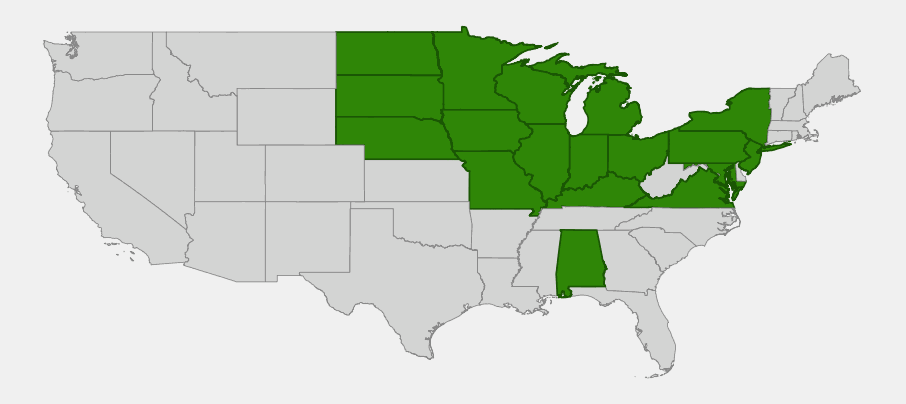
Small white lady’s slipper is native to eastern North America, with its range centered in the Upper Midwest. USDA PLANTS records it as native in 18 states: North Dakota, South Dakota, Nebraska, Minnesota, Iowa, Missouri, Wisconsin, Illinois, Michigan, Indiana, Ohio, Kentucky, New York, New Jersey, Pennsylvania, Maryland, Virginia and Alabama. In Canada it grows in southern Manitoba and southern Ontario and was once known from Saskatchewan, where it has not been seen since 1895.
Minnesota, especially the northwestern prairie region, has by far the most plants. Elsewhere it is scattered and local. Eastern and southern populations, in Maryland, Virginia, Kentucky and Alabama, are small and isolated, and it is considered gone from Pennsylvania, where it was first described. A population reported from Arkansas in 2024 extends the known range further south.
It grows in wet to moist prairies, sedge meadows, calcareous fens and seeps, and marly lake plains, usually in full sun on alkaline soils. A few southern and eastern populations grow in unusual places such as cedar barrens and open wooded slopes over limestone or dolomite, probably relics of former prairie openings.
📋 Regional plant lists featuring Small White Lady’s Slipper: Michigan, Wisconsin & Eastern Minnesota · North Dakota, South Dakota & Western Minnesota · Illinois, Iowa & Missouri · Ohio & Indiana · Nebraska, Kansas & Eastern Colorado · Kentucky & Tennessee · New York, Pennsylvania & Northern New Jersey · Delaware, Southern New Jersey & Long Island · Maryland, Virginia & West Virginia · Alabama, Georgia & Mississippi
Growing & Care Guide
Small white lady’s slipper is not a plant for ordinary gardens, and wild plants must never be dug or moved. Its seeds need a specific soil fungus to germinate, and established plants depend on undisturbed, constantly moist, alkaline soil. A few specialist orchid nurseries raise it from seed in sterile laboratory culture and occasionally sell those plants. Buy only from a nursery that states its plants are laboratory seed-grown, and treat any ‘nursery-grown’ plant of uncertain origin with suspicion, since wild-collected slipper orchids have long been sold that way. If you have a suitable wet, sunny, limy site, the notes below describe what those plants need.
Light
Full sun to light shade. In the wild it is shade-intolerant and declines as shrubs and trees close in; in a garden, morning sun with light afternoon shade is easiest to manage.
Soil & Water
It needs soil that stays moist all season but is not stagnant: a mix of loam, sand and fine limestone gravel or marl, neutral to alkaline, with a little leaf mold. Never let it dry out in spring and summer, and do not use acid peat. A sunny bog garden with alkaline water or a seep edge is the closest garden match.
Planting Tips
Plant dormant, laboratory-raised plants in early spring or fall, with the buds just below the surface and the roots spread horizontally. Mark the spot; the shoots emerge late and are easily trampled. Mulch lightly with fine gravel and keep surrounding plants from crowding it.
Pruning & Maintenance
Leave the foliage until it yellows in late summer, since it feeds next year’s buds, which form underground in late summer. Do not mow or burn the area after shoots emerge. Remove encroaching shrubs and aggressive grasses, protect shoots from slugs and rabbits, and leave the plant undisturbed; clumps resent division.
Propagation
Propagation is a job for specialist laboratories: the dust-like seeds lack food reserves and are germinated in sterile culture, then grown on for several years before planting. Home gardeners should not try to divide plants or move them, and collecting seed from wild populations is not legal in many states without a permit.
Landscape Uses
- Prairie and fen restoration: reintroduced in some protected prairies and fens from laboratory-raised stock as part of managed recovery work
- Specialist bog or fen gardens: for experienced growers with a sunny, constantly moist, alkaline site and legally propagated plants
- Nature viewing: one of the signature spring wildflowers of preserved wet prairies in Minnesota, Illinois, Wisconsin and Michigan
- Botanical study: a classic example of orchid pollination by deception and of hybridization between species
Wildlife & Ecological Value
Small white lady’s slipper offers no nectar, but its flowers are part of a busy community of small insects, and its presence signals a high-quality prairie or fen.
For Pollinators
The flowers trap small insects that enter the pouch looking for food. To escape, they squeeze out past the stigma and anthers through tiny exit holes at the back, picking up or delivering pollen. Documented pollinators are small sweat bees (Lasioglossum, Halictus, Augochlorella), small carpenter bees (Ceratina) and a small stink bug. Because it relies on these generalists, it needs a diverse prairie with plenty of other flowers to keep them around.
For Birds
It has no fruit eaten by birds. Its wet prairie habitat supports sedge wrens, bobolinks and other grassland birds.
For Mammals
Deer and rabbits occasionally browse the shoots, and voles may damage rhizomes. It is not an important food plant for mammals.
Ecosystem Role
Like all orchids, it depends on mycorrhizal fungi, which supply the seedlings with nutrients for years before they produce leaves and continue to support adult plants, especially during dormancy. It is a reliable indicator of undisturbed, unplowed, ungrazed wet prairie and fen, and it benefits from well-timed prescribed burns and brush removal that keep its habitat open.
Cultural & Historical Uses
Carl Ludwig Willdenow described Cypripedium candidum in 1805 from plants collected in Pennsylvania, crediting the name to the Pennsylvania botanist Gotthilf Heinrich Ernst Muhlenberg. The epithet candidum means ‘white’, for the pouch. Ironically, the species is now considered extirpated from the state where it was first collected.
Its decline mirrors the loss of the tallgrass prairie. In Minnesota, its stronghold, the statewide population is estimated at less than 5 percent of its historic level, and the plants survive mostly in unplowed remnants: roadsides, railroad rights-of-way, old hay meadows and preserves. Draining of wetlands, invasive plants such as reed canary grass and smooth brome, and shrubs taking over unburned prairie remain the main threats, and digging by collectors has removed plants from some sites.
Conservation groups, state agencies and botanic gardens now protect key sites, manage them with prescribed fire and brush cutting, and in a few places use laboratory-grown seedlings to restore populations. Visiting a protected colony in late May, and leaving it exactly as you found it, is the best way to enjoy this orchid.
Frequently Asked Questions
Is small white lady’s slipper endangered?
It is not federally listed in the United States, but it is rare across its range and has declined by as much as 90 percent. It is listed as endangered in Kentucky, Maryland, New Jersey and New York, has protected or special-concern status in many other states, and is listed as threatened in Canada. Check your state’s list before handling plants or seed.
Can I dig one up and move it to my garden?
No. Collecting wild plants is illegal in many states and on public land, and transplanted wild orchids almost always die within a few years because they depend on specific soil fungi and conditions. Enjoy wild plants where they grow.
Can I buy small white lady’s slipper?
Occasionally. A few specialist orchid nurseries sell plants raised from seed in sterile laboratory culture. Buy only from sellers who state that plants are laboratory-propagated, never collected.
When does it bloom?
Usually from mid-May to mid-June, depending on latitude and spring weather. Each flower lasts about a week to ten days.
How is it different from yellow lady’s slipper?
Small white lady’s slipper has a white pouch and is usually shorter, with upright leaves. Yellow lady’s slipper has a yellow pouch. The two hybridize, producing plants with cream to pale yellow pouches.

Looking for a nursery that carries Small White Lady’s Slipper?
Browse our native plant nursery directory: Alabama · Illinois, Indiana & Iowa · Kentucky, Maryland, Michigan, Minnesota & Missouri · Nebraska, New Jersey, New York, North Dakota & Ohio · Pennsylvania, South Dakota & Virginia · Wisconsin

