
Southern Spicebush (Lindera melissifolia)
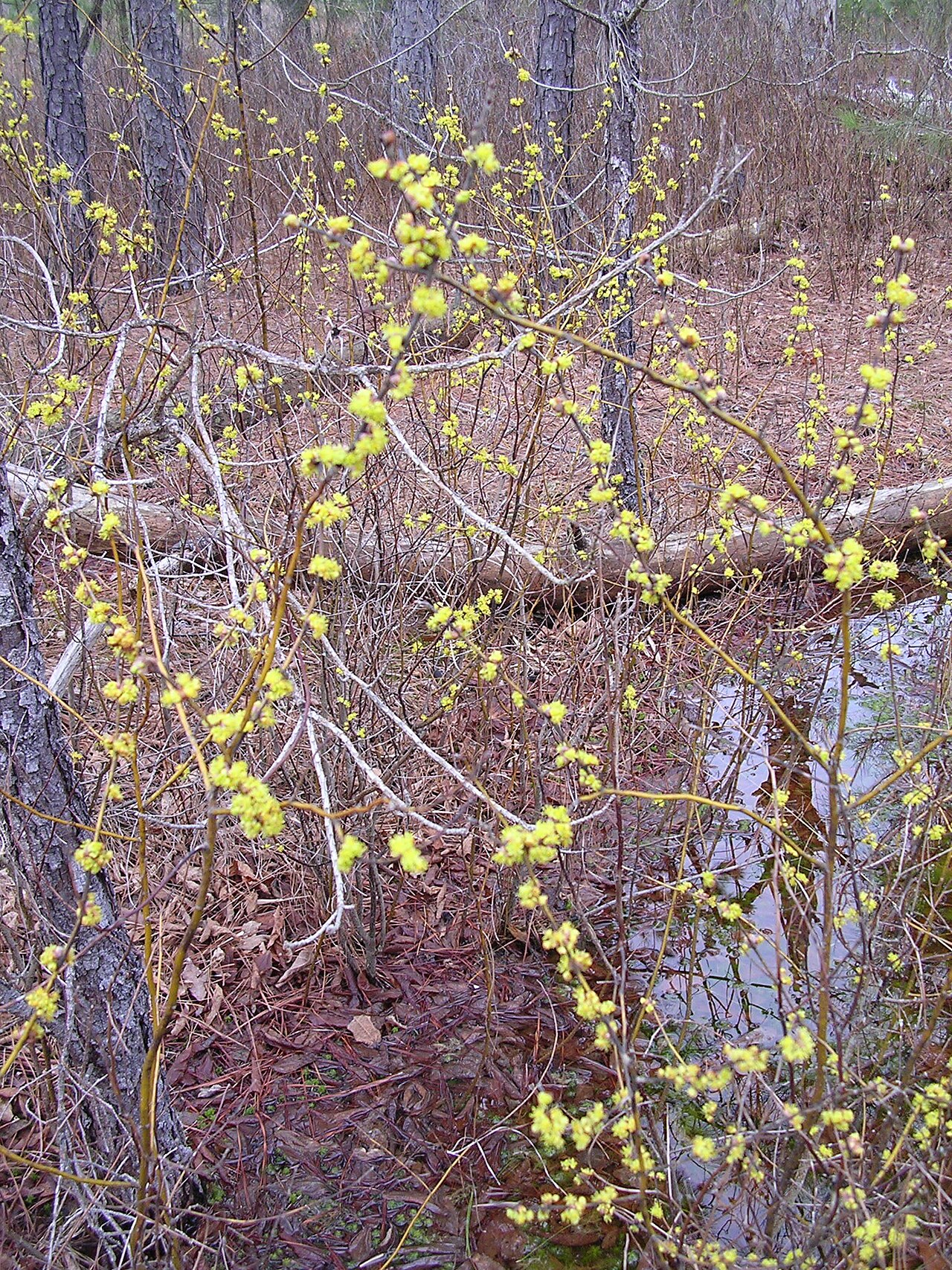
Lindera melissifolia, known as Southern Spicebush or pondberry, is a rare, aromatic shrub of seasonally flooded forests and pond margins in the southeastern United States. It is a close relative of the familiar Spicebush (Lindera benzoin), with the same clusters of small yellow flowers on bare branches in late winter and glossy red berries in fall. Pondberry is smaller, usually under 6 feet, and it grows in colonies of slender stems linked by underground runners.
Pondberry is federally listed as Endangered under the U.S. Endangered Species Act, a status it has held since 1986. Only a few dozen populations are known, scattered from the Mississippi Delta and the Missouri Bootheel to the coastal plain of the Carolinas and Georgia. Most of its original habitat, wet bottomland forests and shallow seasonal ponds, was cleared and drained for agriculture and timber, and many surviving colonies contain plants of only one sex, so they rarely set seed.
Protected species note: never dig, cut or collect pondberry from the wild, and never move plants between sites. If you want to grow it, buy only plants that a reputable native nursery or conservation program has propagated from cultivated stock, and ask the seller where the stock came from. This guide focuses on identifying pondberry, where it grows, why it is rare, and how propagated plants can be grown responsibly.
Identification
Pondberry looks much like common spicebush, and the two can grow in the same region. Look at the growth form, the leaves and the way the leaves hang. When in doubt, crush a leaf: pondberry smells strongly of Sassafras, and common spicebush has a sharper, spicy-citrus scent.
Growth Habit
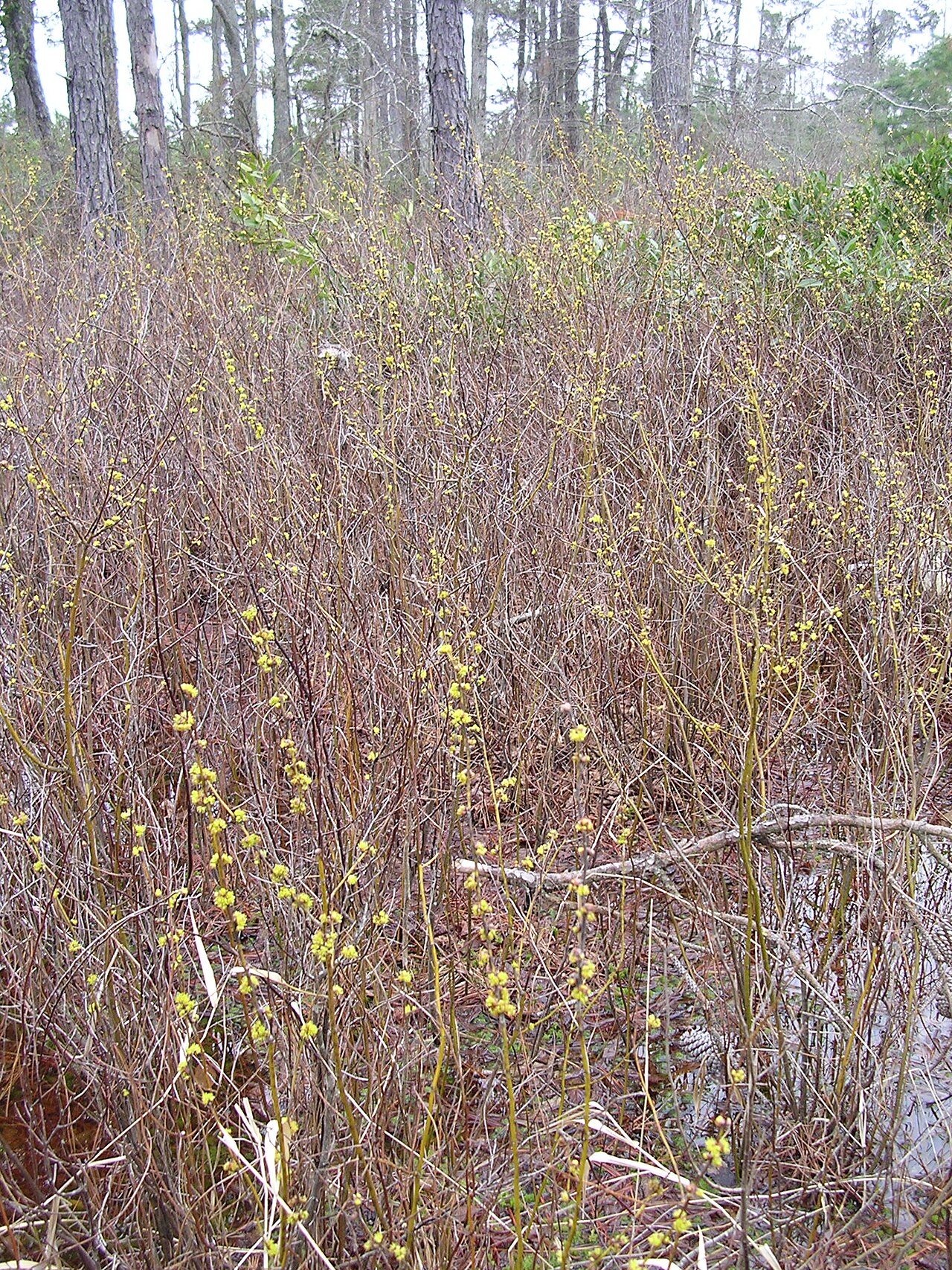
Pondberry is a deciduous shrub about 2 to 6 feet tall. It grows in dense clumps or thickets of erect, sparsely branched stems that are connected underground by stolons (runners). Individual stems usually live only six or seven years before dying back and being replaced by new shoots from the base, so a healthy colony often contains some dead stems among the living ones. The young twigs are often yellowish-green.
Leaves
The leaves are alternate, simple and untoothed, about 2 to 6 inches long and up to about 2½ inches wide, oblong to narrowly oval with a tapering tip. They tend to droop from the stems, which gives the plant a limp, wilted look even when it is healthy. The undersides are strongly net-veined and covered with short, soft hairs. Crushed leaves have a strong sassafras-like fragrance. The leaves turn yellow before they fall in autumn.
Flowers
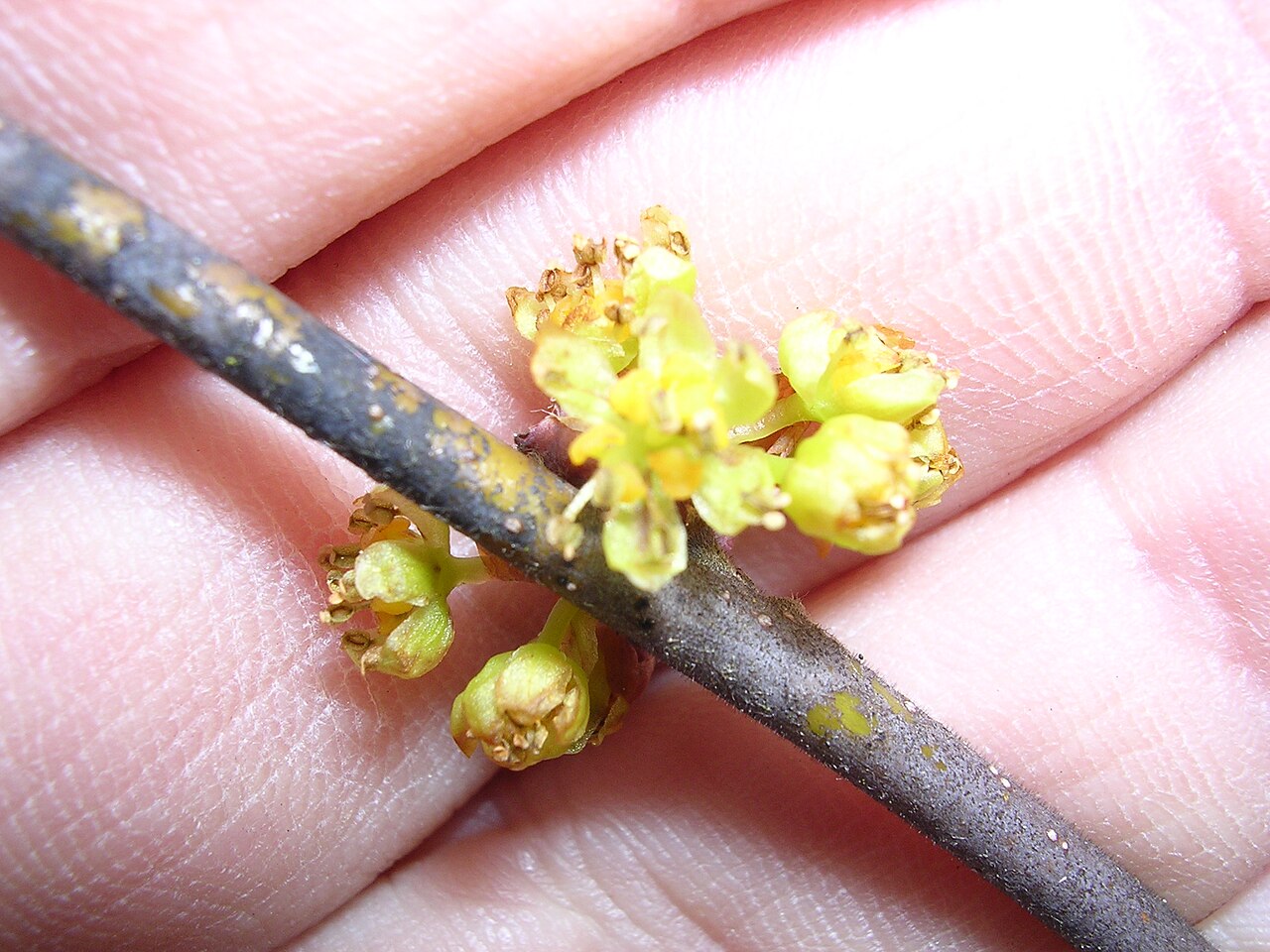
Pondberry flowers in late winter and early spring, usually February to mid-March, before the leaves appear. The flowers are small, about a quarter inch across, pale to bright yellow, and borne in tight, stalkless clusters along the stems. Male and female flowers are on separate plants (the species is dioecious). Male clusters are denser and showier; female flowers are fewer and less conspicuous. A colony in bloom stands out against the bare, gray late-winter woods for about a week.
Fruit
Female plants bear bright red, oval drupes about half an inch long, each holding a single seed. They ripen from late summer into early fall. The fruit stalks are noticeably swollen just below the fruit and often stay on the stems after the fruit drops. Fruit production varies greatly from year to year, and colonies made up only of male plants never fruit at all.
Similar Species
Common spicebush is usually taller, 6 to 12 feet, with spreading branches, broader, flatter leaves that do not droop, and a sharper scent. Its fruits are on slender stalks without the swollen tip. In Georgia and the Carolinas, pondberry can also grow near bog spicebush (Lindera subcoriacea), another rare species that has thicker, almost leathery leaves.
Quick Facts
| Scientific Name | Lindera melissifolia (Walter) Blume |
| Family | Lauraceae (laurel family) |
| Plant Type | Deciduous colonial shrub; dioecious |
| Mature Height | 2–6 ft |
| Mature Spread | Spreads slowly by stolons into clumps several feet wide |
| Growth Rate | Slow to moderate |
| Sun Exposure | Partial shade to light shade; tolerates sun with constant moisture |
| Water Needs | High; seasonally flooded to consistently moist soil |
| Soil Type | Wet, acidic, sandy or clay loam; hydric soils of ponds and bottomlands |
| Soil pH | About 4.5–6.5 (acidic) |
| Bloom Time | February–March, before the leaves |
| Flower Color | Pale to bright yellow |
| Fall Color | Yellow |
| Fruit | Bright red, oval single-seeded drupe, late summer–fall |
| Deer Resistant | Moderate; aromatic leaves are not favored |
| USDA Hardiness Zones | 6–9 |
Native Range
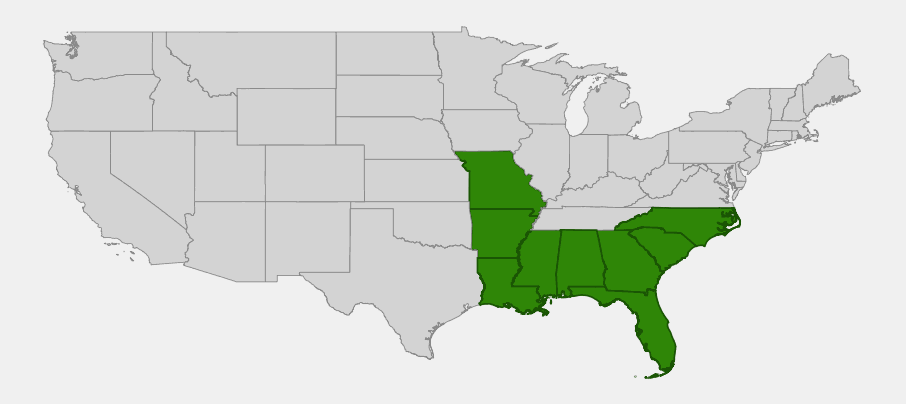
Pondberry has a scattered range across the southeastern coastal plain and the Lower Mississippi Alluvial Valley. USDA PLANTS records it from Alabama, Arkansas, Florida, Georgia, Louisiana, Mississippi, Missouri, North Carolina and South Carolina. The largest populations are in the Mississippi Delta, especially in and around the Delta National Forest in western Mississippi. Other colonies grow around seasonal ponds in the old sand-dune fields of northeastern Arkansas and southeastern Missouri, along the edges of limestone sinks in South Carolina, around sand-hill ponds in North Carolina, and at the margins of bogs and cypress ponds in Georgia.
Pondberry has probably always been rare, but it has declined sharply as bottomland forests were cleared and drained. The Florida and Louisiana records are historical; the species is believed to be extirpated, or nearly so, in both states, although they remain part of its documented native range and are shown on the map. Many surviving colonies are clones of a single male or female plant, and seedlings are almost never found in the wild, so recovery work depends on protecting habitat and on propagation by conservation programs.
Its habitat is defined by water. Pondberry grows on hydric soils in shallow depressions, along the edges of cypress ponds and sinkhole ponds, and in low, seasonally flooded spots within bottomland hardwood forests. These sites are usually wet or flooded in winter and spring and dry out by late summer. Most colonies grow in light shade under a forest canopy, but some grow in nearly full sun where water is reliable.
📋 Regional plant lists featuring Southern Spicebush: North & South Florida · Alabama, Georgia & Mississippi · North & South Carolina · Arkansas, Louisiana, Eastern Oklahoma & Eastern Texas · Illinois, Iowa & Missouri
Growing & Care Guide
Pondberry is a plant for conservation-minded gardeners within its native region, not a general landscape shrub. Wild plants must never be dug or moved. A few native-plant nurseries and conservation programs propagate it from cultivated stock; buy only from a seller who can tell you the plants were propagated, not collected. If you are not sure, plant common Spicebush instead, which offers the same late-winter flowers and red fruit and is easy to find. Because populations are under federal protection, check with your state natural heritage program before planting pondberry near a natural area.
Light
Light shade or partial shade is ideal, matching the thin canopy of a bottomland forest. Pondberry can take more sun if the soil never dries out completely, but in hot, dry sites the drooping leaves scorch.
Soil & Water
Give it moist to wet, acidic soil rich in organic matter. A rain garden, the edge of a pond, a low spot that collects water in winter, or a bog garden is a good fit. It tolerates winter and spring flooding and appreciates some drying in late summer, as in the wild, but established plants should not be left in dry soil for long stretches. Water during droughts.
Planting Tips
Plant container-grown plants in late fall or winter while they are dormant. Because the species is dioecious, you need both male and female plants, within reach of the same pollinators, to get fruit; ask the nursery whether plants are sexed. Space plants about 3 to 4 feet apart and let them form a colony. Mulch with leaf litter to keep the soil moist and cool.
Pruning & Maintenance
Little pruning is needed. Cut dead stems out at the base in late winter; dieback of older stems is normal, and new shoots will replace them. Keep vigorous neighbors, especially vines and invasive shrubs such as Chinese privet, from crowding the colony. Avoid fertilizer and herbicides near the plants.
Propagation
Propagation is best left to nurseries and conservation programs working with cultivated stock. Seeds are recalcitrant (they lose viability if they dry out) and are usually sown fresh in fall; softwood cuttings and division of cultivated colonies also work. Never collect seeds, cuttings or plants from wild populations: removing or damaging endangered plants on federal land, or in violation of state law, is prohibited, and wild colonies need every seed and stem they produce.
Landscape Uses
- Conservation plantings: propagated plants support recovery of an endangered species within its native range
- Rain gardens: tolerates winter and spring flooding in low, shady spots
- Pond and bog margins: a small shrub for the wet edge of a pond, swale or bog garden
- Woodland gardens: late-winter yellow flowers and fall red fruit under a light canopy
- Educational gardens: a living example of a rare southeastern wetland plant
Wildlife & Ecological Value
Pondberry is part of the specialized wildlife community of seasonal wetlands. Because the species is so rare, its relationships with wildlife are less studied than those of common spicebush.
For Pollinators
The flowers open very early in the year, when few other nectar sources are available, and are thought to be pollinated by small insects such as bees and flies. Male and female flowers are on separate plants, so pollinators must carry pollen between colonies for fruit to form. Lindera species are host plants for the spicebush swallowtail butterfly, and pondberry is likely used where it grows near common spicebush, though this has been little documented.
For Birds
The red, fatty fruits ripen in late summer and fall, when migrating songbirds need energy-rich food, and birds are the likely main seed dispersers. Because fruiting is irregular and many colonies are male-only, fruit is not always available.
For Mammals
Small mammals may eat fallen fruit and use the dense thickets for cover. Deer browse pondberry stems in some areas, but the aromatic leaves are not a preferred food.
Ecosystem Role
Pondberry is a characteristic shrub of seasonally flooded depressions and pond margins, habitats that also support rare amphibians such as the striped newt in Georgia. It depends on the natural cycle of winter flooding and summer drying. Draining, ditching and clearing of these wetlands, along with changes in flooding patterns, are the main reasons for its decline, so protecting pondberry also protects these vanishing wetlands.
Cultural & Historical Uses
The species was first described in 1788 by Thomas Walter in his Flora Caroliniana, based on plants from South Carolina, under the name Laurus melissifolia. It was later moved to Benzoin and then to Lindera, a genus named for the Swedish physician and botanist Johan Linder. The epithet melissifolia means “with leaves like Melissa,” the lemon balm.
Pondberry was listed as an endangered species by the U.S. Fish and Wildlife Service in 1986. Since then, federal and state agencies, universities and conservation groups have surveyed its remaining populations, studied its unusual biology, including its sex ratios, flooding tolerance and lack of seedlings, and grown plants for reintroduction on protected lands in the Mississippi Delta and elsewhere.
The common name “southern spicebush” reflects its close relationship to common spicebush, while “pondberry” describes where it grows and its red fruit. Like its relatives, it has aromatic leaves and twigs, a trait shared across the laurel family that also includes sassafras, red bay and the culinary bay laurel.
Frequently Asked Questions
Is pondberry endangered?
Yes. Pondberry (Lindera melissifolia) has been federally listed as Endangered under the U.S. Endangered Species Act since 1986. Only a few dozen populations are known, mostly in Mississippi, Arkansas, Missouri, the Carolinas, Georgia and Alabama.
Can I grow southern spicebush in my garden?
Yes, if you buy plants propagated from cultivated stock by a reputable nursery or conservation program, and if you have moist to wet, acidic soil in light shade. Never dig plants or collect seeds from the wild. For most gardens, common spicebush is an easier alternative.
How is pondberry different from common spicebush?
Pondberry is shorter (2 to 6 feet), grows in colonies of slender stems linked by runners, and has drooping, narrower leaves that smell like sassafras when crushed. Common spicebush is taller, with broader, flatter leaves and a sharper spicy scent.
Why is pondberry so rare?
Most of its habitat, seasonally flooded bottomland forests and pond margins, has been cleared and drained. Many surviving colonies are made up of plants of a single sex that spread only by runners, so they produce little or no seed, and seedlings are rarely found.
Are pondberry fruits edible?
Pondberry fruits are eaten by birds, but this is an endangered plant: do not collect fruit from wild colonies. They have no established food use, and wild fruits are needed for natural reproduction.

Looking for a nursery that carries Southern Spicebush?
Browse our native plant nursery directory: Alabama & Arkansas · Florida & Georgia · Louisiana, Mississippi & Missouri · North Carolina · South Carolina

