
Small White Aster (Symphyotrichum racemosum)
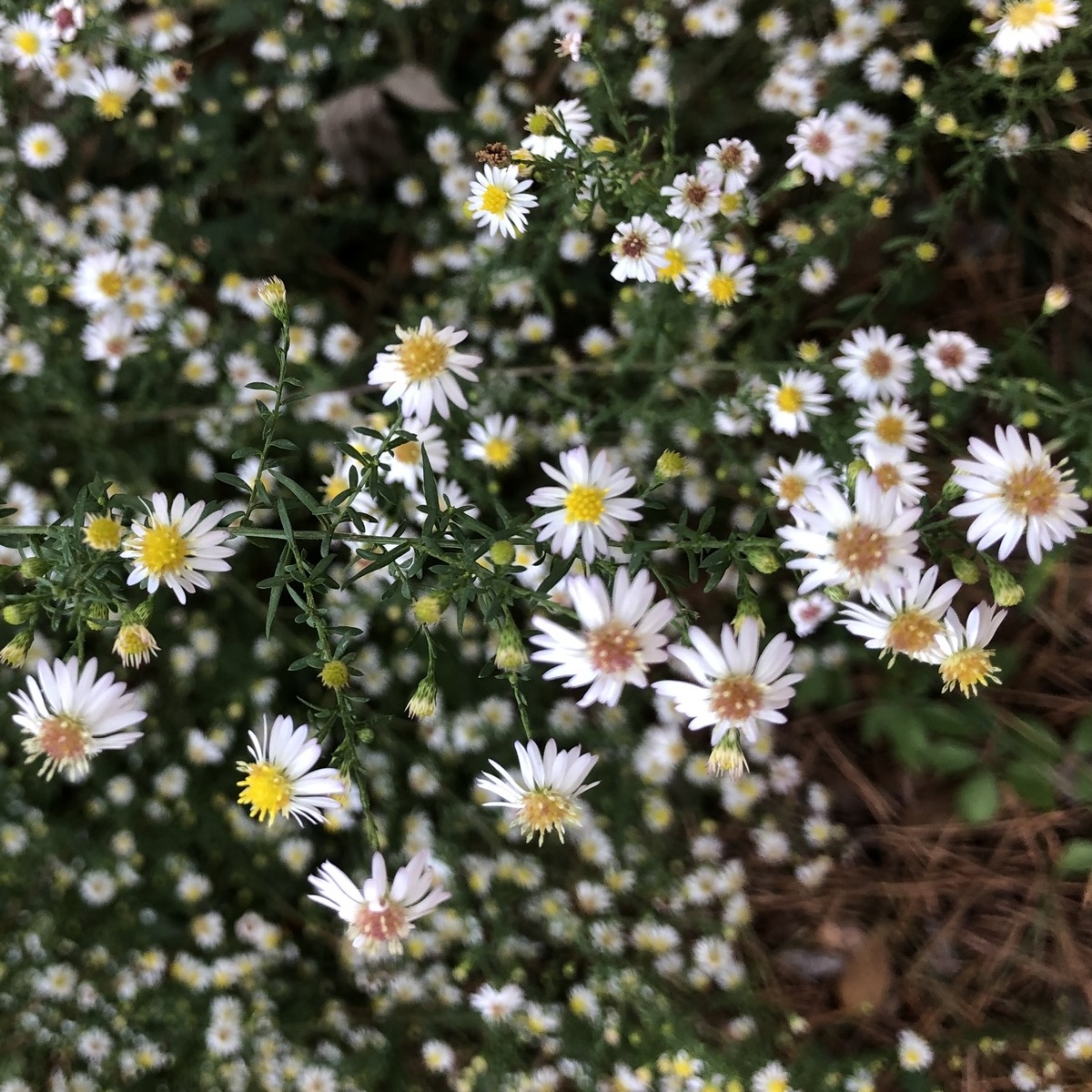
Symphyotrichum racemosum, known as Small White Aster or smooth white oldfield aster, is a native fall aster of moist meadows, stream banks and open woods across the eastern United States. From late summer into fall its slender, arching stems are lined with hundreds of small white daisies, each about half an inch across, with yellow centers that turn reddish purple as they age. Plants usually grow 1 to 4 feet tall and spread slowly by rhizomes into loose colonies.
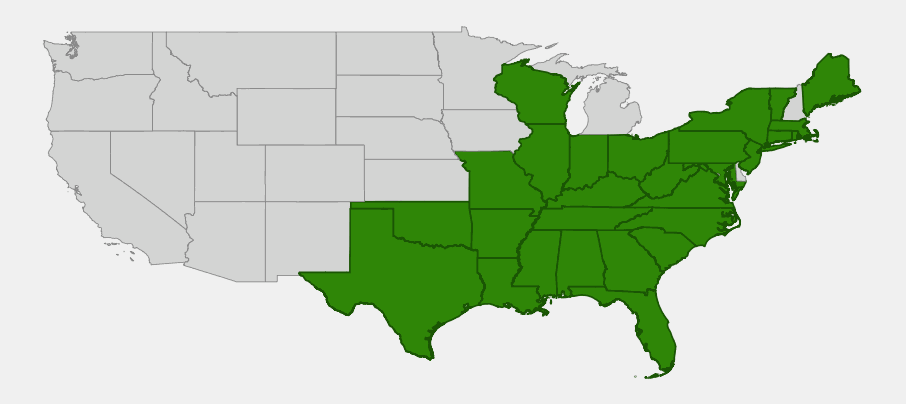
It is native from Maine and Wisconsin south to Florida and west to Missouri, Oklahoma and eastern Texas. It favors damper ground than many of its relatives, so it is a good choice for rain gardens, low meadows and the edges of ponds and woods, and it is a valuable late-season food source for bees and other pollinators.
Small white aster was long known as Aster vimineus or Aster racemosus, and older guides may use those names. Today it is placed in Symphyotrichum, the genus that holds most North American asters. This page covers identification, native range, how to grow it, and its value to wildlife.
Identification
Small white aster belongs to a group of look-alike white-flowered asters with small heads. Its combination of tiny, narrow branch leaves, mostly smooth stems, flower heads strung along one side of long, arching branches, and a preference for moist soil helps separate it.
Stems & Growth Habit
The stems are slender, erect to leaning, often purplish below, and smooth or with fine hairs in lines. They branch widely in the upper half, with long, wand-like side branches that arch outward. Plants spread by creeping rhizomes and form loose clumps or colonies.
Leaves
The lower leaves are narrow, lance-shaped and 2 to 5 inches long, but they usually wither by flowering time. The leaves on the branches are much smaller, often less than half an inch long, narrow and crowded, giving the flowering branches a fine, feathery look. The leaves are mostly hairless.
Flowers
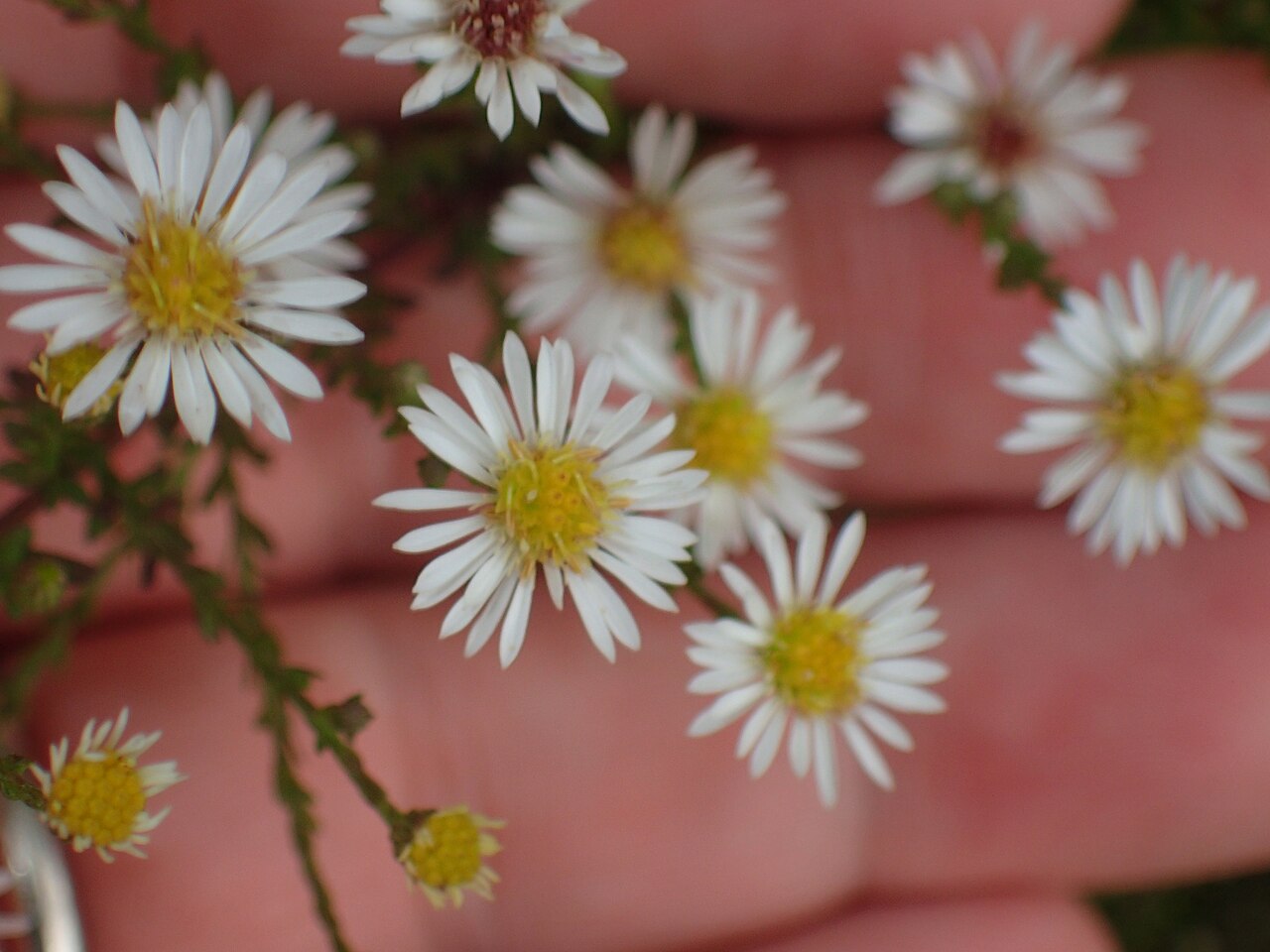
The small flower heads are about a third to a half inch wide, with roughly 15 to 30 white (rarely pale pink) ray florets around a center of yellow disk florets that turn reddish purple as they age. The heads sit on short stalks along one side of the arching branches, in long, raceme-like sprays, the feature behind the name racemosum. The bracts beneath each head are narrow, pressed close, and green-tipped.
Seeds
After flowering, each head produces small, dry seeds (cypselae) topped with tufts of whitish bristles that carry them on the wind in late fall.
Similar Species
Calico aster (Symphyotrichum lateriflorum) has fewer rays (usually 9 to 15), larger branch leaves and hairy leaf midribs underneath. Frost Aster has spreading, spine-tipped bracts and is often hairy. Heath Aster has stiff, spine-tipped bracts and prefers dry ground. Bushy aster (S. dumosum) has pale lavender to white rays and heads on longer stalks with many tiny leaf-like bracts.
Quick Facts
| Scientific Name | Symphyotrichum racemosum (Elliott) G.L. Nesom (syn. Aster racemosus, Aster vimineus) |
| Family | Asteraceae (aster family) |
| Plant Type | Herbaceous perennial; spreads by rhizomes |
| Mature Height | 1–4 ft |
| Mature Spread | 1–2 ft; slowly forms colonies |
| Growth Rate | Moderate to fast |
| Sun Exposure | Full sun to part shade |
| Water Needs | Medium to high; moist to wet soils |
| Soil Type | Loam, clay or sand; tolerates heavy, damp soils |
| Soil pH | About 5.5–7.5 |
| Bloom Time | Late August through October (into November in the South) |
| Flower Color | White rays; yellow centers aging to reddish purple |
| Fall Color | Foliage may turn reddish or bronze |
| Fruit | Small, dry seeds with fluffy white bristles |
| Deer Resistant | Moderate; deer sometimes browse asters |
| USDA Hardiness Zones | 4–9 |
Native Range
USDA PLANTS records small white aster as native in Alabama, Arkansas, Connecticut, Florida, Georgia, Illinois, Indiana, Kentucky, Louisiana, Maine, Maryland, Massachusetts, Mississippi, Missouri, New Jersey, New York, North Carolina, Ohio, Oklahoma, Pennsylvania, Rhode Island, South Carolina, Tennessee, Texas, Vermont, Virginia, West Virginia and Wisconsin. It is most common in the Southeast and the Ohio and Mississippi valleys. In Texas and Oklahoma it is limited to the eastern part of each state, and it reaches northern Florida.
It grows in moist to wet open places: floodplain woods and their edges, stream banks, wet meadows, marsh edges, swales, ditches, damp old fields and powerline cuts. It handles clay and seasonal flooding better than many asters, and it often appears on disturbed, damp ground.
Small white aster is not considered native to Canada; USDA treats the few records there as introduced. Two varieties are recognized by some botanists: var. racemosum, widespread through the range, and var. subdumosum, mainly in the Southeast.
📋 Regional plant lists featuring Small White Aster: New York, Pennsylvania & Northern New Jersey · Ohio & Indiana · Michigan, Wisconsin & Eastern Minnesota · Kentucky & Tennessee · Connecticut, Massachusetts & Rhode Island · New Hampshire, Maine & Vermont · Maryland, Virginia & West Virginia · Delaware, Southern New Jersey & Long Island · Illinois, Iowa & Missouri · Alabama, Georgia & Mississippi · North & South Florida · North & South Carolina · Arkansas, Louisiana, Eastern Oklahoma & Eastern Texas
Growing & Care Guide
Small white aster is an easy, adaptable perennial for moist, sunny spots. It is not as widely sold as some showier asters, but native plant nurseries and seed suppliers in the East sometimes carry it, and it fills in quickly once established. Its fine texture and clouds of white flowers combine well with goldenrods and blue asters in fall.
Light
Full sun to part shade. In full sun the plants are bushier and flower more heavily; in shade they get taller, lean and flower less.
Soil & Water
It prefers evenly moist to wet soil and grows well in clay. It tolerates brief flooding, which makes it good for rain gardens and swales. Established plants survive short dry spells, but in dry soil they may drop their lower leaves early and flower poorly.
Planting Tips
Plant in spring or early fall, 18 to 24 inches apart. Seed can be sown outdoors in fall or winter so it gets the cold, moist period that improves germination, or cold-stratified for about 60 days before spring sowing. Use it in groups or drifts for the best show.
Pruning & Maintenance
To keep plants shorter and less floppy, cut the stems back by about a third in late May or early June. Leave the stems standing over winter for seed-eating birds and overwintering insects, then cut them down in early spring. Divide crowded clumps every few years. Like many asters it can get powdery mildew in humid, crowded conditions, though it rarely harms the plant.
Propagation
Grow it from seed, by dividing clumps in spring, or from rhizome pieces. Plants also self-seed modestly in open, damp soil.
Landscape Uses
- Rain gardens and swales: tolerates wet clay and periodic flooding
- Pollinator gardens: a major late-season nectar source for bees
- Meadows and naturalized areas: fine-textured white drifts with goldenrods and blue asters
- Pond and stream edges: helps hold moist soil along banks
- Woodland edges: tolerates light shade at the margin of trees
Wildlife & Ecological Value
Like other native asters, small white aster is one of the most important late-season wildlife plants in eastern North America.
For Pollinators
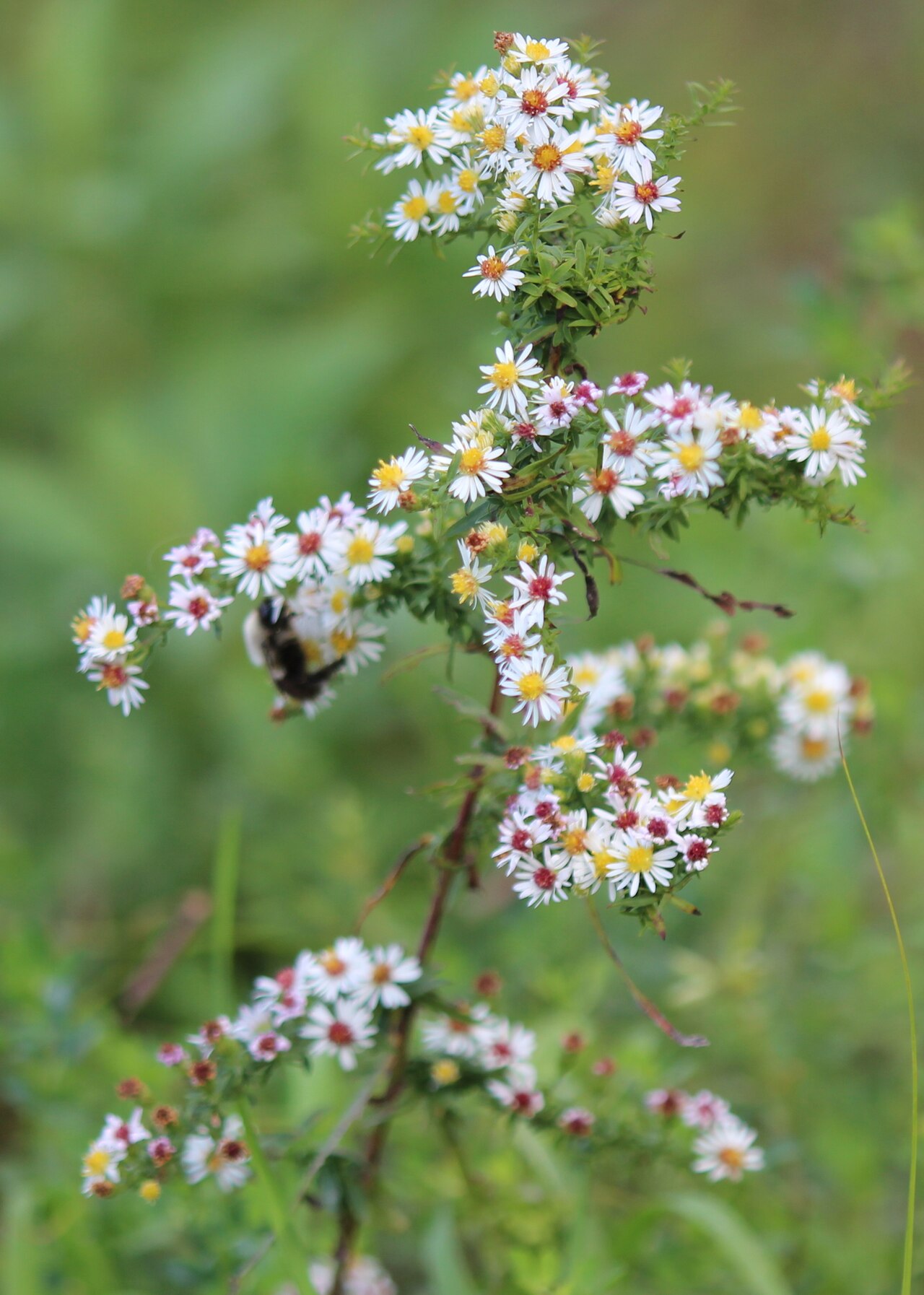
The many small flower heads provide nectar and pollen in September and October, when few other flowers remain. They are visited by bumblebees, honeybees, small native bees including specialist mining bees that collect pollen only from asters and their relatives, as well as wasps, flies and butterflies such as skippers and sulphurs. Native asters are larval host plants for the pearl crescent butterfly and for many moth caterpillars.
For Birds
Goldfinches, sparrows and other small birds eat the seeds in late fall and winter, and birds forage for insects among the stems.
For Mammals
Rabbits and deer browse asters at times. The dense stems give cover to small mammals in wet meadows.
Ecosystem Role
Small white aster helps hold soil along streams and in wet meadows, and its late flowers support the insects that pollinators, birds and other animals depend on as they prepare for winter. The standing stems shelter overwintering insects.
Cultural & Historical Uses
Small white aster was described by the South Carolina botanist Stephen Elliott in the early 1800s as Aster racemosus. For much of the 20th century it was better known under Lamarck’s name Aster vimineus, from the Latin for “with long, flexible shoots,” a description of its wand-like branches.
In the 1990s the botanist Guy Nesom moved most North American asters from Aster into the genus Symphyotrichum, based on differences in their flowers, chromosome numbers and DNA. True Aster is now mostly a Eurasian genus.
The white-flowered asters with small heads are among the trickiest plants in eastern North America to tell apart, and they sometimes hybridize. Botanists often use the number of rays, the size of the branch leaves and the hairiness of stems and midribs to separate small white aster from calico aster, frost aster and bushy aster.
Frequently Asked Questions
When does small white aster bloom?
It blooms from late August through October, and into November in the South. Its flowers are among the last nectar sources for bees in fall.
Does small white aster grow in wet soil?
Yes. It prefers moist to wet soil and grows naturally along streams, in wet meadows and in ditches. It is a good choice for rain gardens and other places that stay damp.
Is Symphyotrichum racemosum the same as Aster vimineus?
Yes. Aster vimineus and Aster racemosus are older names for the same plant. Most North American asters were moved to Symphyotrichum in the 1990s.
How do I tell small white aster from calico aster?
Small white aster usually has more rays (about 15 to 30), very small branch leaves, and smooth leaf midribs. Calico aster usually has 9 to 15 rays, larger branch leaves, and hairs on the underside of the leaf midribs.
Will small white aster spread?
It spreads slowly by rhizomes and can self-seed in open, damp soil, forming loose colonies. It is not aggressive, and extra plants are easy to dig and share.

Looking for a nursery that carries Small White Aster?
Browse our native plant nursery directory: Alabama & Arkansas · Connecticut, Florida & Georgia · Illinois & Indiana · Kentucky, Louisiana, Maine, Maryland, Massachusetts, Mississippi & Missouri · New Jersey, New York, North Carolina, Ohio & Oklahoma · Pennsylvania, Rhode Island, South Carolina, Tennessee, Texas, Vermont & Virginia · West Virginia & Wisconsin

