
Wild Tantan (Desmanthus virgatus)
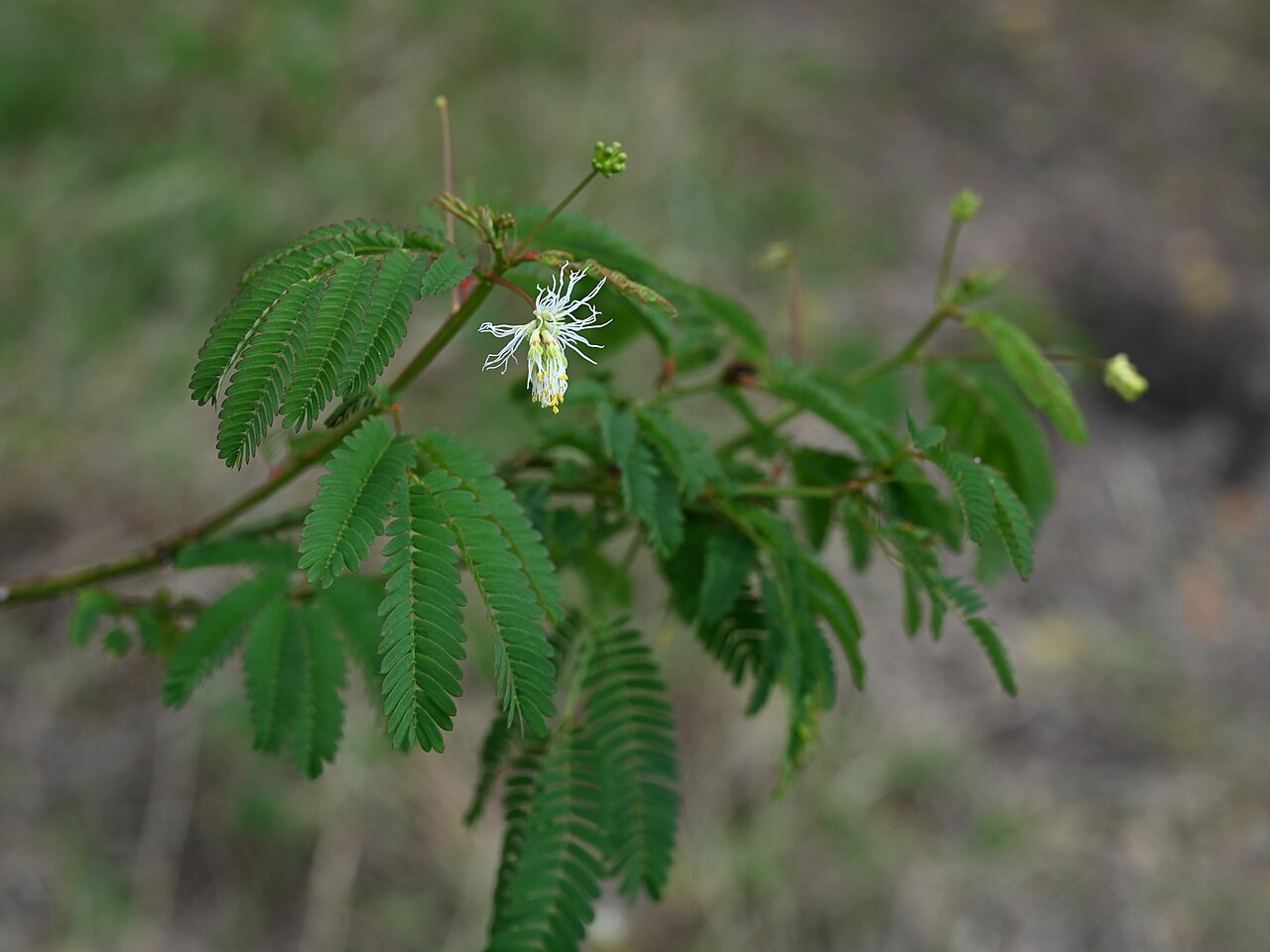
Desmanthus virgatus, Wild Tantan, also called slender mimosa, ground tamarind or desmanto, is a small, fine-leaved shrub or woody-based perennial in the mimosa group of the legume family. It has feathery, twice-divided leaves, small white to cream powder-puff flower heads and clusters of slender, straight seed pods, and it grows 1 to 5 feet tall from a deep, woody taproot.
It is native to the American tropics and subtropics, from Texas and Florida through Mexico, Central America and the Caribbean, including Puerto Rico and the U.S. Virgin Islands, to South America. Because it is drought-tolerant, nitrogen-fixing and nutritious for livestock, it has been planted as a forage crop in Australia, India and other warm regions, and it has escaped in places such as Hawaiʻi and Guam, where it is introduced.
In the United States it is a plant of South Texas brushlands and roadsides, the Florida Keys and southern Florida, and the dry coastal hills of Puerto Rico. This guide covers how to identify it, its native range and how to grow it as a tough native for dry, sunny gardens and wildlife plantings in zones 9 to 13.
Identification
Wild tantan looks like a small, fine-textured mimosa without prickles. Its leaves do not fold when touched as quickly as sensitive plants do, and its slender, straight pods in small clusters are distinctive.
Stems & Leaves
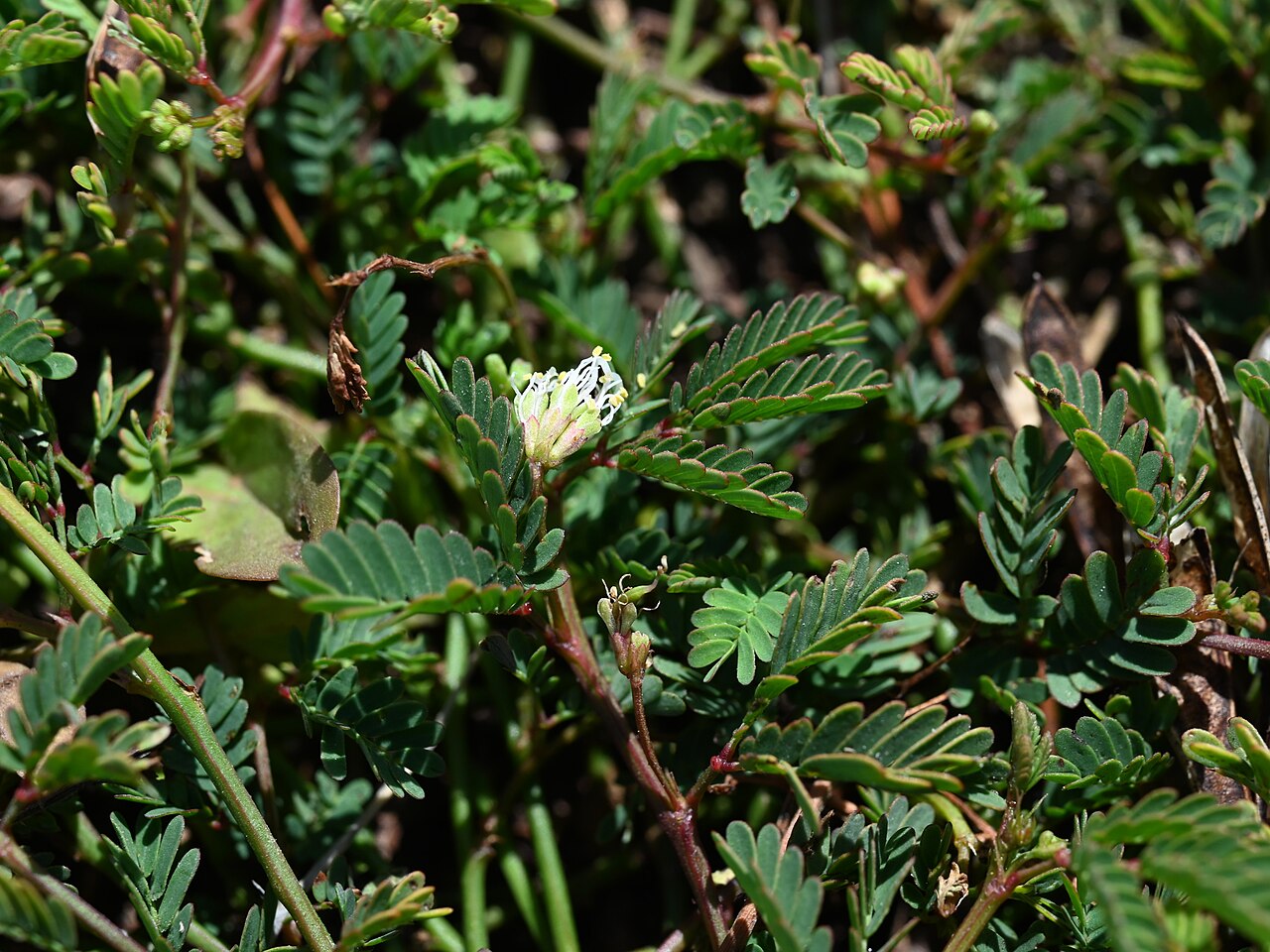
Stems are slender, smooth and often reddish-brown, upright to sprawling, branching from a woody base; plants may have dozens of stems. The leaves are twice-pinnate, 1 to 3 inches long, with 2 to 7 pairs of side branches, each bearing 10 to 25 pairs of tiny oblong leaflets about ⅛ to ⅓ inch long. A small, round gland sits on the leaf stalk just below the lowest pair of side branches. There are no prickles.
Flowers
Small, round heads of about 5 to 20 tiny white to greenish-white flowers, each with 10 protruding stamens, grow on short stalks from the leaf axils. In South Texas and Florida they bloom mainly from spring to fall; in Puerto Rico they bloom nearly year-round when there is moisture.
Fruit
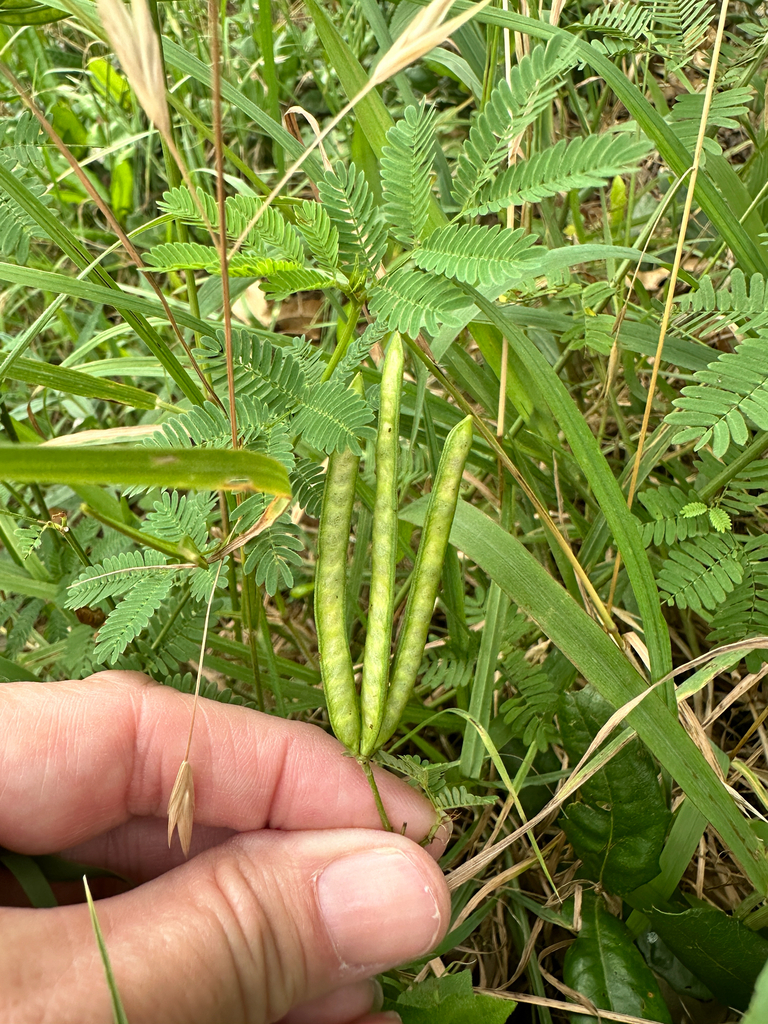
Each head produces a small cluster of 2 to 10 flat, linear pods, about 2 to 3½ inches long and ⅛ inch wide, straight, ripening reddish-brown to blackish. They split along both edges to release up to about 30 small, shiny brown seeds.
Look-alikes
Illinois bundleflower (D. illinoensis) is a herbaceous prairie plant with dense, round clusters of strongly curved pods. Prairie bundleflower (D. leptolobus) of the southern Plains is herbaceous with narrower pods. Sensitive plant and other mimosas have prickles and pink flower heads, and leadtrees (Leucaena) are trees with much larger heads and broad pods. Plants called D. pernambucanus, a closely related, weedier species, are often lumped with wild tantan; in Hawaiʻi and Guam, these are introduced.
Quick Facts
| Scientific Name | Desmanthus virgatus |
| Family | Fabaceae (legume family) |
| Plant Type | Woody-based perennial or small shrub, nitrogen-fixing |
| Mature Height | 1–5 ft (taller in the tropics) |
| Mature Spread | 1–3 ft |
| Growth Rate | Fast |
| Sun Exposure | Full sun |
| Water Needs | Low; very drought tolerant |
| Soil Type | Sandy, rocky, clay or limestone soils; well-drained |
| Soil pH | About 6.0–8.5 |
| Bloom Time | Spring–fall; nearly year-round in the tropics |
| Flower Color | White to greenish-white |
| Fall Color | None notable |
| Fruit | Slender, flat pods, 2–3½ in |
| Deer Resistant | No; browsed by deer and livestock |
| USDA Hardiness Zones | 9–13 |
Native Range
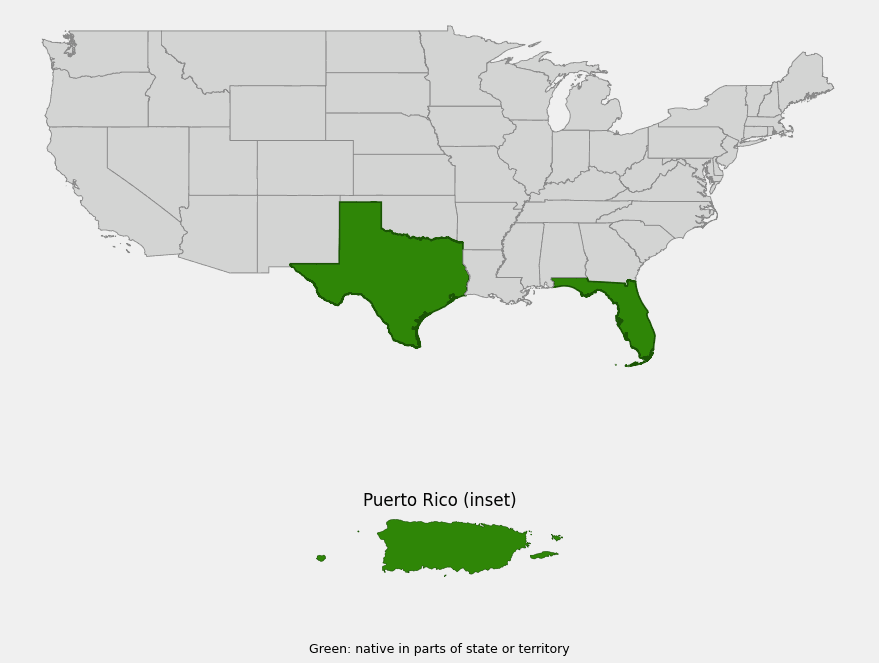
Wild tantan is native from the southern United States and Mexico through Central America and the Caribbean to South America. USDA PLANTS lists it as native in Florida, Texas, Puerto Rico and the U.S. Virgin Islands. Records from Hawaiʻi, Guam and other Pacific islands are introductions, mostly from forage plantings. A 2011 record from a vacant lot in Shreveport, Louisiana, appears to be a recent arrival rather than a native population, so Louisiana is not mapped here.
In Texas it grows mainly in the South Texas plains and the Rio Grande Valley, north into central Texas. In Florida it is found in the southern part of the state, including the Keys; botanists have long debated whether Florida populations are native or long-established arrivals from the Caribbean, but USDA treats them as native. In Puerto Rico it is widespread in the dry southern coastal lowlands and on offshore islands.
It grows in open, sunny places: brushland and thorn scrub, grasslands, coastal scrub and dunes, rocky limestone slopes, pastures, roadsides and disturbed ground. Its deep taproot lets it die back in drought, frost or fire and resprout when conditions improve, but it does not tolerate shade.
📋 Regional plant lists featuring Wild Tantan: North & South Florida · South & West Texas · Puerto Rico
Growing & Care Guide
Wild tantan is an easy, tough native for hot, dry, sunny gardens in South Texas, South Florida and Puerto Rico. It is fine-textured and informal, fixes nitrogen and needs almost no care once established. It is sold mainly as seed by forage and native seed suppliers rather than as nursery plants.
Light
Full sun. It becomes thin and flowers poorly in shade.
Soil & Water
Any well-drained soil, from sand and limestone rubble to clay. Water seedlings until they are established; after that it survives long droughts by dying back to its taproot and resprouting when rain returns. Avoid waterlogged soil.
Planting Tips
Sow scarified seed in spring or at the start of the rainy season, ¼ inch deep, or set out young plants 2 to 3 feet apart. It mixes well with native grasses and other drought-tolerant wildflowers in meadow and roadside plantings.
Pruning & Maintenance
Cut it back hard in late winter or after a drought to renew dense growth; it resprouts readily. It self-sows, so remove pods before they split if you want to limit seedlings.
Propagation
Grow from seed. The seeds have hard coats: nick them or soak them briefly in hot (not boiling) water, then sow. Germination is quick and seedlings grow fast in warm weather.
Landscape Uses
- Dry native gardens: a fine-textured, drought-proof filler for sunny beds in zones 9–13
- Wildlife plantings: seeds for quail and doves, foliage for deer and pollen for small bees
- Soil improvement: fixes nitrogen and holds soil on dry slopes and roadsides
- Forage: valued as a nutritious, drought-tolerant browse and forage legume for livestock
- Restoration: South Texas brushland, South Florida coastal scrub and Puerto Rico dry forest openings
Wildlife & Ecological Value
Wild tantan is a small but useful plant for wildlife in dry country.
For Pollinators
Its small white flower heads are visited by small native bees, wasps and flies for pollen and nectar. Like many legumes, its foliage and seeds are fed on by small native insects, which in turn feed birds and lizards.
For Birds
Bobwhite quail, scaled quail, doves and other ground-feeding birds eat the seeds, and the bushy plants give them cover.
For Mammals
White-tailed deer browse the protein-rich foliage, and small mammals eat the seeds. It is also palatable to cattle and goats.
Ecosystem Role
As a legume, it hosts nitrogen-fixing bacteria in its root nodules and adds nitrogen to poor soils. Its ability to resprout after drought, fire and grazing makes it a persistent part of brushland and grassland plant communities.
Cultural & Historical Uses
Linnaeus described this plant in 1753 as Mimosa virgata; Carl Ludwig Willdenow moved it to Desmanthus in 1806. The genus name means “bundle flower”, for the small, tight flower heads, and virgatus means twiggy or wand-like, for its slender stems.
The plant has a remarkable number of local names across the Caribbean and Latin America, including desmanto, frijolillo, guajillo, petit mimosa and ground tamarind, a sign of how familiar it is in pastures and roadsides there. Its sheer list of names reflects how widely it has been grazed, cut for fodder and walked past along roads for centuries.
Australian researchers have developed forage cultivars from wild tantan and its close relatives for tropical grazing lands, and it is now grown for livestock feed in Australia, India and other warm countries. Botanists have since split some of these forage plants into separate species, such as D. pernambucanus.
Frequently Asked Questions
Is wild tantan native to the United States?
Yes. USDA PLANTS lists it as native in Texas, Florida, Puerto Rico and the U.S. Virgin Islands. It is introduced in Hawaiʻi and Guam.
Is wild tantan the same as a mimosa?
It belongs to the same group of the legume family and looks similar, with feathery leaves and powder-puff flowers, but it has no prickles and its flowers are white rather than pink.
Is wild tantan invasive?
Not within its native range. Outside it, where it was planted as forage, it can spread along roadsides and pastures.
Is wild tantan good for livestock and deer?
Yes. Its leaves are high in protein and it is grown as a forage legume in many tropical countries. Deer browse it readily.
How do I grow wild tantan from seed?
Nick or soak the hard seeds in hot water, then sow in warm weather in full sun and well-drained soil. Seedlings grow quickly.


