
Mountain Fly Honeysuckle (Lonicera villosa)
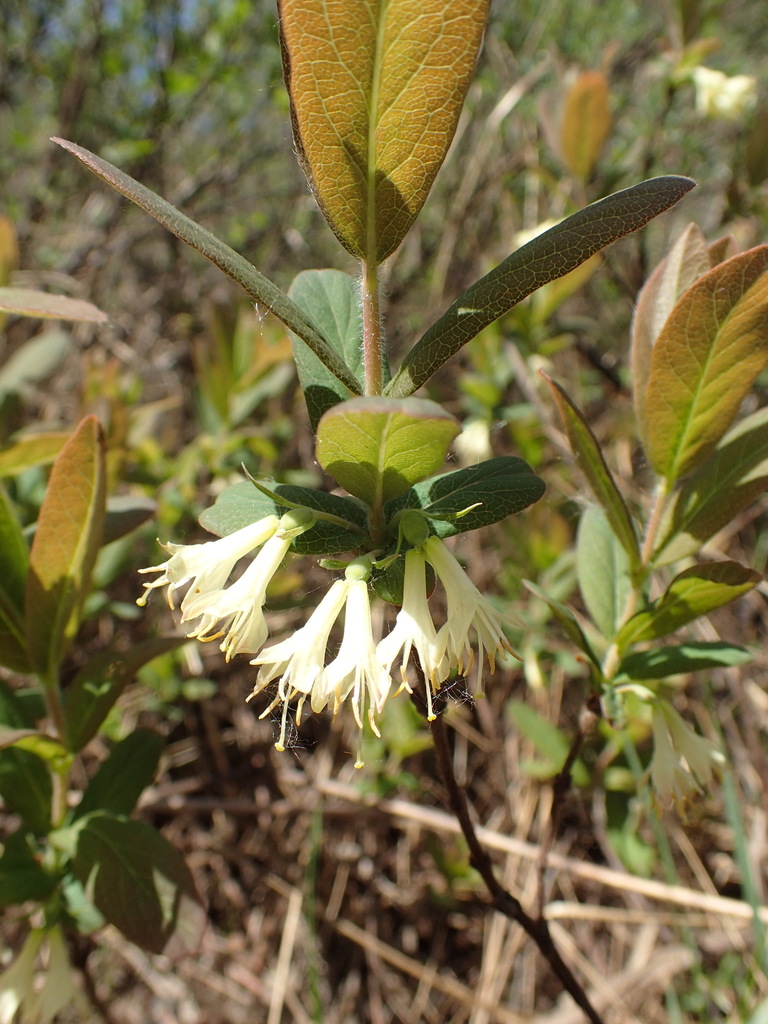
Lonicera villosa, known as Mountain Fly Honeysuckle or blue fly honeysuckle, is a small native shrub of bogs, fens, conifer swamps and cold, rocky places across northeastern North America. It is a low, upright shrub, usually 1 to 3 feet tall, with soft, hairy leaves and pairs of pale yellow flowers in late spring, followed in summer by sweet, dusty-blue berries.
It is the eastern North American counterpart of the honeyberry or haskap, the edible blue honeysuckle that has become popular as a fruit crop. Some botanists treat it as a variety of the circumpolar Lonicera caerulea, but USDA PLANTS keeps it as a separate species, while the western plants are covered on our Sweetberry Honeysuckle page.
Unlike the invasive Asian bush honeysuckles that crowd eastern woodlands, mountain fly honeysuckle is a modest, slow-growing native of cold, wet ground. This guide covers how to identify it, where it grows, and how it can be grown in northern gardens.
Identification
Mountain fly honeysuckle is a small shrub with hairy, oblong leaves, paired yellow flowers and distinctive blue berries that each develop from two flowers.
Growth Habit & Bark
A low, upright to spreading deciduous shrub, usually 1 to 3 feet tall and occasionally up to 5 feet. The branches are stiff, and the older bark is reddish-brown to gray and shreds in thin strips. Young twigs are often hairy.
Leaves
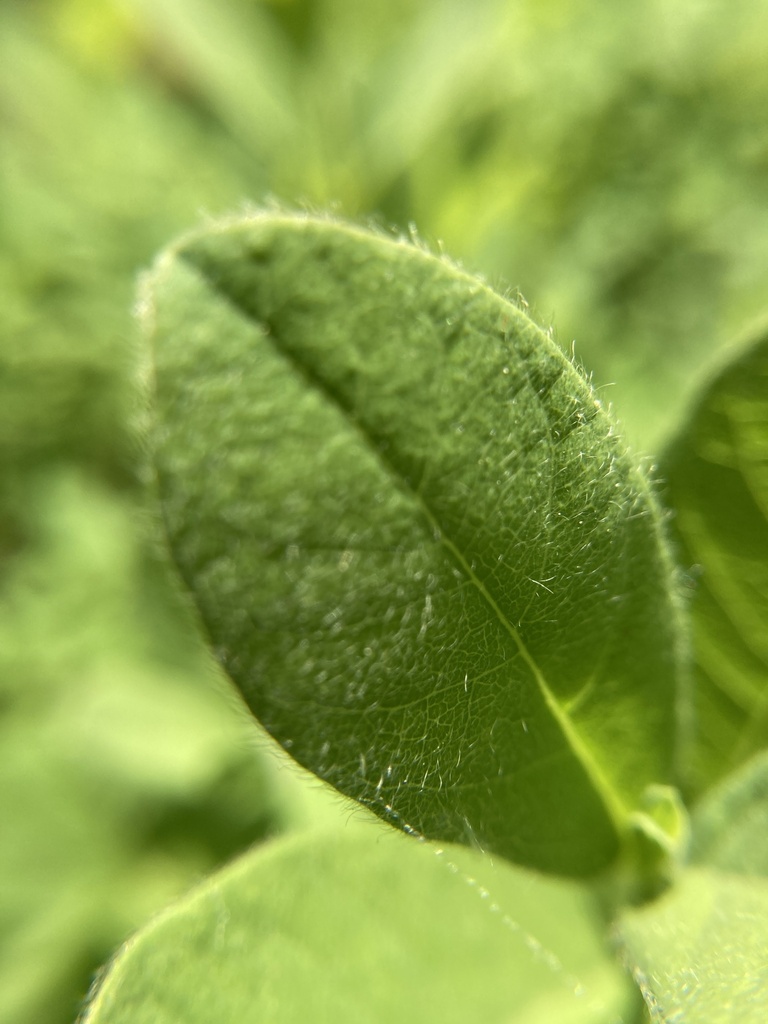
The leaves are opposite, simple, oblong to elliptic, about 1 to 2½ inches long, with smooth edges and blunt or rounded tips. They are dull, dark to bluish green and usually softly hairy on both sides, especially when young.
Flowers
In May and June, pale yellow, funnel-shaped flowers about ½ inch long open in pairs on short stalks from the leaf axils. The two flowers of each pair share a single fused base, the joined ovaries.
Fruit & Look-alikes
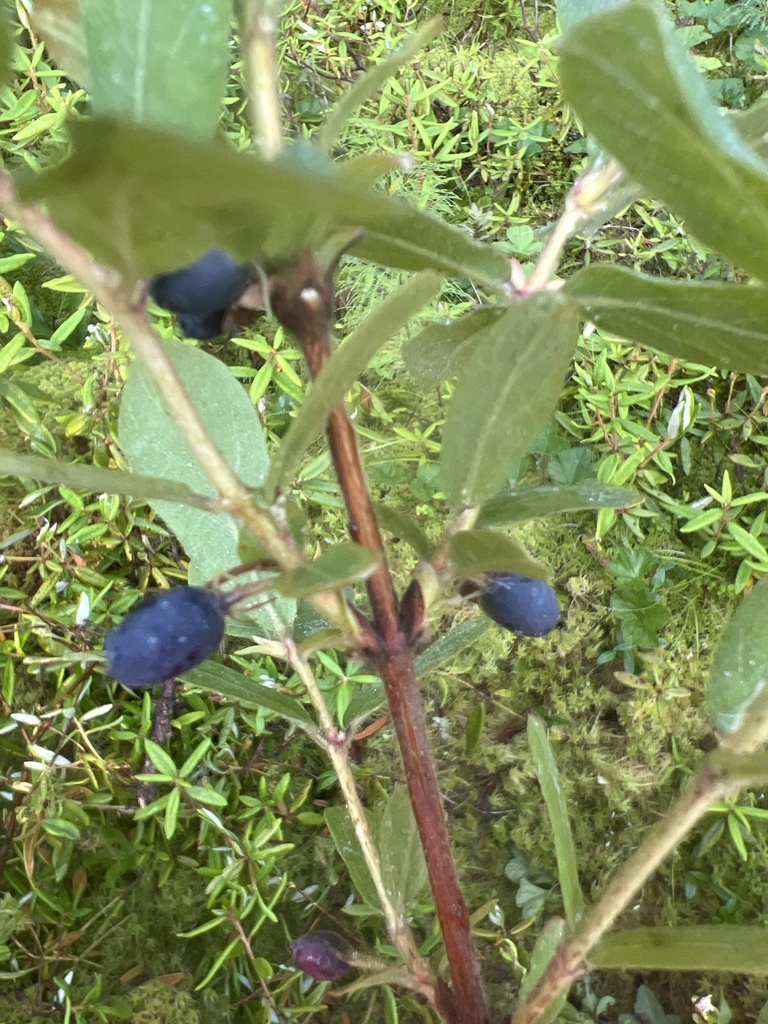
Each pair of flowers produces a single oblong, dusty-blue berry about ⅓ to ½ inch long, ripening in July and August. Two small scars at the tip show where the two flowers were attached. American Fly Honeysuckle (Lonicera canadensis) grows in shadier forests, has thinner, fringed leaves and produces paired red berries that are separate. The invasive Asian bush honeysuckles are larger shrubs with hollow stems and red or orange berries.
Quick Facts
| Scientific Name | Lonicera villosa (syn. Lonicera caerulea var. villosa) |
| Family | Caprifoliaceae (honeysuckle family) |
| Plant Type | Low deciduous shrub |
| Mature Height | 1–3 ft (occasionally to 5 ft) |
| Mature Spread | 2–4 ft |
| Growth Rate | Slow |
| Sun Exposure | Full sun to part shade |
| Water Needs | Moist to wet; tolerates seasonal saturation |
| Soil Type | Peat, wet sand or gravel, rocky soil over bedrock |
| Soil pH | Acidic to near neutral |
| Bloom Time | May–June |
| Flower Color | Pale yellow |
| Fall Color | Not notable |
| Fruit | Edible, oblong, dusty-blue berry formed from two fused ovaries |
| Deer Resistant | Low to moderate; browsed occasionally |
| USDA Hardiness Zones | 2–6 |
Native Range
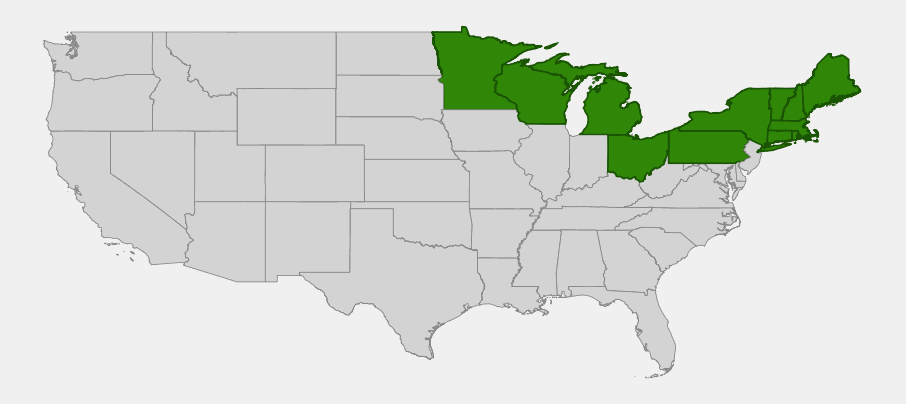
Mountain fly honeysuckle is native to northeastern North America. USDA PLANTS lists it in Maine, New Hampshire, Vermont, Massachusetts, Rhode Island, Connecticut, New York, Pennsylvania, Ohio, Michigan, Wisconsin and Minnesota. In Canada it ranges widely from Newfoundland, Labrador and the Maritime Provinces west through Quebec and Ontario to Manitoba, Saskatchewan and Alberta.
It is most common in northern New England, northern New York, the upper Great Lakes region and boreal Canada. Toward the southern edge of its range, in southern New England, Pennsylvania and Ohio, it becomes rare and is restricted to scattered bogs and other cold sites, where several states track it as a rare plant.
Its habitats include open bogs and fens, the edges of black spruce and tamarack swamps, wet shores, cold ravines and rocky ledges. In the northern Appalachians it also grows on exposed rocky summits and in subalpine areas, which explains the common name “mountain” fly honeysuckle.
📋 Regional plant lists featuring Mountain Fly Honeysuckle: New Hampshire, Maine & Vermont · Connecticut, Massachusetts & Rhode Island · New York, Pennsylvania & Northern New Jersey · Delaware, Southern New Jersey & Long Island · Ohio & Indiana · Michigan, Wisconsin & Eastern Minnesota · North Dakota, South Dakota & Western Minnesota
Growing & Care Guide
Mountain fly honeysuckle is rarely sold under its own name, but a few native nurseries in the Northeast and upper Midwest offer it. Never dig plants from bogs or rare-plant sites.
Light
Full sun to part shade. It fruits best in sun, but in warmer areas it appreciates some afternoon shade.
Soil & Water
It grows naturally in wet, acidic, low-nutrient soils, but in gardens it adapts to evenly moist, well-drained, slightly acidic soil rich in organic matter. Keep the soil from drying out in summer. It is best suited to cold climates and struggles in hot, humid summers.
Planting Tips
Plant in spring or fall, 2 to 3 feet apart, in a rain garden, the moist edge of a pond, a bog garden or a cool, partly shaded border. For good fruit set, plant at least two genetically different plants, because blue honeysuckles generally need cross-pollination.
Pruning & Maintenance
Little pruning is needed. Remove old, unproductive stems at the base in late winter to keep the shrub vigorous. Protect ripening berries with netting if you want to harvest them before the birds do.
Propagation
Grow it from seed cleaned from ripe berries and given two to three months of cold, moist stratification, or from softwood cuttings in early summer. Low branches can also be layered.
Landscape Uses
- Bog and rain gardens: for cold, moist, acidic sites
- Edible native landscaping: sweet blue berries in midsummer
- Wetland restoration: bogs, fens and shoreline plantings in the North
- Wildlife gardens: early flowers for bumblebees and berries for birds
Wildlife & Ecological Value
Mountain fly honeysuckle is part of the shrub layer of northern bogs and fens and offers food at both ends of the growing season.
For Pollinators
Its early flowers provide nectar and pollen for queen bumblebees and other early-season bees, which are the main pollinators of blue honeysuckles.
For Birds
Cedar waxwings, robins, thrushes, grouse and other birds eat the berries, and the low shrubs provide cover in open bogs.
For Mammals
Bears, foxes and small mammals eat the fruit, and moose, deer and hares sometimes browse the twigs.
Ecosystem Role
It is one of the characteristic shrubs of northern peatlands and contributes to their diverse shrub layer. Native honeysuckles like this one support native wildlife without the invasive behavior of Asian bush honeysuckles.
Cultural & Historical Uses
André Michaux first described the species in 1803 as Xylosteon villosum, and it was later moved to Lonicera. The species name villosa means “shaggy” or “with long soft hairs,” referring to the hairy leaves and twigs.
Its sweet berries are eaten by northern foragers, and they taste similar to blueberries with a slightly tart finish. The berries are sometimes mistaken for blueberries, although they are elongated and form from two fused flowers.
The blue honeysuckle group, which also includes the Eurasian Lonicera caerulea, is the source of modern haskap and honeyberry cultivars. Breeding programs, notably at the University of Saskatchewan, have developed hardy fruiting varieties for cold climates, mainly from Russian and Japanese blue honeysuckles.
Frequently Asked Questions
Are mountain fly honeysuckle berries edible?
Yes. The ripe blue berries are edible and sweet to slightly tart. Be sure of your identification: other honeysuckles, including the invasive bush honeysuckles, have red or orange berries that are not edible.
Is mountain fly honeysuckle the same as haskap?
It is closely related. Haskap is usually Lonicera caerulea in the broad sense, and some botanists treat mountain fly honeysuckle as a North American variety of that species. USDA PLANTS lists it as a separate species, Lonicera villosa.
Where does it grow?
In bogs, fens, conifer swamps, wet shores and cold rocky places from Newfoundland to Alberta, south to New England, New York, Pennsylvania, Ohio and the upper Great Lakes states.
Is it invasive like other bush honeysuckles?
No. It is a slow-growing native shrub. The invasive bush honeysuckles of eastern forests are Asian species such as Amur, Morrow’s and Tatarian honeysuckle.
Can I grow it in my garden?
Yes, in cold climates with moist, acidic soil and full sun to part shade. Plant two or more plants for better fruit set.

Looking for a nursery that carries Mountain Fly Honeysuckle?
Browse our native plant nursery directory: Connecticut · Maine, Massachusetts, Michigan & Minnesota · New Hampshire, New York & Ohio · Pennsylvania, Rhode Island & Vermont · Wisconsin

