
Glade Spurge (Euphorbia purpurea)
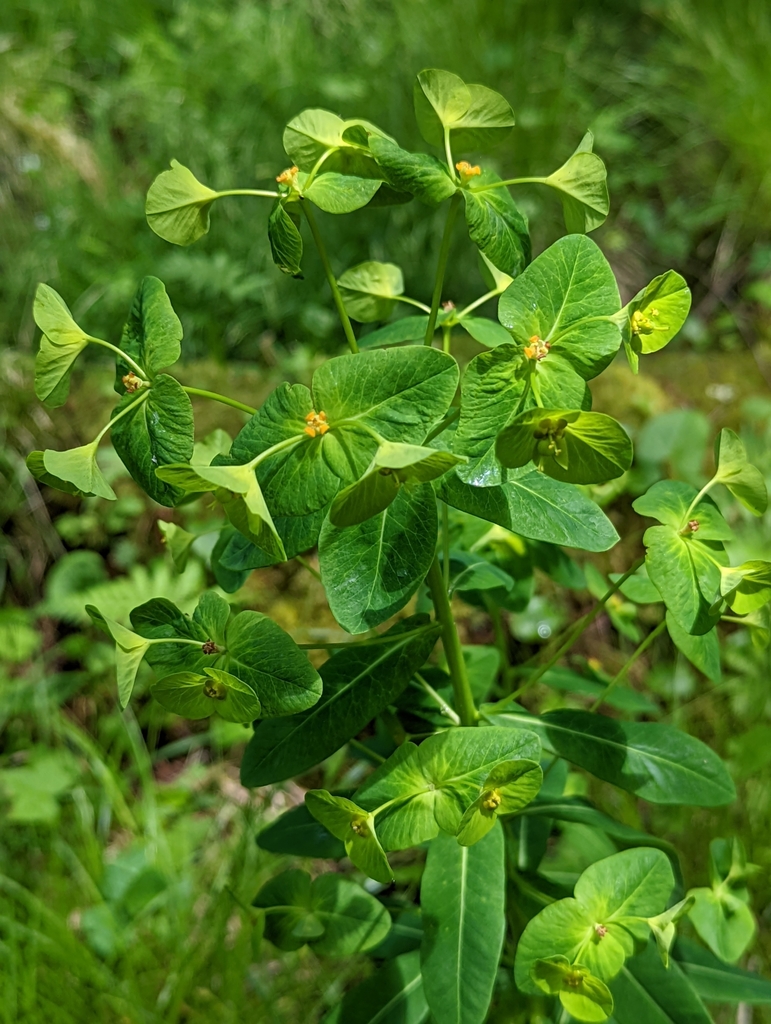
Euphorbia purpurea, known as Glade Spurge, Darlington’s glade spurge or purple spurge, is a rare perennial wildflower of moist woods, seeps and stream banks in the central Appalachians and Mid-Atlantic region of the eastern United States. It is one of the largest native spurges in the East: from a thick rhizome it sends up leafy stems 2 to 4 feet tall, crowned in spring by branched clusters of yellow-green bracts that look much like the European garden euphorbias.
Glade spurge is uncommon throughout its range, with only a few dozen known populations, and it is tracked as rare, threatened or endangered in most of the states where it grows. Some historical populations have disappeared, and it has been lost from parts of its former range. NatureServe ranks it as vulnerable globally.
Like all spurges, it has a milky sap that irritates skin and eyes, so it should be handled with gloves. This guide covers how to identify glade spurge, where it grows, how it can be grown from nursery-propagated plants, and why it matters for conservation.
Identification
Glade spurge is the only large, clump-forming native spurge with showy yellow-green bracts in the moist woods of the central Appalachians.
Leaves & Growth Habit
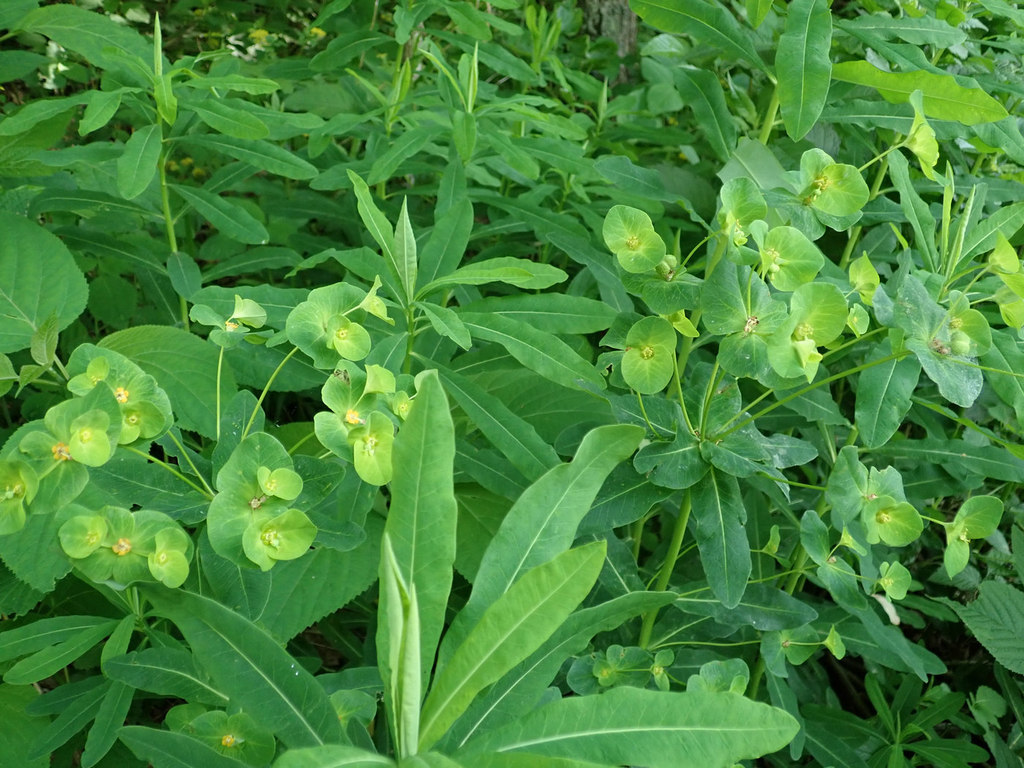
A robust herbaceous perennial from a thick, tuberous rhizome, forming clumps of stout, unbranched stems 2 to 4 feet tall. The leaves are alternate along the stem, oblong to lance-shaped, about 2 to 4 inches long, smooth-edged and often slightly hairy beneath. Just below the flower clusters, the stem carries a whorl of leaves. Every part of the plant contains a milky latex sap.
Flowers
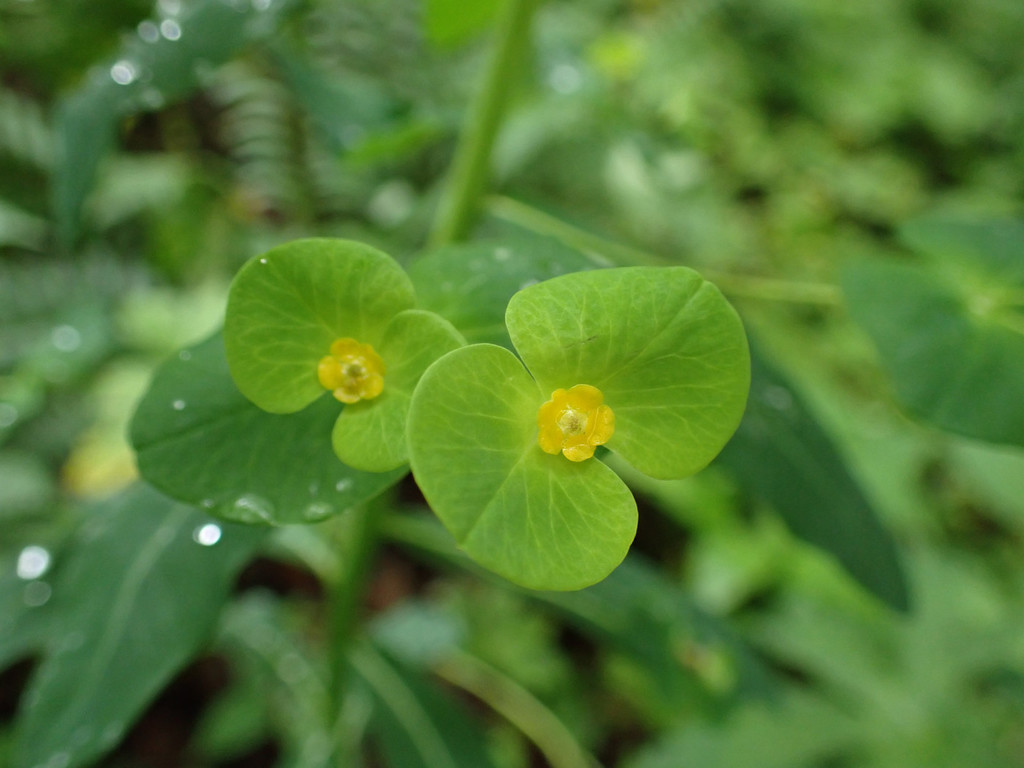
Flowering runs from late April to June. The stem ends in an umbrella-like cluster of several rays that fork repeatedly. Each fork carries a pair of broad, rounded, yellow-green bracts that cup the tiny flower structures (cyathia), which have four small orange-yellow glands around a single female flower and several male flowers. As in other spurges, the showy color comes from the bracts, not from petals. Despite the species name purpurea (“purple”), the bracts are yellow-green.
Fruit
The fruit is a three-lobed capsule about ¼ inch long, covered with small wart-like bumps. When ripe it splits explosively, flinging its seeds a short distance.
Look-alikes
It resembles several Eurasian garden spurges, such as cushion spurge (Euphorbia epithymoides), but those are not native and rarely escape into moist mountain woods. Leafy spurge and cypress spurge, both invasive, have much narrower leaves. The native Flowering Spurge grows in dry, open places and has white “petals” (bracts). Wood spurge (Euphorbia commutata) is a smaller, short-lived plant of rocky woods. Out of flower, glade spurge can be mistaken for a milkweed or a large bellwort, but its milky sap and whorled upper leaves are distinctive.
Quick Facts
| Scientific Name | Euphorbia purpurea (syn. Euphorbia darlingtonii, Tithymalus purpureus) |
| Family | Euphorbiaceae (spurge family) |
| Plant Type | Clump-forming herbaceous perennial |
| Mature Height | 2–4 ft |
| Mature Spread | 1½–2 ft |
| Growth Rate | Moderate |
| Sun Exposure | Partial shade to full sun |
| Water Needs | Moist to wet; tolerates seeps and saturated soil |
| Soil Type | Rich loam, mucky or rocky soils; often over limestone or mafic rock |
| Soil pH | Slightly acidic to alkaline |
| Bloom Time | Late April–June |
| Flower Color | Yellow-green bracts with orange-yellow glands |
| Fall Color | Foliage may yellow before dying back |
| Fruit | Warty three-lobed capsule |
| Deer Resistant | Partly; toxic latex, but deer and groundhogs have been recorded browsing it |
| USDA Hardiness Zones | 5–7 |
Native Range
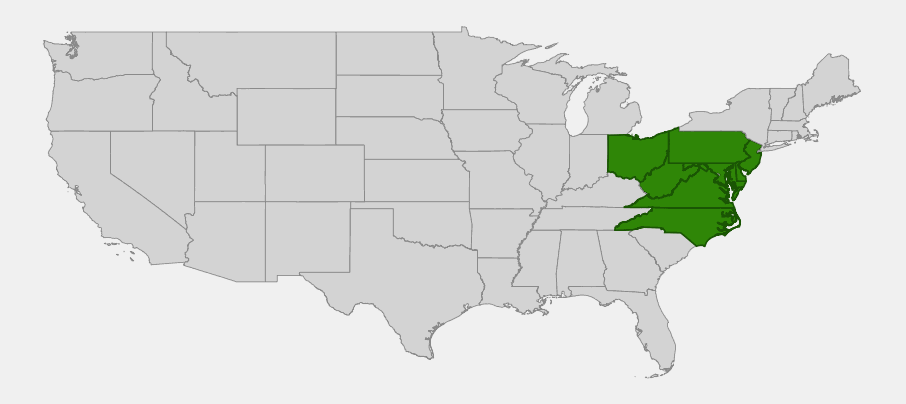
Glade spurge is endemic to the eastern United States. USDA PLANTS lists it in Ohio, Pennsylvania, New Jersey, Delaware, Maryland, Virginia, West Virginia and North Carolina, and it has also been reported from the mountains of extreme northern Georgia. Most surviving populations are in the Appalachians of West Virginia, western Maryland, Virginia and western North Carolina, with a few in Ohio and Pennsylvania.
In New Jersey and Delaware it is known mainly from historical records; in Delaware a population was rediscovered in 1997 after the species was thought to be lost from the state. Several historical populations in eastern Pennsylvania were eliminated by grazing and development.
It grows in moist, rich deciduous woods, wooded swamps, seepy slopes, stream banks and the edges of wet meadows and mountain glades, often in saturated soil near springs. It can also grow on drier wooded slopes, and in both shade and sun. Threats include the draining and filling of wetlands, logging, invasive plants, heavy browsing by deer, and the loss of the open, lightly disturbed conditions it favors.
📋 Regional plant lists featuring Glade Spurge: Delaware, Southern New Jersey & Long Island · Ohio & Indiana · Maryland, Virginia & West Virginia · North & South Carolina · New York, Pennsylvania & Northern New Jersey
Growing & Care Guide
Glade spurge is rare in the wild, so buy only nursery-propagated plants from reputable native plant nurseries and never dig or collect it from wild populations. It is occasionally offered by Mid-Atlantic and Appalachian native plant specialists, and it is easily propagated from cuttings. Safety note: the milky sap can cause skin irritation, rashes and severe eye irritation; wear gloves when handling or cutting it, avoid touching your eyes, and keep it away from pets and children who might chew it.
Light
Partial shade is ideal, especially in hot climates; it also grows in full sun where the soil stays moist.
Soil & Water
Give it rich, moist to wet soil that does not dry out in summer. It does well in rain gardens, along streams or in a damp woodland garden, and tolerates seasonally saturated soil. Mulch with leaf litter to keep the roots cool and moist.
Planting Tips
Plant in spring or early fall, spacing plants 2 feet apart. It combines well with ferns, sedges and woodland wildflowers such as Jacob’s ladder and phlox. Because of its toxic sap, plant it away from play areas.
Pruning & Maintenance
Cut stems back to the ground after they die down in fall, wearing gloves. Remove spent flower stalks before the capsules open if you want to limit self-seeding. Protect young plants from deer and groundhogs, which sometimes browse it despite the latex.
Propagation
Take stem cuttings in late spring or early summer; rinse the latex from the cut ends and root them in a moist, well-drained mix, where they root readily. Mature clumps can be divided in early spring. Seed can be sown fresh in fall; collect the capsules before they burst by tying a small mesh bag over them.
Landscape Uses
- Woodland and rain gardens: bold yellow-green spring color in moist shade
- Conservation plantings: growing nursery-propagated plants of a rare native
- Streamside and seep plantings: within its native range
- Native alternative: to non-native garden euphorbias
Wildlife & Ecological Value
Glade spurge is a rare member of the moist woodland and seep communities of the central Appalachians.
For Pollinators
The open cyathia offer easily reached nectar from their glands, attracting small bees, flies, wasps and beetles in spring.
For Birds
Its seeds are eaten by some ground-feeding birds, as are those of other spurges, but it is too rare to be a significant food source.
For Mammals
White-tailed deer and groundhogs browse it, and heavy browsing is considered one of the threats to remaining populations.
Ecosystem Role
It is part of the specialized plant community of mountain seeps and wet woods, often over calcium-rich soils, where it grows with other uncommon plants. It appears to benefit from light disturbance that keeps taller competitors in check, while overgrazing and trampling harm it.
Cultural & Historical Uses
Constantine Rafinesque first described this plant in the early 1800s, and Merritt Lyndon Fernald later transferred it to Euphorbia as E. purpurea. It was also described as Euphorbia darlingtonii, named for the Pennsylvania botanist William Darlington, which is why it is sometimes called Darlington’s glade spurge.
The name “spurge” comes from the Old French espurge, “to purge,” because many spurges were once used as strong laxatives. The genus name Euphorbia honors Euphorbus, physician to the ancient North African king Juba II.
As one of the rarest wildflowers of the central Appalachians, glade spurge is a focus of state natural heritage programs, and several of its populations are protected on public conservation lands, where managers monitor them and control deer browsing and invasive plants.
Frequently Asked Questions
Is glade spurge rare?
Yes. Only a few dozen populations are known, and it is tracked as rare, threatened or endangered in most of the states where it grows. Buy only nursery-propagated plants and never collect it from the wild.
Is glade spurge poisonous?
Yes. Like other spurges, it has a milky latex sap that can irritate skin and seriously irritate the eyes, and the plant is toxic if eaten. Wear gloves when handling it.
Why is it called purple spurge if the flowers are yellow-green?
The species name purpurea means “purple,” but its showy bracts are yellow-green. The common name glade spurge, for its mountain glade habitat, is more descriptive.
Where does glade spurge grow?
In moist woods, seeps and stream banks of the central Appalachians and Mid-Atlantic, from Ohio and Pennsylvania south to North Carolina.
Can I grow glade spurge in my garden?
Yes, in partial shade and moist, rich soil within its native region. It roots readily from cuttings, so nursery propagation is easy; just remember to handle it with gloves.

Looking for a nursery that carries Glade Spurge?
Browse our native plant nursery directory: Delaware · Maryland · New Jersey, North Carolina & Ohio · Pennsylvania & Virginia · West Virginia

