Blue Mistflower Seedlings or Weeds? What to Look for Before Pulling
Last updated: November 5, 2026
Small green plants are popping up around your blue mistflower patch, and some of them are a long way from it. Are they new mistflower plants, or weeds you should pull?
It matters either way. Pull the wrong ones and you lose free plants. Leave the wrong ones and you’re feeding a weed problem, or letting a toxic look-alike settle in.
This guide shows you the features that separate young blue mistflower from the plants most often confused with it, and how to decide what to do with each.
The Short Answer
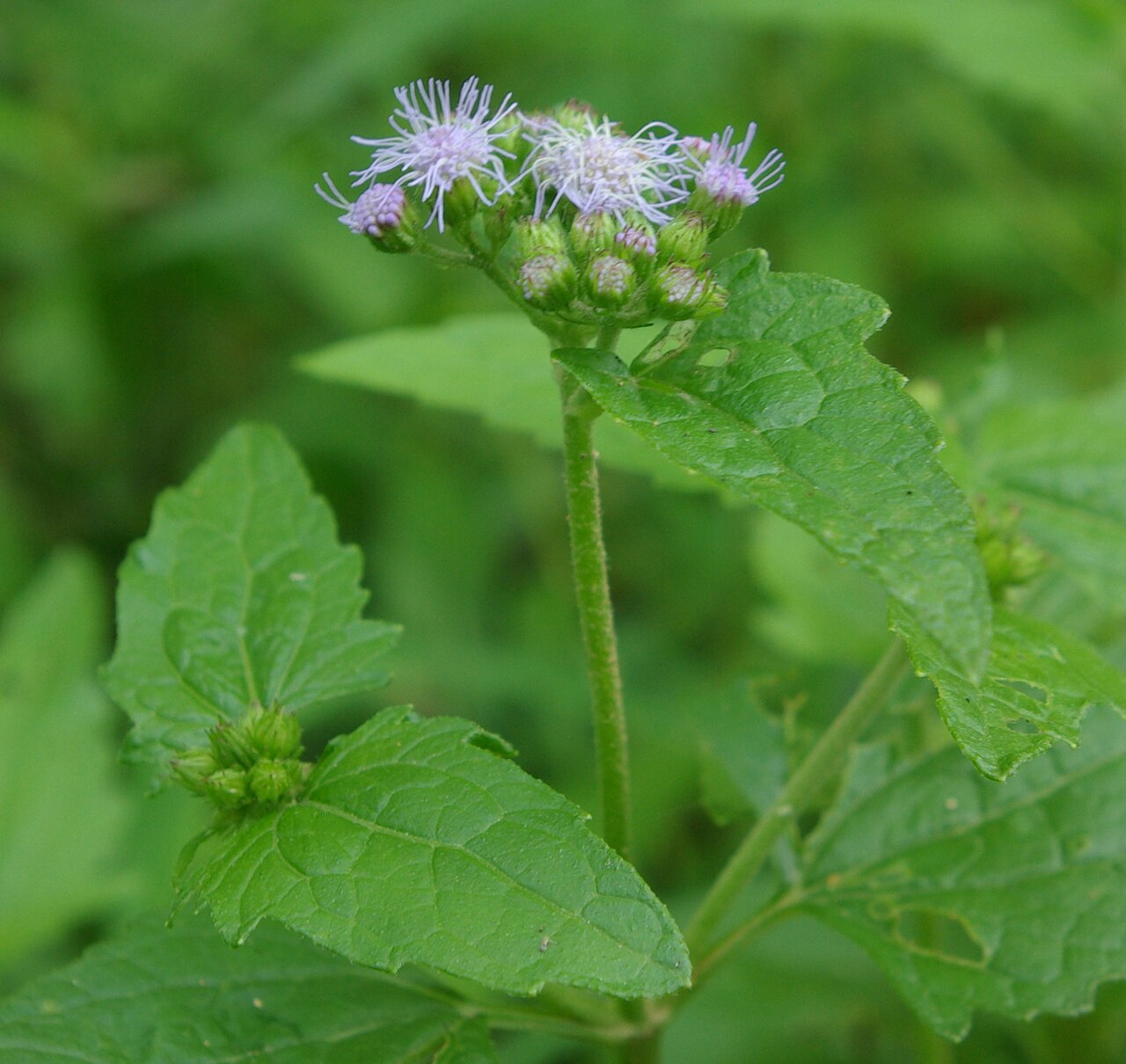
Young blue mistflower (Conoclinium coelestinum) has:
- Leaves in opposite pairs, roughly triangular, with blunt, rounded teeth.
- Short leaf stalks and a visible network of veins on the upper surface.
- A round stem, often finely hairy and sometimes purplish, not square.
- Shoots connected by shallow runners when they come up next to the patch.
Square stems point to mint-family weeds. Long, sharply toothed leaves on smooth stems point to white snakeroot. When in doubt, wait a few weeks before pulling.
Where New Mistflower Plants Come From
Blue mistflower makes new plants two ways, and each looks different in the garden.
Rhizome shoots. Illinois Wildflowers describes the root system as highly rhizomatous. Underground stems run out from the patch and send up shoots. These appear right next to the parent plants, often in a line, and they grow fast because they’re fed by the parent.
Seedlings. After bloom, the florets turn into small seeds with tufts of hair that blow in the wind, according to Illinois Wildflowers. The Missouri Botanical Garden and NC State Extension both note that the plant self-seeds. Seedlings can turn up several feet or more from the patch, usually in bare or disturbed soil.
The Lady Bird Johnson Wildflower Center notes that the seed benefits from a period of cold, moist conditions. That fits what many gardeners see: self-sown seedlings mostly appear in spring, after a winter outdoors.
Blue Mistflower ID Features
| Leaf arrangement | Opposite, in pairs along the stem. |
| Leaf shape | Triangular to oval, up to about 3 inches long, with a blunt or squared-off base. |
| Leaf edge | Coarse, blunt, rounded teeth. |
| Leaf surface | Light to mid green with an obvious network of veins. |
| Leaf stalk | Short and slender. |
| Stem | Round, finely hairy, green to purplish. |
These features come from the Missouri Botanical Garden, NC State Extension, Illinois Wildflowers, and the Wildflower Center. All of them are easier to see once a plant has a few pairs of true leaves.
Check 1: Wait for the True Leaves
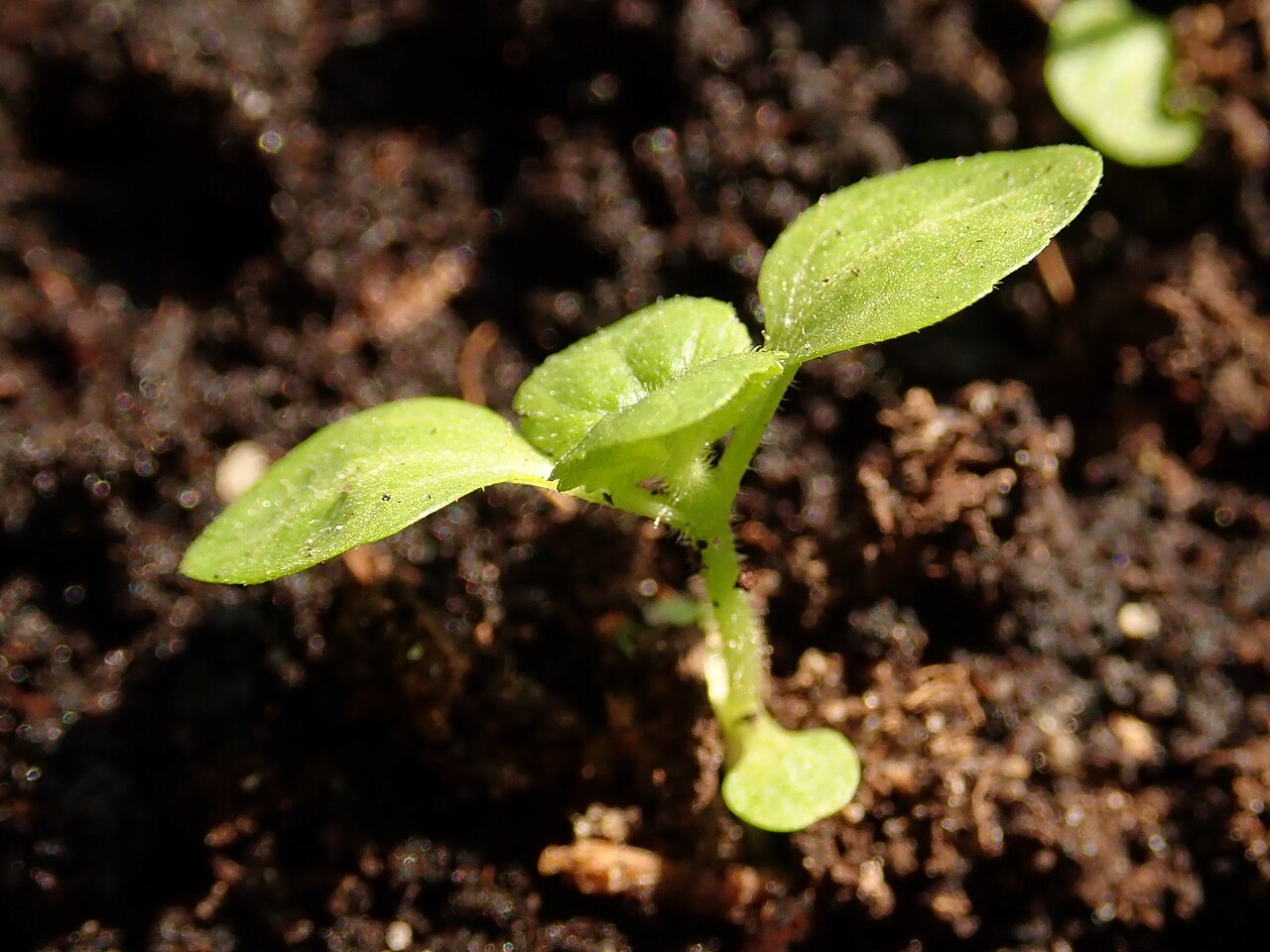
The first leaves a seedling shows are its seed leaves, or cotyledons. They’re small and simple, and they look much like the seed leaves of many other plants, including weeds.
Don’t try to identify anything at that stage. Wait until the seedling has at least two or three pairs of true leaves, the ones with the teeth and veins. That usually takes a few weeks in spring.
If you weed on a schedule, mark suspicious seedlings with a stick or a plant label and come back to them. A few weeks of waiting costs nothing.
Check 2: Roll the Stem Between Your Fingers
This is the fastest test and it rules out a lot of common weeds.
Gently roll a stem between your thumb and finger. Blue mistflower has a round stem. Illinois Wildflowers describes it as terete, which means round in cross-section, and Wikipedia’s species account calls the stems round as well.
If the stem feels square, with four distinct edges, it’s almost certainly in the mint family. Ground ivy and purple deadnettle, two common lawn and garden weeds with opposite, toothed leaves, both have square stems.
Check 3: Look Closely at a Leaf
Pick a mature leaf from a few pairs up the stem and compare it to the ID features above.
The Missouri Botanical Garden describes the leaves as coarsely toothed and ovate-deltoid, which means somewhere between oval and triangular, up to 3 inches long. The Wildflower Center and Wikipedia both note the teeth are blunt. Illinois Wildflowers and NC State point out the conspicuous network of veins on the upper surface.
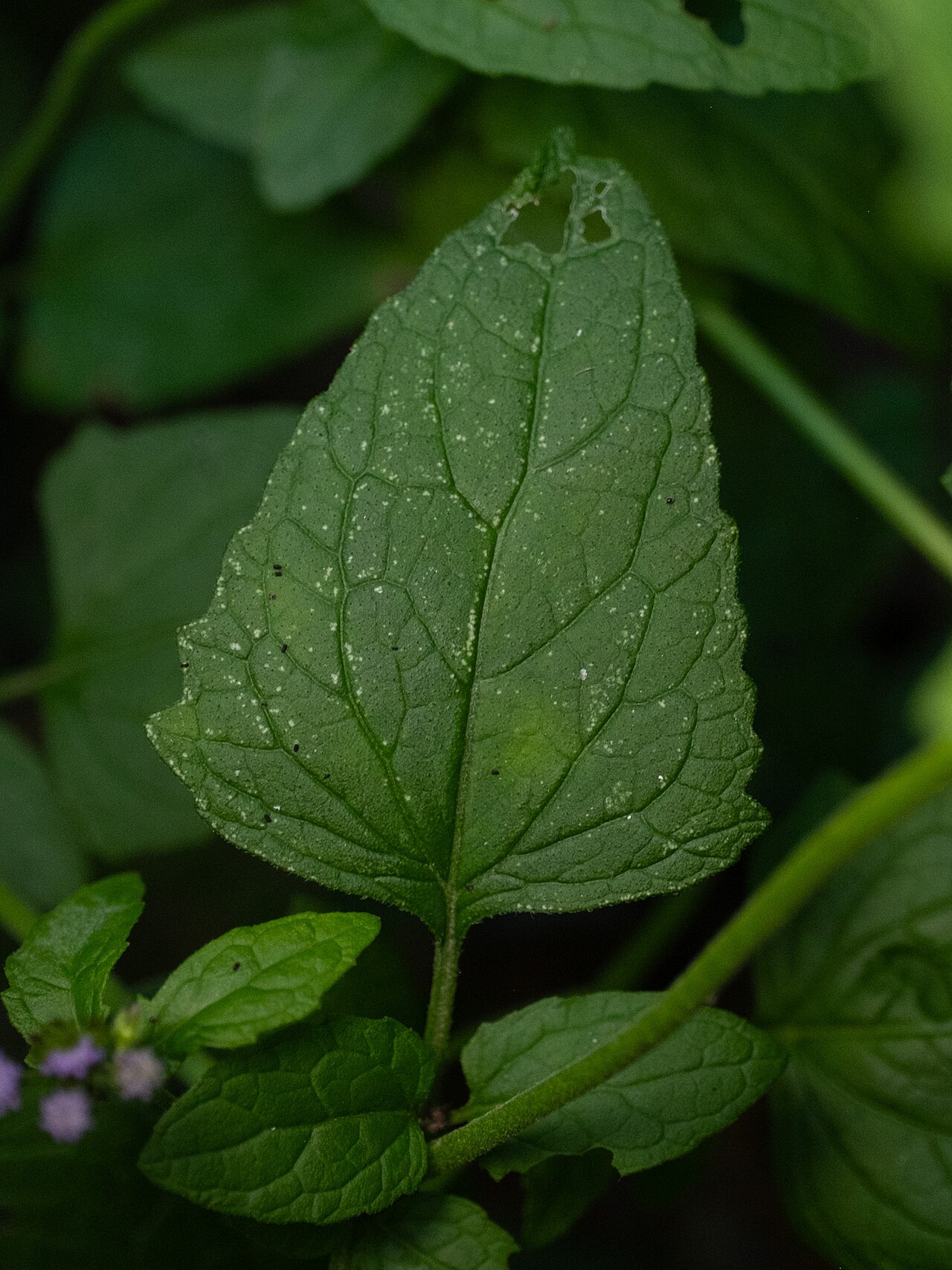
Check where the leaf meets the stem, too. Blue mistflower has short, slender leaf stalks. Leaves on very long stalks, or with no stalk at all, suggest a different plant.
Check 4: Rule Out White Snakeroot
White snakeroot (Ageratina altissima) is the look-alike that matters most. It’s a native relative that grows in many of the same eastern gardens, it spreads by wind-blown seed, and it’s toxic.
Young plants of the two can look similar: opposite, toothed, roughly triangular leaves on upright stems. Look for these differences:
- Leaf edges: white snakeroot leaves are sharply serrated, according to Wikipedia. Mistflower’s teeth are blunter and rounder.
- Leaf size: white snakeroot leaves can reach about 6 inches long. Mistflower leaves top out around 3 inches.
- Stems: white snakeroot stems are smooth. Mistflower stems are finely hairy.
- Flowers: the giveaway in late summer. White snakeroot has clean white flower clusters. Mistflower’s are blue to lavender.
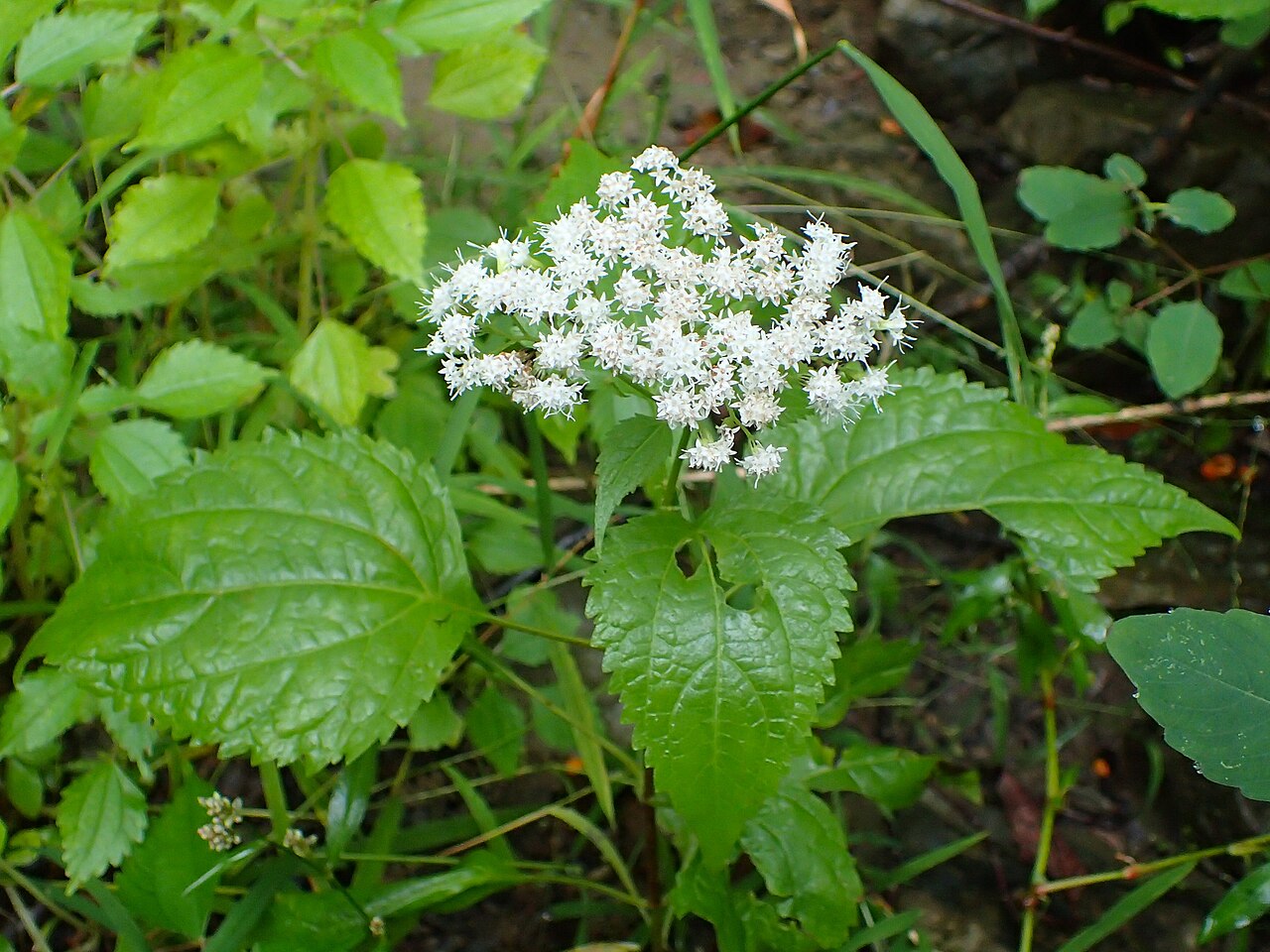
White snakeroot contains a toxin called tremetol. Cattle that eat it pass the toxin into their milk and meat, which historically caused “milk sickness” in people. If you keep livestock, remove it from pastures. In any garden, don’t let children or pets chew on unknown seedlings.
That said, white snakeroot is a native plant that feeds many late-season insects. In a shady woodland edge without livestock, many gardeners leave some. Just don’t mistake it for mistflower and transplant it into a sunny bed.
Check 5: Rule Out Annual Ageratum
The Missouri Botanical Garden notes that blue mistflower looks like annual ageratum, which is why mistflower is sometimes sold as “hardy ageratum.” Annual ageratum (Ageratum houstonianum), also called floss flower, is a bedding plant from Mexico and Central America.
Wikipedia describes its leaves as oval to triangular, much like mistflower’s, and its blue flowers come in similar fuzzy clusters. It has also escaped cultivation and become weedy in some warm regions, including the southern United States.
The two are hard to separate as young plants. Use context:
- If you or a neighbor grew annual ageratum last year, seedlings near those beds may be ageratum.
- Annual ageratum doesn’t spread by underground runners. Mistflower shoots near the patch are connected by rhizomes.
- Mistflower comes back from its roots after winter. Annual ageratum dies at frost.
If you can’t tell, let it grow. By the time it flowers or survives a winter, the answer will be clear.
Check 6: Rule Out Mint-Family Weeds
Two common weeds with opposite, toothed leaves trip people up in early spring, when mistflower seedlings are also appearing.
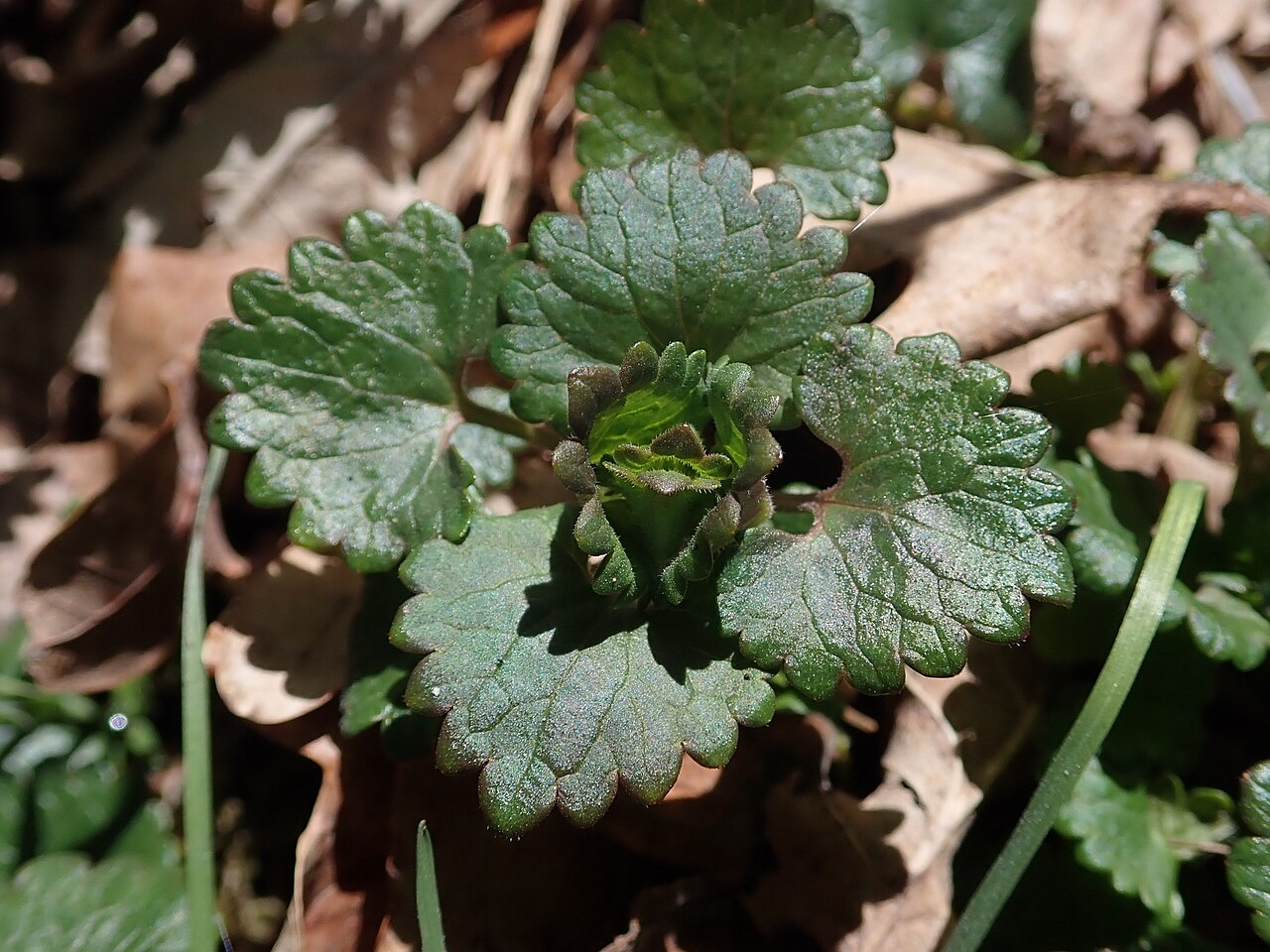
Ground ivy (Glechoma hederacea), also called creeping Charlie, has round to kidney-shaped leaves with scalloped edges on long leaf stalks. Its square stems creep along the ground and root at the nodes, according to Wikipedia. It’s a non-native plant considered an aggressive invasive weed of lawns and woodlands in parts of North America.
Purple deadnettle (Lamium purpureum) is a small annual from Eurasia with square stems usually 2 to 8 inches tall. Its upper leaves often shade to purple, and it can flower even in mild winter weather, according to Wikipedia. Henbit, a close relative, looks very similar.
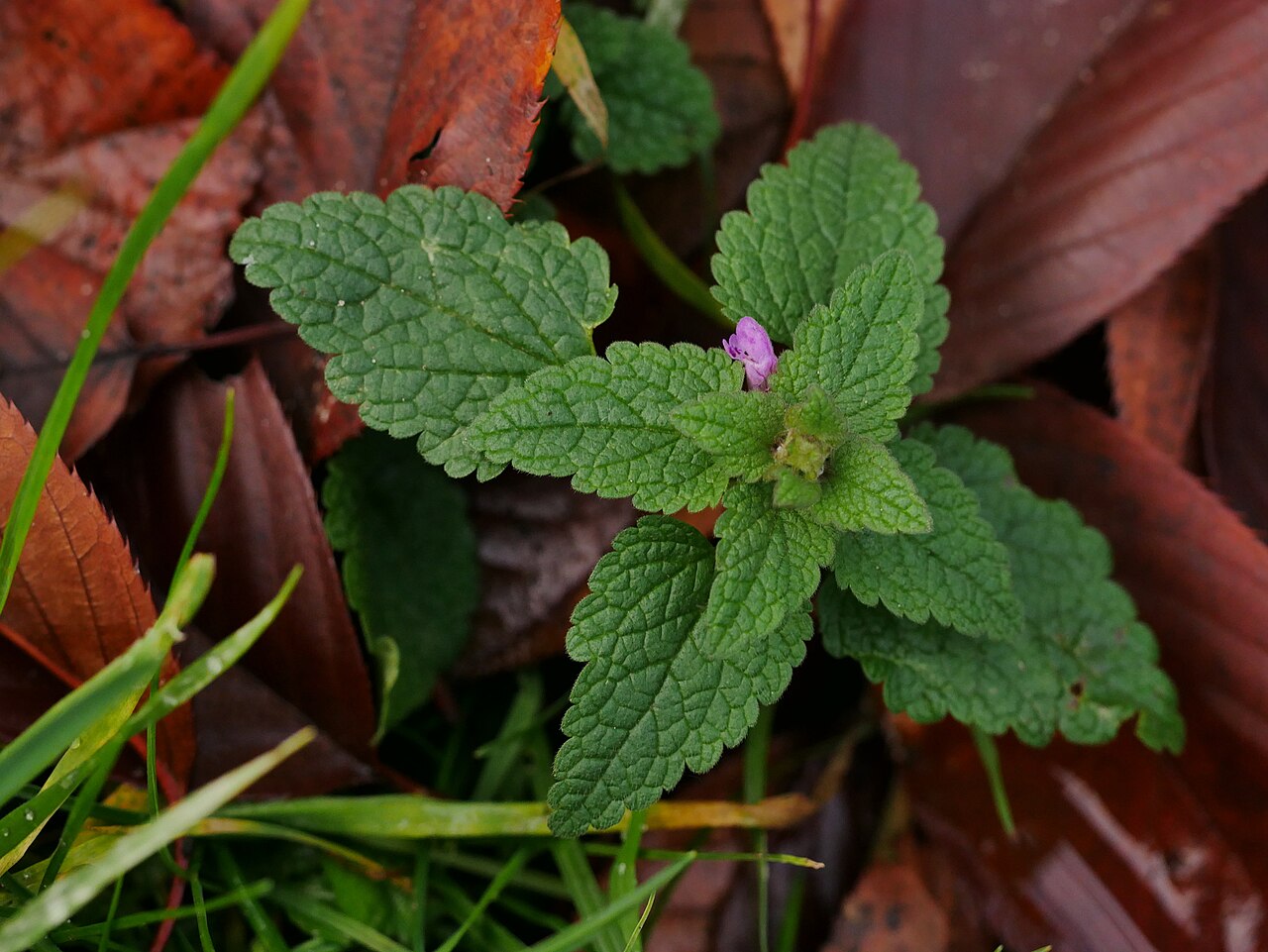
Both are easy to pull, and both fail the stem-roll test. For more blue-flowered weeds, see our guide to weeds with blue flowers.
Check 7: Tug Gently and Look Underground
If a shoot is close to the patch, ease your fingers into the soil at its base and lift gently.
A mistflower shoot from a rhizome will be attached to a horizontal runner just under the surface. The Native Plant Society of Texas notes these roots are shallow and easy to pull. A true seedling has its own small root and no runner.
Ground ivy also has runners, but they’re on top of the soil and root at the leaf joints. Rolling the stem tells you which you have.
Quick Reference: Mistflower vs. Look-Alikes
| Blue mistflower | Round hairy stem, triangular leaves with blunt teeth, short leaf stalks, rhizomes. |
| White snakeroot | Smooth stem, larger sharply toothed leaves, white flowers. Toxic. |
| Annual ageratum | Very similar leaves and flowers. No rhizomes; dies at frost. |
| Ground ivy | Square creeping stems, round scalloped leaves on long stalks. |
| Purple deadnettle / henbit | Small, square-stemmed annuals, often flowering in late winter or early spring. |
What to Do With Each Plant
Mistflower in the right place: leave it, and thin later if the patch gets crowded.
Mistflower in the wrong place: pull it or dig and move it. Young plants move easily in spring. Our guides to dividing a mistflower patch and keeping it within a bed cover replanting and boundary control.
White snakeroot: remove it from beds near pastures and from places where children play. Wear gloves and wash up afterward as a sensible precaution. Bag the plants rather than leaving them where animals can reach them.
Ground ivy and deadnettle: pull them, ideally before they set seed or spread. Mulch the bare soil afterward. See our mulching techniques for native gardens.
Still not sure: mark it and let it grow. For broader tips on keying out unfamiliar plants, our beginner’s guide to identifying native plants is a good next step.
A Season-by-Season Plan for Volunteers
- Early spring: pull obvious mint-family weeds. Leave unknown seedlings alone until they have true leaves.
- Mid to late spring: identify seedlings with the stem and leaf checks. Move keepers while small.
- Summer: recheck anything you weren’t sure about. Remove white snakeroot before it flowers and sets seed.
- Late summer to fall: flower color settles any remaining questions. Note where mistflower seed will land.
- After bloom: cut spent mistflower heads on the outer edge of the patch if seedlings are more than you want.
📋 More on this plant: read the full Mist Flower (Conoclinium coelestinum) profile, or see it in our native plant lists for Maryland, Virginia & West Virginia, Georgia, Alabama & Mississippi, and Arkansas, Louisiana, Eastern Oklahoma & Eastern Texas.
Frequently Asked Questions
What do blue mistflower seedlings look like?
At first, just two small, simple seed leaves that are hard to tell from other seedlings. Within a few weeks they produce pairs of triangular, blunt-toothed leaves with visible veins on a round, finely hairy stem.
Does blue mistflower self-seed?
Yes. The Missouri Botanical Garden and NC State Extension both note that it spreads by self-seeding as well as by rhizomes. The seeds have tufts of hair and travel on the wind.
Is white snakeroot the same as white mistflower?
No. White snakeroot is Ageratina altissima, a toxic eastern native. White mistflower usually refers to Ageratina havanensis, a shrub of the central Texas hill country. Blue mistflower also has an occasional white-flowered form.
Is blue mistflower poisonous?
We didn’t find authoritative sources reporting it as a significant poison. Illinois Wildflowers notes that mammals rarely eat it because of its bitter leaves. As with any garden plant, don’t eat it, and keep pets from chewing on plants.
When should I pull unwanted mistflower seedlings?
In spring, while they’re small. The shallow roots come up easily, and young plants transplant well if you’d rather move them.
Sources
- Missouri Botanical Garden Plant Finder, Conoclinium coelestinum: leaf and stem description, self-seeding, resemblance to annual ageratum.
- Illinois Wildflowers, Mistflower: round stems, leaf stalks and veins, rhizomes, wind-dispersed seed, bitter foliage.
- North Carolina Extension Gardener Plant Toolbox, Conoclinium coelestinum: leaf description, rhizomes and self-seeding.
- Lady Bird Johnson Wildflower Center, Conoclinium coelestinum: bluntly toothed leaves, cold-moist stratification of seed.
- Wikipedia, Ageratina altissima: white snakeroot leaves, stems, flowers and tremetol toxicity.
- Wikipedia, Ageratum houstonianum, Glechoma hederacea and Lamium purpureum: look-alike descriptions and weed status.
- Native Plant Society of Texas, Conoclinium coelestinum: shallow roots.