
Broadleaf Enchanter’s Nightshade (Circaea canadensis)
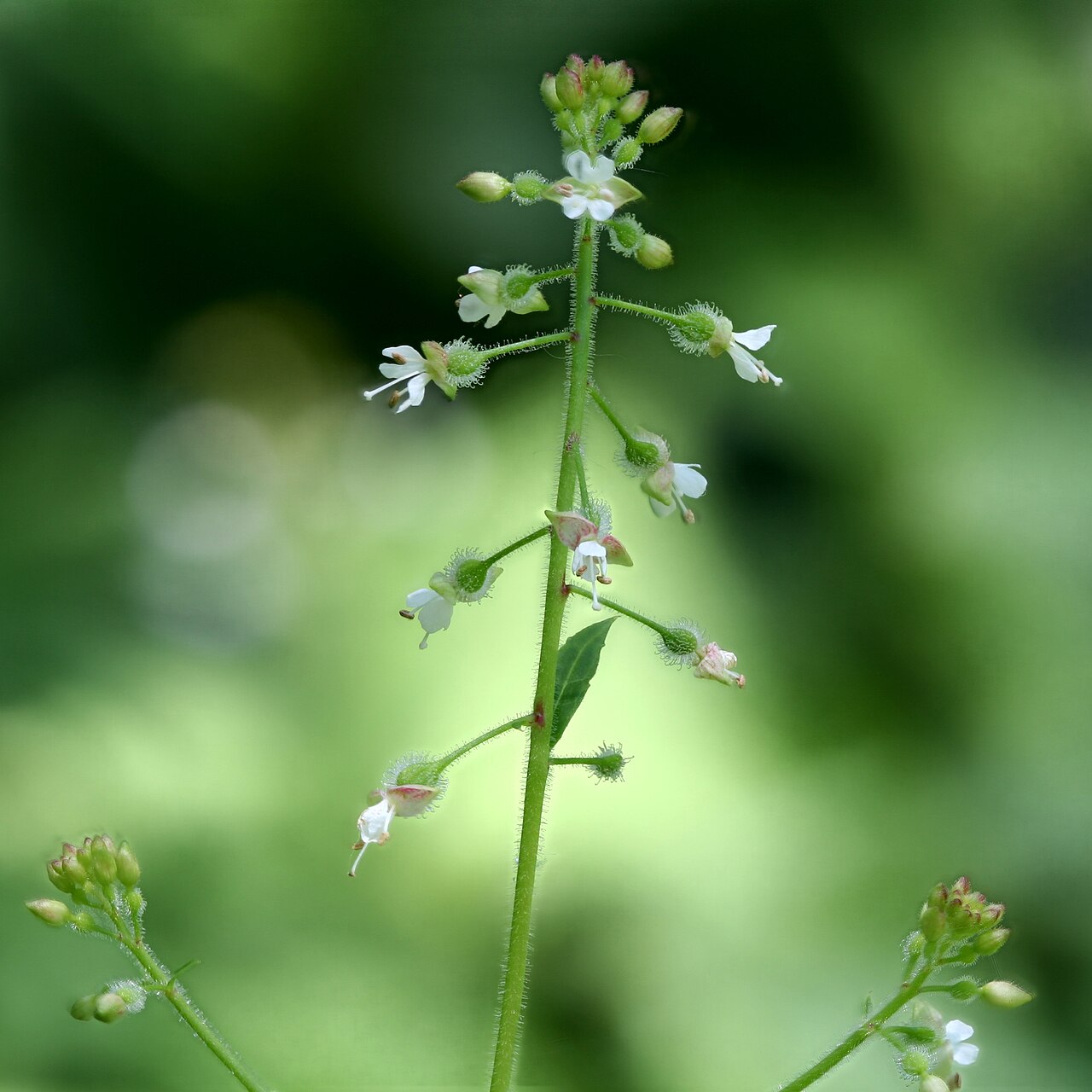
Circaea canadensis, known as Broadleaf Enchanter’s Nightshade or simply enchanter’s nightshade, is a native woodland wildflower of eastern and central North America. It is a slender perennial 1 to 2 feet tall with pairs of broad, pointed leaves and, in summer, airy spikes of tiny white flowers. Each flower has just two petals, each so deeply notched that it can look like four, and two stamens. The small fruits that follow are covered in hooked bristles and cling to anything that brushes past.
It belongs to the evening primrose family (Onagraceae). Despite its common name, it is not related to the true nightshades (Solanum) and is not known to be poisonous; the name comes from European folklore about its Eurasian relative. USDA PLANTS treats it as a subspecies of the Eurasian species, Circaea lutetiana subsp. canadensis, while many recent floras, and iNaturalist, recognize it as a separate species, Circaea canadensis.
Broadleaf enchanter’s nightshade is one of the most common summer-blooming herbs of moist, shady eastern woods, and it spreads into colonies by slender rhizomes. It is useful as a groundcover in wild shade gardens, though it can spread more than some gardeners like. This guide covers how to identify it, where it grows natively, how to grow it, and its role in woodland ecosystems.
Identification
Broadleaf enchanter’s nightshade is easy to identify by its opposite, broad leaves, its slender spikes of tiny two-petaled white flowers, and its small, bristly, bur-like fruits.
Growth Habit
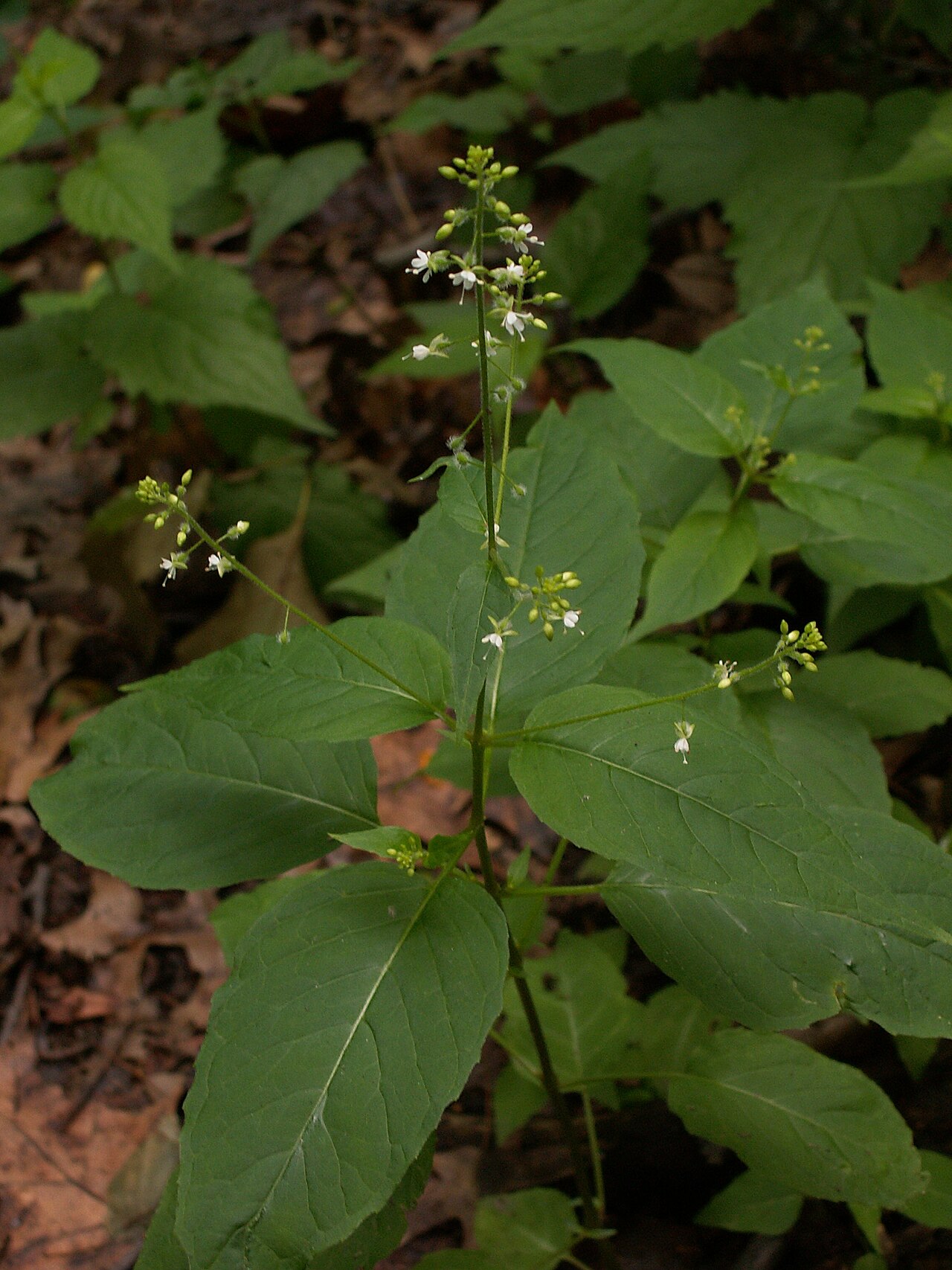
It is a perennial with a single, mostly unbranched stem 1 to 2 feet tall (occasionally up to 3 feet) rising from slender, creeping rhizomes. Plants usually grow in loose colonies on the forest floor. The stem is often slightly swollen at the leaf nodes.
Leaves
The leaves are opposite, egg-shaped to broadly oval, 2 to 5 inches long, with pointed tips, rounded or slightly heart-shaped bases, and shallow, widely spaced teeth. They are dark green, thin and soft, on stalks up to 2 inches long.
Flowers
The flowers are borne in slender spikes (racemes) at the top of the stem and in the upper leaf axils, opening a few at a time from the bottom up from about June to August. Each flower is only about ⅛ to ¼ inch across, with two green or pinkish sepals bent backward, two white (sometimes pinkish) petals that are deeply notched at the tip, two stamens, and a single style.
Fruit & Seeds
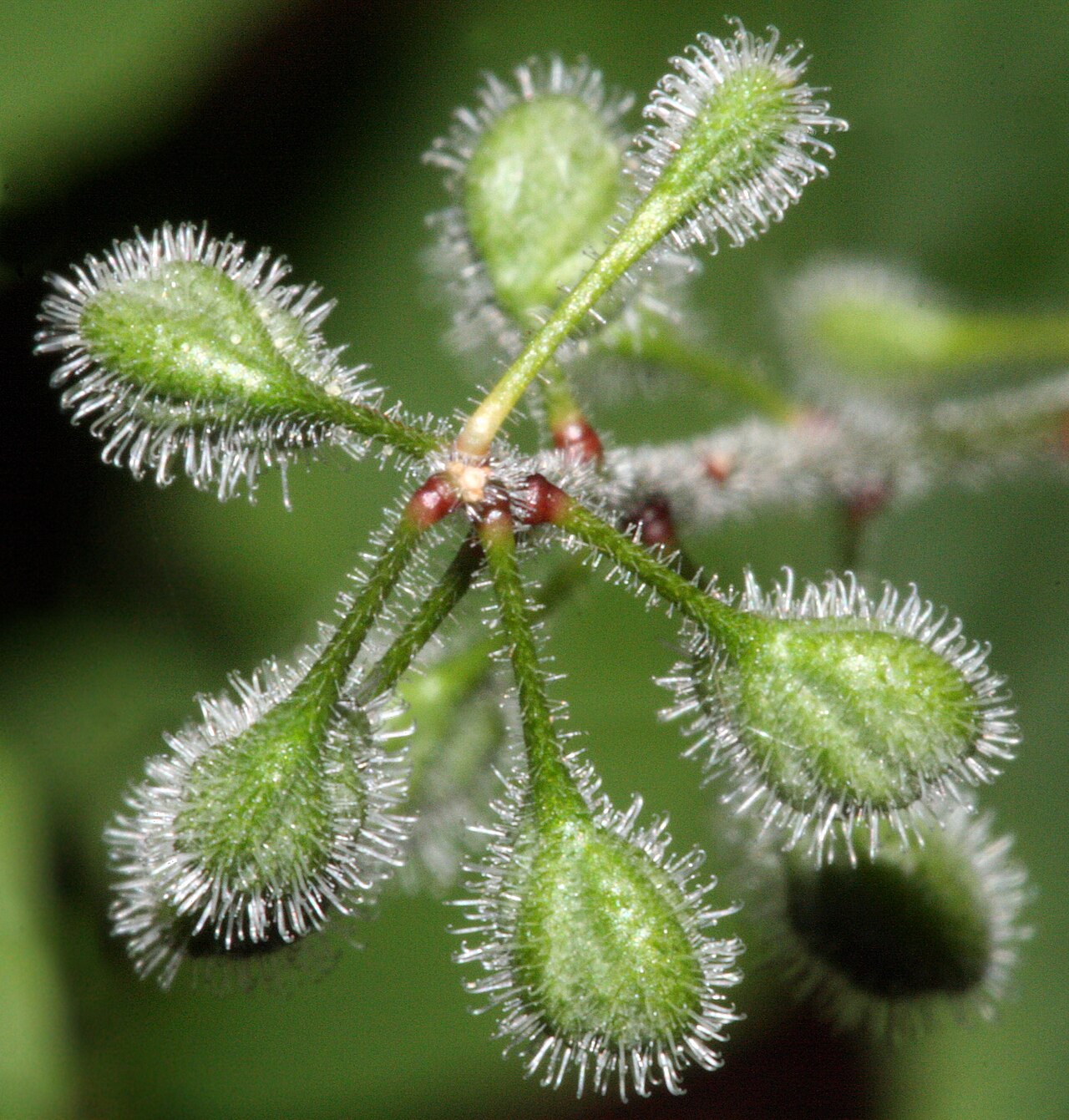
The fruit is a small, hard, teardrop-shaped capsule about ⅛ inch long, densely covered in stiff, hooked hairs. Each holds one or two seeds. As they ripen in late summer, the stalks bend downward and the fruits catch on fur, feathers and clothing.
Look-alikes
Small enchanter’s nightshade (Circaea alpina) of cool, moist northern and mountain forests is smaller (usually under 12 inches), with thin, translucent leaves, and smaller fruits with softer bristles. The hybrid between the two, Circaea × intermedia, is intermediate and mostly sterile. Out of flower, the paired leaves can resemble those of White Snakeroot, which has coarser teeth and fuzzy white flower heads in fall.
Quick Facts
| Scientific Name | Circaea canadensis (USDA: Circaea lutetiana subsp. canadensis) |
| Family | Onagraceae (evening primrose family) |
| Plant Type | Herbaceous perennial, spreading by rhizomes |
| Mature Height | 1–2 ft (occasionally 3 ft) |
| Mature Spread | Spreads into loose colonies |
| Growth Rate | Moderate to fast |
| Sun Exposure | Part shade to full shade |
| Water Needs | Medium; moist soil |
| Soil Type | Rich, moist loam; tolerates clay |
| Soil pH | About 5.5–7.5 |
| Bloom Time | June–August |
| Flower Color | White, sometimes tinged pink |
| Fall Color | Leaves yellow before dying back |
| Fruit | Small bur-like capsule with hooked bristles |
| Deer Resistant | Moderate |
| USDA Hardiness Zones | 3–8 |
Native Range
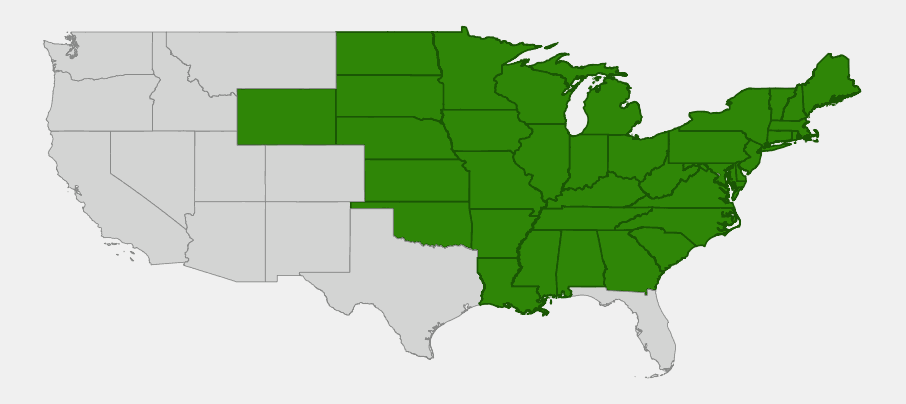
Broadleaf enchanter’s nightshade is widespread across eastern and central North America. USDA PLANTS records it as native in 36 states, from Maine, New Hampshire and Vermont south through New England, the Mid-Atlantic and the Appalachians to Georgia, Alabama, Mississippi and Louisiana, and west through the Great Lakes and Ohio Valley to Minnesota, the Dakotas, Nebraska, Kansas and Oklahoma. USDA also lists an outlying record from Wyoming, at the western edge of its range. In Canada it is native from Manitoba east to the Maritime provinces.
It is most common in the Northeast, the Appalachians, the Great Lakes states and the Ohio and upper Mississippi valleys. It grows in moist, rich deciduous and mixed woods, floodplain forests, wooded ravines, thickets, shaded stream banks and the edges of swamps, and it often turns up in shady, moist yards and along woodland trails.
Toward the southern and western edges of its range it becomes less common and is confined to moist, shaded valleys and stream bottoms. It is not recorded as native in Florida or Texas by USDA.
📋 Regional plant lists featuring Broadleaf Enchanter’s Nightshade: Alabama, Georgia & Mississippi · North & South Carolina · Maryland, Virginia & West Virginia · Kentucky & Tennessee · Arkansas, Louisiana, Eastern Oklahoma & Eastern Texas · Illinois, Iowa & Missouri · Ohio & Indiana · Nebraska, Kansas & Eastern Colorado · North Dakota, South Dakota & Western Minnesota · Michigan, Wisconsin & Eastern Minnesota · New York, Pennsylvania & Northern New Jersey · Delaware, Southern New Jersey & Long Island · Connecticut, Massachusetts & Rhode Island · New Hampshire, Maine & Vermont · Montana & Wyoming
Growing & Care Guide
Broadleaf enchanter’s nightshade is an easy, adaptable plant for moist shade. It is best used as a summer-blooming groundcover in naturalistic woodland gardens, where its spreading habit is an advantage rather than a nuisance. In small, formal beds it can spread more than you want.
Light
It grows best in part to full shade under deciduous trees. It tolerates fairly deep shade and some morning sun, but hot afternoon sun scorches the thin leaves.
Soil & Water
Plant it in moist, rich, loamy soil with plenty of organic matter. It tolerates clay and periodically damp soil along streams. Water during long dry spells; in drought, the plants may wilt and go dormant early.
Planting Tips
Set out plants or rhizome divisions in spring or fall about 12 inches apart. They will fill in within a season or two. Plant it with ferns and other robust woodland plants that can hold their own beside it.
Pruning & Maintenance
Little care is needed. To limit spreading, pull unwanted stems in spring when the soil is moist; the shallow rhizomes come up easily. If you do not want the sticky burs on pets and clothing, cut the flower stalks after bloom.
Propagation
Divide the rhizomes in early spring or fall. Seed can be sown outdoors in fall, but division is faster and more reliable. Plants also often appear on their own from seed carried in on animals.
Landscape Uses
- Woodland groundcover: fills shady spaces between ferns and spring wildflowers
- Moist shade and rain gardens: tolerates damp, shaded soil
- Woodland and floodplain restoration: a common herb of rich eastern forests
- Summer interest in shade: blooms after most spring woodland flowers have finished
Wildlife & Ecological Value
Broadleaf enchanter’s nightshade is a small but common part of the summer forest floor, and its tiny flowers and bur-like fruits connect it to insects and animals.
For Pollinators
The small flowers offer nectar from a little disk at the base of the style and are visited mainly by small bees, especially sweat bees, and by hover flies. The flowers are open in summer, when few other woodland herbs are blooming.
For Birds
Birds make limited use of the hard, bristly fruits as food, but ground-feeding birds can pick up the hooked burs in their feathers and carry them to new places.
For Mammals
The hooked fruits are designed to catch on the fur of deer, raccoons, foxes and other mammals, which spread the seeds through the woods. Deer browse the plants lightly.
Ecosystem Role
Its creeping rhizomes help hold soil on shady slopes and stream banks, and its colonies form part of the summer ground layer in moist hardwood forests, alongside ferns and nettles.
Cultural & Historical Uses
The genus name Circaea honors Circe, the enchantress of Greek mythology, who used magic herbs to turn Odysseus’s men into pigs. The European species, Circaea lutetiana, was named for Lutetia, the Roman name of Paris. The name “enchanter’s nightshade” came to English from older European herbals, and the plant has no relation to the true nightshades.
Linnaeus first treated the North American plant as a variety of the European species, and it has been treated at different times as a variety, a subspecies, and a full species. USDA PLANTS currently uses Circaea lutetiana subsp. canadensis, while many regional floras and iNaturalist use Circaea canadensis, reflecting differences in flowers, fruit and chromosomes between the American and Eurasian plants.
The hooked fruits are a classic example of seed dispersal by animals. Hikers who walk through woods in late summer often find them stuck to socks and pant legs, which is one way the plant gets around.
Frequently Asked Questions
Is broadleaf enchanter’s nightshade poisonous?
It is not related to the true nightshades and is not known to be toxic. The name comes from European folklore, not from any poisonous properties. As with any wild plant, do not eat it.
Why does it have the name enchanter’s nightshade?
The genus is named for Circe, the enchantress of Greek mythology. The English name was passed down from European herbals that associated the plant with magic.
Is broadleaf enchanter’s nightshade invasive?
It is native and not invasive, but it can spread vigorously by rhizomes in moist shade and may need to be pulled in small gardens.
How do I get the burs off my dog?
The small burs come off with a comb or by hand. Cutting the flower stalks after bloom prevents them from forming in your garden.
What is the difference between Circaea canadensis and Circaea lutetiana?
They are closely related. Circaea lutetiana in the strict sense is Eurasian, while the North American plant is treated by USDA as a subspecies of it and by many other sources as a separate species, Circaea canadensis.

Looking for a nursery that carries Broadleaf Enchanter’s Nightshade?
Browse our native plant nursery directory: Alabama & Arkansas · Connecticut, Delaware & Georgia · Illinois, Indiana, Iowa & Kansas · Kentucky, Louisiana, Maine, Maryland, Massachusetts, Michigan, Minnesota, Mississippi & Missouri · Nebraska, New Hampshire, New Jersey, New York, North Carolina, North Dakota, Ohio & Oklahoma · Pennsylvania, Rhode Island, South Carolina, South Dakota, Tennessee, Vermont & Virginia · West Virginia, Wisconsin & Wyoming