
Coastal Serviceberry (Amelanchier obovalis)
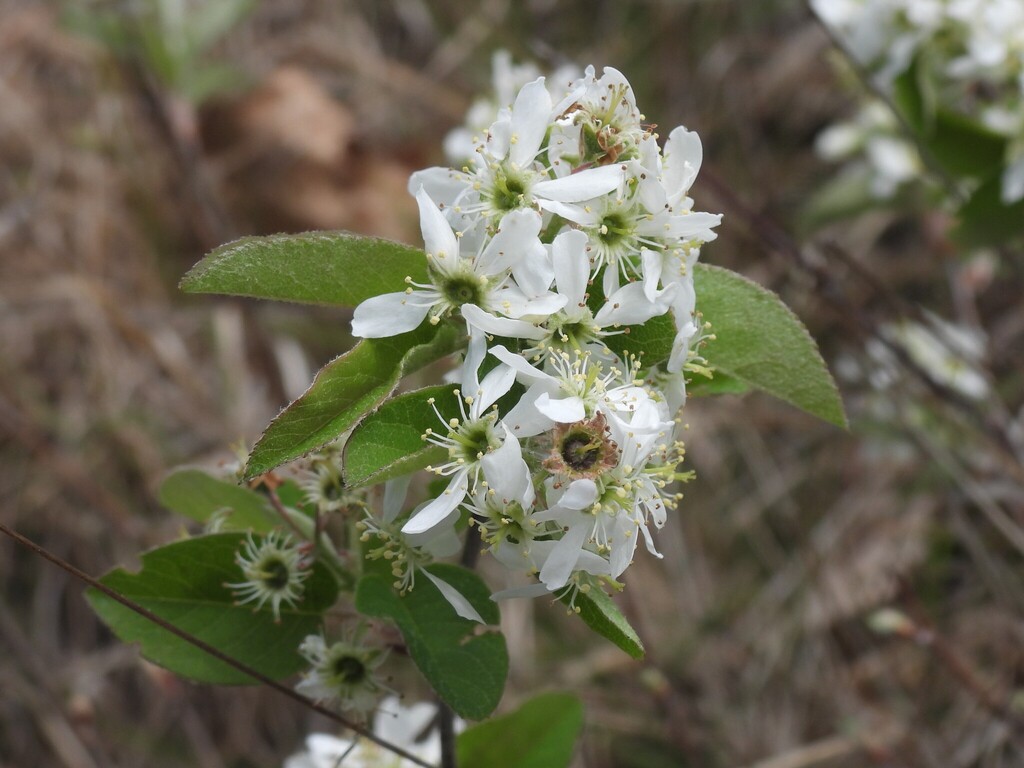
Amelanchier obovalis, the Coastal Serviceberry (also called coastal juneberry or coastal plain serviceberry), is a low, colony-forming shrub of the Atlantic Coastal Plain. It grows in sandy pine barrens, dry open woods, sandhills and pine savannas from New Jersey south to Georgia and Alabama, with outlying records north to New York and Massachusetts.
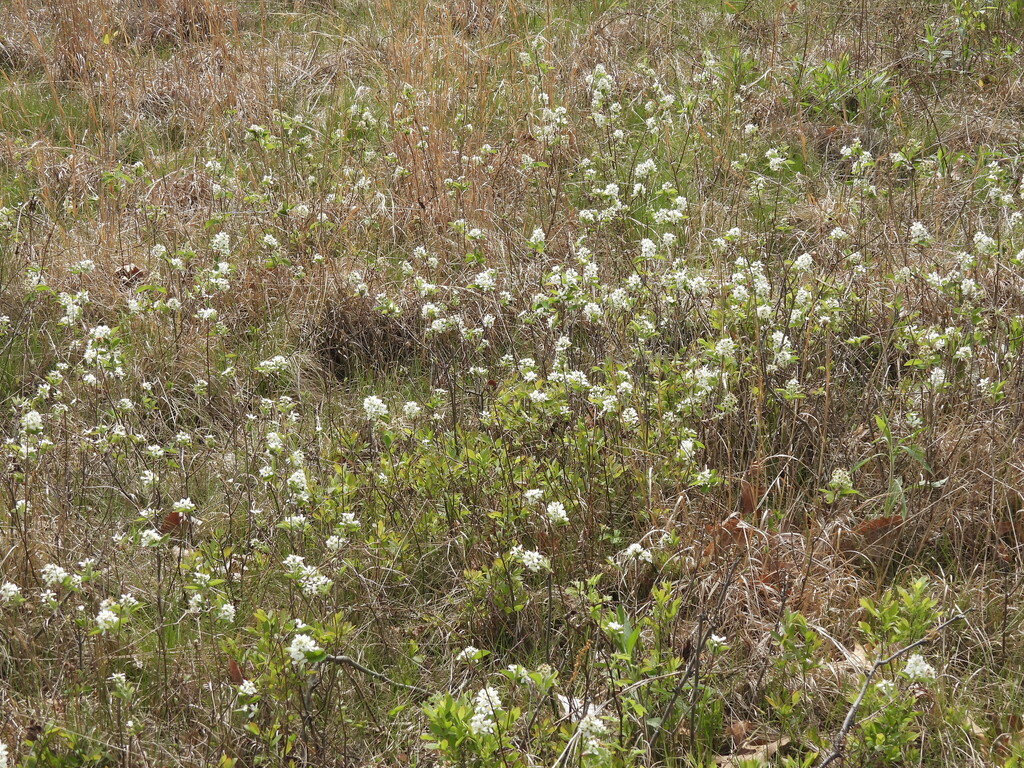
Unlike the familiar tree-sized serviceberries, it usually stays 1 to 5 feet tall and spreads by underground runners into patches. In early spring it is covered with upright clusters of white flowers, followed in early summer by sweet, dark purple to black berries that are relished by birds and people alike.
It is a great choice for sandy, sunny gardens and restorations in the East, where it adds early flowers, edible fruit and fall color in a small space. This guide covers how to identify it, where it grows, how to grow it and its value to wildlife.
Identification
Coastal serviceberry is a low, suckering shrub with oval to obovate, finely toothed leaves, upright clusters of white flowers in early spring and small, dark, juicy berries in early summer.
Form & Stems
It grows 1 to 5 feet tall from spreading rhizomes, forming loose colonies of slender, upright stems. The bark is smooth and gray to reddish-brown. Several stems usually arise close together.
Leaves
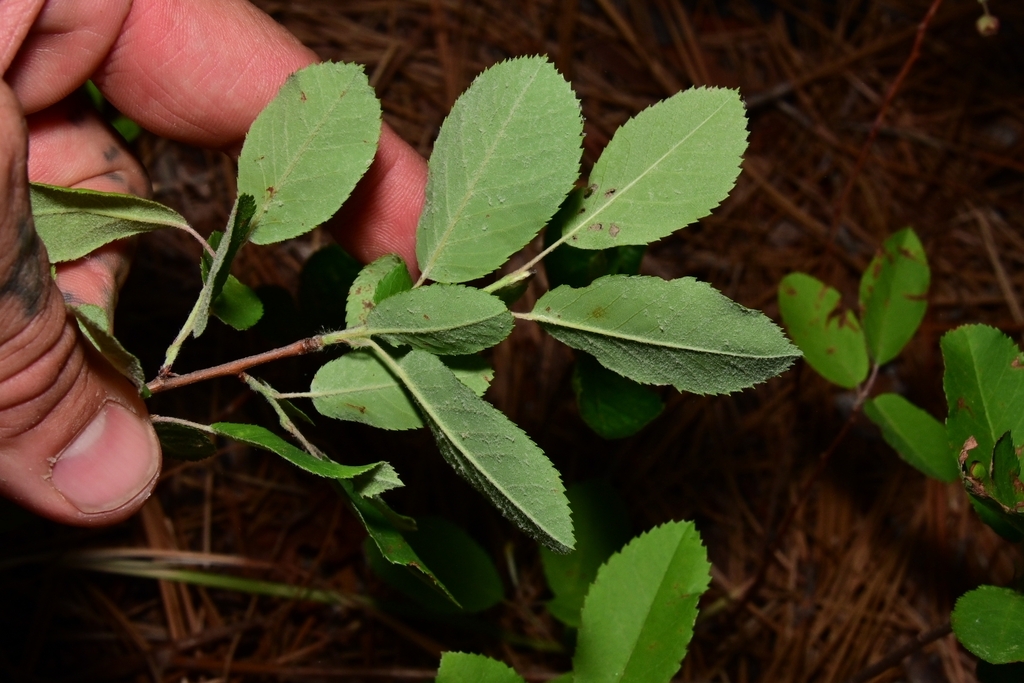
The leaves are alternate, oval to obovate (widest above the middle), about 1 to 2 inches long, with finely toothed edges and a rounded or blunt tip. They are densely woolly-white underneath when young, becoming smooth and dull green above, and turn yellow to orange-red in fall.
Flowers
In early spring, from about March to April in the South and April to May in the North, it bears upright, compact clusters of 4 to 10 white flowers as the leaves unfold. Each flower has five narrow white petals about ¼ to ½ inch long.
Fruit & Look-alikes
The berries are round, about ¼ to ⅜ inch across, ripening from red to dark purple-black in late spring to early summer. They are sweet and edible. Shadblow (A. canadensis) is a taller, multi-stemmed shrub or small tree of wetter ground, and Downy Serviceberry is a tree with drooping flower clusters. Serviceberries hybridize readily, and some botanists treat coastal serviceberry as part of a broader A. stolonifera or A. canadensis complex.
Quick Facts
| Scientific Name | Amelanchier obovalis (Michx.) Ashe |
| Family | Rosaceae (rose family) |
| Plant Type | Deciduous colonial shrub |
| Mature Height | 1–5 ft |
| Mature Spread | Spreads by rhizomes into colonies |
| Growth Rate | Moderate |
| Sun Exposure | Full sun to partial shade |
| Water Needs | Low to moderate; drought tolerant |
| Soil Type | Sandy, acidic, well-drained |
| Soil pH | About 4.5–6.5 |
| Bloom Time | March–May |
| Flower Color | White |
| Fall Color | Yellow to orange-red |
| Fruit | Sweet, dark purple-black berry |
| Deer Resistant | Low; browsed by deer |
| USDA Hardiness Zones | 5–9 |
Native Range
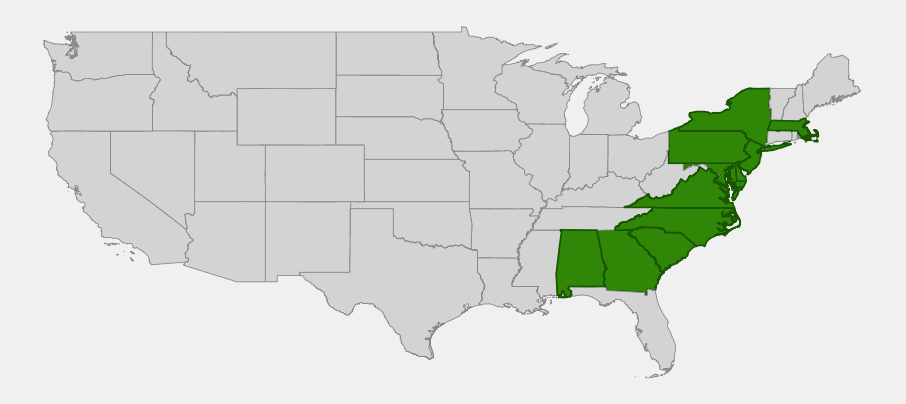
Coastal serviceberry is native to the Atlantic and eastern Gulf Coastal Plain. USDA PLANTS lists it in New Jersey, Delaware, Maryland, Virginia, North Carolina, South Carolina, Georgia and Alabama, with records also from Pennsylvania, New York and Massachusetts at the northern edge of its range.
It is most common in the pine barrens of New Jersey and in the sandhills and pine savannas of the Carolinas and Georgia, where it is often found in the open understory of longleaf pine and scrub oak woodlands.
It grows in dry to moist, sandy, acidic, nutrient-poor soils in pine barrens, sandhills, pine flatwoods and savannas, open oak-pine woods, clearings, roadsides and power-line rights-of-way. It depends on fire or other disturbance to keep its habitat open and sunny.
📋 Regional plant lists featuring Coastal Serviceberry: Alabama, Georgia & Mississippi · North & South Carolina · Maryland, Virginia & West Virginia · Delaware, Southern New Jersey & Long Island · New York, Pennsylvania & Northern New Jersey · Connecticut, Massachusetts & Rhode Island · New Hampshire, Maine & Vermont
Growing & Care Guide
Coastal serviceberry is offered by some native plant nurseries in the Mid-Atlantic and Southeast. It is an excellent small shrub for sandy, acidic soils, where it forms a low thicket with spring flowers, summer fruit and fall color.
Light
Full sun to partial shade. It flowers and fruits best in full sun, as in its fire-maintained native habitats.
Soil & Water
It needs well-drained, acidic, sandy soil and tolerates poor, dry soil once established. It also grows in moister sandy soil, but avoid heavy clay and alkaline soils. Water during the first summer.
Planting Tips
Plant in fall or early spring, 2 to 3 feet apart for a mass. Use it as a low hedge, a groundcover-like thicket on a sunny bank, or in a pine-barrens garden with blueberries and huckleberries. Protect young plants from deer.
Pruning & Maintenance
Little pruning is needed. To renew an old patch, cut some of the oldest stems to the ground in late winter. Remove suckers if you want to limit spread. Like other serviceberries it can get rust diseases, especially near junipers, but these are usually minor.
Propagation
Divide or dig rooted suckers in late winter or early spring. Seeds cleaned from ripe fruit need warm, then cold, moist stratification and germinate slowly.
Landscape Uses
- Sandy, sunny gardens: low thicket with spring flowers and fall color
- Edible landscaping: sweet early-summer berries
- Bird gardens: fruit ripens early for nesting birds
- Pine barrens and sandhill restoration: native understory shrub
Wildlife & Ecological Value
Coastal serviceberry provides early-season flowers and fruit when few other foods are available.
For Pollinators
The early spring flowers are visited by native bees, including mining bees, as well as flies and early butterflies. Serviceberries are larval hosts for many moths and for butterflies such as the striped hairstreak and red-spotted purple.
For Birds
Robins, catbirds, mockingbirds, thrashers, cedar waxwings and many other birds eat the berries as soon as they ripen in early summer.
For Mammals
Black bears, foxes, raccoons and squirrels eat the fruit, and white-tailed deer and rabbits browse the twigs and leaves.
Ecosystem Role
As a fire-adapted shrub that resprouts from its rhizomes, it is part of the low shrub layer of pine barrens and longleaf pine woodlands, where it helps provide food and cover after fires.
Cultural & Historical Uses
André Michaux described this serviceberry in 1803 in his Flora Boreali-Americana, and William Willard Ashe later placed it in Amelanchier. The species name obovalis refers to its obovate leaves.
The names serviceberry, shadbush and juneberry are shared by the whole genus. “Shadbush” refers to blooming when shad fish run upriver in spring, and “juneberry” to the early ripening of the fruit.
Serviceberry fruits were widely eaten by Indigenous peoples and early settlers, fresh, dried or cooked, and they are still enjoyed in pies, jams and fresh off the shrub.
Frequently Asked Questions
Are coastal serviceberry berries edible?
Yes. The dark purple-black berries are sweet and juicy, eaten fresh or cooked into jams and pies. Pick them quickly before the birds do.
How tall does coastal serviceberry grow?
Usually 1 to 5 feet, spreading into low colonies by underground runners, much smaller than tree-form serviceberries.
Where does coastal serviceberry grow?
In sandy pine barrens, sandhills, pine savannas and open woods on the Atlantic Coastal Plain from New Jersey to Georgia and Alabama.
When does coastal serviceberry bloom?
From about March in the South to May in the North, as the leaves unfold.
Is coastal serviceberry good for wildlife?
Yes. Its early flowers feed bees, its fruit feeds many birds and mammals, and its leaves host the caterpillars of several butterflies and moths.

Looking for a nursery that carries Coastal Serviceberry?
Browse our native plant nursery directory: Alabama · Delaware & Georgia · Maryland & Massachusetts · New Jersey, New York & North Carolina · Pennsylvania, South Carolina & Virginia

