
Giant Sensitive Plant (Mimosa pellita)
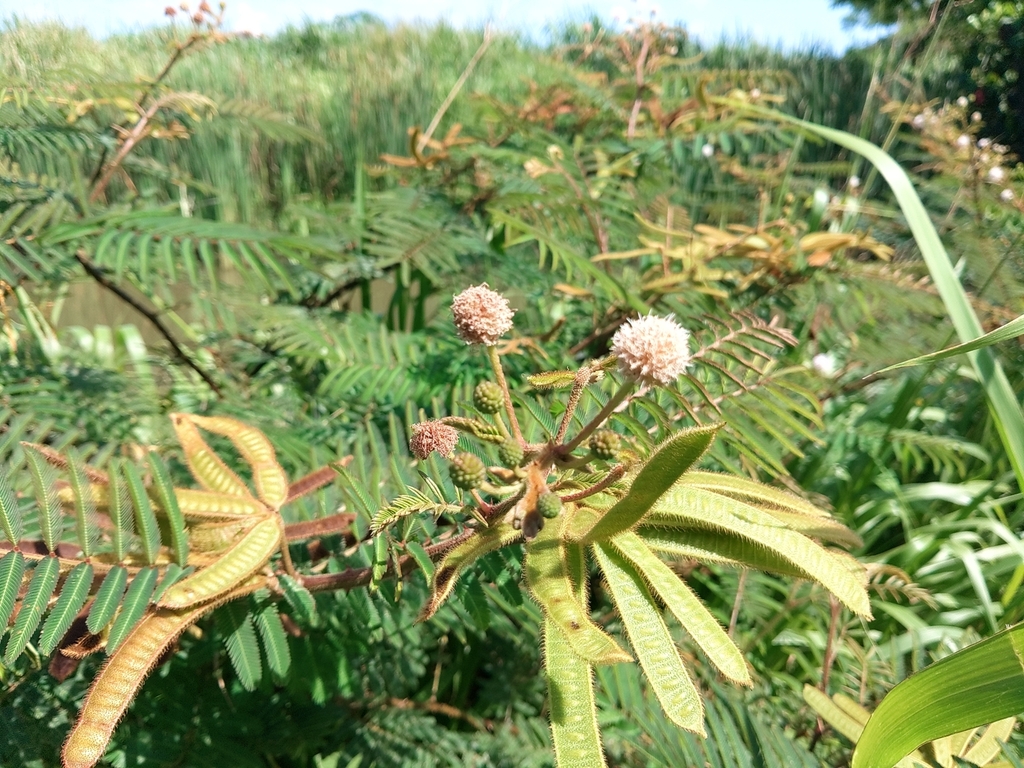
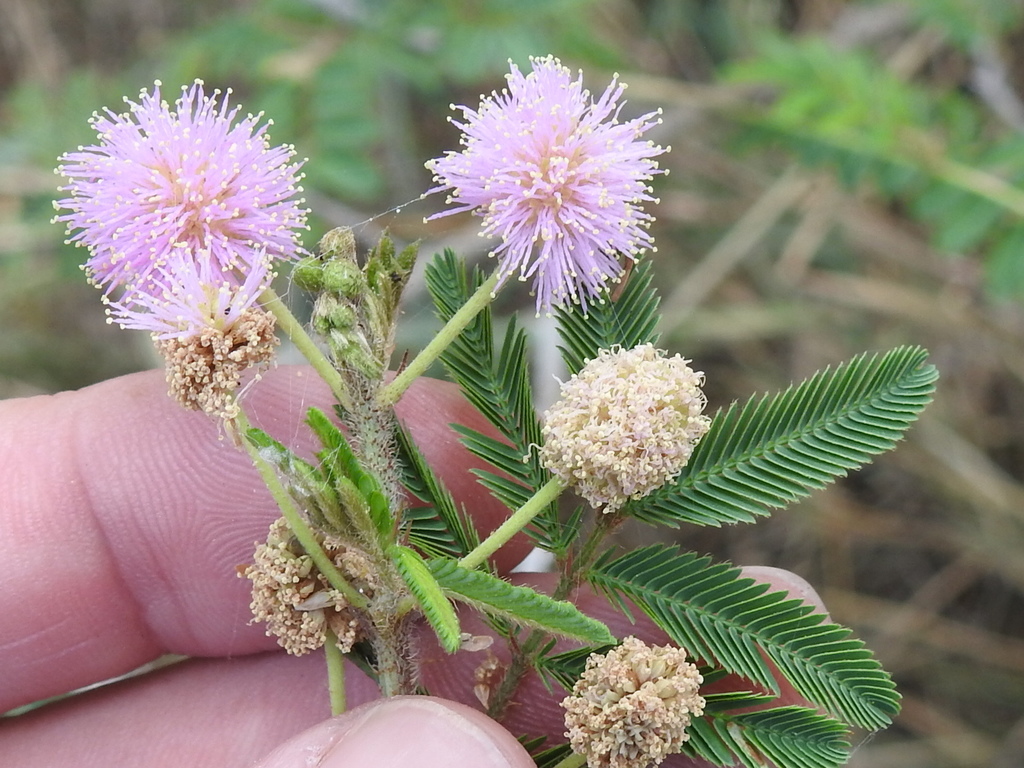
Mimosa pellita, known as Giant Sensitive Plant, black mimosa, catclaw mimosa or lollipop mimosa, is a prickly, fast-growing shrub in the legume family (Fabaceae). Its feathery, fern-like leaves fold up when touched, like those of its small relative sensitive plant, and it bears round, fluffy, pink to whitish flower heads and clusters of flat, bristly seed pods. It usually grows 3 to 10 feet tall and can reach 15 feet. Most botanists and many floras call this plant Mimosa pigra; USDA PLANTS uses the name M. pellita.
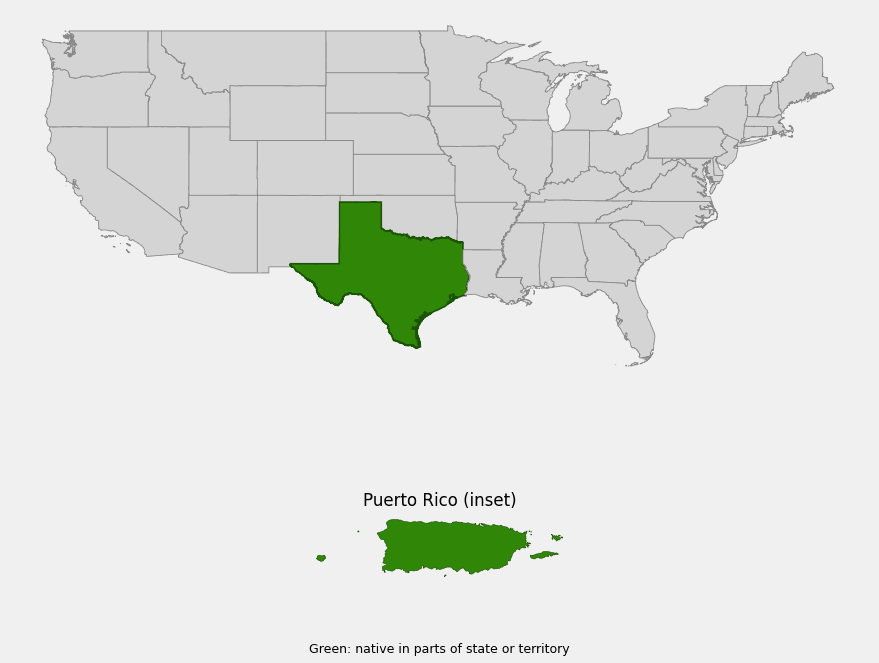
It is native to tropical America, from Mexico and the Caribbean through Central America to Argentina. In U.S. territory it is native to Puerto Rico and to the Lower Rio Grande Valley of southern Texas, where it grows on the banks of resacas, ponds and ditches. The Texas plants are often treated as a separate variety or species, Berlandier’s mimosa (Mimosa pigra var. berlandieri or M. berlandieri). USDA also lists Florida, but the Atlas of Florida Plants treats it as not native there.
Outside its native range, giant sensitive plant is one of the world’s worst invasive plants. It forms impenetrable thorny thickets on floodplains in northern Australia, Southeast Asia and Africa, and it is a Category I invasive in Florida. Do not plant it. It is on the U.S. federal noxious weed list, it is armed with sharp prickles, and like several of its relatives it should be treated as potentially toxic. This page is an identification and natural history guide.
Identification
Look for a thorny shrub of wet ground with sensitive, finely divided leaves, round pink or whitish puffball flowers and clusters of flat, densely bristly pods.
Growth Habit
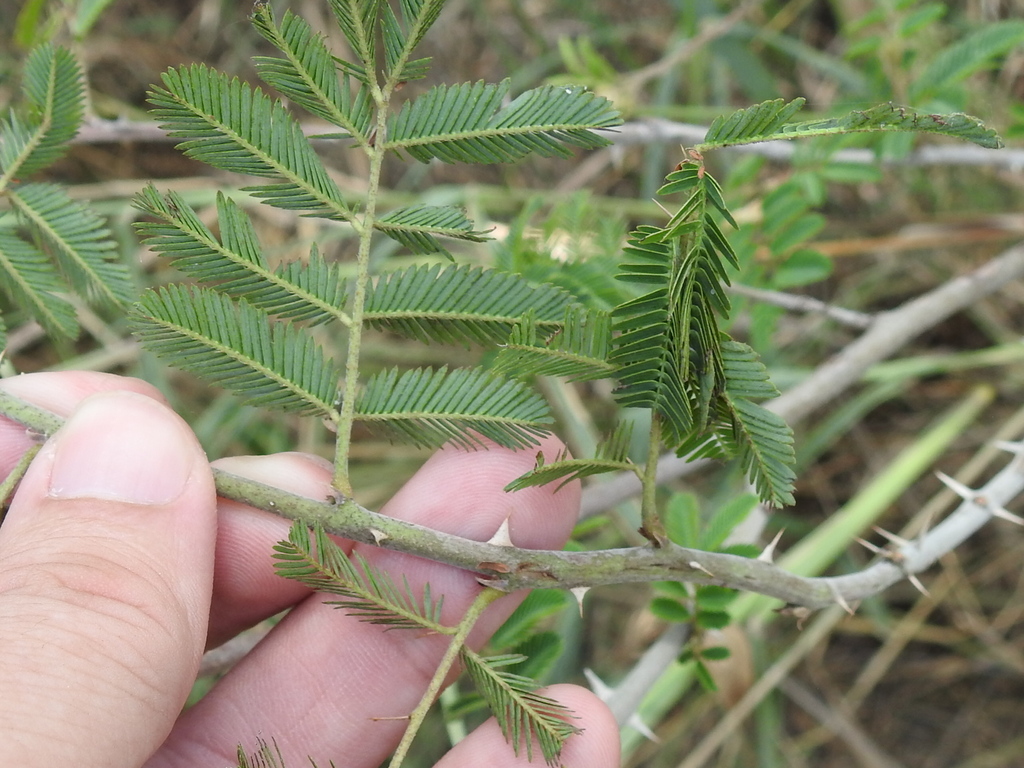
Giant sensitive plant is a much-branched, thorny shrub, usually 3 to 10 feet tall, sometimes taller, with a rounded or flat-topped crown. It grows fast, flowers when young, and often forms dense thickets along water. The stems are green to brown, hairy, and armed with sharp, broad-based prickles up to about 1/4 inch long.
Leaves
The leaves are bipinnate (twice divided) and fern-like, up to about 8 inches long, with about 6 to 14 pairs of side branches (pinnae), each bearing many pairs of tiny, narrow leaflets. Small, upright prickles grow on the leaf stalk between the pairs of pinnae. The leaflets fold together when touched, shaken or at night, though more slowly than in sensitive plant.
Flowers
The flowers are packed into round, fluffy heads about 1/2 inch across on stalks from the upper leaf axils, one to several together. Each head is made up of many tiny flowers with long stamens, pink to mauve or nearly white. In the tropics it can bloom almost all year; in Texas mostly from spring to fall.
Fruit & Seeds
The pods are borne in clusters of several to many, flat, 2 to 4 inches long, and densely covered with stiff brown bristles. When ripe they break crosswise into one-seeded segments that keep the bristly edges. The segments float and are carried by water, and the bristles catch on animal fur and clothing. Seeds can survive for many years in the soil.
Look-alikes
Sensitive plant (Mimosa pudica) is a low, sprawling plant with fewer pinnae and faster-folding leaves. Catclaw briar and other sensitive briars are low, trailing plants of dry ground with narrow, prickly pods. Leadtrees and acacias, such as sweet acacia, have puffball flowers but leaves that do not fold when touched and pods that are not bristly.
Quick Facts
| Scientific Name | Mimosa pellita (often treated as Mimosa pigra) |
| Family | Fabaceae (legume family) |
| Plant Type | Thorny shrub; invasive outside its native range |
| Mature Height | 3–15 ft |
| Mature Spread | 3–10 ft; forms thickets |
| Growth Rate | Fast |
| Sun Exposure | Full sun |
| Water Needs | High; seasonally flooded or wet ground |
| Soil Type | Clay, silt and sandy soils of floodplains and pond edges |
| Soil pH | Slightly acidic to alkaline (about 6.0–8.0) |
| Bloom Time | Spring–fall in Texas; much of the year in Puerto Rico |
| Flower Color | Pink, mauve or whitish |
| Fall Color | None |
| Fruit | Clusters of flat, densely bristly pods that break into segments |
| Deer Resistant | Yes (thorny) |
| USDA Hardiness Zones | 9–13 |
Native Range
Giant sensitive plant is native to the American tropics and subtropics, from Mexico and the West Indies through Central America to northern Argentina. USDA PLANTS lists it as native in Puerto Rico and the lower 48 states, with records from Texas and Florida. We map it as native in Texas and Puerto Rico only: the Atlas of Florida Plants lists it as not native in Florida, where it is a Category I invasive species.
In Texas it grows in the Lower Rio Grande Valley, mainly in Cameron and Hidalgo counties, along the banks of resacas (old river channels), ponds, canals and ditches. The Texas form has bright pink flower heads and is often treated as a separate taxon, Berlandier’s mimosa. In Puerto Rico it grows in lowland wetlands, pastures, ditches and along rivers and the edges of lagoons.
Over the last century it has spread across the tropics. It is a major invader of floodplains in Australia’s Northern Territory, of wetlands and rice-growing areas in Thailand, Vietnam, Cambodia and other parts of Southeast Asia, and of parts of Africa. It is listed among the “100 of the World’s Worst Invasive Alien Species” by the IUCN Invasive Species Specialist Group.
📋 Regional plant lists featuring Giant Sensitive Plant: South & West Texas · Puerto Rico
Should You Grow It?
No. Although it is native to South Texas and Puerto Rico, giant sensitive plant should not be planted or moved. It is a federal noxious weed in the United States, so moving plants or seeds is regulated, and it is a serious invader of wetlands. For a sensitive-leaved native in Texas gardens, try powderpuff mimosa or fragrant mimosa instead.
Light
In the wild it grows in full sun on open, wet ground and does not tolerate deep shade.
Soil & Water
It needs seasonally wet or flooded soil, especially clay and silt along water, but survives dry seasons once established.
Planting Tips
Do not plant it. Where it grows on your land in Puerto Rico or South Texas as part of a native wetland, it can be left in place, but watch that it does not form dense thickets.
Pruning & Maintenance
Wear thick gloves and long sleeves when handling it because of the prickles. Outside its native range, report new infestations to local invasive species authorities. Seedlings can be pulled; larger plants are controlled by cutting, burning, herbicides or biological control, often over many years because of the long-lived seed bank.
Propagation
It spreads by seed, carried by floodwater, mud, vehicles, animals and clothing. Never collect or share seed or plants.
Uses and Values
- Native wetland plant: part of riparian thickets in South Texas and Puerto Rico
- Soil improvement: fixes nitrogen like other legumes
- Wildlife cover: thorny thickets shelter birds in its native range
- Nectar: flower heads visited by bees
- Education: a well-known example of a sensitive, moving plant
Wildlife & Ecological Value
In its native range, giant sensitive plant is part of riparian and wetland thickets, where it provides nectar, cover and seeds.
For Pollinators
The fluffy flower heads produce pollen and are visited by bees, including honey bees and native bees, and by other insects.
For Birds
The thorny thickets give nesting and escape cover to small birds in South Texas and Puerto Rico. Dense invasive stands elsewhere, though, can push out the wetland plants and open water that many birds need.
For Mammals
The prickles discourage browsing, but some livestock eat the young leaves and pods. Seeds can pass through animals and spread.
Ecosystem Role
As a legume, it fixes nitrogen and helps colonize bare, flood-scoured ground in its native habitat. Where it is invasive, it forms dense, single-species thickets that replace native floodplain grasses and wetland plants, block access to water and change how floodplains work.
Cultural & Historical Uses
The genus name Mimosa comes from the Greek for “mimic,” because the moving leaves seem to imitate an animal. Pigra means “lazy” or “slow,” because its leaves fold more slowly than those of the true sensitive plant. Pellita refers to the plant’s hairy covering.
The scientific name has a complicated history. For a time botanists used Mimosa pellita for this widespread plant because the old name M. pigra was found to belong to a different South American species. The name M. pigra was then formally conserved for the widespread plant, so most current references, including the Atlas of Florida Plants, call it Mimosa pigra.
Safety note: the stems, leaf stalks and pods are covered in sharp prickles and bristles that can cut skin and catch on clothing. It is not a food plant. Several Mimosa relatives contain mimosine, a toxic amino acid, so keep children and pets from chewing on the leaves or seeds and wash your hands after handling it.
Frequently Asked Questions
Is giant sensitive plant native to the United States?
Yes, in a small area. It is native to Puerto Rico and the Lower Rio Grande Valley of South Texas. It is not native in Florida, where it is invasive.
Is Mimosa pellita the same as Mimosa pigra?
Yes, for practical purposes. USDA PLANTS uses Mimosa pellita, while most other references use Mimosa pigra for the same plant.
Is giant sensitive plant invasive?
Yes, outside its native range. It is listed among the world’s 100 worst invasive species and is a U.S. federal noxious weed.
Is giant sensitive plant poisonous?
It is not known as a food plant and is very prickly. Treat it as potentially toxic, and keep children and pets from chewing it.
Why do the leaves fold up?
Like sensitive plant, its leaflets fold when touched or shaken and at night, probably to protect the leaves from grazing animals and insects and to reduce water loss.

Looking for a nursery that carries Giant Sensitive Plant?
Browse our native plant nursery directory: Texas

