
Horned Bladderwort (Utricularia cornuta)
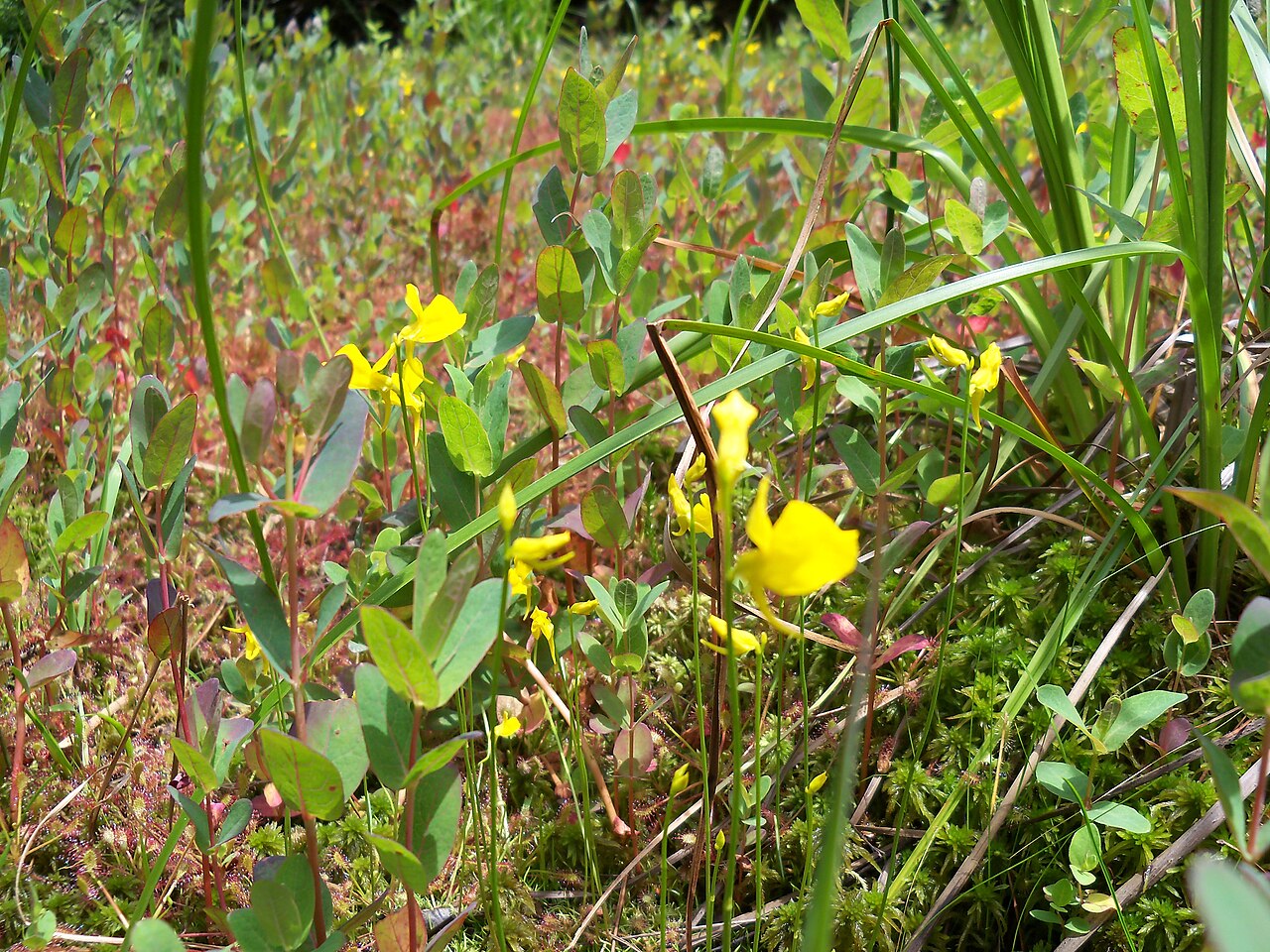
Utricularia cornuta, known as Horned Bladderwort, is a small carnivorous plant of bogs, fens, wet sandy shores and savannas in eastern North America. It belongs to the bladderwort family (Lentibulariaceae). Most of the plant is hidden: its tiny, thread-like leaves and stems grow in wet sand, peat or shallow water, where they carry microscopic bladder traps that catch tiny aquatic animals.
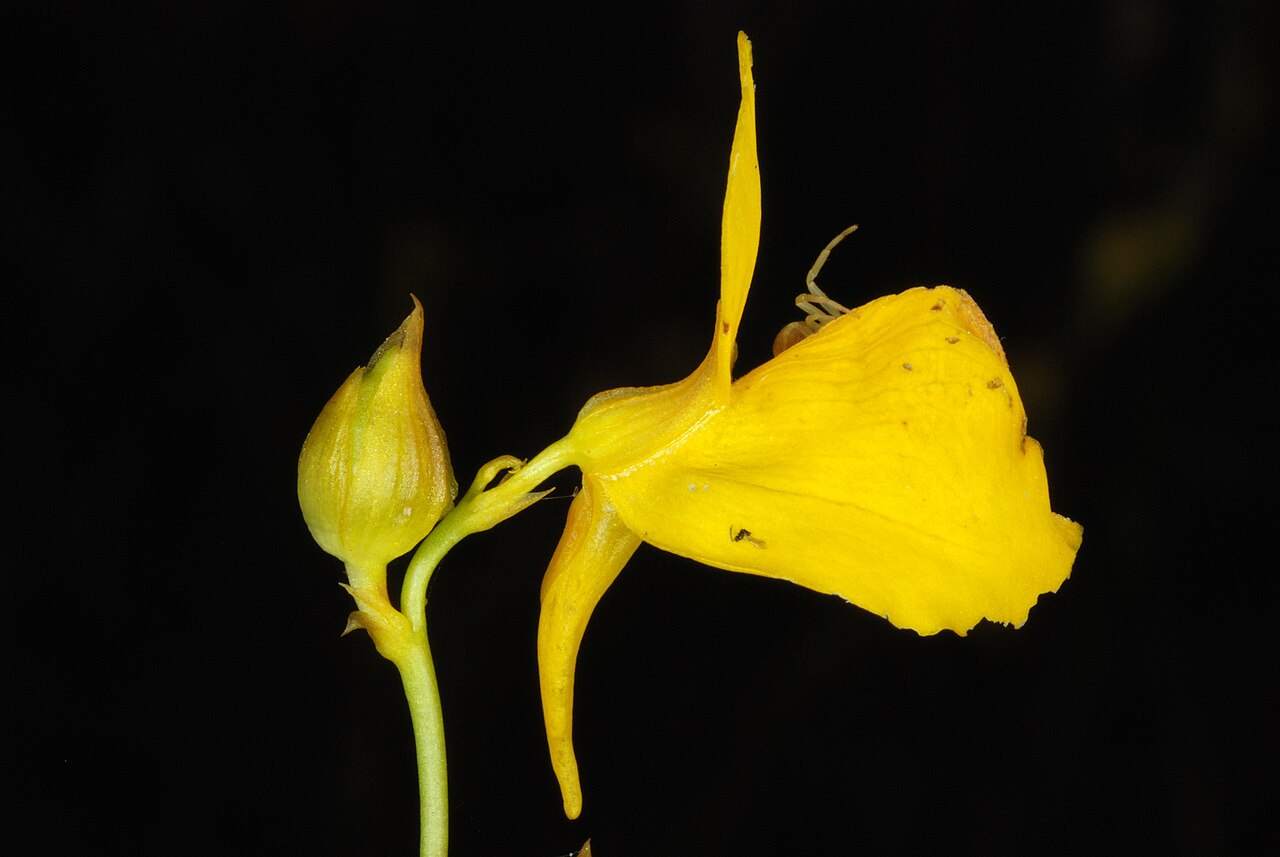
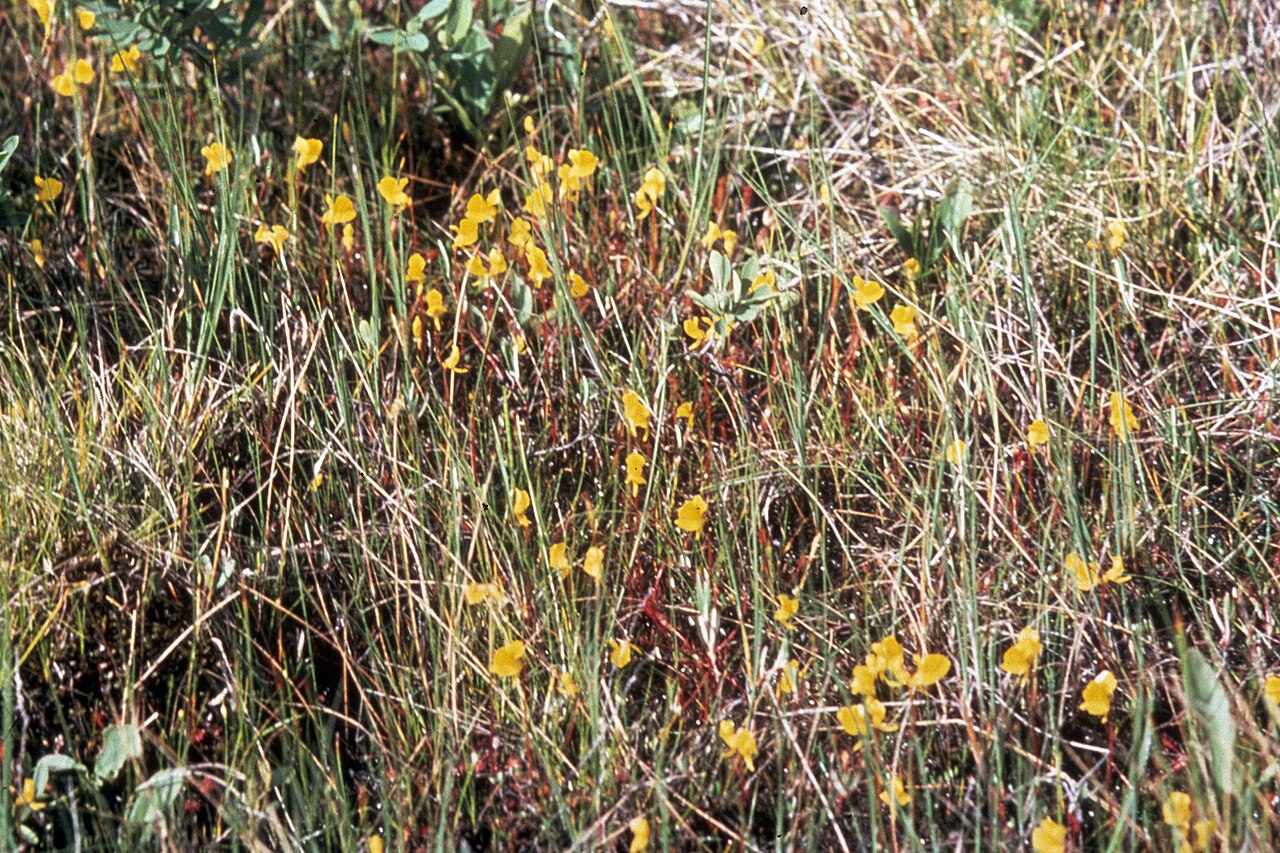
What you see are the flowers. In summer, slender, leafless stalks 2 to 12 inches tall rise from the wet ground, each with one to several bright yellow flowers about 3/4 inch long. Each flower has a broad, helmet-like lower lip and a long, downward-pointing spur, the “horn” of its name. In good years they bloom by the hundreds, coloring whole shorelines yellow.
Horned bladderwort is one of the showiest native bladderworts. It can be grown in a bog garden or a container of wet peat and sand with other carnivorous plants. Grow it only from propagated stock; wild bog habitats are fragile and should not be disturbed.
Identification
Look for bright yellow, two-lipped flowers with a long, pointed spur on thin, leafless stalks rising from wet sand, peat or shallow water.
Growth Habit
A perennial that lives mostly within saturated sand, peat or mud, or in very shallow water. Its fine, branching stolons and tiny, grass-like leaves are rarely noticed. Only the flower stalks, which are 2 to 12 inches tall, usually stand above the surface.
Leaves & Traps
The leaves are tiny, narrow and simple, and mostly buried. The underground stems carry small bladders, each about 1/50 inch across, with a trapdoor that springs open when tiny animals such as protozoa, rotifers and small crustaceans touch trigger hairs. Water and prey are sucked in within a fraction of a second, and the prey is digested.
Flowers
From June to September in the North, and over a longer season in the South, each stalk carries one to six flowers. The flowers are bright yellow, about 3/4 inch long, fragrant, with a small upper lip, a large, rounded, helmet-like lower lip with a raised palate, and a slender spur 1/3 to 1/2 inch long that points downward, nearly parallel to the stalk.
Fruit
The fruit is a small, round capsule that contains many tiny seeds, which are dispersed by water.
Look-alikes
Other yellow bladderworts, such as zigzag bladderwort (U. subulata), have smaller flowers on zigzag stalks. Southern horned bladderwort (U. juncea) of the Coastal Plain is very similar but usually has smaller flowers, and the two can be hard to tell apart. Floating bladderworts, such as common bladderwort (U. macrorhiza), have larger, divided leaves with obvious bladders in open water, and purple bladderwort has purple flowers.
Quick Facts
| Scientific Name | Utricularia cornuta |
| Family | Lentibulariaceae (bladderwort family) |
| Plant Type | Carnivorous perennial (terrestrial to semi-aquatic) |
| Mature Height | 2–12 in (flower stalks) |
| Mature Spread | Spreads by underground stolons |
| Growth Rate | Moderate |
| Sun Exposure | Full sun |
| Water Needs | Very high; saturated soil or shallow water |
| Soil Type | Wet sand, peat or muck |
| Soil pH | Acidic to neutral (about 4.5–7.0) |
| Bloom Time | June–September (longer in the South) |
| Flower Color | Bright yellow |
| Fall Color | None |
| Fruit | Small round capsule with tiny seeds |
| Deer Resistant | Yes |
| USDA Hardiness Zones | 3–9 |
Native Range
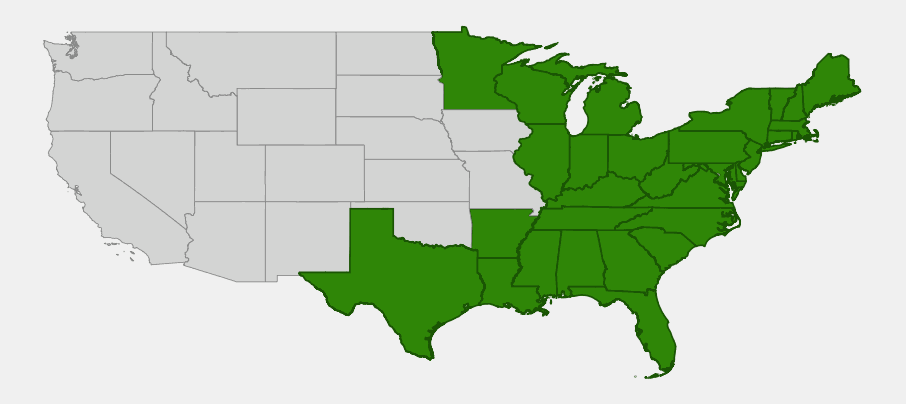
Horned bladderwort is native to eastern North America. In Canada it grows from Newfoundland, Nova Scotia, Prince Edward Island and New Brunswick west through Quebec and Ontario to Manitoba. In the United States, USDA PLANTS lists it as native in 30 eastern states, from Maine to Minnesota and south to Florida and eastern Texas.
Its range has two main parts: the glaciated Northeast and Great Lakes region, from New England and New York to Michigan, Wisconsin and northern Minnesota, and the Atlantic and Gulf Coastal Plain from New Jersey to Florida, Louisiana and East Texas. It is scattered and rarer in the interior states between them, such as Kentucky, Tennessee, West Virginia and Arkansas. USDA PLANTS also lists Washington, but that rests on a single, unconfirmed 1908 specimen; the species is not included in the Burke Herbarium’s flora of Washington and is not counted here.
It grows in full sun on constantly wet, open ground: bogs and fens, wet sandy and peaty lake and pond shores, interdunal swales, seepage slopes, wet pine savannas and flatwoods, and ditches in sandy country. It often blooms best where water levels drop in summer and expose wet sand or peat.
📋 Regional plant lists featuring Horned Bladderwort: New York, Pennsylvania & Northern New Jersey · Ohio & Indiana · Michigan, Wisconsin & Eastern Minnesota · Kentucky & Tennessee · Connecticut, Massachusetts & Rhode Island · New Hampshire, Maine & Vermont · Maryland, Virginia & West Virginia · Delaware, Southern New Jersey & Long Island · Illinois, Iowa & Missouri · Alabama, Georgia & Mississippi · North & South Florida · North & South Carolina · Arkansas, Louisiana, Eastern Oklahoma & Eastern Texas · North Dakota, South Dakota & Western Minnesota
Growing & Care Guide
Horned bladderwort can be grown in a bog garden or container with other carnivorous plants, as long as it has full sun, wet, nutrient-poor soil and pure water.
Light
Full sun. It flowers poorly in shade.
Soil & Water
Use a mix of peat and clean sand, kept saturated at all times, or a shallow tray of water over peat. Water only with rainwater, distilled or reverse-osmosis water, because minerals in tap water harm it. Never fertilize; it gets nutrients from its prey.
Planting Tips
Plant small clumps of the plant with its substrate into a sunny bog garden or a container set in a tray of water, along with sundews and pitcher plants. Buy plants only from nurseries that propagate carnivorous plants; never collect from wild bogs.
Pruning & Maintenance
Very little care is needed. Remove weeds and grasses that start to shade it. Northern plants need a cold winter rest; in mild climates or indoors, keep it cool in winter.
Propagation
Divide clumps of stolons and replant them in wet media, or sow the tiny seeds on the surface of wet peat and sand in spring and keep them moist and bright.
Landscape Uses
- Bog gardens: bright summer color among carnivorous plants
- Carnivorous plant containers: a showy yellow bladderwort for wet peat and sand
- Pond and water-garden edges: for very shallow, sunny margins with clean water
- Wildflower viewing: mass blooms on bog and pond shores in summer
- Education: a good example of a carnivorous plant with underground traps
Wildlife & Ecological Value
Horned bladderwort is a small but fascinating part of nutrient-poor wetland communities.
For Pollinators
Its bright yellow, fragrant flowers are pollinated mainly by bees, which push open the closed throat of the flower to reach the nectar in the spur.
For Birds
It provides little direct food for birds, but the bogs and shores where it grows support many birds, such as sandpipers, rails and swamp sparrows.
For Mammals
It is rarely eaten by mammals.
Ecosystem Role
Its underground bladders capture tiny animals, such as protozoa, rotifers and small crustaceans, adding nitrogen and phosphorus that are scarce in bog and sand soils. It is an indicator of open, nutrient-poor wetlands and declines where these are drained, fertilized or overgrown.
Cultural & Historical Uses
The genus name Utricularia comes from the Latin utriculus, “a small bag” or “bottle,” referring to the bladders. The species name cornuta means “horned,” for the long spur of the flower.
Bladderworts have one of the fastest movements known in the plant world. Their traps can open and suck in prey in about a thousandth of a second, a fact that has made them a favorite subject of botanists since Charles Darwin studied them in his 1875 book Insectivorous Plants.
Horned bladderwort is uncommon in many interior states at the edge of its range. Because its habitat is fragile, observe it from boardwalks or the edges of wetlands and avoid trampling bog mats.
Frequently Asked Questions
Is horned bladderwort carnivorous?
Yes. It has tiny, underground bladder traps that capture microscopic animals in the wet soil. The traps are rarely seen because they are buried.
Why is it called horned bladderwort?
Its yellow flowers have a long, pointed spur that hangs down like a horn.
Where does horned bladderwort grow?
In bogs, fens, wet sandy shores and savannas, from Newfoundland and Manitoba south to Florida and eastern Texas.
Can I grow horned bladderwort?
Yes, in a sunny bog garden or container with wet peat and sand, using rainwater or distilled water. Use nursery-propagated plants.
When does horned bladderwort bloom?
Mainly from June to September in the North, and over a longer season in the South.

Looking for a nursery that carries Horned Bladderwort?
Browse our native plant nursery directory: Alabama & Arkansas · Connecticut, Delaware, Florida & Georgia · Illinois & Indiana · Kentucky, Louisiana, Maine, Maryland, Massachusetts, Michigan, Minnesota & Mississippi · New Hampshire, New Jersey, New York, North Carolina & Ohio · Pennsylvania, Rhode Island, South Carolina, Tennessee, Texas, Vermont & Virginia · West Virginia & Wisconsin

