
Native Bellflowers and Harebells (Campanula)
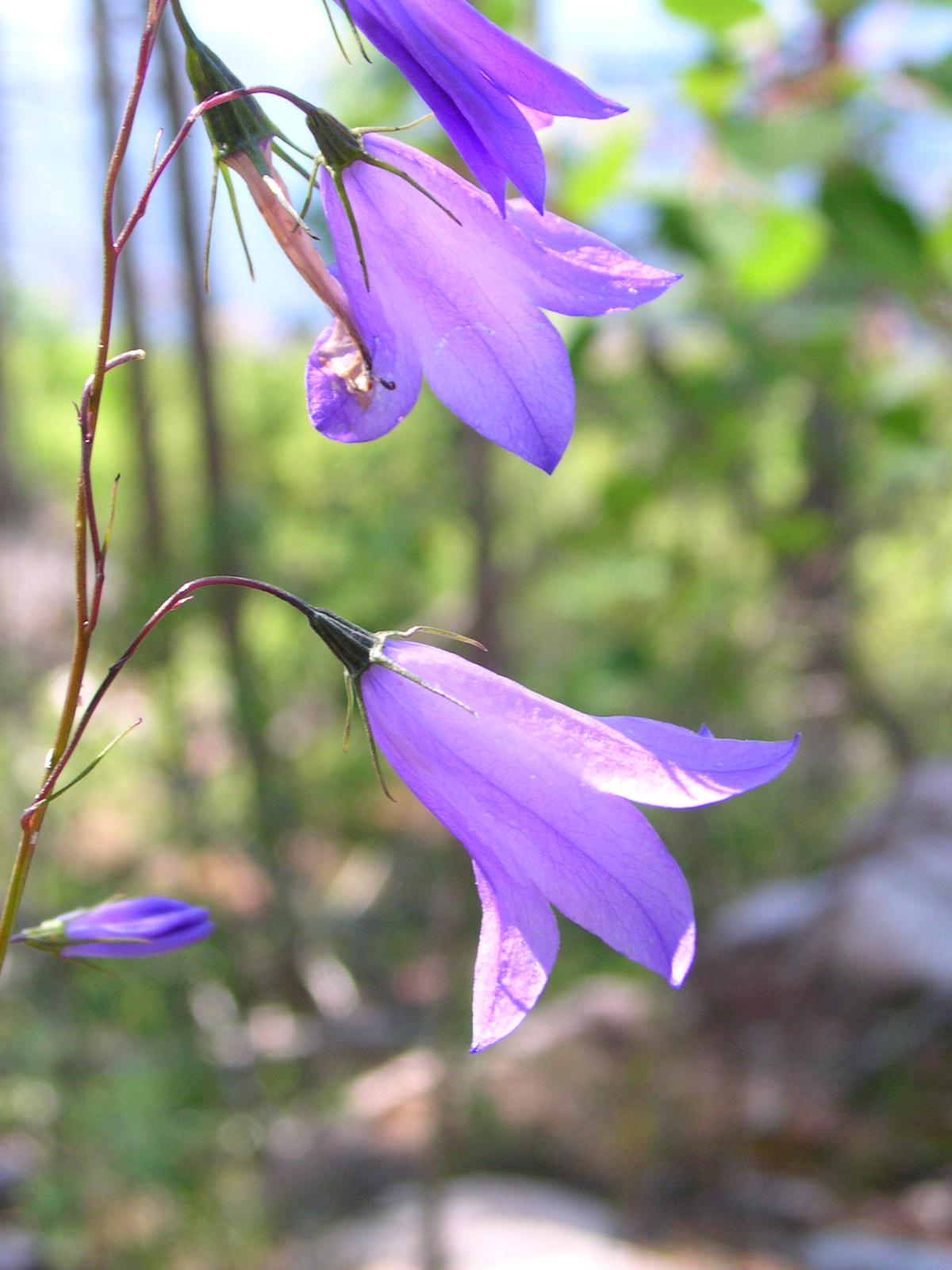
Bellflowers (genus Campanula) are herbaceous plants in the bellflower family (Campanulaceae), named for their bell-shaped, usually blue or violet flowers. The genus is huge, with roughly 400 to 500 species, but most of them come from Europe, the Mediterranean and western Asia. Only about 20 are native to the United States, and most of the bellflowers sold for gardens, including the low, mounding ground-cover types, are European.
The best-known American native is harebell (Campanula rotundifolia), a slender, wiry-stemmed wildflower of rocky slopes, prairies and mountain meadows from Alaska to New England and the Southwest. Other natives include marsh bellflower of northern wetlands, southern harebell of Appalachian rock outcrops, Parry’s bellflower in the Rocky Mountains, Scouler’s bellflower in Pacific Northwest forests, and several rare species in California, Florida and Texas. The tall American bellflower, long known as Campanula americana, is now placed in its own genus, Campanulastrum, but gardeners still think of it as a native bellflower.
If you arrived from our list of ground covers for Minnesota, note that the bellflowers described there, such as the Carpathian bellflower and other compact garden types, are European plants. Minnesota’s own bellflowers are harebell, marsh bellflower and American bellflower. None of them forms a dense mat, but harebell spreads gently by seed and thin rhizomes into sunny, rocky or sandy openings and looks lovely tucked among low native ground covers. This page explains how to tell native bellflowers from the imports, and why one import, creeping bellflower, should never be planted.
Identification
Native bellflowers are mostly small, delicate perennials, with a few annuals and biennials. Look at the flower shape, the leaves at the base and along the stem, and the habitat.
Stems & Leaves
Many bellflowers have two kinds of leaves. Harebell, for example, has rounded or heart-shaped basal leaves (the “rotundifolia” of its name) that often wither by flowering time, and narrow, grass-like leaves along its thin, wiry stems. Marsh bellflower has weak, sprawling three-angled stems lined with tiny backward-pointing bristles that cling to surrounding sedges, much like bedstraw. Southern harebell has toothed, oval stem leaves on branched stems. Most native bellflowers have milky sap when a stem or leaf is broken.
Flowers
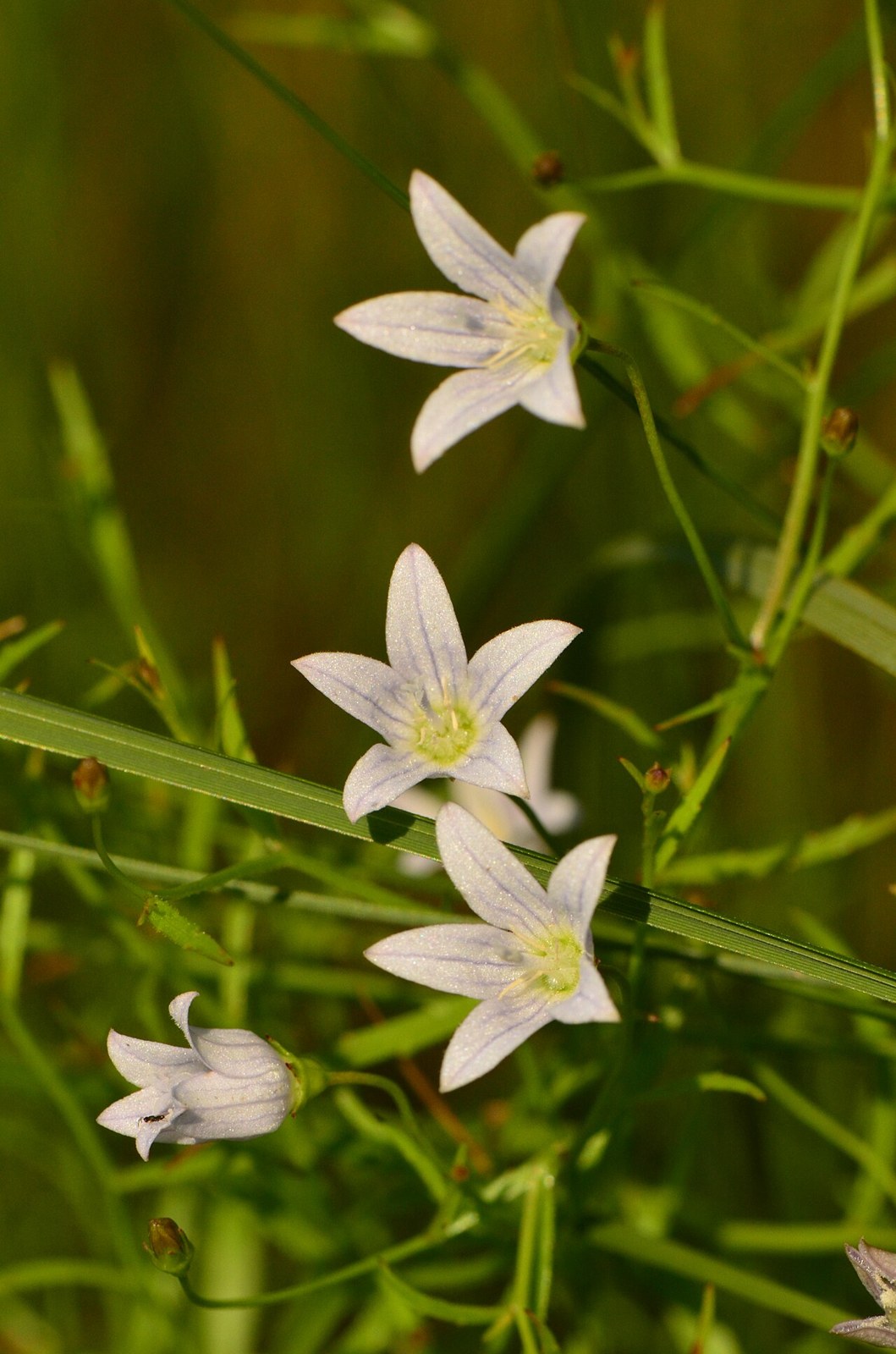
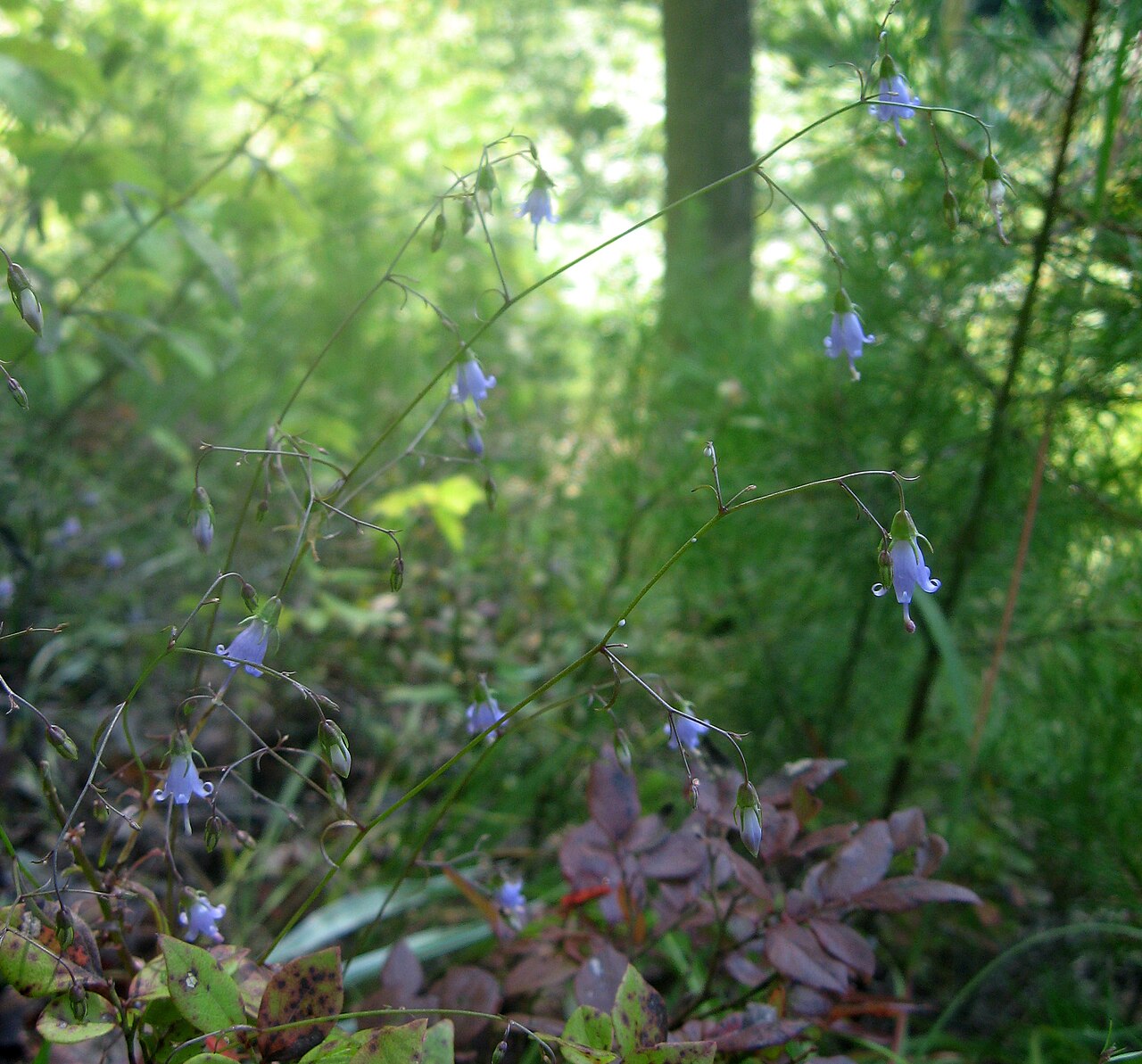
Flowers have five petals fused into a bell or open star, usually violet-blue, sometimes pale blue or white. Harebell bells are about 3/4 inch long and nod from hair-thin stalks; southern harebell bells are small (about 1/4 inch) with a long style poking out like a clapper; marsh bellflower flowers are tiny, open and white to pale blue. Parry’s bellflower carries upright, open violet flowers. Native bellflowers bloom from early summer into fall, depending on species.
Fruit & Seeds
The fruit is a small capsule that opens by pores, releasing very fine, dust-like seeds. Harebell capsules nod and open by pores near the base, so seeds sift out as the stems sway in the wind.
Close relatives
American bellflower (Campanulastrum americanum) grows 2 to 6 feet tall with flat, star-shaped blue flowers along a long spike and a long, upcurved style. Venus’s looking-glass (Triodanis), such as clasping Venus’s looking-glass, has small, flat violet flowers tucked into clasping leaf bases. Lobelias, including cardinal flower and great blue lobelia, are in the same family but have two-lipped flowers.
Quick Facts
| Scientific Name | Campanula (genus) |
| Family | Campanulaceae (Bellflower) |
| U.S. Native Species | About 20 (several are rare local endemics) |
| Plant Type | Herbaceous perennials, a few annuals and biennials |
| Mature Height | 4–18 in for most natives; southern harebell to about 2 ft |
| Mature Spread | 6–12 in; harebell spreads slowly into loose patches |
| Growth Rate | Moderate |
| Sun Exposure | Full sun to part shade, depending on species |
| Water Needs | Dry to average for harebell and southern harebell; wet for marsh bellflower |
| Soil Type | Well-drained sandy, gravelly or rocky soil for most; wet peaty soil for marsh bellflower |
| Soil pH | Acidic to slightly alkaline (about 5.0–7.5) |
| Bloom Time | June–September (harebell); July–October (southern harebell) |
| Flower Color | Violet-blue, pale blue or white |
| Fall Color | None notable |
| Wildlife Value | Nectar and pollen for bumble bees and small native bees |
| Deer Resistant | Moderately; deer and rabbits browse some bellflowers |
| USDA Hardiness Zones | 2–8 for harebell; zones vary by species |
Native Range
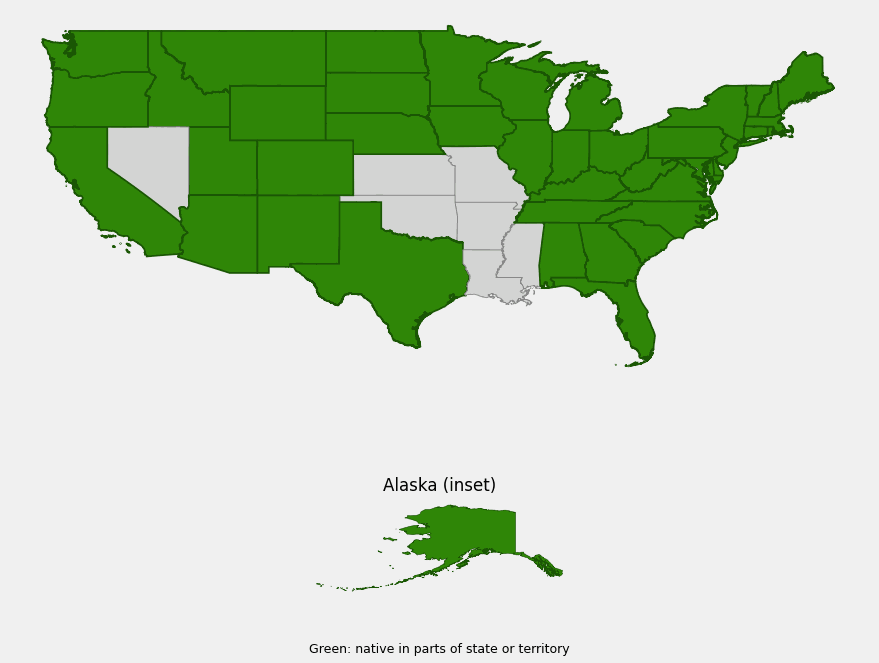
harebell carries most of the native range. It grows around the whole Northern Hemisphere, and in the United States it ranges from Alaska and the Pacific Northwest across the northern states to New England and south through the Rocky Mountains to Arizona, New Mexico and the mountains of California. In the East it reaches Pennsylvania and New Jersey, with rare outposts farther south in the central Appalachians. Marsh bellflower (C. aparinoides) covers wet meadows and fens from Minnesota and the Dakotas east to New England and south to Virginia, with rare populations in the Carolina mountains and outliers on the western Plains and in Colorado.
The Southeast has its own species. southern harebell grows on dry, rocky slopes and outcrops of the southern Appalachians from Maryland and West Virginia to Kentucky, Tennessee, the Carolinas, Georgia and Alabama. Florida bellflower (C. floridana) lives in wet pine flatwoods and marshes across Florida, and the tiny Brooksville bellflower (C. robinsiae) is known only from a few seasonal ponds in west-central Florida. Texas has Reverchon’s bellflower (C. reverchonii), an annual of granite outcrops in the Hill Country.
The West is richest in species: Parry’s bellflower and arctic harebell in the Rockies, Scouler’s and rough harebell in the Northwest, Olympic bellflower on the peaks of the Olympic Mountains, and a group of small annual and perennial bellflowers found only in California. According to county-level records, no Campanula is native to Kansas, Oklahoma, Missouri, Arkansas, Louisiana, Mississippi, Nevada or Hawaii; bellflowers growing wild there are garden escapes.
📋 Regional plant lists covering native bellflower ranges: Maine, New Hampshire & Vermont · Southern New England · New York, Pennsylvania & Northern New Jersey · Delaware, Southern New Jersey & Long Island · Maryland, Virginia & West Virginia · North Carolina & South Carolina · Georgia, Alabama & Mississippi · Kentucky & Tennessee · Ohio & Indiana · Illinois, Iowa & Missouri · Michigan, Wisconsin & Eastern Minnesota · Dakotas & Western Minnesota · Nebraska, Kansas & Eastern Colorado · South & West Texas · Arizona & New Mexico · Utah & Western Colorado · Montana & Wyoming · Idaho, Eastern Oregon & Washington · Western Oregon & Washington · California & Nevada · Alaska
Native Species
These are the native bellflowers gardeners are most likely to grow or find in the wild. Click a name for its full growing guide.
Harebell (Campanula rotundifolia)
Native to: Alaska and the northern states from Washington to Maine, south in the Rocky Mountains to Arizona and New Mexico, in California’s mountains and in scattered rocky sites in the East. Six to 18 inches tall, with nodding violet-blue bells on hair-thin stems from June into September. Thrives on dry, rocky, sandy or gravelly soils in full sun or light shade, including cliffs and lakeshore rocks. The best native bellflower for rock gardens, sunny slopes and the edges of native ground covers; it self-sows lightly.
Southern Harebell (Campanula divaricata)
Native to: the southern Appalachians, from Maryland and West Virginia to Kentucky, Tennessee, the Carolinas, Georgia and Alabama. A 1- to 2-foot, airy, much-branched perennial with clouds of tiny, nodding pale blue bells and protruding styles from midsummer into fall. Grows on dry, rocky, acidic slopes and outcrops in sun or part shade, and suits a dry woodland edge or rock garden.
Marsh Bellflower (Campanula aparinoides)
Native to: Minnesota and the Dakotas east to New England and south to Virginia, with scattered outliers west to Colorado. A weak-stemmed, sprawling plant that leans on sedges with its rough, clinging stems. Tiny white to pale blue flowers appear in summer. Grows in sedge meadows, fens and wet shores; plant it in a rain garden or bog garden rather than a border.
Parry’s Bellflower (Campanula parryi)
Native to: the Rocky Mountains, from Idaho, Montana and Wyoming to Utah, Colorado, Arizona and New Mexico. A small, 4- to 12-inch mountain perennial with one or a few upright, open violet flowers per stem, common in moist subalpine meadows in late summer.
Scouler’s Bellflower (Campanula scouleri)
Native to: the Pacific Northwest and northern California, mainly in Washington, Oregon and California. A low woodland perennial with pale blue flowers whose petals curl back sharply, exposing a long style. A good native for shady Northwest gardens.
Florida Bellflower (Campanula floridana)
Native to: wet pine flatwoods, marshes and ditches across Florida. A slender, sprawling plant with small violet star-shaped flowers through much of the year. Florida also has the federally endangered Brooksville bellflower (C. robinsiae), known from only a few seasonal ponds; never collect it.
Arctic Harebell (Campanula uniflora)
Native to: Alaska and the high Rocky Mountains of Montana, Wyoming and Colorado. A tiny alpine with a single narrow, dark blue bell per stem, growing in tundra and rocky ridges above treeline.
American Bellflower (Campanulastrum americanum (formerly Campanula americana))
Native to: much of the eastern United States, from Minnesota and New York south to Florida and west to Oklahoma. A tall annual or biennial, 2 to 6 feet, with flat, star-shaped blue flowers along long spikes from July to September. Grows in moist woodland edges and part shade, self-sowing readily. Now classified in its own genus but still sold as a native bellflower.
Non-Native Look-Alikes
Almost every bellflower in a garden center is European or western Asian. Most are well-behaved perennials, but they are not native, and one is a serious invasive. If a plant label says only “Campanula” or “bellflower”, assume it is not native unless it says rotundifolia, divaricata or another North American species.
Creeping Bellflower (Campanula rapunculoides) – invasive
The one bellflower to avoid. It grows 2 to 3 feet tall, with heart-shaped lower leaves and a one-sided spike of nodding purple-blue bells in midsummer. It spreads aggressively by thick, white, deep tuberous roots and by abundant seed, invading lawns, gardens, roadsides and woodland edges across the northern United States and southern Canada, including Minnesota. Every root fragment can resprout, so it is extremely hard to remove once established. It is still passed along between gardeners; do not plant it. Harebell is easy to separate: it is much smaller, with very thin stems, narrow stem leaves and only a few bells per stem.
Carpathian Bellflower (Campanula carpatica)
A compact, 8- to 12-inch mounding plant from the Carpathian Mountains of central and eastern Europe, with large, upward-facing, cup-shaped blue, violet or white flowers in summer. This is the “clump-forming, low-growing bellflower” of many ground-cover lists. It is not invasive, but it is not native.
Dalmatian and Serbian Bellflowers (C. portenschlagiana and C. poscharskyana)
Low, spreading bellflowers from the mountains of the Balkans, sold for walls, rock gardens and edging. Dalmatian bellflower has deep purple, bell-shaped flowers; Serbian bellflower has star-shaped lavender flowers and spreads more vigorously by runners. Both are non-native ground covers.
Peach-leaved Bellflower (Campanula persicifolia)
A 2- to 3-foot European perennial with narrow, glossy leaves and large, open, cup-shaped blue or white flowers on upright stems. It occasionally self-sows outside gardens in the northern states.
Other common imports
Clustered bellflower (C. glomerata), with dense heads of violet flowers, spreads by rhizomes and has escaped in places. Canterbury bells (C. medium) is a large-flowered biennial from southern Europe. Many hybrid bellflowers, such as ‘Kent Belle’ and ‘Sarastro’, are crosses of Eurasian species.
Growing & Care Guide
Native bellflowers are small, delicate plants that do best in conditions close to their wild habitats: lean, well-drained soil and little competition for harebell and southern harebell, and constant moisture for marsh bellflower.
Light
Harebell blooms best in full sun to light shade. Southern harebell tolerates part shade at woodland edges. Marsh bellflower likes sun to part shade in wet ground, and American bellflower prefers dappled or afternoon shade.
Soil & Water
Give harebell sandy, gravelly or rocky soil with excellent drainage. It tolerates drought and poor soil once established, but rots in heavy, wet clay or rich, constantly watered beds. Southern harebell likes dry, acidic, rocky soil. Marsh bellflower needs soil that stays wet all season. Water new plantings through their first summer.
Planting Tips
Plant harebell in spring or early fall from small containers, spacing plants 8 to 12 inches apart in groups of five or more so the thin stems hold each other up and make a visible drift. Rock gardens, wall crevices, sunny slopes, gravel gardens and the gaps between pavers suit it well. Pair it with low natives such as prairie smoke, pussytoes, wild strawberry, bearberry and little bluestem rather than relying on it as a solid ground cover.
Pruning & Maintenance
Little care is needed. Leave some seed heads to let harebell self-sow, and cut stems back after they brown in fall or leave them through winter. Keep taller neighbors from crowding small bellflowers. Slugs can damage young plants in moist gardens.
Propagation
Sow the dust-fine seed on the surface of moist soil in fall or after a few weeks of cold, moist stratification; do not cover it, since it needs light to germinate. Harebell can also be divided in early spring. American bellflower self-sows readily and is easy to establish from seed scattered in fall.
Landscape Uses
- Rock gardens, wall plantings and gravel gardens (harebell, southern harebell)
- Edging and gap fillers among low native ground covers in sunny, dry sites
- Prairie, savanna and meadow plantings on sandy or rocky soil
- Bog gardens, rain gardens and wet meadows (marsh bellflower)
- Woodland edges with part shade (southern harebell, American bellflower)
Wildlife & Ecological Value
For Pollinators
Bellflowers are visited by bumble bees and many small native bees, including sweat bees, small carpenter bees and leafcutter bees, along with hover flies. The nodding bells protect pollen and nectar from rain, and bumble bees are often seen sheltering inside harebell flowers in bad weather. Because harebell blooms for months in summer and fall, it adds a long-lasting nectar source to dry, sunny plantings.
For Birds
Bellflowers have little direct value for birds beyond the insects they support, though small finches may pick at the seed capsules.
For Mammals
Deer, rabbits and elk graze bellflowers lightly. Harebell’s thin, sparse foliage means it rarely draws heavy browsing.
Ecosystem Role
Harebell is a characteristic plant of rock outcrops, dry prairies, sand barrens and alpine tundra, places where low, sparse vegetation leaves room for small wildflowers. Marsh bellflower is a sign of healthy sedge meadows and fens. Several native bellflowers are rare: Brooksville bellflower is federally endangered, Olympic bellflower is confined to one mountain range, and harebell itself becomes uncommon to rare at the southern edge of its eastern range.
Cultural & Historical Uses
Harebell is the “bluebell of Scotland” of song and poetry, and the same species grows across northern Europe and Asia as well as North America. In Britain, where the name “bluebell” usually refers to a different plant, folk tales linked harebells with fairies, hares and witches.
The genus name Campanula means “little bell” in Latin, and the common names harebell, bluebell, bellflower and witch’s thimble all describe the flower. Because harebell grows wild on both sides of the Atlantic, European settlers in North America recognized it at once as the familiar bluebell of home, one of the few native wildflowers they already knew by name.
European bellflowers have been popular in gardens for centuries; rampion (C. rapunculus) was once grown as a root vegetable and gave its name to the fairy tale of Rapunzel. Creeping bellflower probably came to North America the same way, as a garden ornamental, before escaping to become an invasive weed.
Frequently Asked Questions
Which bellflowers are native to Minnesota?
Minnesota has harebell (Campanula rotundifolia), marsh bellflower (C. aparinoides) and American bellflower (Campanulastrum americanum). Carpathian bellflower, Serbian bellflower, Dalmatian bellflower and creeping bellflower are European and not native.
Is harebell a good ground cover?
Not as a solid mat. Harebell has thin, wiry stems and sparse leaves, so it does not smother weeds the way creeping ground covers do. It works best as a drift or filler on sunny, dry, rocky or sandy ground, mixed with low natives such as prairie smoke, pussytoes, wild strawberry or bearberry.
How do I tell creeping bellflower from harebell?
Creeping bellflower is a much bigger plant, 2 to 3 feet tall, with broad heart-shaped leaves and many purple bells along one side of a tall spike, and it spreads from thick, white roots. Harebell is 6 to 18 inches tall, with thread-thin stems, narrow stem leaves and just a few nodding bells per stem.
Is creeping bellflower invasive?
Yes. Creeping bellflower (Campanula rapunculoides) is a European plant that has become an invasive weed of gardens, lawns and roadsides across the northern United States and Canada. Its deep tuberous roots resprout from small pieces, so it is very difficult to eliminate. Do not plant it or share divisions.
Do native bellflowers attract pollinators?
Yes. Bumble bees and many small solitary bees visit harebell and other native bellflowers for nectar and pollen, and harebell’s long summer-to-fall bloom makes it a dependable source in dry, sunny gardens.
Will harebell grow in clay soil?
Usually not well. Harebell needs sharp drainage and tends to rot in heavy, wet clay. Plant it in a raised, gravelly bed, a rock garden or a sandy slope instead.

Looking for a nursery that carries Native Bellflowers?
Browse our native plant nursery directory: Alaska, Alabama & Arizona · California · Colorado, Connecticut, Delaware, Florida & Georgia · Iowa, Idaho, Illinois & Indiana · Kentucky, Massachusetts, Maryland, Maine, Michigan, Minnesota & Montana · North Carolina, North Dakota, Nebraska, New Hampshire, New Jersey, New Mexico, New York & Ohio · Oregon · Pennsylvania, Rhode Island, South Carolina, South Dakota, Tennessee, Texas, Utah, Virginia & Vermont · Washington · Wisconsin, West Virginia & Wyoming

