
Native Mesquites (Prosopis)
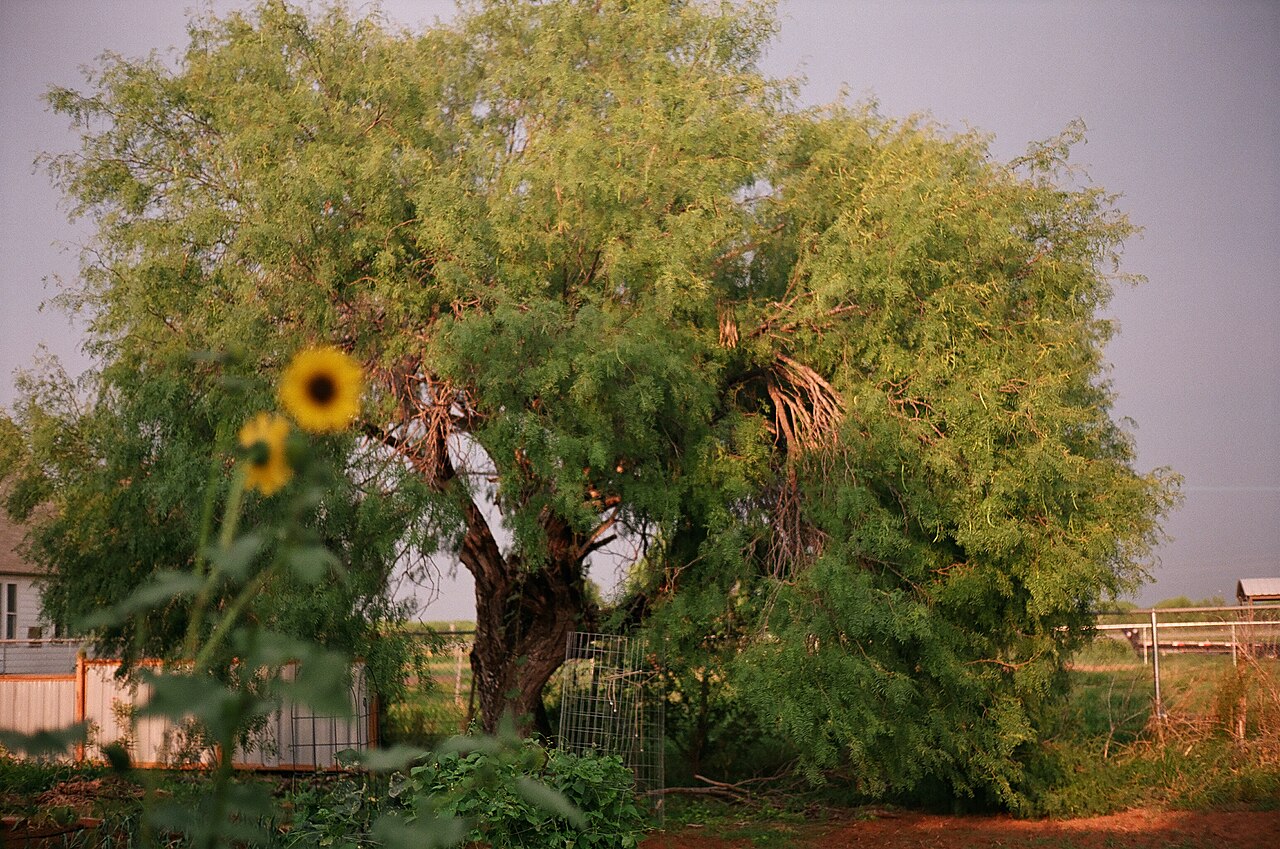
Mesquites (genus Prosopis) are thorny, deep-rooted trees and shrubs in the pea family (Fabaceae) that define the desert washes, river bottoms and brushy grasslands of the American Southwest. Their feathery, twice-divided leaves cast light shade, their creamy flower spikes hum with bees in spring, and their long, sweet seed pods fed desert peoples for thousands of years. Worldwide there are roughly 40 to 45 species, most of them in South America. Four are native to the United States: honey mesquite (Prosopis glandulosa), velvet mesquite (P. velutina), screwbean mesquite (P. pubescens) and creeping mesquite, or tornillo (P. reptans).
If you arrived here from our guide to plants of the Mojave Desert, the mesquites you meet there are western honey mesquite (P. glandulosa var. torreyana) and screwbean mesquite. Both grow where their roots can reach groundwater: along washes, around springs and in dune hollows. The claim you read there is true: mesquites have some of the deepest roots of any desert plant, and their pods were a staple food for the Cahuilla, Mojave, Tohono O’odham, Pima and many other peoples.
Many “mesquites” planted in Phoenix, Tucson, Las Vegas and Southern California parking lots and yards are not native. Thornless Chilean and Argentine mesquites from South America and their hybrids are sold widely because they grow fast and look tidy. This guide covers the native species, how to tell them from the imports, and how to grow them.
A note on names: a 2022 study split the old genus Prosopis, moving most American mesquites (including honey and velvet mesquite) to Neltuma and the screwbeans to Strombocarpa. USDA PLANTS and most nurseries and field guides still use Prosopis, so this page does too.
Identification
All mesquites share a few traits: bipinnate (twice-divided) leaves with many small leaflets, usually on a short, forked stalk; paired spines at the nodes of vigorous shoots; tiny creamy yellow flowers in dense, catkin-like spikes; and bean pods that are either long and straight or tightly coiled like a screw.
Bark & Form
Mesquites grow as multi-trunked shrubs on dry, shallow soils and as single-trunked trees where groundwater is close. Old trees have dark gray-brown to nearly black bark in long, shaggy, fibrous strips, and the trunks often twist and lean. Honey and velvet mesquite can reach 20 to 30 feet, and velvet mesquite in old Arizona river bosques reaches 40 feet or more. Screwbean mesquite is usually a shrub or small tree, 10 to 25 feet, with lighter, shreddy bark. Tornillo is a low, spreading shrub under about 3 feet.
Leaves
Leaves drop in winter and leaf out late in spring, which desert gardeners use as a sign that frost is over. Honey mesquite has smooth, bright green leaflets that are long (often 1 to 2 inches), narrow and widely spaced, usually on one or two pairs of side stalks. Velvet mesquite leaflets are much shorter (about 1/4 to 1/2 inch), closely spaced and covered in fine, soft hairs, giving the tree a grayish, velvety look. Screwbean leaflets are tiny, gray-green and hairy, in five to eight pairs, and the spines are often whitish and straight.
Flowers
From April to June, and often again after summer rains, mesquites bear pale yellow to cream flower spikes 2 to 4 inches long. The individual flowers are tiny, but a tree in full bloom smells sweet and draws enormous numbers of bees.
Pods
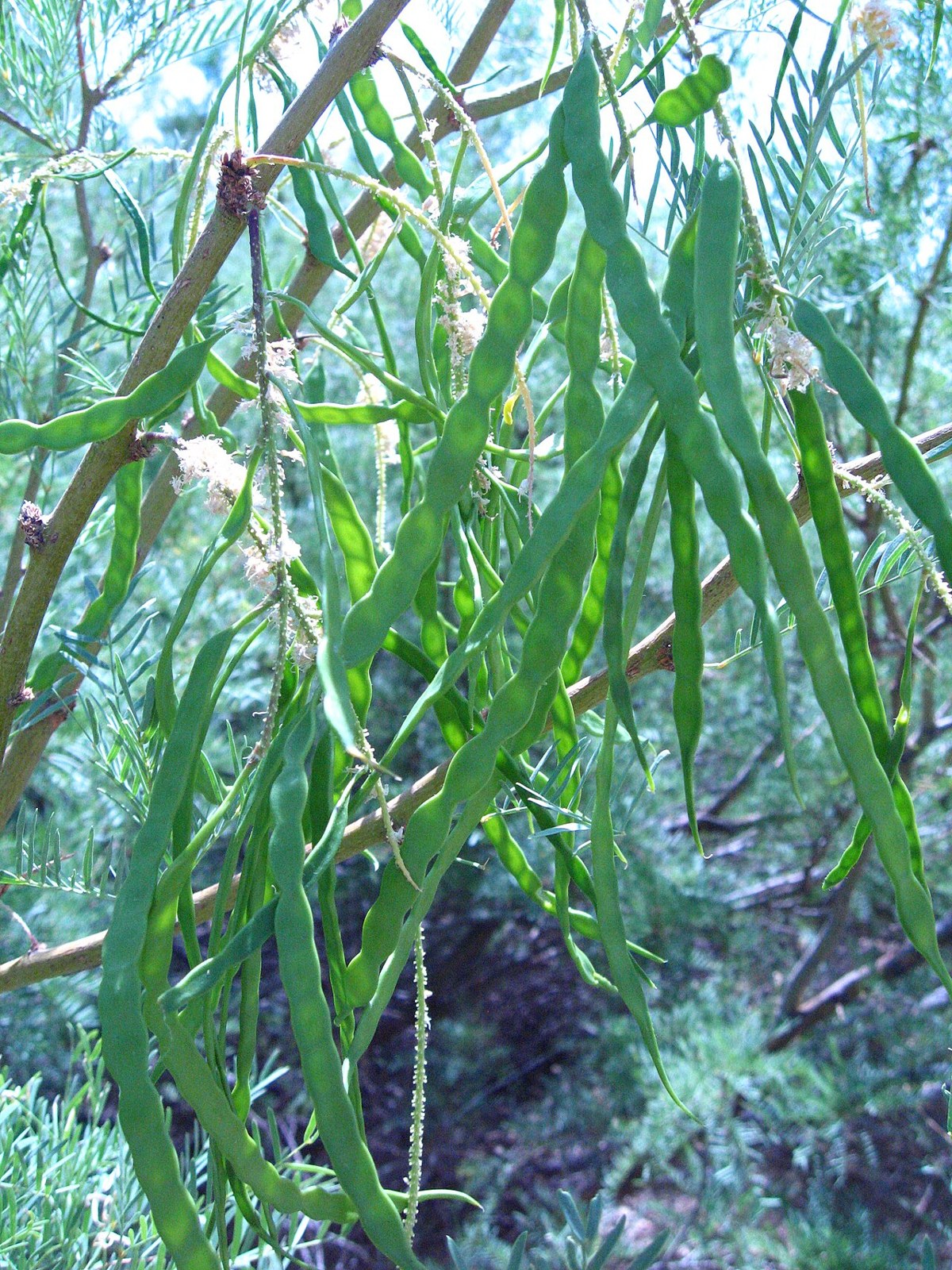
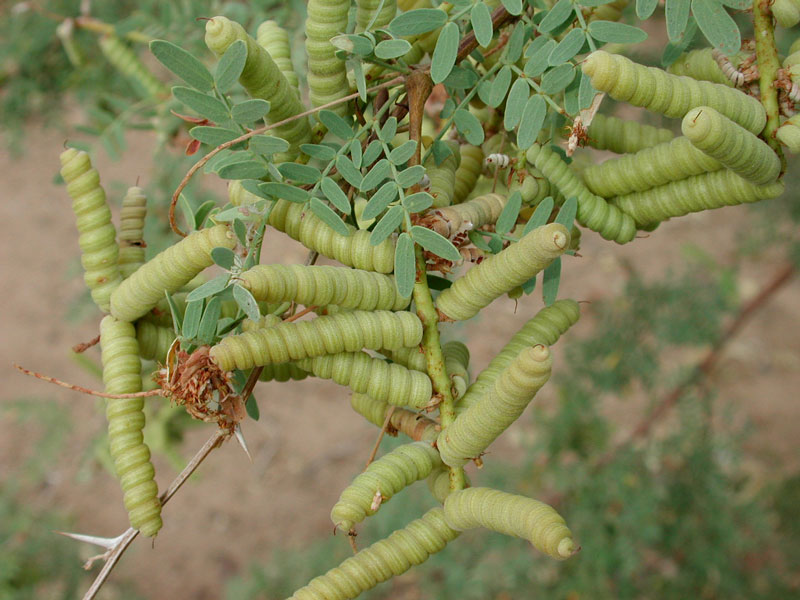
The pods tell the species apart most easily. Honey and velvet mesquite produce long, straight to curved pods, 4 to 10 inches long, slightly constricted between the seeds, ripening straw-yellow to tan (velvet mesquite pods are often streaked with red or purple). Screwbean and tornillo produce tightly coiled pods, 1 to 2 inches long, that look like small springs, borne in clusters.
Quick Facts
| Scientific Name | Prosopis (genus); recently split into Neltuma and Strombocarpa |
| Family | Fabaceae (Pea/Legume) |
| U.S. Native Species | Four: honey, velvet, screwbean and creeping mesquite (tornillo) |
| Plant Type | Deciduous thorny trees and shrubs |
| Mature Height | Under 3 ft (tornillo) to 20–30 ft (honey, velvet); old velvet mesquites 40 ft+ |
| Mature Spread | Often as wide as tall; 20–35 ft for tree forms |
| Growth Rate | Moderate to fast with water; slow on dry sites |
| Sun Exposure | Full sun |
| Water Needs | Low once established; deep, infrequent watering |
| Soil Type | Sandy, gravelly, silty or clay soils; tolerates alkaline and somewhat salty soil |
| Soil pH | About 6.5–8.5 |
| Bloom Time | April–June, often again after summer rains |
| Flower Color | Pale yellow to cream, in catkin-like spikes |
| Fruit | Sweet, edible pods: long and straight (honey, velvet) or coiled (screwbean, tornillo) |
| Wildlife Value | Major bee plant; pods feed quail, doves, javelina and coyotes; host for Palmer’s metalmark and Reakirt’s blue |
| Deer Resistant | Mostly; thorns deter browsing |
| USDA Hardiness Zones | About 6–10 (honey mesquite); 7–10 (velvet and screwbean) |
Native Range
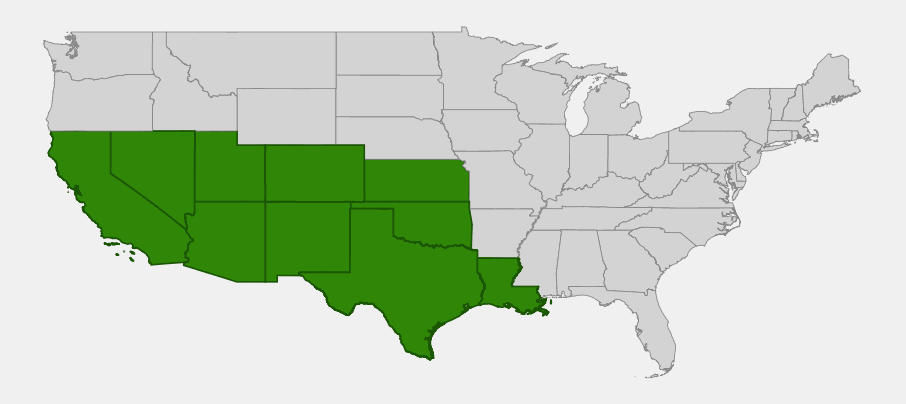
honey mesquite has the largest range. The typical variety (var. glandulosa) covers most of Texas, western and southern Oklahoma, southwestern Kansas, eastern New Mexico and scattered sites in western Louisiana, with rare stands at the southeastern edge of Colorado. Western honey mesquite (var. torreyana) runs from western Texas through southern New Mexico and Arizona to the Mojave and Colorado deserts of California, southern Nevada and the southwestern tip of Utah. In California it reaches the San Joaquin Valley and coastal Southern California.
velvet mesquite is the mesquite of the Sonoran Desert: southern and central Arizona and southwestern New Mexico, south into Sonora. Its great riverside forests, called bosques, once lined the Santa Cruz, San Pedro, Gila and Salt rivers. screwbean mesquite follows rivers and springs from southeastern California, southern Nevada and southwestern Utah through Arizona and southern New Mexico to western Texas, especially along the Colorado River and the Rio Grande. Tornillo, or creeping mesquite (P. reptans var. cinerascens), grows only in South Texas in the United States, on clay flats of the Rio Grande Plains and the coastal bend, and in northeastern Mexico.
Honey mesquite has thickened across Texas, Oklahoma and New Mexico grasslands since the late 1800s, as heavy grazing and the end of regular prairie fires let seedlings spread. It is native there, but range managers often treat it as brush to control. Mesquites are not native east of Louisiana or north of Kansas, Colorado and Utah, and planted trees in those places are ornamental.
📋 Regional plant lists covering native mesquite ranges: California & Nevada · Arizona & New Mexico · Utah & Western Colorado · South & West Texas · Nebraska, Kansas & Eastern Colorado · Arkansas, Louisiana, Eastern Oklahoma & East Texas
Native Species
Four mesquites are native to the United States. Each has a place in desert and dryland gardens, and three already have full profiles on this site.
Honey Mesquite (Prosopis glandulosa)
Native to: Texas, Oklahoma, southwestern Kansas, western Louisiana and southeastern Colorado west through New Mexico and Arizona to California, Nevada and southwestern Utah. The most widespread native mesquite, with long, smooth, bright green leaflets, broad weeping crowns and long, sweet, straw-colored pods. It is the hardiest species (to about zone 6) and the best choice from Texas to the Mojave. The thornless selection ‘Maverick’, from Texas, keeps the native species without the spines.
Velvet Mesquite (Prosopis velutina)
Native to: southern and central Arizona and southwestern New Mexico, south into Sonora. The Sonoran Desert’s signature shade tree, with fine, gray-green, velvety leaflets and dark, shaggy bark. Long-lived and sturdy when grown with deep, infrequent watering, it is the best native alternative to Chilean mesquite in Phoenix and Tucson.
Screwbean Mesquite (Prosopis pubescens)
Native to: river corridors and springs of southeastern California, southern Nevada, southwestern Utah, Arizona, southern New Mexico and western Texas. A smaller, often shrubby mesquite with tiny gray leaflets, white spines and clusters of tightly coiled, spring-like pods. It grows best near groundwater and tolerates salty soils, making it valuable for riparian restoration and as a conversation-piece small tree.
Creeping Mesquite, Tornillo (Prosopis reptans)
Native to: South Texas (Rio Grande Plains and coastal bend) and northeastern Mexico. A low, thorny shrub under about 3 feet that spreads by underground stems, with gray-hairy leaflets and small coiled pods. It is rarely sold but is part of the native thornscrub of South Texas clay flats.
Mesquites often host mesquite mistletoe (Phoradendron californicum), a native leafless mistletoe whose red-pink berries feed phainopeplas and other birds through winter. A few clumps are normal on healthy trees.
Non-Native Look-Alikes
Chilean Mesquite (Prosopis chilensis) and South American Hybrids
“Chilean mesquite” is the most widely planted mesquite in the low deserts of Arizona, Nevada and California. True P. chilensis is native to Chile, Argentina, Bolivia and Peru, but most trees sold under that name are hybrids involving Argentine mesquite (P. alba), P. chilensis and sometimes native velvet or honey mesquite. Thornless selections such as ‘Phoenix’ are popular in parking lots and new subdivisions. Look for larger, brighter green, often nearly evergreen leaves, a fast, upright habit, and few or no thorns. These trees grow quickly with regular irrigation but form shallow roots and dense, top-heavy crowns, and they are notorious for blowing over or splitting in summer monsoon storms. They also cross with native mesquites, mixing foreign genes into wild populations near cities.
Argentine Mesquite (Prosopis alba)
A South American tree sold for its fast growth and large shade canopy, with long, bright green leaflets and few thorns. Like Chilean mesquite, it is common in Southwestern landscapes and is a parent of many landscape hybrids.
Mesquite and Kiawe Invasive Overseas and in Hawaii (P. juliflora, P. pallida)
Tropical mesquites are among the world’s worst invasive plants. Kiawe (Prosopis pallida), from Peru and Ecuador, was introduced to Hawaii in 1828 and now forms dense thorny thickets across the dry lowlands of all the main islands; no mesquite is native to Hawaii. Honey mesquite and South American species are also serious invaders in Australia, South Africa, India and East Africa, a reminder that a plant can be a well-behaved native in one place and a pest in another.
Other Thorny Look-Alikes
Native catclaw acacia and the palo verdes share mesquite’s feathery leaves and thorns. Catclaw has curved, cat-claw prickles and short, twisted pods; palo verdes have green bark and yellow flowers in spring. Jerusalem thorn (Parkinsonia aculeata), widely planted and naturalized, has long, flat, ribbon-like leaf stalks with tiny leaflets.
Growing & Care Guide
Native mesquites are tough, long-lived trees that need sun, drainage and patience more than fertilizer or frequent water. The most common way to ruin one is to water it like a lawn.
Light
Full sun. Mesquites tolerate reflected heat from walls and pavement and become thin and leggy in shade.
Soil & Water
Mesquites grow in almost any well-drained soil, from sand and gravel to silty floodplain and caliche-laced clay, and tolerate alkaline and moderately salty conditions. Water deeply but infrequently: soak the root zone to 2 to 3 feet, then let the soil dry before watering again. During the first two summers in the low desert, that may mean every week or two; established trees may need only occasional deep summer soakings or none at all where roots reach groundwater. Frequent shallow watering builds weak, shallow roots and soft, fast growth that breaks in storms.
Planting Tips
Plant from fall through early spring in the low desert, or in spring in colder areas. Choose small nursery trees (5- to 15-gallon) of a native species, labeled with its scientific name; they establish faster than large boxed trees. Give tree forms 25 to 35 feet of room, and keep them away from walkways if you buy a thorny form. Mesquites are legumes that work with soil bacteria to fix nitrogen, so do not fertilize.
Pruning & Maintenance
Prune in late winter or early spring, removing dead, crossing and low branches, and thin the canopy lightly so wind passes through. Never remove more than about a quarter of the crown in a year, and avoid “lion-tailing” (stripping all inner branches), which weakens limbs. Wear heavy gloves; the spines are sharp and can cause painful puncture wounds.
Pests & Problems
Native mesquites have few serious problems. Mesquite twig girdler beetles may chew rings around small twigs, and mistletoe can build up on old trees. Overwatered or poorly rooted trees, especially South American hybrids, are prone to blowing over. Seedlings sprout from pods eaten and spread by animals, so pull unwanted volunteers while small.
Propagation
Mesquite seeds have hard coats. Scarify them by nicking the coat or soaking them in hot water overnight, then sow in deep pots in warm weather. Seedlings form a long taproot quickly and dislike transplanting, so move them to the ground young.
Landscape Uses
- Light, filtered shade tree for desert and dryland yards, patios and parking areas
- Wildlife and bird gardens, especially with desert willow, blue palo verde, desert ironwood, desert hackberry and fourwing saltbush
- Riparian, wash and bosque restoration within the native range (velvet, honey, screwbean)
- Thorny barrier hedge and wildlife cover
- Edible landscapes: pods for mesquite flour
Wildlife & Ecological Value
For Pollinators
Mesquite blossoms are a major spring nectar and pollen source for native bees and honey bees across the Southwest, and mesquite honey is a well-known regional product. Mesquites are caterpillar host plants for Palmer’s metalmark and Reakirt’s blue butterflies and many moths.
For Birds
Mesquite thickets and bosques are prime bird habitat. Lucy’s warbler, Bell’s vireo, verdins and Abert’s towhees nest in them, Gambel’s quail and white-winged and mourning doves eat the seeds, and phainopeplas gather to eat mistletoe berries on mesquite branches in winter.
For Mammals
Coyotes, javelina, kangaroo rats, ground squirrels, rabbits and deer eat fallen pods and spread the seeds. Cattle eat pods as well, which helped mesquite spread across Texas rangelands.
Ecosystem Role
Mesquites fix nitrogen and pull water and nutrients up from deep soil, so the ground under an old tree is richer, shadier and cooler than the surrounding desert. Their roots are famous: a mesquite root was found more than 150 feet below the surface in an open-pit mine in Arizona. Velvet mesquite bosques along Arizona’s rivers are among the most valuable and most reduced wildlife habitats in the Southwest; many were cleared for farms and firewood or died when groundwater was pumped down.
Cultural & Historical Uses
Mesquite pods were one of the most important wild foods of the Southwest. The Cahuilla, Mojave, Quechan, Tohono O’odham, Akimel O’odham and many other peoples gathered the ripe pods in summer, stored them in granaries and pounded them into a sweet flour for cakes, porridge and drinks. Screwbean pods were gathered and processed too. Mesquite wood was the main fuel and building material of desert villages, and the gum, bark and fibers had many traditional uses.
Today mesquite flour is sold as a specialty food, mesquite wood is prized for grilling and smoking meat and for furniture, and mesquite honey is a regional favorite. If you gather pods, pick dry, ripe pods from the tree rather than the ground, and discard any that are moldy or insect-damaged, since stored pods can grow molds that produce harmful toxins.
Frequently Asked Questions
Which mesquites are native to the Mojave Desert?
Western honey mesquite (Prosopis glandulosa var. torreyana) and screwbean mesquite (P. pubescens). Both grow where their roots reach groundwater, along washes, springs and dune hollows. Velvet mesquite is a Sonoran Desert species found farther south and east in Arizona.
How deep do mesquite roots go?
Very deep. Mesquites form long taproots that follow moisture down, and a root was once found more than 150 feet below the surface in an Arizona mine. Most roots, though, spread widely in the upper few feet of soil.
Are mesquite pods edible?
Yes. Ripe, dry pods of the native mesquites are sweet and were a staple food for many Southwestern peoples; they are ground into mesquite flour. Gather them from the tree, not the ground, and throw out any moldy pods.
Is Chilean mesquite native?
No. Chilean mesquite comes from South America, and most trees sold under that name are hybrids. They grow fast with irrigation but blow over easily in storms. Velvet or honey mesquite is the native choice for Southwestern yards.
Is mesquite invasive?
Native mesquites belong in the Southwest, although honey mesquite has spread into overgrazed grasslands within its native range. Outside the Americas, and in Hawaii, mesquites and kiawe are serious invasive weeds.
How do I tell honey mesquite from velvet mesquite?
Look at the leaflets. Honey mesquite leaflets are long (often over an inch), smooth and widely spaced. Velvet mesquite leaflets are short, crowded and covered with soft gray hairs.
Do mesquites have thorns?
Most native mesquites have paired, sharp spines up to about 2 inches long on vigorous shoots. Thornless selections of honey mesquite, such as ‘Maverick’, are available for patios and walkways.

Looking for a nursery that carries Native Mesquites?
Browse our native plant nursery directory: Arizona · California · Colorado · Kansas · Louisiana · New Mexico, Nevada & Oklahoma · Texas & Utah

