
Native Spruces (Picea)
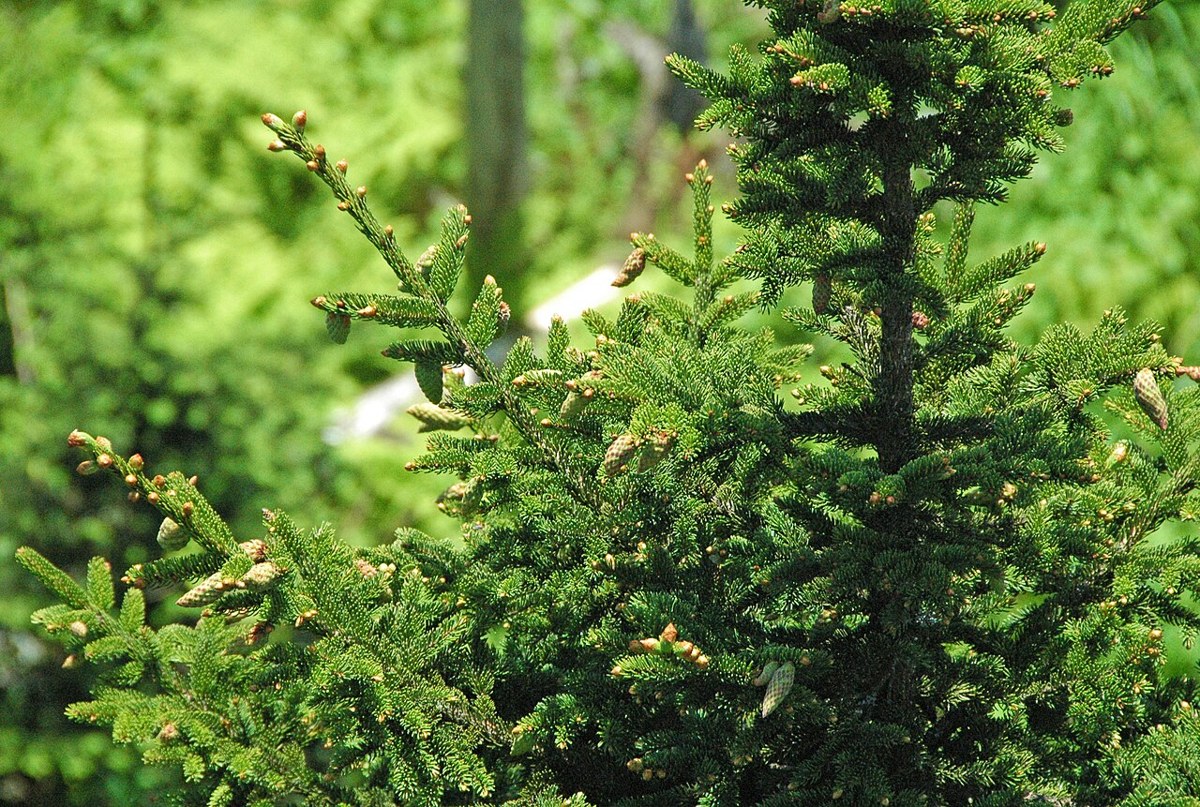
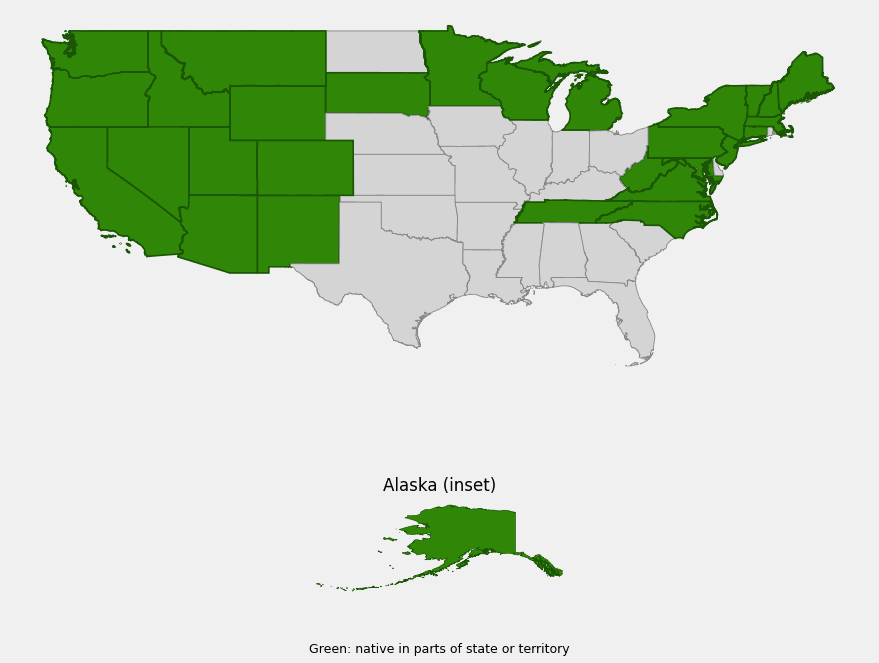
Spruces (genus Picea) are evergreen conifers with short, stiff, four-sided needles and hanging cones. About 35 species grow across the cooler parts of the Northern Hemisphere, and seven of them are native to the United States: white, black and red spruce in the North and East, Engelmann and blue spruce in the Rocky Mountains, and Sitka and Brewer spruce near the Pacific Coast. Together they grow wild in 29 states, from the bogs of Maine to the fog belt of northern California and across most of Alaska.
When an article lists “Spruce” as a good evergreen, it usually means whatever spruce the local nursery stocks, and that is very often Norway spruce, a European tree, or a blue spruce grown far outside its Rocky Mountain home. This guide explains how to recognize a spruce, which species are native and where, which ones are worth planting in your region, and how to tell the natives from the imported spruces sold in garden centers.
Spruces are trees of cold climates. They grow best where summers are cool and moist, which is why they are common across the northern tier of states and on high mountains, and why none is native to the Deep South, the southern Great Plains or Missouri. In hot, humid summers they struggle, a point worth knowing before you plant one in the lower Midwest.
Identification
Three features together identify a spruce. Its needles are short (usually under 1¼ inches), stiff and sharp-tipped, and most are four-sided in cross section, so they roll easily between your fingers. Each needle sits on a small woody peg that stays on the twig after the needle falls, which makes bare spruce twigs feel rough like a file. And the cones hang down from the branches and fall to the ground whole after releasing their seeds.
Spruce, Fir or Hemlock?
These three are the conifers most often confused. Firs (Abies) have flat, soft needles that leave a round, flat scar like a tiny suction cup when pulled off, and their cones stand upright on the top branches and fall apart on the tree, so you rarely find a whole fir cone on the ground. Hemlocks (Tsuga) have short, flat needles on thin stalks, usually with two white lines underneath, and very small cones under an inch long. A spruce needle pulled off the twig takes a little piece of the bark with it, and the pegs left behind are the giveaway. A simple rule: “spiky, square spruce; friendly, flat fir.”
Needles
Needle color and feel help separate the species. Blue spruce needles are the stiffest and sharpest of all, painful to grab, and often blue-gray to silvery. Engelmann spruce needles are softer and more flexible, blue-green, and smell rank when crushed. White spruce needles are blue-green with a whitish bloom and have a skunky or “catty” smell when crushed, which earned it the name cat spruce. Black spruce needles are short (about ¼–½ inch), dull and bluish green. Red spruce needles are shiny and dark yellow-green. Sitka spruce needles are flattened, sharp and stand out all around the twig, with whitish bands on two sides.
Cones
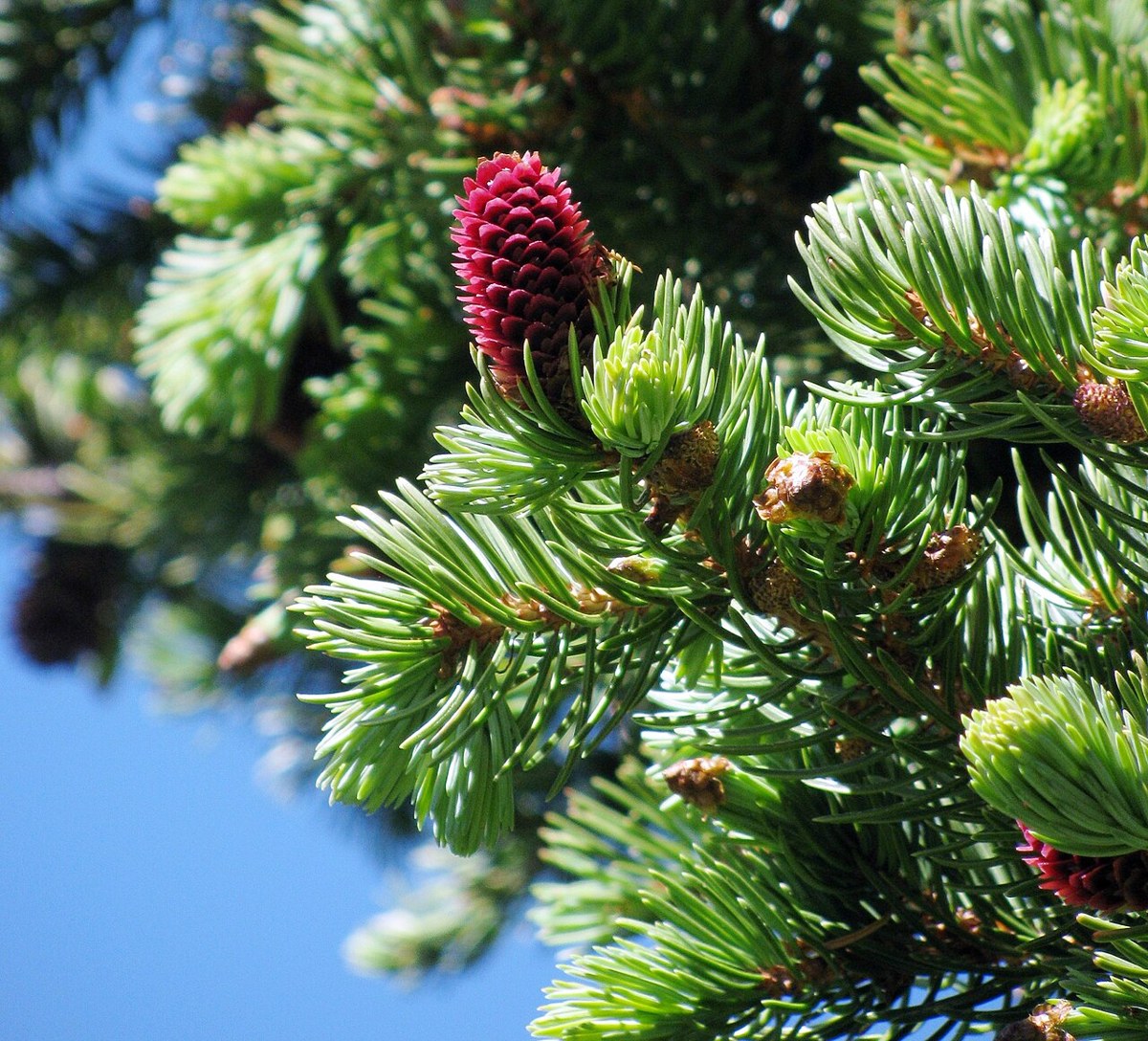
Cone size is one of the best field marks. Black spruce has the smallest cones, about ½–1¼ inches, egg-shaped and purplish when young, and they often stay on the tree for many years, clustered near the top. Red spruce cones are 1¼–2 inches with stiff, rounded scales. White spruce cones are slender, 1–2½ inches, with smooth, flexible scale edges. Engelmann spruce cones are 1½–3 inches with thin, papery, wavy-edged scales. Blue spruce cones are larger, 2–4 inches, also with papery, wavy scales. Sitka spruce cones are 2–4 inches with thin, crinkled scales. Norway spruce, the common non-native, has by far the biggest cones, 4–7 inches long.
Twigs, Bark & Form
Twigs help separate pairs of similar species: black and red spruce have finely hairy twigs, while white spruce twigs are hairless. Engelmann spruce twigs are usually finely hairy and blue spruce twigs are hairless. Spruce bark is thin and scaly on most species, gray-brown to reddish. Most spruces are narrow, spire-shaped trees that keep their lower branches if they grow in the open. Black spruce in bogs is often a thin, scraggly tree with a dense club of branches near the top, and Brewer spruce is unmistakable for its long, curtain-like hanging branchlets.
Quick Facts
| Genus | Picea |
| Family | Pinaceae (Pine family) |
| U.S. Native Species | 7 (white, black, red, Engelmann, blue, Sitka and Brewer spruce), plus the natural hybrid Lutz spruce in Alaska |
| Plant Type | Evergreen coniferous trees |
| Mature Height | About 15–60 ft for black spruce; 60–100 ft for most others; Sitka spruce can exceed 200 ft |
| Growth Rate | Slow to moderate |
| Sun Exposure | Full Sun to Part Shade (red and white spruce tolerate shade when young) |
| Water Needs | Moist; black spruce grows in wet bogs, blue spruce along mountain streams |
| Soil Type | Cool, moist, well-drained loams; acidic peat for black spruce |
| Soil pH | Mostly acidic (about 4.0–6.5); white and blue spruce tolerate near-neutral soils |
| Cones | Hanging, ½–4 in long depending on species; fall whole |
| Fall Color | None (evergreen) |
| Deer Resistant | Usually; deer browse spruce only when other food is scarce |
| USDA Hardiness Zones | About 2–7 for most species (black and white spruce to Zone 1); Sitka and Brewer spruce mainly 6–8 |
| Wildlife Value | Seeds feed crossbills, siskins and red squirrels; dense cover for birds through winter; larval host for many moths |
Native Range
Native spruces fall into three regional groups. In the Northeast and Great Lakes, white and black spruce form part of the boreal forest that reaches south from Canada into Maine, New Hampshire, Vermont, northern New York, Michigan, Wisconsin and Minnesota, with black spruce also scattered in cold bogs south to Pennsylvania, New Jersey and Connecticut. Red spruce grows from Maine through New England and New York and down the high Appalachians through Pennsylvania, Maryland, West Virginia and Virginia to the Great Smoky Mountains of North Carolina and Tennessee. In the Southern Appalachians it grows only on the highest peaks, mostly above about 4,500 feet, often with Fraser fir.
In the Rocky Mountains and Intermountain West, Engelmann spruce forms subalpine forests with subalpine fir from Montana and Idaho to Arizona and New Mexico, west to the Cascades of Washington and Oregon, a few ranges in Nevada and far northern California. Blue spruce has a smaller range in the central and southern Rockies (Wyoming, Idaho, Utah, Colorado, New Mexico and Arizona), where it grows mainly along streams and in moist canyon bottoms at middle to high elevations. White spruce also reaches the Black Hills of South Dakota and western Montana.
On the Pacific Coast, Sitka spruce follows the foggy coastal strip from Kodiak Island and southeast Alaska through Washington and Oregon to Mendocino County, California. Brewer spruce is a rare endemic of the Klamath-Siskiyou Mountains of southwest Oregon and northwest California. In Alaska, white and black spruce cover much of the interior, and where white and Sitka spruce meet on the Kenai Peninsula and in the Cook Inlet area they hybridize as Lutz spruce. No spruce is native to Missouri, the Southeast below the mountains, the southern and central Great Plains, Ohio, Indiana or Illinois.
📋 Find native spruces on our regional plant lists: NH, ME, VT · CT, MA, RI · NY, PA, NJ north · MD, VA, WV · NC, SC · KY, TN · MI, WI, MN east · ND, SD, MN west · MT, WY · UT, CO west · ID, OR east, WA east · OR west, WA west · AZ, NM · CA, NV · Alaska
Native Species
All seven spruces native to the United States are described below, and each one has its own full Plant Native profile.
White Spruce (Picea glauca)
The common spruce of the northern forest, native from Maine across northern New York, Michigan, Wisconsin and Minnesota to Montana, the Black Hills and nearly all of forested Alaska. A 50–80 ft tree with blue-green needles, slender cones and hairless twigs. It tolerates wind, cold and a wider range of soils than most spruces, and it makes a good windbreak and screen in the North. The Black Hills form is the state tree of South Dakota.
Black Spruce (Picea mariana)
A slow, narrow tree of bogs, fens and cold, poorly drained ground from Maine and the Great Lakes states to Alaska, with outlying bog populations south to Pennsylvania, New Jersey and Connecticut. It has the shortest needles and smallest cones of our spruces, and its cones can stay closed on the tree for years until fire opens them. Lower branches that touch moss often root and form a ring of young trees. Best for wet, acidic sites in cold climates.
Red Spruce (Picea rubens)
The spruce of the Northeast’s mountains and the high Appalachians, from Maine to North Carolina and Tennessee. Shiny yellow-green needles, hairy twigs and reddish-brown cones that fall in their first winter. Red spruce declined badly in the late 20th century from acid rain and logging and is now recovering, and it is being replanted on high-elevation sites in West Virginia and the southern mountains. It is shade tolerant when young and wants cool, moist, acidic soil.
Engelmann Spruce (Picea engelmannii)
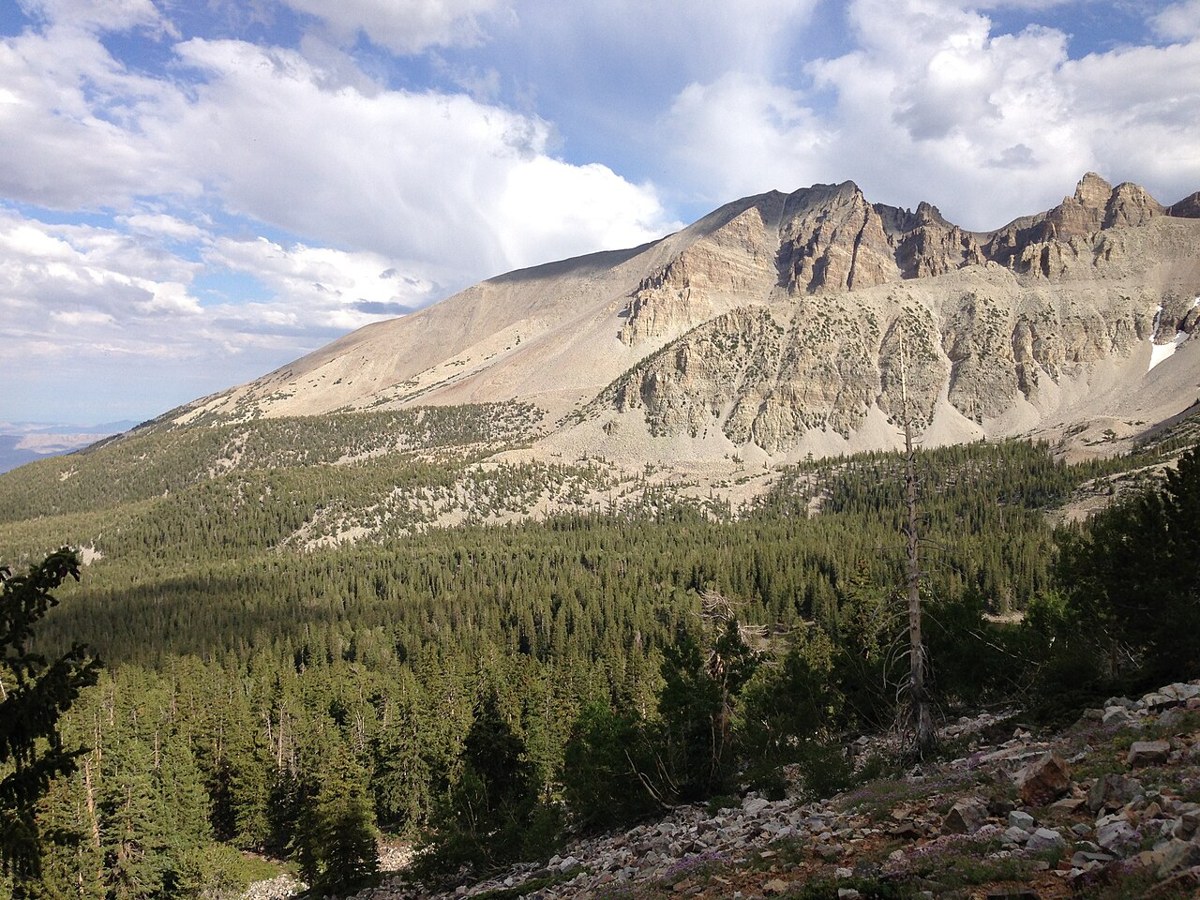
The dominant spruce of high Rocky Mountain and Cascade forests, often growing just below timberline with subalpine fir. A tall, narrow spire with softer, blue-green needles and papery cones. It tolerates deep snow and short summers but not heat or drought, so it rarely thrives at low elevations.
Blue Spruce (Picea pungens)
Also called Colorado blue spruce, and yes, it is a native tree: wild blue spruce grows along streams in the central and southern Rockies of Wyoming, Idaho, Utah, Colorado, New Mexico and Arizona. Many wild trees are green rather than blue; the silvery-blue color of nursery trees comes from selected seed sources and grafted cultivars. It is the state tree of Colorado and Utah. Outside the Rocky Mountain states it is a planted tree, not a native one.
Sitka Spruce (Picea sitchensis)
The largest spruce in the world, regularly over 150 ft and sometimes over 250 ft, confined to a narrow belt of coastal fog and rain from Alaska to northern California. Stiff, sharp, flattened needles and crinkly-scaled cones. It is the state tree of Alaska. It needs cool, humid air and rarely does well far from the coast.
Brewer Spruce (Picea breweriana)
A rare spruce of the Klamath-Siskiyou Mountains of southwest Oregon and northwest California, also called weeping spruce for its long, hanging branchlets. It grows on rocky high ridges and is slow and hard to establish in gardens, but it is one of the most striking conifers in the West.
Lutz Spruce (Picea × lutzii)
A naturally occurring hybrid between white and Sitka spruce in south-central Alaska, especially on the Kenai Peninsula and around Cook Inlet. Trees show a mix of the parents’ traits. It is a native hybrid, not a garden creation.
Non-Native Look-Alikes
Most spruces sold in nurseries outside the Rocky Mountains and the far North are not native to the region where they are planted. Here are the ones you will meet most often and how to tell them apart.
Norway Spruce (Picea abies)
The most widely planted spruce in the eastern United States, native to northern and central Europe. Mature trees have long, drooping branchlets that hang like curtains from upswept branches, and cones 4–7 inches long, much bigger than any native eastern spruce. It was planted heavily for windbreaks, reforestation and Christmas trees and now seeds itself into woods and old fields in parts of the Northeast and Great Lakes region. It is not considered a major invasive, but it is not a native tree, and a planted Norway spruce supports less native wildlife than red or white spruce would in the same spot.
Serbian Spruce (Picea omorika)
A narrow, elegant spruce from a small area of the Balkans, popular in gardens for its slim, spire-like shape. Its needles are flattened, dark green above with two bright white bands below, so the tree looks two-toned when the wind moves it. Its cones are small and purplish when young. It is not native anywhere in North America.
Other Imported Spruces
Oriental spruce (Picea orientalis) from the Caucasus and Turkey has very short, glossy needles under half an inch long. Dwarf Alberta spruce, a common foundation shrub, is a dwarf form of our native white spruce selected in Canada, so it is a native species in cultivated form, though it is a poor wildlife plant and suffers badly from spider mites in hot summers.
Blue Spruce Is Native, but Not Everywhere
Blue spruce often gets lumped with the imports because it is planted so widely. It is a true native of the Rocky Mountains. In Missouri, the Ohio Valley and the East it is an introduced landscape tree, and in hot, humid summers it is prone to Cytospora canker and needle cast diseases that kill the lower branches. Gardeners in those regions usually do better with a different native evergreen.
Growing & Care Guide
Light
Spruces grow densest and healthiest in full sun. Red spruce and white spruce tolerate considerable shade when young and can grow under a hardwood canopy until a gap opens. Blue spruce and black spruce need sun.
Soil & Water
All spruces have shallow, spreading roots and want soil that stays evenly moist. Most prefer acidic, well-drained soil rich in organic matter. Black spruce grows in saturated peat, and blue spruce handles somewhat drier, more alkaline mountain soils than the eastern species, though it still grows best near water in the wild. Water young trees deeply through their first two or three summers and keep a wide ring of mulch over the roots. Avoid compacted, salty or very hot sites.
Planting Tips
Choose the native spruce of your own region, and preferably a tree grown from regional seed: red spruce in the Northeast and Appalachian mountains, white spruce in the northern tier and Black Hills, blue or Engelmann spruce in the Rockies, Sitka spruce near the Pacific Coast. Plant in early spring or early fall. Give the tree room: most native spruces spread 15–30 ft wide at the base and look best with their lower branches left on. In Missouri, the South and the lower Midwest, where no spruce is native, plant a native evergreen instead, such as eastern red cedar or shortleaf pine.
Pruning & Maintenance
Spruces need little pruning. Remove dead or damaged branches in late winter. To slow growth or thicken a young tree, pinch back the soft new candles by about half in spring; spruces have dormant buds along the twigs and will resprout from older wood better than pines, but not reliably from bare inner branches. Watch for spruce spider mites in hot, dry weather, Cytospora canker and Rhizosphaera needle cast on stressed blue spruce, and spruce budworm and spruce beetle outbreaks in wild forests.
Propagation
Spruces are grown from seed. Collect cones as they turn brown in late summer or early fall, dry them until the scales open, and sow the seed in spring; most native spruce seed germinates without special treatment, though a few weeks of cold, moist stratification can improve germination. Seedlings grow slowly for the first few years and appreciate light shade. Named blue spruce cultivars are grafted.
Landscape Uses
- Year-round windbreaks and privacy screens in northern and mountain regions (white, red, Engelmann and blue spruce)
- Specimen evergreens for large lawns where the lower branches can sweep the ground
- Bog gardens and wet, acidic restoration sites in cold climates (black spruce)
- Streamside and canyon plantings in the Rocky Mountain states (blue spruce)
- Coastal forest restoration in the Pacific Northwest (Sitka spruce)
- Winter cover and nesting sites for birds
Wildlife & Ecological Value
For Birds
Spruce seeds are a major winter food for red and white-winged crossbills, pine siskins, pine grosbeaks and chickadees, and crossbills move across the continent following good spruce cone crops. Spruce grouse feed heavily on spruce needles in winter. The dense branches give roosting and nesting cover through the year to species such as golden-crowned kinglets and blackburnian, Cape May and bay-breasted warblers, which also feed on the spruce budworm caterpillars. In the Northeast’s high red spruce and fir forests lives the rare Bicknell’s thrush.
For Mammals
Red squirrels cut spruce cones by the thousand and cache them in large piles called middens. Snowshoe hares shelter under young spruce, and deer, moose and elk use spruce stands for cover in deep snow, though they eat little of the foliage.
For Insects
Spruces are larval hosts for many native moths, including spruce budworm, whose periodic outbreaks are a natural part of the northern forest cycle. Spruce trees are wind-pollinated and offer nothing to pollinating bees.
Ecosystem Role
Spruce forms the backbone of the boreal forest and of subalpine forests in the West. Black spruce bogs store large amounts of carbon in their peat, and spruce-fir forests on mountain tops catch fog and cloud water that feed headwater streams. In Alaska and the Rockies, spruce beetle outbreaks and fire periodically renew these forests.
Cultural & Historical Uses
Native peoples across the North used spruce in many ways. The long, flexible roots were split and used to lace birchbark canoes and baskets, spruce pitch was used to seal canoe seams, and the boughs made bedding and shelters. Sitka spruce roots were woven into fine, watertight baskets and hats by peoples of the Pacific Northwest coast.
European settlers brewed spruce beer from young shoots, and hardened spruce resin was sold as chewing gum in New England in the 1800s; Maine was the center of the trade. Spruce is the main source of pulpwood in the North and of light, strong lumber. Sitka spruce, with its high strength for its weight, was used for aircraft frames in the First World War, and red spruce and Sitka spruce are still prized for the soundboards of guitars, violins and pianos.
Spruces are popular Christmas trees, especially white, black and blue spruce, and Norway spruce in the East. White spruce is the state tree of South Dakota (as Black Hills spruce), blue spruce of Colorado and Utah, and Sitka spruce of Alaska.
Frequently Asked Questions
Is any spruce native to Missouri?
No. Missouri has no native spruce; the spruces planted there, mainly Norway, blue, white and Serbian spruce, all come from colder regions. They grow best in the northern half of the state on well-drained soil and often struggle with summer heat. Missouri’s native evergreen trees are eastern red cedar and shortleaf pine.
Is Colorado blue spruce native?
Yes, to the Rocky Mountains of Wyoming, Idaho, Utah, Colorado, New Mexico and Arizona. Everywhere else in the country it is a planted, non-native tree.
How do I tell a spruce from a fir?
Pull off a needle. Spruce needles are sharp and four-sided and leave a woody peg on the twig; fir needles are flat and soft and leave a smooth round scar. Spruce cones hang down and fall whole; fir cones stand upright and fall apart on the tree.
Which native spruce is best for my yard?
Plant the one native to your area: red or white spruce in the Northeast and Great Lakes, red spruce in the Appalachian mountains, white spruce in the northern Plains, blue or Engelmann spruce in the Rockies, and Sitka spruce on the Pacific Coast. Allow 20 ft or more of width for a mature tree.
Are spruce trees poisonous?
Spruces are not considered toxic to people, dogs or livestock, but the sharp needles, especially of blue spruce, can scratch skin and eyes. Spruce tips have long been used to brew spruce beer.
Is Norway spruce invasive?
It is not native and it does seed into woods and old fields in parts of the Northeast and Great Lakes, but it is generally not listed as a regulated invasive plant. Where you want a spruce in those regions, red or white spruce are the native choices.

Looking for a nursery that carries native spruces?
Browse our native plant nursery directory: Alaska & Arizona · California · Colorado & Connecticut · Idaho · Maine, Maryland, Massachusetts, Michigan, Minnesota & Montana · Nevada, New Hampshire, New Jersey, New Mexico, New York & North Carolina · Oregon · Pennsylvania, South Dakota, Tennessee, Utah, Vermont & Virginia · Washington · West Virginia, Wisconsin & Wyoming

