
Prairie Indian Plantain (Arnoglossum plantagineum)
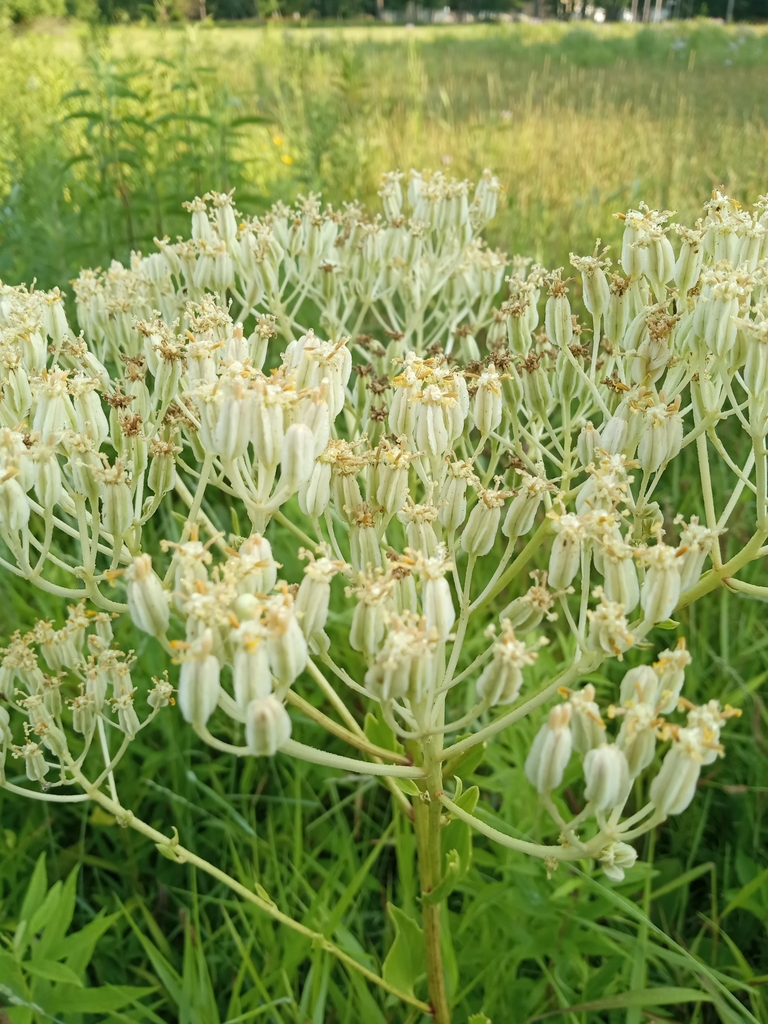
Arnoglossum plantagineum, known as Prairie Indian Plantain, groovestem Indian plantain (the USDA name) or tuberous Indian plantain, is a native perennial wildflower of moist prairies, fens and wet meadows in the central and eastern United States and southern Ontario. It is a member of the aster family (Asteraceae). Older books list it as Cacalia plantaginea, Cacalia tuberosa or Mesadenia tuberosa.
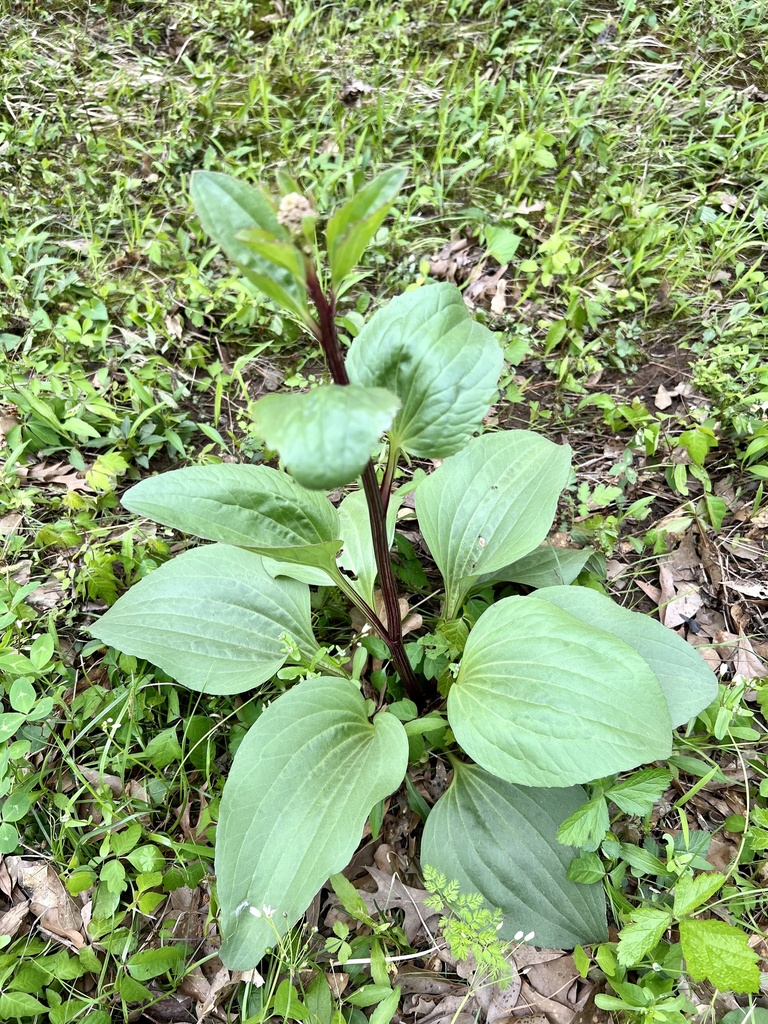
Its most striking feature is the foliage: thick, smooth, rubbery leaves with five to nine nearly parallel veins, like an oversized version of the lawn plantain. From late spring to midsummer, a stout, grooved stem rises 2 to 5 feet tall and carries a broad, flat-topped cluster of narrow, creamy white flower heads. The flowers are subtle, but the plant has a strong architectural presence in a prairie.
Prairie Indian plantain is a good indicator of high-quality, moist prairie and fen habitat, and it has become uncommon in much of its range as those habitats were plowed and drained. It is a long-lived, deep-rooted plant for prairie gardens and rain gardens, and its flowers attract a wide range of small pollinators.
Identification
Look for prairie Indian plantain in moist prairies and fens from May to August. The thick, smooth, plantain-like leaves with parallel veins, the grooved stem and the flat cluster of white, cylindrical flower heads identify it.
Growth Habit
Plants form a clump of large basal leaves and, when mature, send up a single, stout flowering stem 2 to 5 feet tall. The stem is smooth and distinctly grooved or angled lengthwise, which gives the USDA name groovestem Indian plantain. Plants grow from a short, thick, tuber-like rootstock with fleshy roots, which explains the name tuberous Indian plantain.
Leaves
The basal leaves are long-stalked, broadly elliptic to oval, about 4 to 8 inches long, thick and somewhat succulent, smooth and hairless, and bright to blue-green. They have five to nine prominent veins that run nearly parallel from base to tip, an unusual feature in the aster family. The edges are entire or have a few shallow teeth. Leaves on the stem are few and become smaller and narrower upward.
Flowers
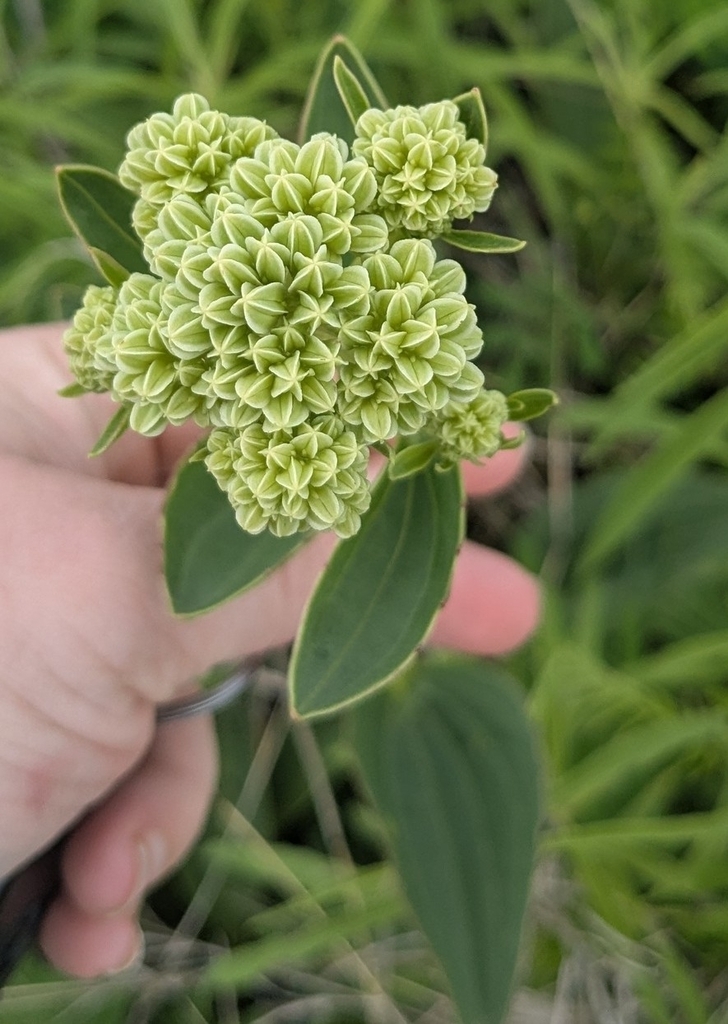
From about May in the South to June through August in the North, the stem ends in a broad, flat-topped or slightly domed cluster 4 to 12 inches across, made of many small, cylindrical heads. Each head is about 1/2 inch long, wrapped in five pale green bracts with a raised, winged keel, and contains five tubular, creamy white florets. There are no ray florets.
Fruit & Seeds
Each floret produces a small, dark, ribbed achene topped by a tuft of soft white bristles. The seeds are carried away by the wind in late summer and fall.
Look-alikes
Pale Indian plantain (Arnoglossum atriplicifolium) has broad, triangular, coarsely toothed leaves with a whitish bloom and grows in woods and edges rather than wet prairies. Great Indian plantain (A. reniforme) has very large, kidney-shaped leaves. Before flowering, the leaf rosette can be mistaken for the weedy common plantain (Plantago major), but prairie Indian plantain leaves are thicker, smoother and much larger.
Quick Facts
| Scientific Name | Arnoglossum plantagineum (syn. Cacalia plantaginea) |
| Family | Asteraceae (aster family) |
| Plant Type | Herbaceous perennial wildflower |
| Mature Height | 2–5 ft in flower |
| Mature Spread | 1–2 ft |
| Growth Rate | Slow; may take 2–3 years to flower from seed |
| Sun Exposure | Full sun to light shade |
| Water Needs | Medium to high; moist soil |
| Soil Type | Loam, clay loam or peaty soil; tolerates lime |
| Soil pH | About 6.0–8.0 (slightly acidic to alkaline) |
| Bloom Time | May–August (earlier in the South) |
| Flower Color | Creamy white |
| Fall Color | Leaves turn tan to brown |
| Fruit | Small achene with a tuft of white bristles |
| Deer Resistant | Moderately; foliage is thick and bitter |
| USDA Hardiness Zones | 4–8 |
Native Range
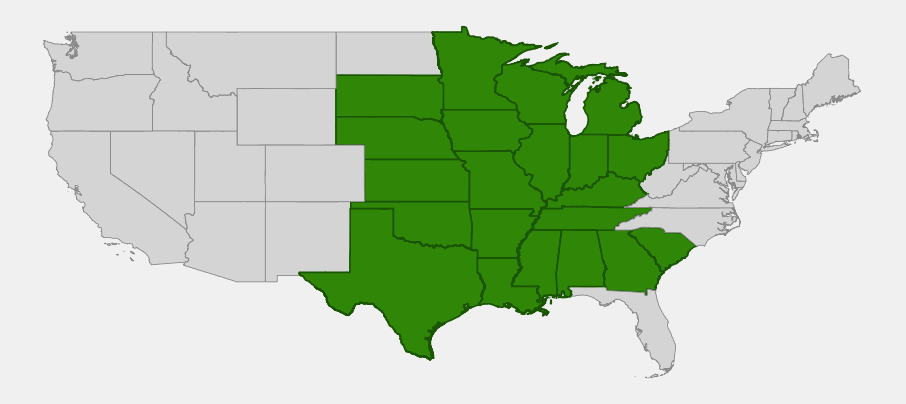
Prairie Indian plantain is native to the central and eastern United States and southern Ontario. USDA PLANTS lists it as native in the lower 48 states and Canada and records it from 21 states, from Michigan, Wisconsin, Minnesota and southeastern South Dakota south through Iowa, Illinois, Indiana, Ohio, Missouri, Nebraska and Kansas to Oklahoma and Texas, and east through Kentucky and Tennessee to Alabama, Georgia and South Carolina. In Canada it is known only from southwestern Ontario.
It is most frequent in the tallgrass prairie region of Illinois, Missouri, Iowa, eastern Kansas and Oklahoma, and in the Blackland Prairie of north-central and East Texas. It reaches central Texas and the Edwards Plateau but not the dry south and west of the state. In the Southeast it is scattered in prairie remnants such as the Black Belt prairies of Alabama and Mississippi. It is rare at the northern and eastern edges of its range, including Michigan, Ontario and the Carolinas.
Typical habitats are moist to wet tallgrass prairies, sedge meadows, calcareous fens and seeps, low swales in prairies, and the edges of open woods. It prefers deep, moist soils and often grows on limestone-influenced or calcium-rich ground.
📋 Regional plant lists featuring Prairie Indian Plantain: Ohio & Indiana · Michigan, Wisconsin & Eastern Minnesota · Kentucky & Tennessee · Nebraska, Kansas & Eastern Colorado · Illinois, Iowa & Missouri · Alabama, Georgia & Mississippi · North & South Carolina · Arkansas, Louisiana, Eastern Oklahoma & Eastern Texas · North Dakota, South Dakota & Western Minnesota
Growing & Care Guide
Prairie Indian plantain is a slow but long-lived perennial for moist, sunny prairie plantings. It is offered by a number of Midwestern native plant nurseries as plants or seed. Buy nursery-grown stock rather than digging wild plants.
Light
Full sun gives the strongest plants and best flowering. It tolerates light shade, especially in the South, but grows weaker and flowers less in heavy shade.
Soil & Water
Grow it in deep, moist loam or clay loam, ideally rich in organic matter. It tolerates wet soils, seasonal flooding and limestone soils, and established plants handle short dry spells thanks to their thick roots. Avoid thin, droughty sand.
Planting Tips
Plant in spring or fall about 18 to 24 inches apart. Place it where its bold leaves can be seen, near the front of a moist prairie bed or rain garden, among grasses and sedges that will not overwhelm the basal leaves. It is slow to establish, and seedlings may take two or three years to bloom.
Pruning & Maintenance
Little care is needed. Leave the stems standing after flowering to let seed disperse, and cut them back in late winter or early spring. In prairie plantings, periodic spring burns or mowing help reduce competition from woody plants. Slugs may damage young leaves; otherwise pests are rare.
Propagation
Sow fresh seed outdoors in fall, or give it 60 days of cold, moist stratification before sowing in spring. Seed germination is moderate. Mature clumps can be divided carefully in early spring, keeping a section of the thick rootstock with each division.
Landscape Uses
- Prairie gardens: bold, smooth leaves and flat white flower clusters
- Rain gardens: tolerates wet soils and seasonal flooding
- Pollinator gardens: early-summer flowers for bees, wasps, flies and beetles
- Fen and wet prairie restoration: a characteristic species of moist, calcareous prairies
- Texture contrast: broad leaves among fine-textured grasses and sedges
Wildlife & Ecological Value
Prairie Indian plantain is an important early-summer flower in wet prairies, and its open heads are easy for many small insects to use.
For Pollinators
The flowers are visited by small bees such as sweat bees and masked bees, wasps, flies including syrphid flies, and beetles such as soldier beetles. The many small heads clustered together make an easy landing platform.
For Birds
Small seed-eating birds may take the seeds in late summer and fall, and the dense prairie vegetation where it grows provides cover for grassland birds.
For Mammals
The thick, bitter leaves are not a preferred browse, though deer and rabbits occasionally nibble young growth. Wildlife use is not otherwise well documented.
Ecosystem Role
As a long-lived, deep-rooted prairie forb, prairie Indian plantain helps hold moist prairie soils and contributes to the diverse plant community of fens and wet prairies. Because it declines when prairies are drained, plowed or overgrown with shrubs, botanists treat it as a sign of good-quality remnant habitat.
Cultural & Historical Uses
The genus name Arnoglossum comes from the Greek for lamb’s tongue, an old name for plantain, and the species name plantagineum also means plantain-like. Both refer to the smooth, parallel-veined leaves. The common name Indian plantain reflects the plant’s reported use by Native American peoples.
The Lady Bird Johnson Wildflower Center notes that the Cherokee reportedly used the leaves as a poultice for cuts, bruises and cancers. These traditional uses are not proven, and the plant should not be used as a home remedy.
Prairie Indian plantain was long known as Cacalia tuberosa or Cacalia plantaginea, and many older books and plant lists still use those names. The newer genus Arnoglossum groups the North American Indian plantains together, separate from their Old World relatives.
Frequently Asked Questions
Why is it called Indian plantain?
Its smooth leaves with nearly parallel veins look like a large version of the common plantain. The name Indian plantain reflects its reported use by Native American peoples.
How is prairie Indian plantain different from pale Indian plantain?
Prairie Indian plantain has thick, smooth, oval leaves with parallel veins and grows in moist prairies. Pale Indian plantain has broad, triangular, toothed leaves with a whitish bloom and grows in woods and edges.
Does prairie Indian plantain need wet soil?
It prefers moist to wet soil and is ideal for rain gardens and low prairie areas, but established plants tolerate average garden soil that does not dry out completely.
When does it bloom?
From about May in the South and June to August in the North, with flat clusters of creamy white flower heads.
Is it good for pollinators?
Yes. Its flowers attract many small bees, wasps, flies and beetles in early summer.

Looking for a nursery that carries Prairie Indian Plantain?
Browse our native plant nursery directory: Alabama & Arkansas · Georgia · Illinois, Indiana, Iowa & Kansas · Kentucky, Louisiana, Michigan, Minnesota, Mississippi & Missouri · Nebraska, Ohio & Oklahoma · South Carolina, South Dakota, Tennessee & Texas · Wisconsin