
Running Strawberry-Bush (Euonymus obovatus)
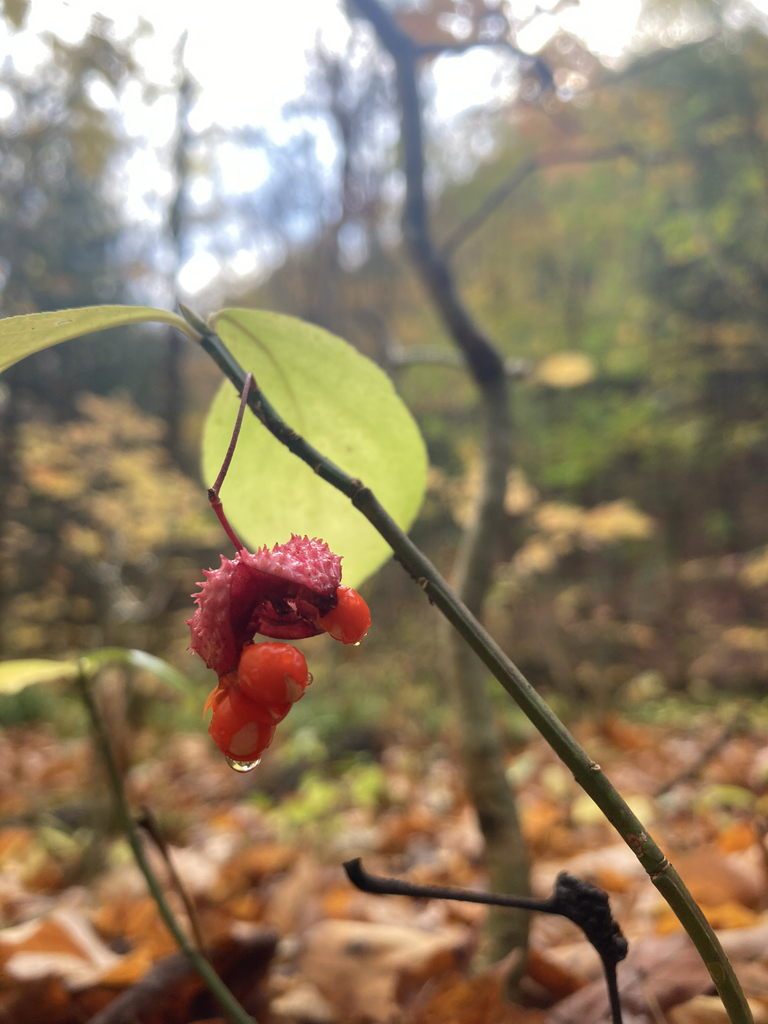
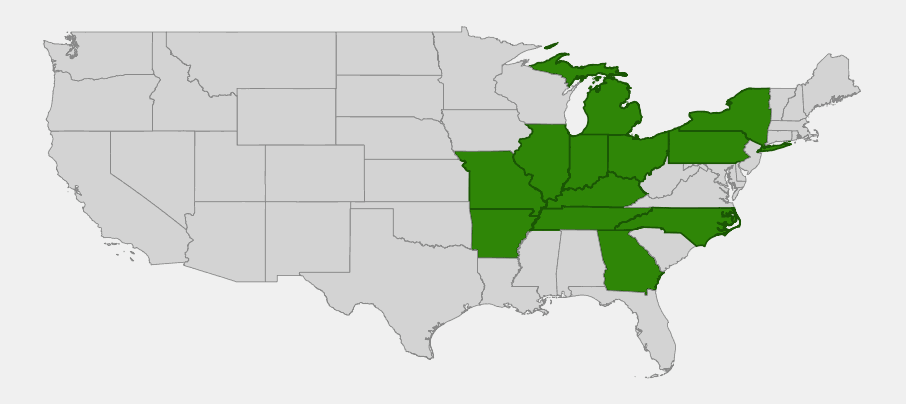
Euonymus obovatus, known as Running Strawberry-Bush or running strawberry bush, is a low, trailing, deciduous shrub of rich hardwood forests in eastern North America. It grows from southern Ontario and New York west to Michigan, Illinois and Missouri and south through the Ohio Valley and Appalachians to Tennessee, North Carolina, Georgia and Arkansas.
Its stems creep along the ground, rooting as they go, with short upright branches rarely more than a foot tall. In spring it bears small, flat, greenish to purplish flowers, but its real show comes in fall, when warty, pink-red capsules split open to reveal bright orange-red seeds, and the leaves often turn soft yellow or pinkish. The fruits look a little like small strawberries, which gives the plant its name.
It is an excellent native ground cover for shade, and a good alternative to the invasive Asian wintercreeper. Gardeners should know two things: deer love to browse it, and its fruits and seeds are toxic if eaten. This guide covers how to identify it, how it differs from its upright cousin strawberry bush, where it grows and how to grow it.
Identification
Running strawberry-bush is a woodland shrub that behaves like a ground cover. Look for trailing green stems with pairs of oval leaves, and in fall, warty pink fruits with orange seeds.
Growth Habit
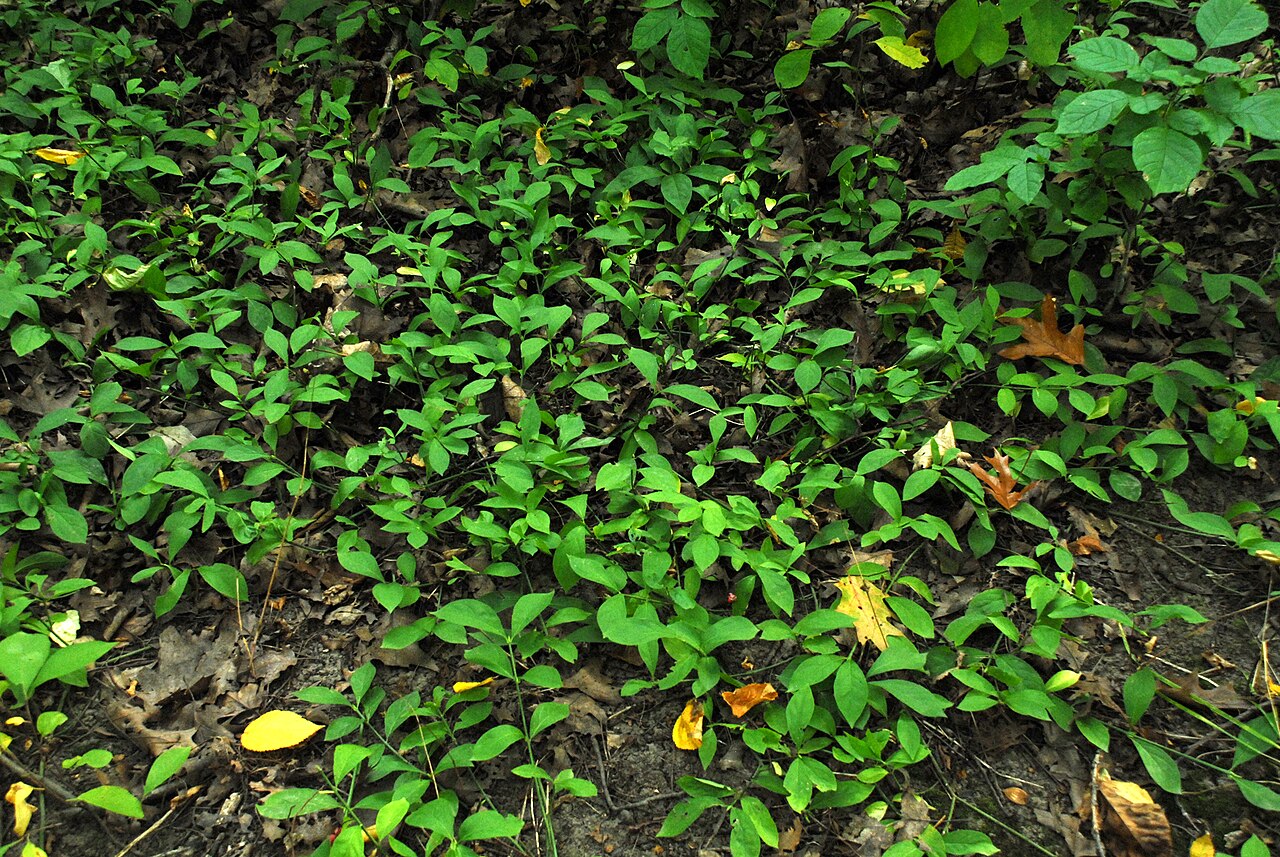
Plants are low, trailing deciduous shrubs. The main stems run along the ground or just under the leaf litter, rooting at the nodes, and send up short branches usually 6 to 12 inches tall, occasionally to about 2 feet. Over time a single plant can spread into a loose mat several feet across. Young stems are green and four-angled or slightly ridged.
Leaves
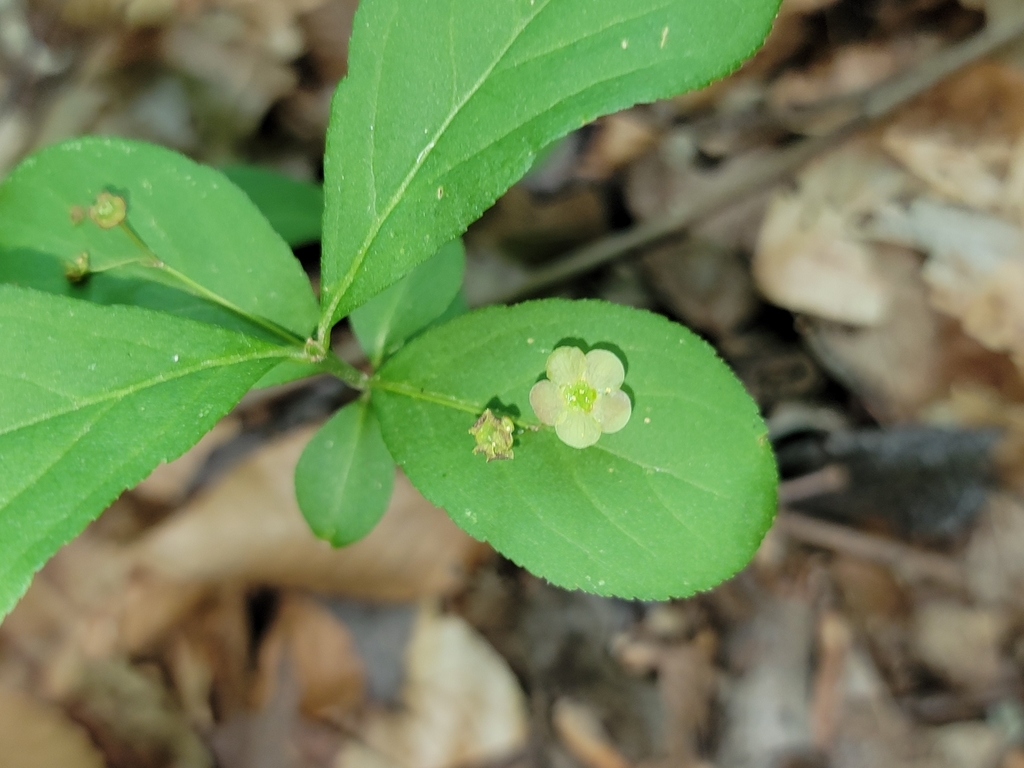
The leaves are opposite, thin and dull green, usually 1 to 2 1/2 inches long, and obovate (widest above the middle, the meaning of obovatus), with a blunt or short-pointed tip and finely toothed edges. They are on very short stalks. In fall they may turn yellow, pinkish or reddish before dropping.
Flowers
The flowers appear in late spring, usually May, on slender stalks from the leaf axils, singly or in small clusters. Each is about 1/4 inch across, flat and saucer-like, with five rounded, greenish-yellow to purplish petals and a broad, fleshy central disk. They are easy to overlook.
Fruit
The fruit is a three-lobed capsule, about 1/2 inch across, with a warty, bumpy surface. It ripens in late summer and fall to pink, red or crimson and splits open to show several seeds wrapped in a bright orange-red fleshy coating (aril). The fruits and seeds are toxic to people and pets.
Look-alikes
Strawberry bush (Euonymus americanus), also called hearts-a-bustin’, is an upright, open shrub 3 to 6 feet tall with narrower, shinier, nearly stalkless leaves and a more southern range; it does not trail and root. Wintercreeper (E. fortunei), an invasive Asian vine common in eastern woods, is evergreen, with thick, glossy leaves, and climbs trees with aerial roots. Eastern wahoo (E. atropurpureus) is a large shrub or small tree with smooth, four-lobed pink capsules.
Quick Facts
| Scientific Name | Euonymus obovatus Nutt. |
| Family | Celastraceae (bittersweet or staff-tree family) |
| Plant Type | Trailing deciduous shrub (ground cover) |
| Mature Height | 6–12 in (occasionally to 2 ft) |
| Mature Spread | 2–6 ft or more, spreading by rooting stems |
| Growth Rate | Slow to moderate |
| Sun Exposure | Part shade to full shade |
| Water Needs | Moderate; evenly moist soil |
| Soil Type | Rich, loamy, well-drained woodland soil |
| Soil pH | Slightly acidic to neutral or alkaline (about 6–7.5) |
| Bloom Time | May–June |
| Flower Color | Greenish-yellow to purplish |
| Fall Color | Yellow to pinkish-red |
| Fruit | Warty pink-red capsule with orange-red seeds (toxic) |
| Deer Resistant | No; heavily browsed by deer |
| USDA Hardiness Zones | 3–7 |
Native Range
Running strawberry-bush is native to eastern North America. USDA PLANTS lists it in Arkansas, Georgia, Illinois, Indiana, Kentucky, Michigan, Missouri, New York, North Carolina, Ohio, Pennsylvania and Tennessee, and in Ontario in Canada. It is most common in the Ohio Valley and the southern Great Lakes region.
In the south it reaches the mountains and plateaus of Tennessee, western North Carolina and northern Georgia and the Ozarks of northern Arkansas, where it is uncommon. NatureServe ranks it as imperiled in Georgia and Tennessee and vulnerable in Arkansas and North Carolina. It reaches its northern limit in southern Ontario, western New York and Michigan.
Typical habitats are rich, moist deciduous and mixed forests, wooded ravines and slopes, stream terraces and the edges of swamps, often over limestone or other base-rich soils. It grows with beech, sugar maple and other hardwoods, in the same communities as spring wildflowers such as trilliums and wild ginger.
📋 Regional plant lists featuring Running Strawberry-Bush: New York, Pennsylvania & Northern New Jersey · Ohio & Indiana · Michigan, Wisconsin & Eastern Minnesota · Kentucky & Tennessee · Delaware, Southern New Jersey & Long Island · Illinois, Iowa & Missouri · Alabama, Georgia & Mississippi · North & South Carolina · Arkansas, Louisiana, Eastern Oklahoma & Eastern Texas
Growing & Care Guide
Running strawberry-bush is a low-maintenance native ground cover for shady gardens in the Midwest and East. It is sold by some native plant nurseries. Its biggest challenge in most yards is deer, which browse it hard.
Light
Grow it in part shade to full shade, such as under deciduous trees or on the north side of a building. It tolerates morning sun, but hot afternoon sun can scorch the thin leaves. Plants in very deep shade grow more slowly and fruit less.
Soil & Water
It prefers rich, loamy, humus-rich soil that stays evenly moist but drains well, like the soil of a hardwood forest. Mulch with shredded leaves to keep the roots cool and moist. Water during dry spells in the first year or two. Once established it handles average garden conditions in shade but does not like long droughts or soggy soil.
Planting Tips
Plant in spring or fall, 18 to 24 inches apart, and let the stems knit together. It works well as a ground cover under trees and shrubs, along shady paths and on wooded slopes, mixed with spring wildflowers and ferns. In areas with many deer, protect plants with fencing or repellent until they are established, because heavy browsing can keep them from spreading.
Pruning & Maintenance
Little pruning is needed. Trim stems that wander onto paths, and remove any dead wood in early spring. Leave the leaf litter in place; it feeds the soil and protects the trailing stems. If you have invasive wintercreeper nearby, keep it out, because it can smother native ground covers.
Propagation
It is easy to propagate from rooted stem sections: cut a piece of stem that has rooted at a node and replant it. It can also be grown from softwood cuttings in early summer. Seed should be cleaned of its fleshy aril and sown in fall outdoors, or given a period of warm then cold moist stratification; germination can be slow. Buy plants from nurseries rather than digging them from the wild.
Landscape Uses
- Woodland ground cover: a native trailing shrub for shade under trees
- Alternative to invasive wintercreeper: fills the same role without spreading into wild forests
- Shade gardens: pairs well with spring ephemerals, ferns and wild ginger
- Fall interest: pink capsules, orange seeds and soft fall color
- Wooded slopes: rooting stems help hold soil on shady banks
Wildlife & Ecological Value
Running strawberry-bush is a modest-looking plant, but it feeds insects, birds and, all too often, deer.
For Pollinators
The small, flat, open flowers offer nectar to short-tongued insects, especially flies, small bees and beetles, which crawl across the flat disk. They bloom in late spring, after most spring ephemerals have finished.
For Birds
The orange-red seeds are eaten by birds such as thrushes and wild turkeys, which help spread the seeds through the forest. The low, dense mats also provide cover for ground-foraging birds.
For Mammals
White-tailed deer browse running strawberry-bush heavily, and in many eastern forests it has become scarce where deer are abundant. Rabbits also eat the stems and leaves. The plant is a useful indicator of deer pressure in woodlands.
Ecosystem Role
It is part of the low shrub and herb layer of rich eastern hardwood forests. Several moths feed on Euonymus leaves as caterpillars. Because it spreads by rooting stems and seldom forms large colonies in the wild, it is a well-behaved native alternative to invasive ground covers.
Cultural & Historical Uses
The genus name Euonymus comes from the Greek for “of good name,” which may be an ironic reference to the toxicity of the plants. The species name obovatus describes the leaves, which are widest above the middle. Thomas Nuttall described the species in 1818 in his Genera of North American Plants.
Safety note: all parts of Euonymus plants, especially the fruits and seeds, contain compounds that can cause vomiting, diarrhea, weakness and, in larger amounts, heart problems. Teach children not to eat the colorful seeds, keep pets from chewing the plants, and call Poison Control (1-800-222-1222 in the U.S.) or a veterinarian if any is swallowed.
The common name strawberry bush is shared with the upright strawberry bush of the Southeast; “running” refers to the trailing stems. Both are sometimes called hearts-a-bustin’ for their split capsules. In the wild, running strawberry-bush has declined in many areas because of deer browsing, so planting it in protected gardens is one way to keep it on the landscape.
Frequently Asked Questions
What is the difference between running strawberry-bush and strawberry bush?
Running strawberry-bush (Euonymus obovatus) is a low, trailing shrub that roots along its stems, with dull, obovate leaves, and grows mostly in the Ohio Valley and Great Lakes region. Strawberry bush (E. americanus) is an upright shrub 3 to 6 feet tall with narrower, shinier leaves and a more southern range.
Are the berries of running strawberry-bush poisonous?
Yes. The fruits and seeds, like other parts of Euonymus plants, are toxic to people and pets if eaten. Birds eat the seeds without harm.
Is running strawberry-bush deer resistant?
No. Deer browse it heavily, and in areas with many deer it may need fencing or repellents to survive and spread.
Can running strawberry-bush replace invasive wintercreeper?
Yes. It is a native, shade-tolerant ground cover for similar spots, though it is deciduous and slower-growing. Remove the wintercreeper first, because it can smother native plants.
Does running strawberry-bush need sun?
No. It grows best in part shade to full shade in rich, moist woodland soil. Strong afternoon sun can scorch its leaves.

Looking for a nursery that carries Running Strawberry-Bush?
Browse our native plant nursery directory: Arkansas · Georgia · Illinois & Indiana · Kentucky, Michigan & Missouri · New York, North Carolina & Ohio · Pennsylvania & Tennessee

