
Shaggy Portulaca (Portulaca pilosa)
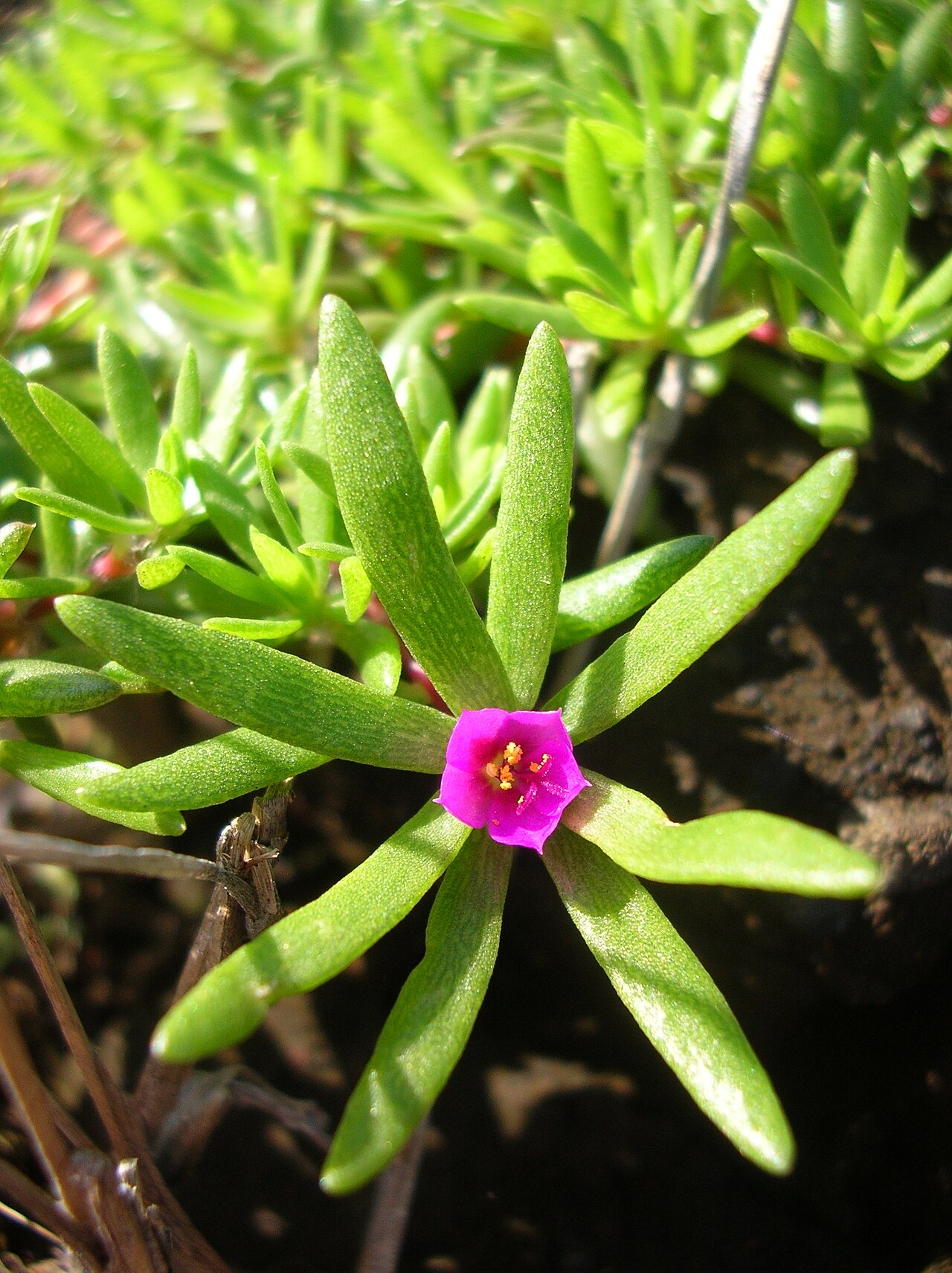
Portulaca pilosa, known as Shaggy Portulaca (USDA: kiss me quick), is a small succulent wildflower of the purslane family (Portulacaceae). It is also called hairy pigweed, pink purslane and, in Spanish-speaking Texas, chisme. It is a close native relative of the familiar garden moss rose (Portulaca grandiflora) and looks like a miniature version of it: low, reddish stems, narrow, fleshy leaves and bright magenta-pink flowers. The name pilosa (“hairy”) and the common name shaggy refer to the tufts of long white hairs at the bases of the leaves and around the flower clusters.
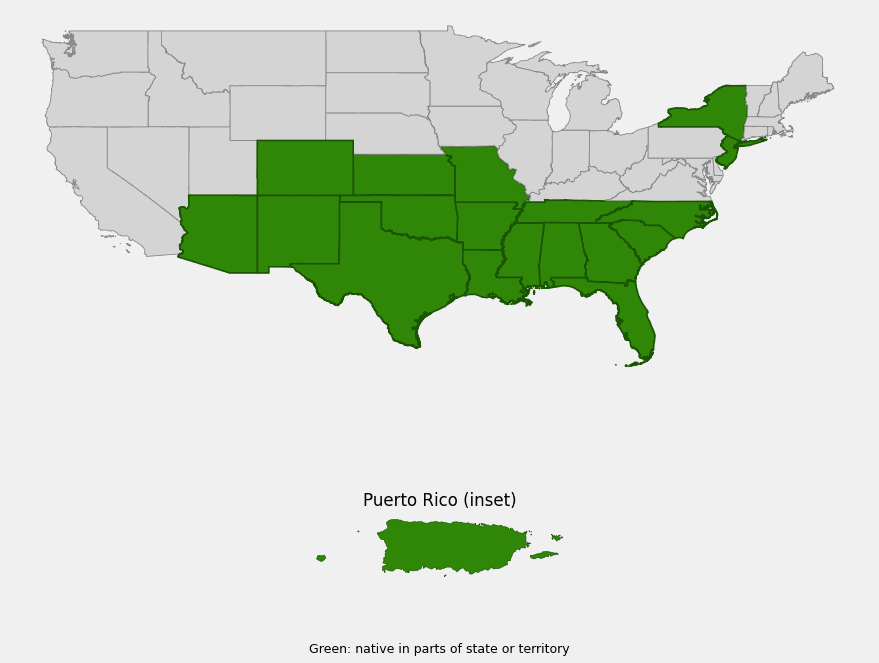
Each flower is only about 1/2 inch across and opens for a few hours on sunny mornings, closing by early afternoon, which explains the name kiss me quick. Plants bloom from early summer to fall and grow in dry, sandy, rocky or gravelly soil: sand hills, coastal dunes, rock outcrops, roadsides, sidewalk cracks and other open, sunny places. It is native across the southern United States from the Carolinas to Florida and west to Texas, the Southwest and the southern Plains, as well as in Puerto Rico, the Caribbean and Central and South America.
Shaggy portulaca is a tough, heat-loving annual that is easy to grow from seed. It is a good native choice for rock gardens, containers, gravel areas and dry, sunny edges, where its jewel-like flowers and succulent foliage add color through the hottest part of the summer. Gardeners in the South can use it in place of non-native ornamental portulacas.
Identification
Shaggy portulaca is easy to recognize once you notice the hairs. Look for a low succulent with narrow, almost cylindrical leaves, conspicuous tufts of white hairs in the leaf axils, and small magenta flowers nested in a whorl of leaves at the stem tips.
Stems & Growth Habit
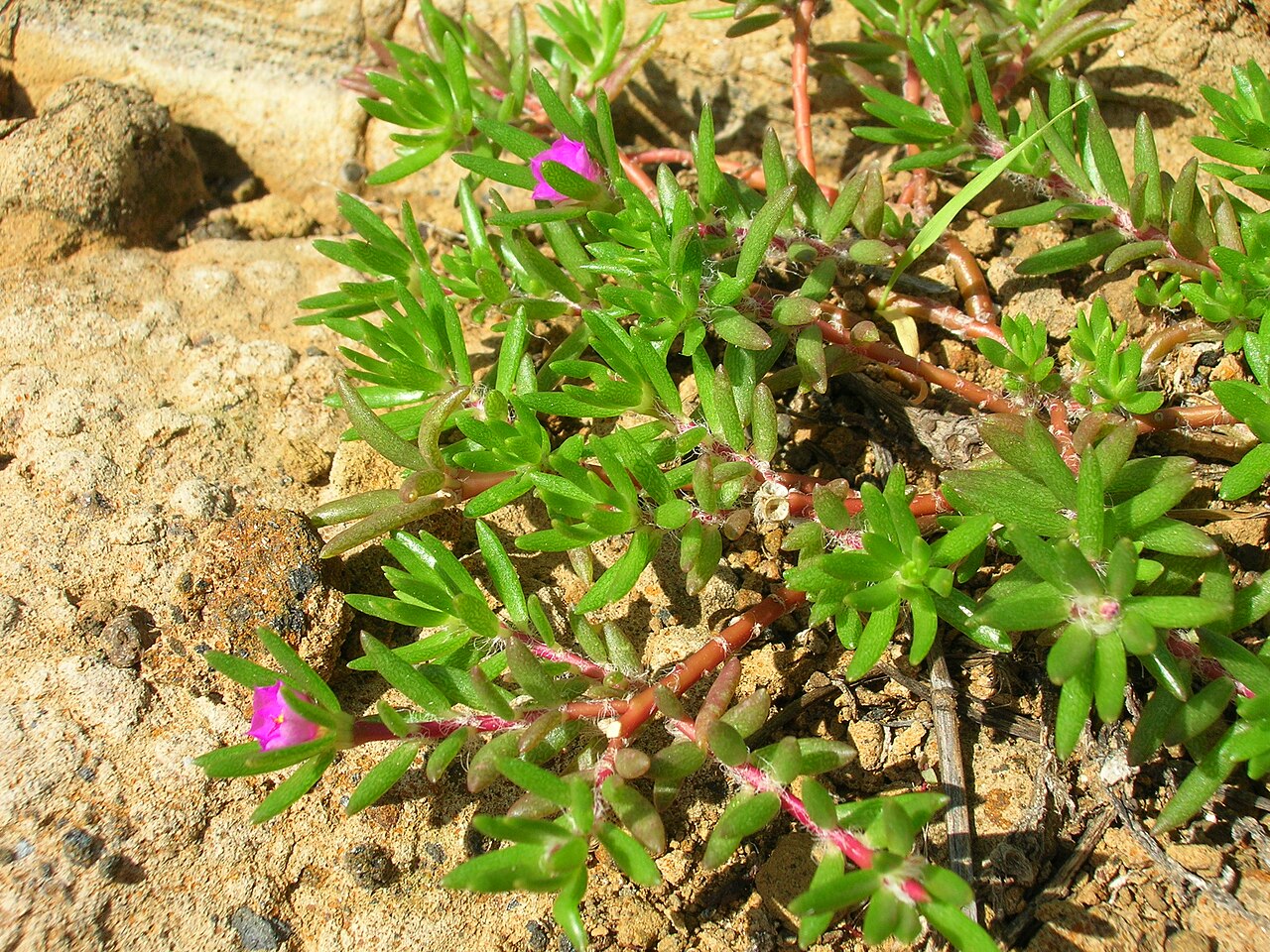
Plants are usually annual, though they may live longer in frost-free areas. Fleshy, branching stems, often reddish, spread along the ground or curve upward, forming loose mats 2 to 8 inches tall and up to about a foot across. The plant grows from a slender taproot.
Leaves
The alternate leaves are succulent, narrow and nearly round in cross-section, about 1/4 to 3/4 inch long. Tufts of long, white, cottony hairs grow at the leaf bases, and denser tufts surround the flowers at the stem tips. The leaves are bright to grayish green and can turn reddish in full sun or drought.
Flowers
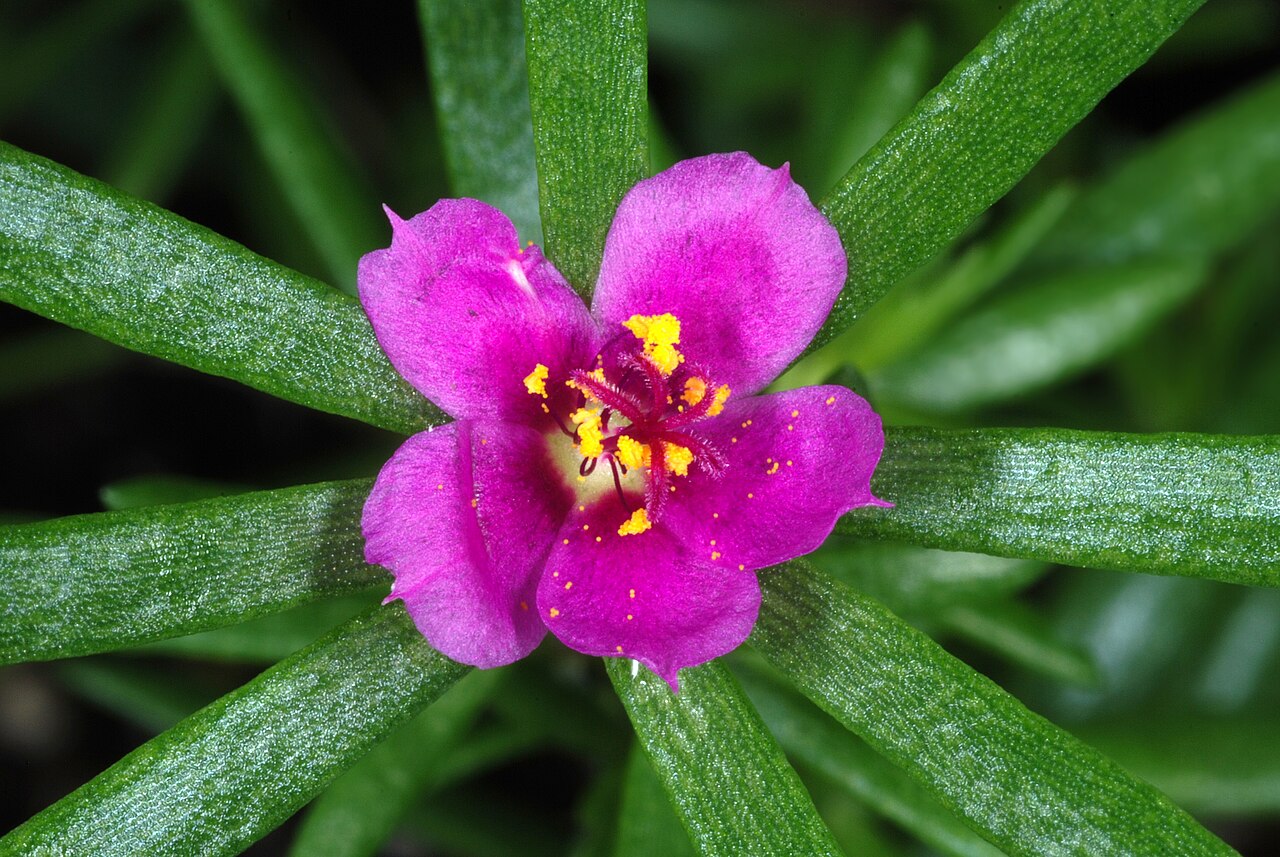
The flowers sit in small clusters at the stem tips, surrounded by a whorl of leaves and white hairs. Each flower is about 1/3 to 1/2 inch across, with five rounded, magenta-pink to purple petals and a center of yellow stamens. They open in the morning sun and close within a few hours. Blooming runs from about June to October, and year-round in warm, frost-free places.
Fruit & Seeds
The fruit is a tiny capsule whose top comes off like a lid, a feature of the purslane family. The Latin name Portulaca, from a word meaning “little gate,” refers to this lid. Inside are many tiny, shiny, dark seeds, which spill out when the lid falls off and germinate readily in warm, bare soil.
Look-alikes
Garden moss rose (Portulaca grandiflora), from South America, also has hair tufts at the leaf bases but has much larger flowers, up to 2 inches wide, in many colors. Common purslane (Portulaca oleracea) has flat, paddle-shaped leaves without hair tufts and small yellow flowers. Fameflowers (Phemeranthus) have similar succulent leaves but bear their pink flowers on long, wiry stalks above the leaves. Plants in the western part of the range are sometimes treated as a separate species, Portulaca mundula.
Safety
Shaggy portulaca is not known as a poisonous plant. Like other purslanes it contains oxalates, so it should not be eaten in quantity, and it should not be used as a home remedy.
Quick Facts
| Scientific Name | Portulaca pilosa (incl. P. mundula) |
| Family | Portulacaceae (purslane family) |
| Plant Type | Succulent annual; short-lived perennial in frost-free areas |
| Mature Height | 2–8 in |
| Mature Spread | 6–12 in |
| Growth Rate | Fast |
| Sun Exposure | Full sun to part shade |
| Water Needs | Low; very drought tolerant |
| Soil Type | Sandy, gravelly or rocky; well-drained |
| Soil pH | Acidic to alkaline |
| Bloom Time | June–October |
| Flower Color | Magenta-pink to purple |
| Fall Color | Leaves may redden |
| Fruit | Tiny capsule with a lid; many tiny dark seeds |
| Deer Resistant | Moderately; low and seldom browsed |
| USDA Hardiness Zones | Annual; perennial in zones 9–11 |
Native Range
Shaggy portulaca is native to the southern United States, Puerto Rico and much of tropical and subtropical America. USDA PLANTS lists it as native in the lower 48 states and Puerto Rico and records it from 18 states. The Lady Bird Johnson Wildflower Center describes its native distribution as the Coastal Plain from North Carolina south to Florida and west to Texas. Western plants, sometimes called Portulaca mundula, extend the range across Texas and Oklahoma to Kansas, Colorado, New Mexico and Arizona.
USDA also has records from Missouri, Tennessee and Arkansas, and outlying records from New Jersey and New York, far north of the main range; these are shown on the map as USDA records but may represent scattered or temporary occurrences. In Hawaii and the U.S. Virgin Islands the species is introduced, so those places are not included. It has also spread as a weed of disturbed ground in parts of Asia, Africa and Australia.
Throughout its range, it grows in open, sunny places with thin, dry, well-drained soil: sandhills and sandy fields, coastal dunes and beaches, granite and limestone outcrops, gravel bars, roadsides, railroad beds, sidewalk cracks and other disturbed sites. In the Southwest it often grows in rocky grasslands and on caliche.
📋 Regional plant lists featuring Shaggy Portulaca: New York, Pennsylvania & Northern New Jersey · Idaho, Eastern Oregon & Eastern Washington · Kentucky & Tennessee · Nebraska, Kansas & Eastern Colorado · Delaware, Southern New Jersey & Long Island · Arizona & New Mexico · Illinois, Iowa & Missouri · Alabama, Georgia & Mississippi · North & South Florida · Puerto Rico · North & South Carolina · Arkansas, Louisiana, Eastern Oklahoma & Eastern Texas · South & West Texas
Growing & Care Guide
Shaggy portulaca is one of the easiest native annuals for hot, dry, sunny spots. Seed is occasionally sold by native seed suppliers, and once established it reseeds itself. Grow it in lean, fast-draining soil, and let it fill in around larger plants, rocks and paving.
Light
Full sun gives the most flowers, which open only in sunshine. It tolerates part shade, but blooms less and may become leggy.
Soil & Water
Give it sandy, gravelly or rocky soil with excellent drainage. It stores water in its succulent leaves and needs little watering once established; too much water and rich soil cause rot and floppy growth. No fertilizer is needed.
Planting Tips
Sow seed on the surface of warm soil in late spring, after the danger of frost, and press it in lightly without covering it. Seed germinates quickly in warm weather. It works well in rock gardens, between stepping stones, along gravel paths, in containers and hanging baskets, and as a filler around larger drought-tolerant perennials.
Pruning & Maintenance
No pruning is needed. Pull a few seedlings where they come up too thickly. Plants decline with the first frost; leave them in place so seed falls for next year. The Lady Bird Johnson Wildflower Center notes that it spreads readily from seed but is easily removed where it is not wanted.
Propagation
Grow it from seed, which is produced in large numbers through the summer. Stem cuttings also root easily in sandy soil in warm weather.
Landscape Uses
- Rock gardens: bright summer color among rocks and gravel
- Containers and hanging baskets: a native alternative to ornamental moss rose
- Sidewalk and path edges: fills cracks and gravel joints in full sun
- Coastal and sandhill gardens: tolerates heat, drought and sandy soil
- Pollinator plantings: morning flowers for small native bees
Wildlife & Ecological Value
Shaggy portulaca is small, but its flowers and seeds feed a variety of small animals on hot, dry, open ground.
For Pollinators
The flowers open in the morning and are visited by small native bees, such as sweat bees, and by flies and other small insects collecting pollen and nectar. The flowers can also self-pollinate when they close, so plants set seed even without visitors.
For Birds
The tiny seeds are eaten by ground-feeding birds such as doves and sparrows, which forage on the bare, open ground where the plant grows.
For Mammals
Small mammals such as rodents may eat the seeds. The low, small plants are seldom a significant food for deer.
Ecosystem Role
As a pioneer of bare sand, rock and disturbed soil, shaggy portulaca helps cover and stabilize open ground. On granite and sandstone outcrops and in sandhills it is part of specialized communities of drought-adapted, succulent plants.
Cultural & Historical Uses
The name kiss me quick refers to the short life of each flower, which opens in the morning and closes within a few hours. In Texas it is also called chisme, Spanish for “gossip,” because, as the Lady Bird Johnson Wildflower Center puts it, it spreads like gossip from seed.
The genus name Portulaca comes from the Latin for “little gate,” a reference to the lid of the seed capsule. The same lid is found in common purslane and garden moss rose, both members of the genus. Linnaeus named Portulaca pilosa in 1753, from tropical American specimens.
In parts of Latin America, including Brazil, shaggy portulaca is a well-known plant in folk medicine. As with many traditional remedies, these uses are not a substitute for medical care, and the plant should not be used as a home remedy.
Frequently Asked Questions
Is shaggy portulaca native?
Yes. It is native to the southern United States, from the Carolinas to Florida and west to Texas, the southern Plains and the Southwest, as well as Puerto Rico and much of tropical America. It is introduced in Hawaii.
Why do the flowers close in the afternoon?
Each flower opens only for a few hours on a sunny morning and then closes for good. This is normal for the species and is why it is called kiss me quick. New flowers open almost every sunny day through summer.
How is it different from moss rose?
Moss rose (Portulaca grandiflora) is a South American garden plant with flowers up to 2 inches wide in many colors. Shaggy portulaca is native in the southern U.S., with smaller magenta flowers about 1/2 inch wide.
Does shaggy portulaca come back every year?
It is usually an annual, but it reseeds readily, so new plants appear each summer. In frost-free areas, individual plants may live longer.
Can I grow shaggy portulaca in a pot?
Yes. Use a fast-draining cactus or sandy mix, give it full sun and water only when the soil dries out. It also works well in hanging baskets and shallow containers.

Looking for a nursery that carries Shaggy Portulaca?
Browse our native plant nursery directory: Alabama, Arizona & Arkansas · Colorado, Florida & Georgia · Kansas · Louisiana, Mississippi & Missouri · New Jersey, New Mexico, New York, North Carolina & Oklahoma · South Carolina, Tennessee & Texas