
Wild Poinsettia (Euphorbia cyathophora)
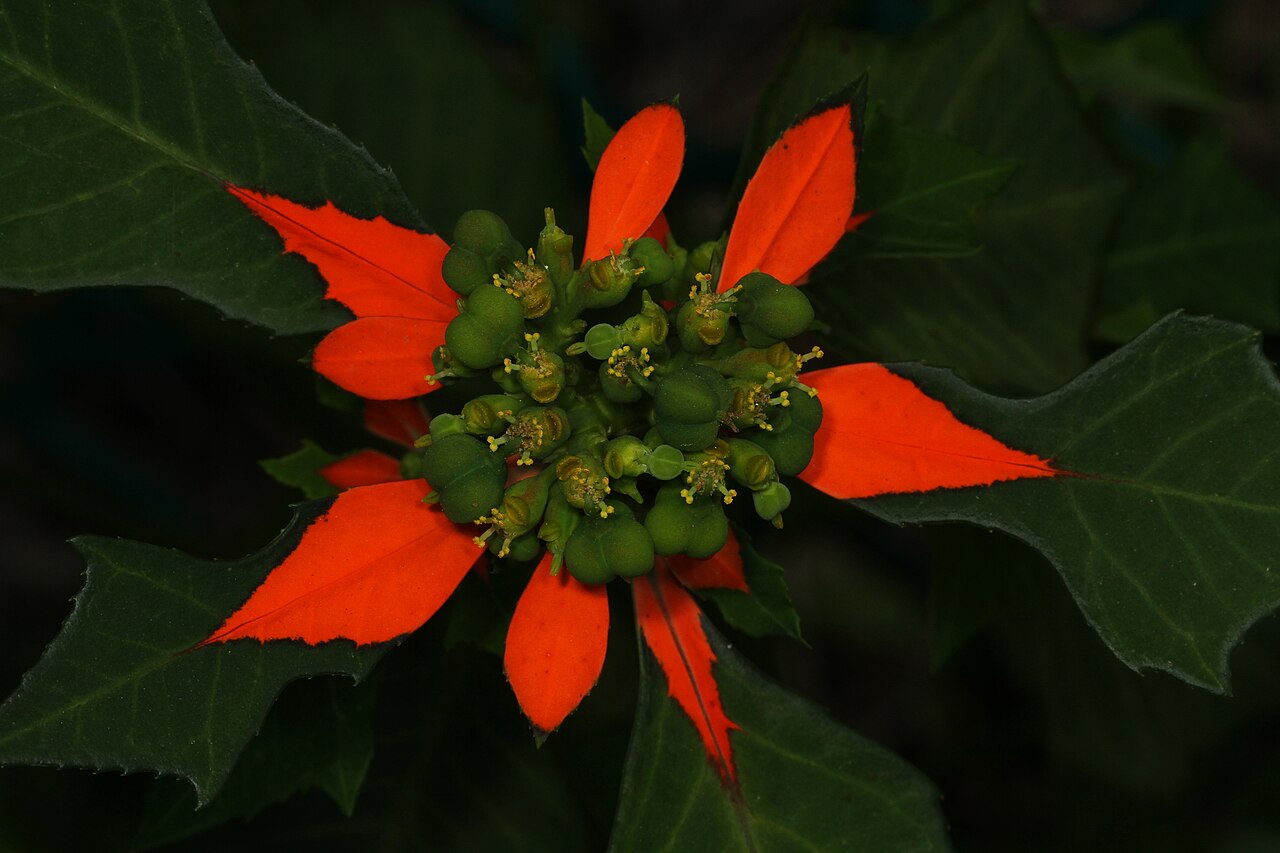
Euphorbia cyathophora, known as Wild Poinsettia, fire-on-the-mountain, painted leaf or dwarf poinsettia, is a native annual spurge with a strong family resemblance to the holiday poinsettia. It is an upright, branching plant usually 1 to 3 feet tall with variable, often fiddle-shaped leaves. At the top of each stem, the uppermost leaves are splashed with bright red or orange at the base, framing a small cluster of green flower cups. From a distance, the effect is a little red flower in a ring of green leaves.
It belongs to the spurge family (Euphorbiaceae) and, like most spurges, has milky sap. Wild poinsettia grows in sandy fields, open woods, hammock edges, riverbanks, roadsides and other sunny, somewhat disturbed ground, mainly across the Southeast, the southern Great Plains, Texas and the Southwest, with scattered records farther north. It blooms from late spring until frost and reseeds freely.
Gardeners often know it as a pass-along plant that turns up each summer from self-sown seed. It is easy to grow in sunny, well-drained spots and its red-blotched leaves add color for months. This guide covers how to identify wild poinsettia, where it grows natively, how to grow it, a safety note about its sap, and what it offers wildlife.
Identification
Wild poinsettia is easy to recognize in summer and fall by the red or orange blotches at the base of its uppermost leaves. Several other annual spurges look similar, so check the leaf shape, the color of the blotches and the glands on the flower cups.
Growth Habit
Wild poinsettia is an annual that grows from a taproot each year. It forms an upright, branched plant 1 to 3 feet tall, occasionally taller in rich soil. The stems are green, smooth or sparsely hairy, and release a white, milky sap when broken.
Leaves
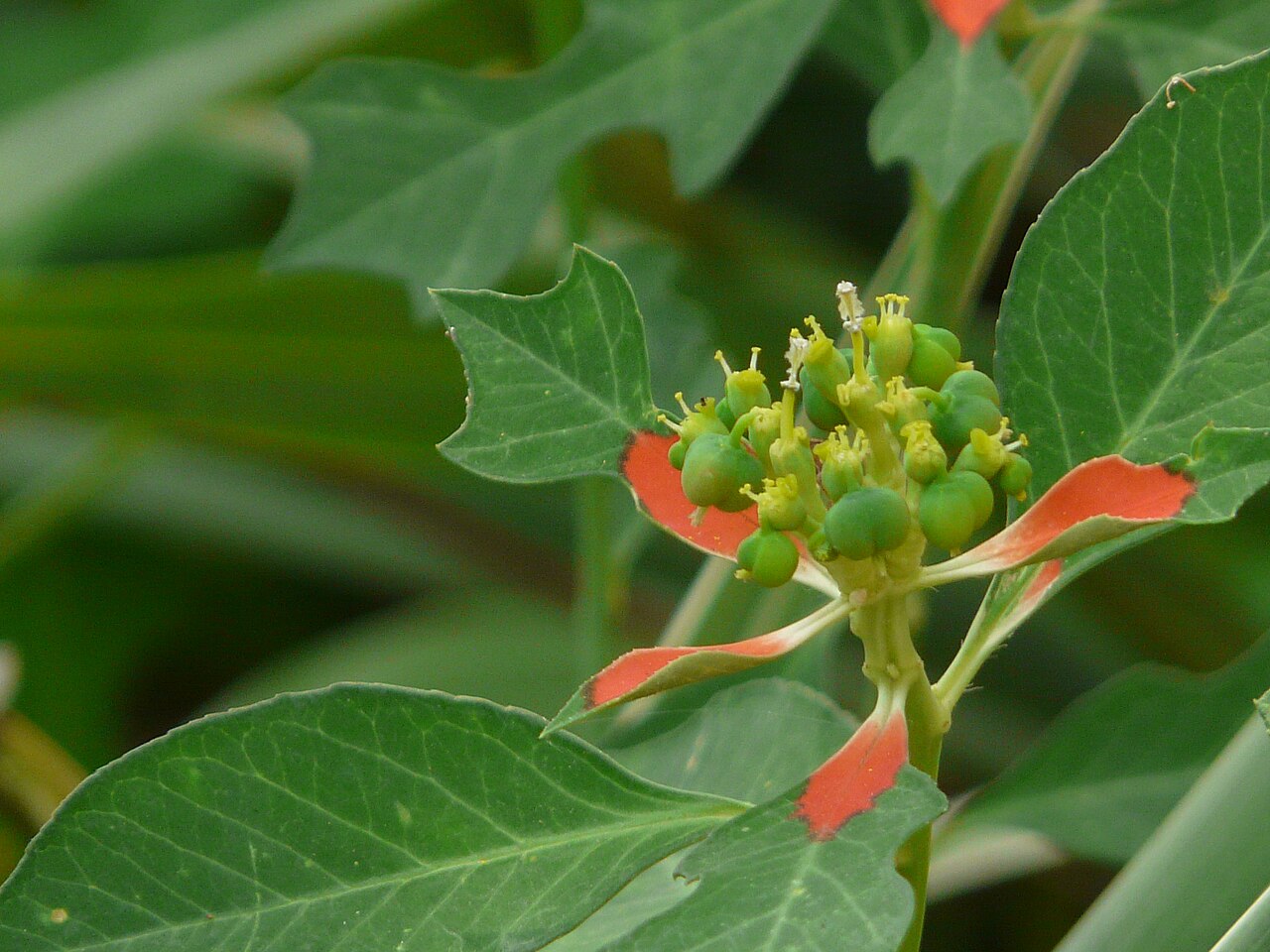
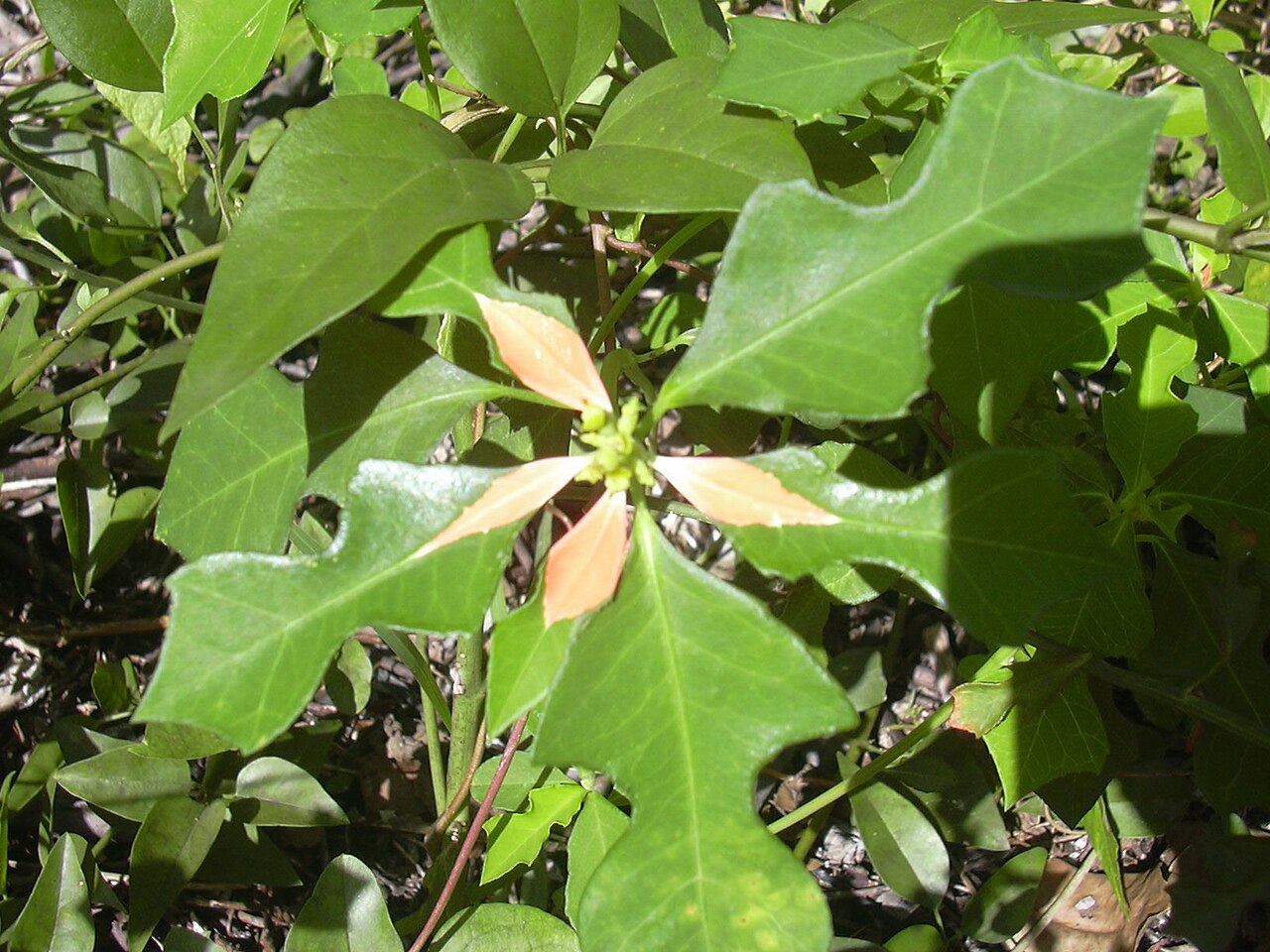
The leaves are alternate on the lower stem and become opposite or crowded near the top. They are very variable in shape, from narrow and almost linear to broad and fiddle-shaped (wider at the tip with a pinched “waist”), with wavy, lobed or toothed edges. They are 1 to 4 inches long and bright green. The uppermost leaves, which act as bracts around the flower clusters, have a red to orange-red (sometimes pale cream) patch at the base.
Flowers
Like all spurges, wild poinsettia does not have true petals. Its “flowers” are tiny cups called cyathia, clustered at the ends of the stems. Each cup holds several minute male flowers and one female flower, and has one (rarely two) small, yellowish, cup-shaped nectar gland on the rim, without the white petal-like appendages found on some other spurges. Plants bloom from about May until frost, and longer in frost-free areas.
Fruit & Seeds
The fruit is a smooth, three-lobed capsule about ¼ inch across, held on a short stalk that bends out of the cup. When ripe it splits explosively and flings its rough, warty seeds several feet. This is why plants appear in new spots each year.
Look-alikes
Mexican fireplant (Euphorbia heterophylla) is very similar, but its upper leaves are green or have pale to purple spots at the base rather than red blotches. Toothed spurge (Euphorbia dentata) has mostly opposite, toothed leaves with whitish or purple-tinged bases. The holiday poinsettia (Euphorbia pulcherrima) is a large Mexican shrub with much bigger red bracts. Its relative Flowering Spurge has white, petal-like appendages and no red bracts.
Quick Facts
| Scientific Name | Euphorbia cyathophora (syn. Poinsettia cyathophora) |
| Family | Euphorbiaceae (spurge family) |
| Plant Type | Annual herb (forb) |
| Mature Height | 1–3 ft |
| Mature Spread | 1–2 ft |
| Growth Rate | Fast |
| Sun Exposure | Full sun to light shade |
| Water Needs | Low to medium; drought tolerant once established |
| Soil Type | Sandy, loamy or rocky, well-drained soils |
| Soil pH | About 6.0–8.0 |
| Bloom Time | May–November (year-round in frost-free areas) |
| Flower Color | Green cyathia framed by red to orange-red bracts |
| Fall Color | Bracts stay red until frost |
| Fruit | Three-lobed capsule that flings warty seeds |
| Deer Resistant | High (bitter, milky sap) |
| USDA Hardiness Zones | Annual; reseeds in zones 4–11 |
Native Range
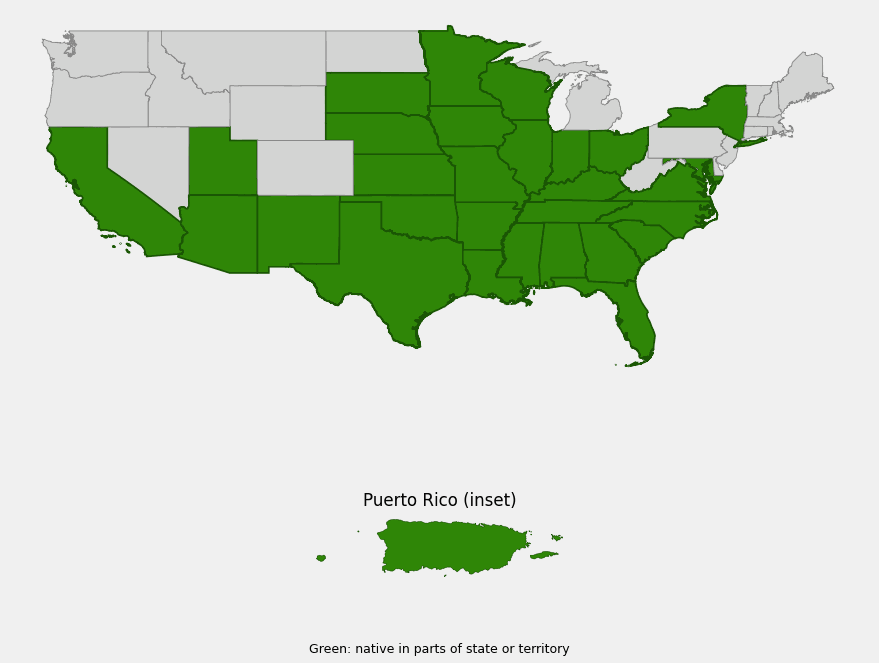
USDA PLANTS lists wild poinsettia as native in the lower 48 states and Puerto Rico, with records from 29 states. Its core range runs from Florida, Georgia and the Carolinas west through the Gulf States, Tennessee, Kentucky and Arkansas to Texas, Oklahoma, Kansas and Nebraska, and north through the Mississippi and Ohio valleys to Missouri, Iowa, Illinois, Indiana and Ohio. In the West it is recorded from New Mexico, Arizona, Utah and California.
It is most common in the Southeast and the southern Plains, where it grows in sandy fields, pine and oak woods, hammock edges, coastal dunes and shell middens, riverbanks, and roadsides. Records from the northern edge of the range, such as New York, Maryland, Wisconsin, Minnesota and South Dakota, are scattered and outlying, and some of these may represent escapes from gardens, where the plant has long been grown as an annual.
Outside the United States, wild poinsettia is native through Mexico, Central America, the Caribbean and parts of South America. It has also been introduced widely in the tropics, including Hawaii, Asia, Africa and Australia, where it is considered a weed. In Hawaii it is not native.
📋 Regional plant lists featuring Wild Poinsettia: North & South Florida · Alabama, Georgia & Mississippi · North & South Carolina · Maryland, Virginia & West Virginia · Kentucky & Tennessee · Arkansas, Louisiana, Eastern Oklahoma & Eastern Texas · South & West Texas · Illinois, Iowa & Missouri · Ohio & Indiana · Nebraska, Kansas & Eastern Colorado · North Dakota, South Dakota & Western Minnesota · Michigan, Wisconsin & Eastern Minnesota · New York, Pennsylvania & Northern New Jersey · Delaware, Southern New Jersey & Long Island · Arizona & New Mexico · Utah & Western Colorado · Idaho, Eastern Oregon & Eastern Washington · California & Nevada · Puerto Rico
Growing & Care Guide
Wild poinsettia is one of the easiest native annuals to grow. Once it has set seed in a garden, it usually comes back every year on its own. Grow it for its long season of red-blotched leaves in a sunny, informal bed, a butterfly garden or a meadow edge.
Light
It does best in full sun, which gives the most compact plants and the brightest bracts. It also tolerates light or dappled shade, as at the edges of hammocks and woods, but plants become taller and looser there.
Soil & Water
Plant it in well-drained sandy, loamy or rocky soil. It tolerates poor soil and alkaline conditions and is drought tolerant once established, though occasional watering in long dry spells keeps it blooming. Avoid soggy soil.
Planting Tips
Sow seed directly in spring after the last frost, or in fall in warm climates, pressing it lightly into the soil surface. Seedlings grow quickly and bloom within a couple of months. Thin them to about 12 inches apart. Potted seedlings can also be transplanted while small.
Pruning & Maintenance
No pruning is needed. Pinching young plants makes them bushier. Because the seeds are flung several feet, plants will move around the garden; pull unwanted seedlings while young. Wear gloves when handling the plant, because the milky sap can irritate skin and eyes.
Propagation
Propagate it from seed. Let a few plants ripen their capsules, or collect capsules just before they split and let them dry in a paper bag. The seed needs no special treatment and germinates in warm soil.
Landscape Uses
- Butterfly and pollinator gardens: long-blooming nectar source for wasps, flies and small bees
- Informal beds and cottage gardens: red-blotched leaves add color from summer into fall
- Coastal and sandy gardens: thrives in sandy, dry soils near the coast
- Meadow and roadside plantings: reseeds in open, sunny ground
- Containers: an unusual native annual for summer pots
Wildlife & Ecological Value
Wild poinsettia is a modest but useful plant for wildlife, especially because it blooms for so long in the heat of summer and fall.
For Pollinators
The nectar glands on the flower cups are open and easy to reach, so they attract a wide range of short-tongued insects, especially wasps, flies and small bees. Ants also visit for the nectar. Because the plant flowers for months, it provides a steady food source in late summer and fall.
For Birds
The seeds are eaten by ground-feeding birds such as doves and quail, which forage on spurge seeds in open, sandy ground.
For Mammals
Its bitter, milky sap makes it unpalatable to most mammals, and deer and rabbits usually leave it alone.
Ecosystem Role
As a fast-growing annual, wild poinsettia is one of the early colonizers of disturbed sandy ground, beaches and burned areas, where it helps hold soil and provides cover and food until longer-lived plants take over.
Cultural & Historical Uses
The species was described by the Swedish botanist Johan Andreas Murray in 1786. The name cyathophora means “cup-bearing,” a reference to the cup-shaped cyathia (and their cup-shaped glands) that are typical of spurges. Some botanists place it and its relatives in a separate genus, Poinsettia, as Poinsettia cyathophora, the name used by some state floras.
Its close relative, the holiday poinsettia (Euphorbia pulcherrima), was brought into U.S. gardens from Mexico in the 1820s by Joel Roberts Poinsett, the first U.S. minister to Mexico, after whom the genus Poinsettia is named. Wild poinsettia has the same red-bract strategy on a much smaller scale, and it has been grown as an easy annual in gardens for generations under names such as fire-on-the-mountain, painted leaf and Mexican fire plant.
Safety note: Like other spurges, wild poinsettia has a milky latex that can irritate the skin and is painful if it gets into the eyes. Eating the plant can cause stomach upset. Wear gloves when pulling or cutting it, wash your hands afterward, and keep children and pets from chewing on it.
Frequently Asked Questions
Is wild poinsettia related to the Christmas poinsettia?
Yes. Both belong to the genus Euphorbia, and both have colorful bracts around small green flower cups. The Christmas poinsettia is a large shrub from Mexico, while wild poinsettia is a small native annual.
Is wild poinsettia poisonous?
Its milky sap can irritate skin and eyes, and eating it may cause stomach upset. Wear gloves when handling it and keep it away from pets and children who might chew it.
Will wild poinsettia come back every year?
The plants are annual and die at frost, but they reseed freely. In most gardens new seedlings appear each spring wherever the seeds landed.
Why are my wild poinsettia bracts pale instead of red?
Bract color varies from plant to plant and with growing conditions. Some plants have cream or pale orange blotches, and plants grown in shade often color less than those in full sun.
Where should I plant wild poinsettia?
In a sunny spot with well-drained sandy or loamy soil, such as a butterfly garden, an informal bed or a meadow edge. Avoid soggy ground.

Looking for a nursery that carries Wild Poinsettia?
Browse our native plant nursery directory: Alabama, Arizona & Arkansas · California · Florida & Georgia · Illinois, Indiana, Iowa & Kansas · Kentucky, Louisiana, Maryland, Minnesota, Mississippi & Missouri · Nebraska, New Mexico, New York, North Carolina, Ohio & Oklahoma · South Carolina, South Dakota, Tennessee, Texas, Utah & Virginia · Wisconsin