
Zigzag Spiderwort (Tradescantia subaspera)
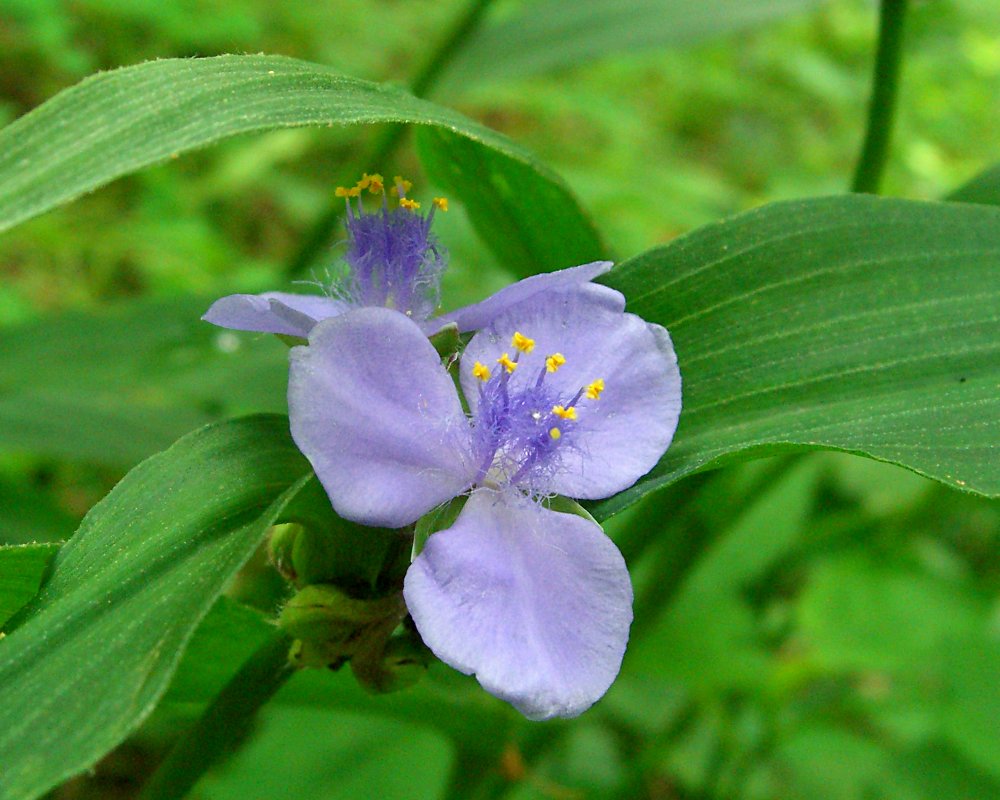
Tradescantia subaspera, known as Zigzag Spiderwort (also wide-leaf spiderwort), is a woodland spiderwort of the eastern and south-central United States. It is a clump-forming perennial, usually 1½ to 3 feet tall, with broad, strap-shaped leaves and blue to violet, three-petaled flowers that open each morning from late spring through summer. It belongs to the spiderwort family (Commelinaceae) and grows in rich, moist woods, on wooded slopes and ravines and in bottomland forests.
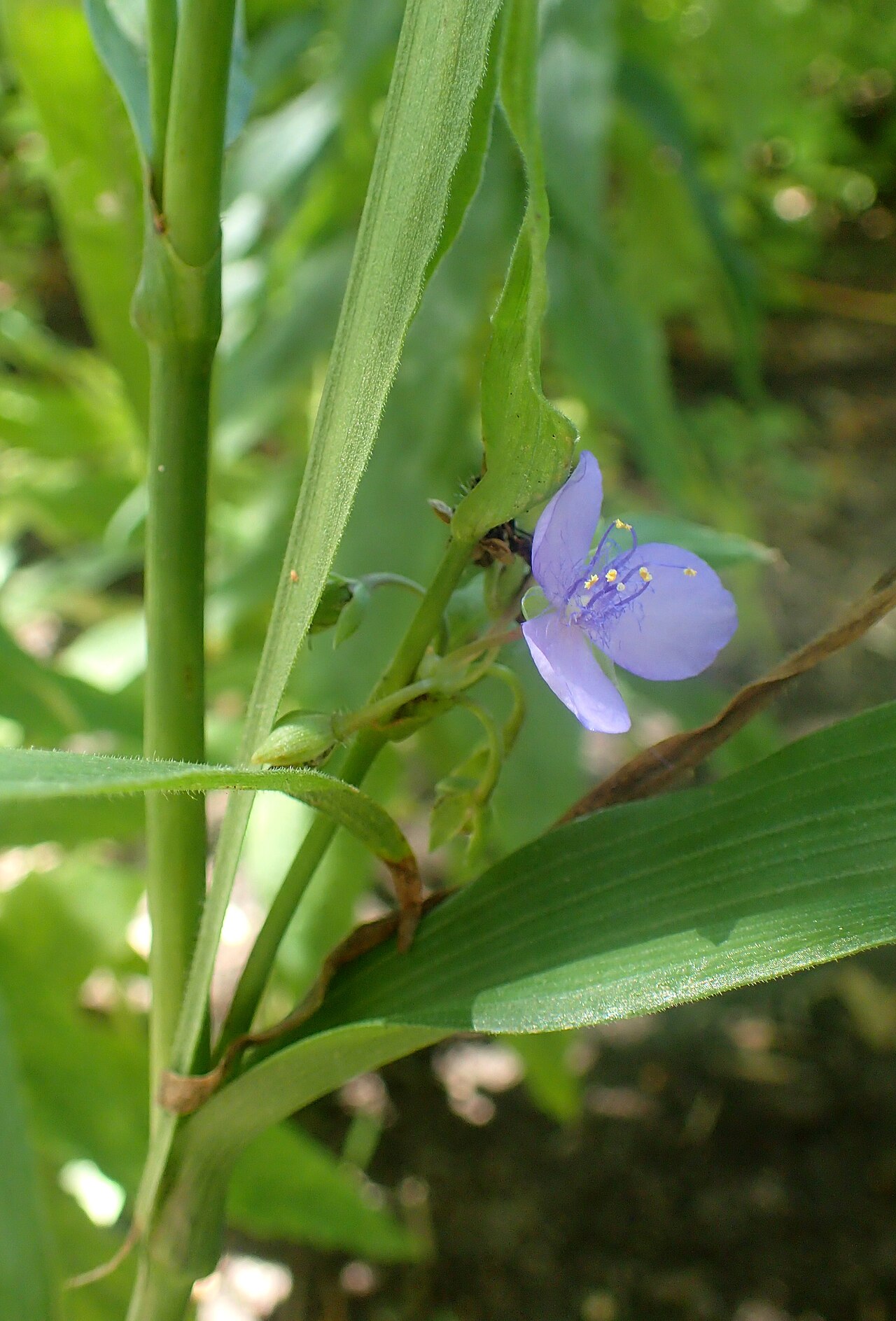
Its name describes the stem, which bends slightly from side to side at each leaf node. It also differs from the familiar sun-loving spiderworts in two ways: its leaves are much wider, and it carries flower clusters not only at the stem tip but also in the axils of the upper leaves. These traits, and its tolerance of shade, make it one of the best spiderworts for woodland gardens.
Each flower lasts only a few hours, opening in the morning and turning to a fluid mass by afternoon, but new buds open day after day for weeks. Bees collect pollen from the bright yellow anthers, and the plant is easy to grow, long-lived and seldom troubled by pests.
Identification
Look for a shade-loving spiderwort with a slightly zigzag stem, broad leaves up to about 1½ inches wide, and clusters of blue-violet, three-petaled flowers both at the stem tip and in the upper leaf axils.
Leaves
The leaves are alternate, lance-shaped to broadly strap-shaped, about 4 to 12 inches long and roughly 3/4 to 1½ inches wide, much broader than those of the common sun-loving spiderworts. They are dark green and parallel-veined, with sheathing bases that wrap the stem. Leaf surfaces may be smooth or sparsely hairy, and the leaf bases are often hairy along the margins.
Stems
The stems are upright or leaning, about 1½ to 3 feet tall, often branched in the upper part, and bend slightly at each node to give the zigzag shape. They are succulent and exude a clear, slimy sap when broken, like other spiderworts.
Flowers
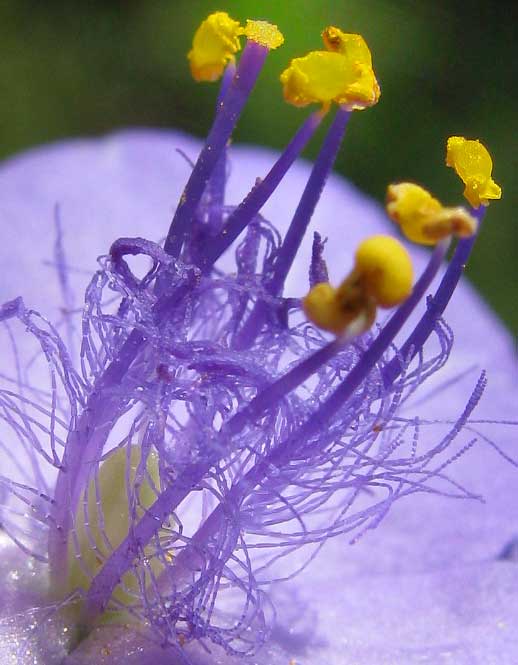
The flowers are about 3/4 to 1 inch across, with three rounded petals that are usually blue to violet, rarely pinkish or white, and three green sepals. They grow in small, umbrella-like clusters (cymes) at the stem tip and in the axils of the upper leaves, each cluster cradled by leafy bracts. Six stamens with bright yellow anthers have filaments covered in long, purple, beaded hairs. Each flower opens for a single morning, and the plant blooms from about May into September.
Fruit & Seeds
After flowering, each flower forms a small, three-chambered capsule hidden among the old sepals. It contains a few small, grayish, wrinkled seeds that drop near the parent plant.
Look-alikes
Virginia Spiderwort (T. virginiana) and Common Spiderwort (T. ohiensis) have narrow, grass-like leaves, straight stems and flowers only at the stem tips; common spiderwort also has a waxy blue-green coating and grows in sunnier places. Virginia Dayflower (Commelina virginica) has a similar habit in moist woods but flowers with two large blue petals and one tiny one, emerging from folded, boat-shaped bracts.
Quick Facts
| Scientific Name | Tradescantia subaspera |
| Family | Commelinaceae (spiderwort family) |
| Plant Type | Herbaceous perennial |
| Mature Height | 1½–3 ft |
| Mature Spread | 1–2 ft |
| Growth Rate | Moderate |
| Sun Exposure | Part shade to full shade |
| Water Needs | Medium; moist to average soil |
| Soil Type | Rich loam, clay loam or rocky woodland soil |
| Soil pH | About 5.5–7.5 |
| Bloom Time | May–September |
| Flower Color | Blue to violet, rarely white |
| Fall Color | None; foliage declines in late summer |
| Fruit | Small three-chambered capsule |
| Deer Resistant | Moderate; sometimes browsed |
| USDA Hardiness Zones | 5–9 |
Native Range
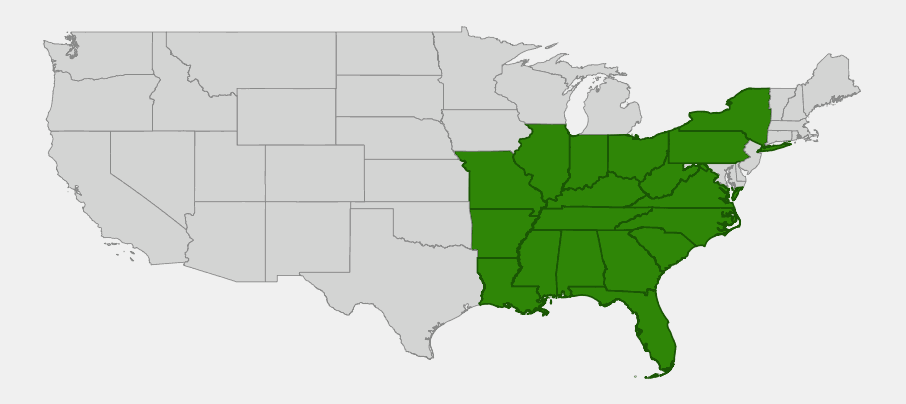
Zigzag spiderwort is native to the eastern and south-central United States. USDA PLANTS lists it as native from New York and Pennsylvania west to Ohio, Indiana, Illinois and Missouri, and south to Arkansas, Louisiana and the Gulf Coast states, including Florida, Georgia and the Carolinas. It is most common in the Appalachian and Ozark regions and in the Ohio and Mississippi river valleys.
It is uncommon at the northern edge of its range, in New York and Pennsylvania, and in Florida it is confined to the northern part of the state. The mountain form, sometimes called variety montana, grows in the southern Appalachians, while the more typical form grows at lower elevations to the west and south.
Look for it in rich, moist deciduous woods, on wooded slopes and bluffs, in ravines and along shaded stream terraces and bottomlands. It often grows on soils over limestone or other base-rich rock, among other spring and summer woodland wildflowers.
📋 Regional plant lists featuring Zigzag Spiderwort: North & South Florida · Alabama, Georgia & Mississippi · North & South Carolina · Maryland, Virginia & West Virginia · Kentucky & Tennessee · Arkansas, Louisiana, Eastern Oklahoma & Eastern Texas · Illinois, Iowa & Missouri · Ohio & Indiana · New York, Pennsylvania & Northern New Jersey · Delaware, Southern New Jersey & Long Island
Growing & Care Guide
Zigzag spiderwort is an easy, long-lived perennial for shaded gardens. It blooms for months, needs little care and tolerates the dry shade under trees better than most woodland wildflowers once it is established.
Light
Part shade to full shade. Dappled light under deciduous trees or morning sun with afternoon shade gives the most flowers. It tolerates more sun in moist soil, but the leaves may scorch in hot, dry sites.
Soil & Water
It prefers rich, moist, well-drained soil with plenty of organic matter, but it adapts to clay, loam and rocky soils. Water regularly in its first season; established plants tolerate short dry spells. In long droughts the foliage may yellow and the plant may go partly dormant, then recover with rain.
Planting Tips
Plant nursery-grown plants in spring or fall, about 18 inches apart. It looks best in groups among ferns, sedges and other woodland perennials, or along a shaded path where you can see the flowers in the morning, when they are open.
Pruning & Maintenance
If the stems flop or the foliage looks tired in late summer, cut the plant back by about half; it will put out fresh growth. Cutting it back after the main bloom also limits self-sowing. Divide crowded clumps every few years. Wear gloves if the slimy sap irritates your skin.
Propagation
Divide clumps in early spring or fall; each piece with roots and a shoot will grow. Stem cuttings root easily in moist soil. Seed sown outdoors in fall usually germinates the next spring, and seedlings often bloom in their second year. It may self-sow lightly in good conditions.
Landscape Uses
- Woodland gardens: long summer bloom in part to full shade
- Shade borders: broad foliage and blue flowers among ferns and hostas
- Pollinator gardens: pollen source for bumblebees and other bees
- Naturalized areas: spreads slowly by self-sowing in moist woods
- Slope plantings: grows on wooded slopes and stream banks
Wildlife & Ecological Value
Zigzag spiderwort offers a long season of pollen in shady places, where few other plants bloom in midsummer.
For Pollinators
Spiderwort flowers have no nectar, but they produce plenty of pollen. Bumblebees, small carpenter bees, sweat bees and other native bees visit in the morning to collect it, and syrphid flies feed on it as well. Because each flower lasts only a few hours, pollinators work the plant early in the day.
For Birds
The small seeds are eaten occasionally by ground-feeding birds, but the plant is not a major bird food.
For Mammals
Deer, rabbits and groundhogs sometimes browse spiderworts, though browsed plants usually resprout.
Ecosystem Role
As a long-blooming woodland perennial, it adds summer flowers and pollen to forest understories after most spring wildflowers have finished. It also contributes leafy ground cover on rich wooded slopes.
Cultural & Historical Uses
The genus Tradescantia honors John Tradescant the Elder and the Younger, English gardeners and plant collectors of the 1600s; the younger Tradescant brought T. virginiana from Virginia to England. The species name subaspera means “somewhat rough,” for the slightly hairy leaves and stems of some plants.
Spiderworts are named for the long, beaded hairs on their stamens, which look like spider webs, and for the stringy, slimy sap of the broken stems. The stamen hairs are made of chains of single cells, and they have been used in classrooms to show cytoplasmic streaming under a microscope. Some spiderwort species have also been used in research because their stamen-hair cells change color when exposed to mutagens.
Garden selections, such as the mountain form sold as ‘Montana’, have long been grown in American and European gardens. On this site, related plants include Virginia Spiderwort, Common Spiderwort, Bracted Spiderwort and Virginia Dayflower.
Frequently Asked Questions
Why is it called zigzag spiderwort?
Its stem bends slightly from side to side at each leaf node, making a zigzag line. “Spiderwort” refers to the web-like hairs on the stamens and the stringy sap.
How is zigzag spiderwort different from Virginia spiderwort?
Zigzag spiderwort has broad leaves, a zigzag stem, flowers in the upper leaf axils as well as at the tip, and it grows in shade. Virginia spiderwort has narrow, grass-like leaves and flowers only at the stem tips.
Does zigzag spiderwort grow in shade?
Yes. It is one of the most shade-tolerant spiderworts and does well in part to full shade in rich woodland soil.
When does zigzag spiderwort bloom?
From about May into September. Each flower lasts one morning, but new flowers open daily for weeks.
Does zigzag spiderwort attract pollinators?
Yes. Its flowers have no nectar, but bumblebees and other native bees visit for the abundant yellow pollen.

Looking for a nursery that carries Zigzag Spiderwort?
Browse our native plant nursery directory: Alabama & Arkansas · Florida & Georgia · Illinois & Indiana · Kentucky, Louisiana, Mississippi & Missouri · New York, North Carolina & Ohio · Pennsylvania, South Carolina, Tennessee & Virginia · West Virginia

