
Violet Woodsorrel (Oxalis violacea)
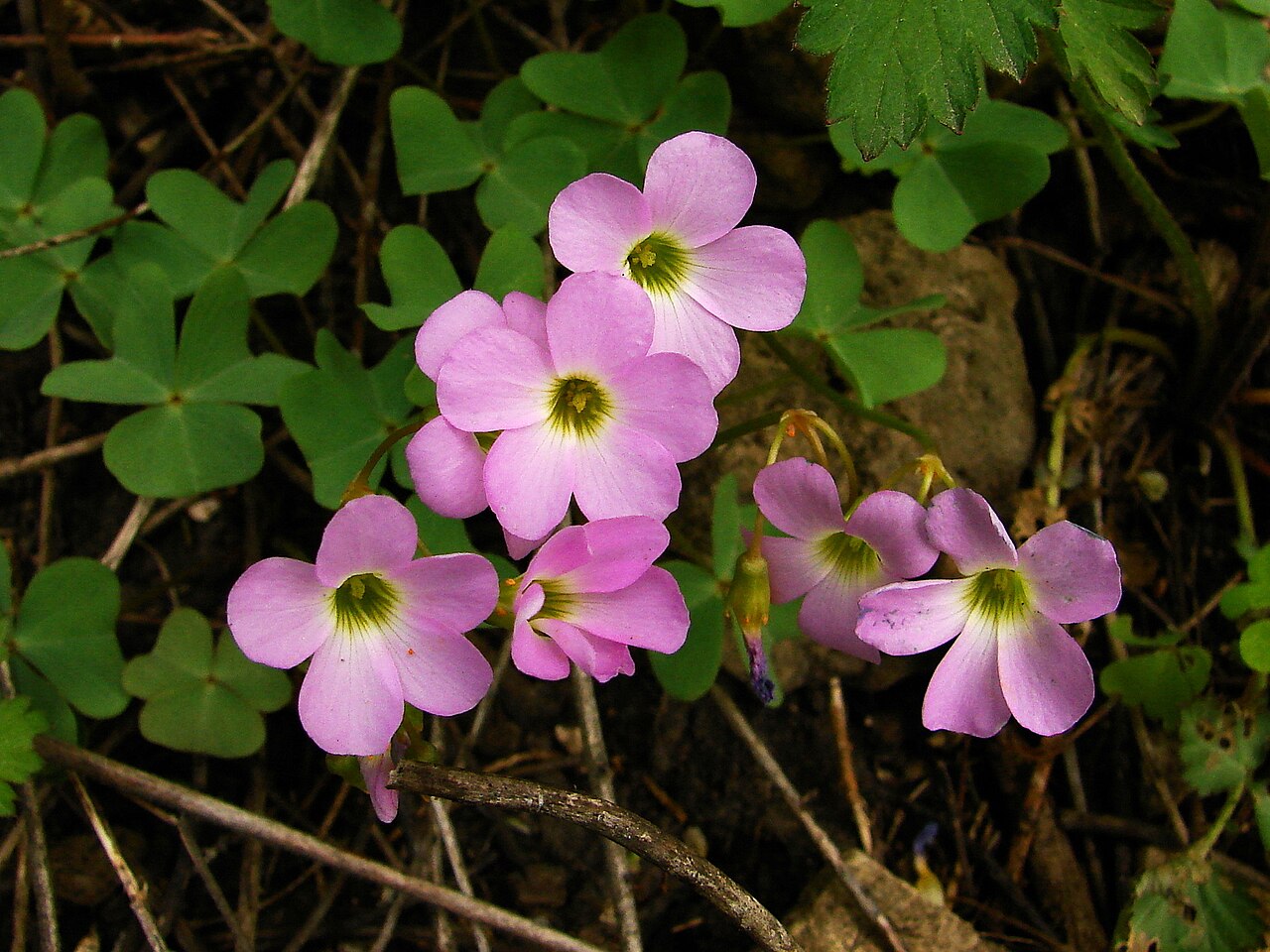
Oxalis violacea, known as Violet Woodsorrel or violet wood sorrel, is a small, graceful spring wildflower of open woods, prairies and rocky glades across much of the United States. It grows from a small, scaly bulb and produces a tuft of long-stalked, shamrock-like leaves, each with three heart-shaped leaflets that are often tinged purple underneath. In spring, slender stalks 4 to 10 inches tall rise above the leaves, carrying loose clusters of rose-violet to lavender flowers with five petals and a greenish-yellow eye.
It belongs to the wood sorrel family (Oxalidaceae), and like its relatives it has a sour, lemony taste from oxalic acid. Unlike the common yellow wood sorrels that grow as weeds in lawns and gardens, violet woodsorrel is a plant of undisturbed habitat. It blooms mostly from April to June, often goes dormant in summer heat, and sometimes produces a second, smaller flush of leaves and flowers in fall.
Violet woodsorrel is the only native North American Oxalis with violet flowers in most of its range, and it is a pretty addition to dry woodland gardens, rock gardens and prairie plantings. This guide covers how to identify it, where it grows natively, how to grow it, and its role in spring ecosystems.
Identification
Violet woodsorrel is easy to recognize when in bloom by its rose-violet flowers and shamrock-like leaves. Out of flower, the leaves alone can be confused with clover or other wood sorrels.
Bulb & Growth Habit
Each plant grows from a small, scaly, brown bulb about ½ inch across, buried an inch or two deep. Plants do not form above-ground stems; all leaves and flower stalks rise directly from the bulb. The bulbs produce small offsets, so plants often grow in small clusters or loose colonies.
Leaves
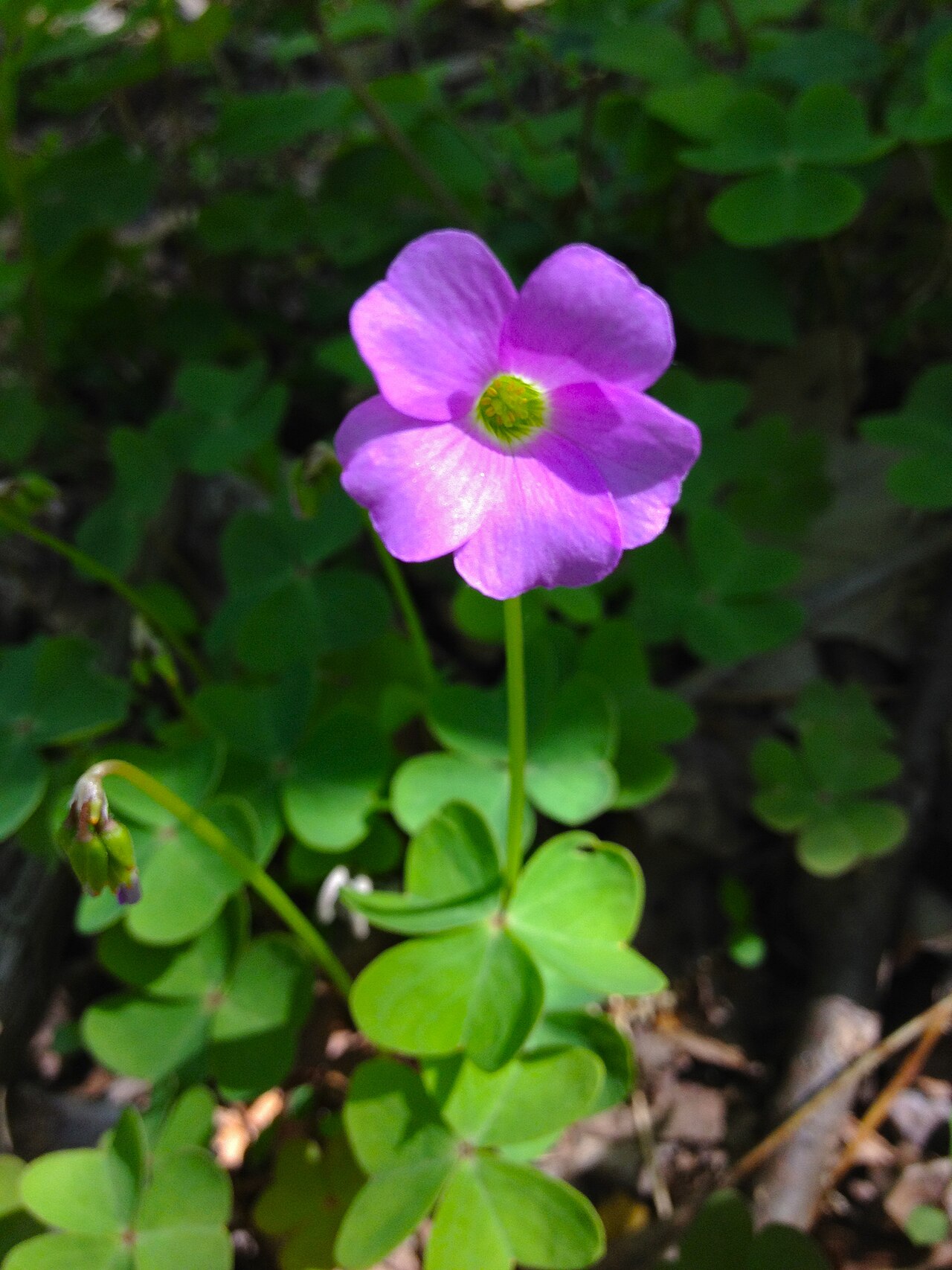
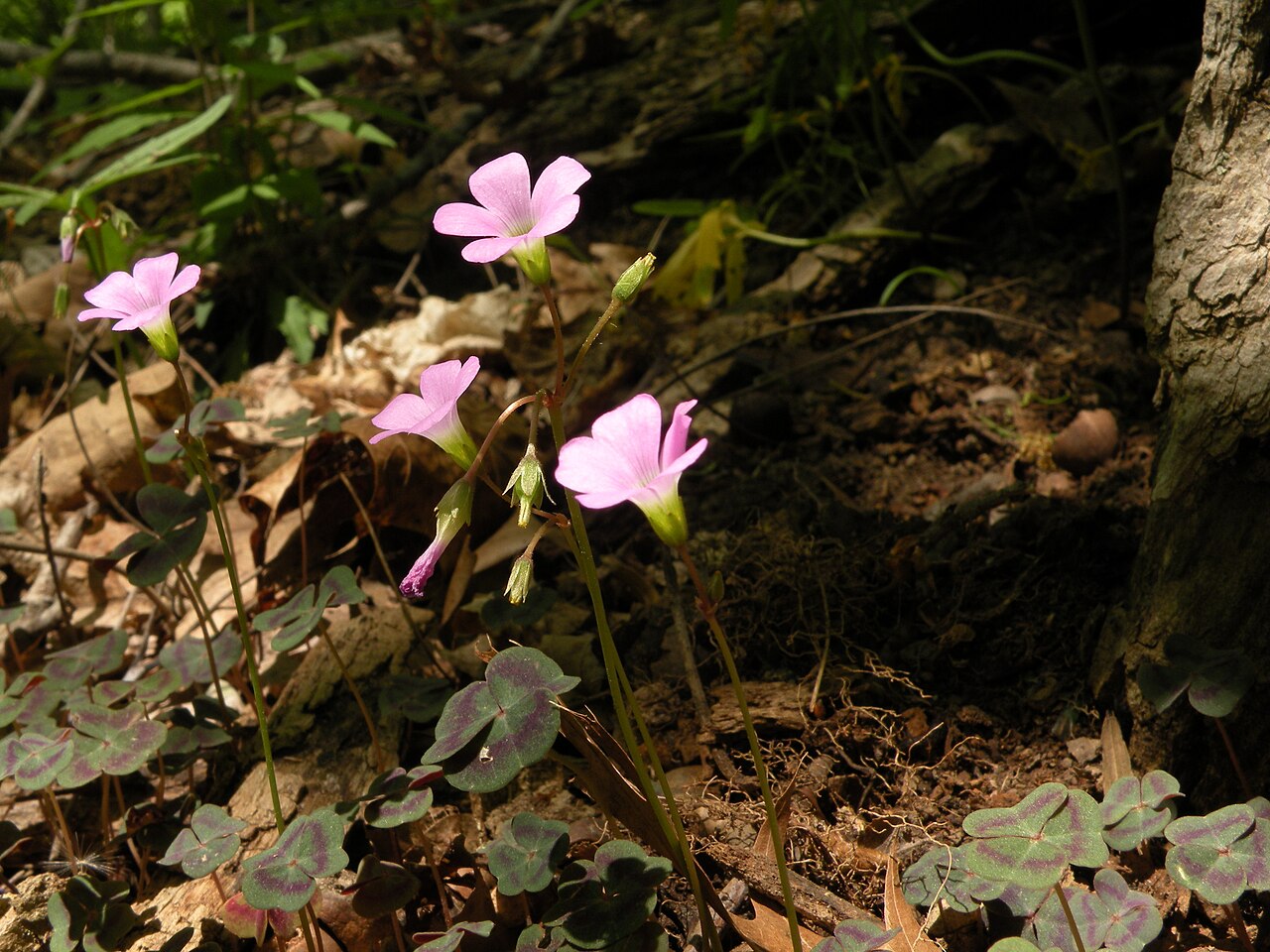
The leaves are all basal, on stalks 2 to 6 inches long. Each leaf has three broad, heart-shaped leaflets, ½ to 1 inch wide, joined at their tips to the leaf stalk, like a shamrock. The leaflets are smooth, often bluish-green above, and frequently purple or with purple markings underneath or along the edges. Like other wood sorrels, they fold down along the midrib at night and in bright, hot sun.
Flowers
Each flower stalk carries an umbel of about 3 to 12 flowers, each on a thin stalk. The flowers are about ¾ inch across, with five rose-violet to lavender (occasionally pink or white) petals and a greenish-yellow center with darker veins. They open in sun and close in cloudy weather and at night. The main flowering season is April to June, with occasional flowering in fall.
Fruit & Seeds
The fruit is a small, round to egg-shaped capsule. Seed production is often sparse, and many populations spread mainly through bulb offsets.
Look-alikes
Yellow wood sorrel (Oxalis stricta) and its relatives have yellow flowers, leafy stems, and long, narrow seed pods. Introduced pink-flowered sorrels such as Oxalis debilis, common in southern gardens, have larger, more crowded flowers and grow in disturbed ground. White clover has toothed, oval leaflets and round white flower heads.
Quick Facts
| Scientific Name | Oxalis violacea (syn. Ionoxalis violacea) |
| Family | Oxalidaceae (wood sorrel family) |
| Plant Type | Herbaceous perennial from a small bulb |
| Mature Height | 4–10 in |
| Mature Spread | 3–6 in per plant; spreads slowly by offsets |
| Growth Rate | Slow to moderate |
| Sun Exposure | Full sun to part shade |
| Water Needs | Low to medium; tolerates summer drought |
| Soil Type | Well-drained loam, sandy, gravelly or rocky soils |
| Soil pH | About 5.5–7.5 |
| Bloom Time | April–June; sometimes again in fall |
| Flower Color | Rose-violet to lavender; rarely white |
| Fall Color | None; leaves often die back in summer |
| Fruit | Small rounded capsule (seed often sparse) |
| Deer Resistant | Moderate |
| USDA Hardiness Zones | 4–9 |
Native Range
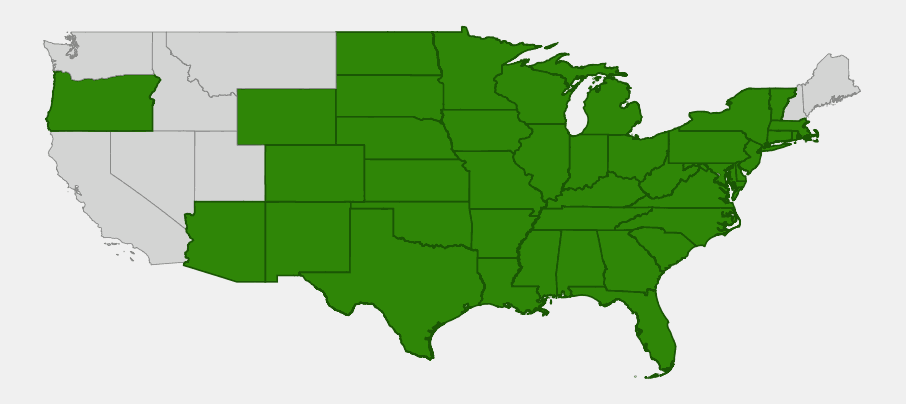
Violet woodsorrel has a broad range in the eastern and central United States. USDA PLANTS records it as native in 40 states, from Massachusetts, Vermont and New York west through the Great Lakes states to Minnesota and the Dakotas, south through the Ohio and Mississippi valleys to Florida and the Gulf Coast, and west across the Great Plains to Texas, Oklahoma, Kansas and Nebraska. It also reaches the eastern foothills of the Rockies in Wyoming, Colorado and New Mexico, and USDA lists it for Arizona and Oregon as well, where it is scattered and local.
It is most common in the Midwest, the Ozarks, the southern Appalachians and the Piedmont, where it grows in open oak and hickory woods, savannas, prairies, rocky glades, bluffs and roadside banks. It thrives where the ground is not heavily disturbed but receives plenty of spring sunshine, such as in woods with thin canopies or prairies that are burned or mowed regularly.
At the northeastern edge of its range in New England it is uncommon and protected in some states. In the western Great Plains it grows in mixed-grass prairies and wooded draws. Its bulbs allow it to survive fire, drought and grazing, and it often reappears in remnant prairies and savannas after restoration.
📋 Regional plant lists featuring Violet Woodsorrel: New York, Pennsylvania & Northern New Jersey · Idaho, Eastern Oregon & Eastern Washington · Ohio & Indiana · Montana & Wyoming · Michigan, Wisconsin & Eastern Minnesota · Kentucky & Tennessee · Nebraska, Kansas & Eastern Colorado · Connecticut, Massachusetts & Rhode Island · New Hampshire, Maine & Vermont · Maryland, Virginia & West Virginia · Delaware, Southern New Jersey & Long Island · Arizona & New Mexico · Illinois, Iowa & Missouri · Alabama, Georgia & Mississippi · North & South Florida
Growing & Care Guide
Violet woodsorrel is an easy, low-maintenance plant for sunny or lightly shaded spots with good drainage. It is small, so plant it where it can be seen up close: along a path, in a rock garden, or at the front of a prairie or woodland bed. Buy nursery-propagated plants or bulbs rather than digging them from the wild.
Light
It grows in full sun to part shade. In the wild it is found in open woods and prairies, and in gardens it does best where it gets sun in spring, such as under deciduous trees or among short prairie plants.
Soil & Water
Plant it in well-drained soil. It tolerates sandy, gravelly, rocky and clay-loam soils, but not wet soil, which can rot the bulbs. Water it in spring if the weather is dry. In summer it often goes dormant and needs no watering.
Planting Tips
Plant bulbs in fall about 1 to 2 inches deep, or set out potted plants in spring. Space them 3 to 6 inches apart in small groups. Mark their location, because plants can disappear completely in summer dormancy.
Pruning & Maintenance
Little care is needed. Allow the leaves to die back naturally after flowering. Keep taller, aggressive plants from crowding it out. In prairie plantings, regular spring burning or mowing helps maintain the open conditions it likes.
Propagation
Divide clumps and separate bulb offsets while dormant in late summer or fall. Seed can also be sown in fall, but seed is often sparse and seedlings grow slowly, so division is the more practical method.
Landscape Uses
- Rock gardens: a small, colorful spring flower for dry, well-drained pockets
- Prairie and savanna plantings: adds spring color among bunchgrasses and early wildflowers
- Dry woodland gardens: under deciduous trees with spring sun
- Path edges and front borders: planted in small groups where it can be seen up close
- Restoration: a characteristic spring plant of remnant prairies and open woods
Wildlife & Ecological Value
Violet woodsorrel is small, but its spring flowers and persistent bulbs give it a place in the ecology of prairies and open woodlands.
For Pollinators
The flowers are visited by small bees, including sweat bees and mining bees, as well as bee flies and small butterflies. Since the flowers open only in sunshine, pollinator visits are concentrated on warm, sunny spring days.
For Birds
Birds do not use it much as food, though some ground-feeding birds may eat the small seeds.
For Mammals
Deer and rabbits occasionally graze the leaves. Small mammals such as voles and pocket gophers may eat the bulbs.
Ecosystem Role
Its bulbs survive fire, drought and grazing underground, so violet woodsorrel persists in prairies and savannas through disturbance. It is a host plant for some leaf-feeding insects and contributes early-season flowers to the spring pollinator community.
Cultural & Historical Uses
Linnaeus described violet woodsorrel in 1753. The genus name Oxalis comes from the Greek oxys, meaning “sour” or “sharp,” for the sour-tasting leaves, and violacea refers to the violet flowers. For a time it was placed in a separate genus, Ionoxalis, for the violet-flowered wood sorrels.
The leaves contain oxalic acid, which gives them a pleasant lemony taste. Several Native American peoples, and later settlers, nibbled the leaves and flowers or used them to flavor food and drinks, and some used the plant medicinally. Oxalic acid can interfere with calcium absorption and irritate the kidneys when eaten in large amounts, so the leaves should be eaten only occasionally and in small quantities, if at all. Large amounts can be harmful to livestock and pets.
Violet woodsorrel’s shamrock-like leaves sometimes cause it to be called a “shamrock,” and native and ornamental wood sorrels are often sold around St. Patrick’s Day. Ornamental “shamrocks” are usually non-native species, so gardeners who want the native plant should look for Oxalis violacea by its scientific name.
Frequently Asked Questions
Is violet woodsorrel edible?
The leaves and flowers are edible in small amounts and have a sour, lemony taste from oxalic acid. Eat them only occasionally and sparingly, since oxalic acid can be harmful in large quantities, especially for people with kidney problems.
Is violet woodsorrel a weed?
No. Unlike the yellow wood sorrels that grow in lawns and gardens, violet woodsorrel is a native wildflower of undisturbed habitat and rarely spreads aggressively.
Why do violet woodsorrel leaves disappear in summer?
It often goes dormant in summer heat and drought, surviving as a bulb underground. New leaves and sometimes flowers may appear again in fall.
How is violet woodsorrel different from a shamrock?
“Shamrock” is a common name for several plants with three-parted leaves, including clovers and wood sorrels. Violet woodsorrel is a native North American wood sorrel with violet flowers, while the ornamental shamrocks sold at stores are usually non-native species.
Where should I plant violet woodsorrel?
In full sun to part shade with well-drained soil, such as a rock garden, prairie planting or open woodland garden. Avoid wet soil, which can rot the bulbs.

Looking for a nursery that carries Violet Woodsorrel?
Browse our native plant nursery directory: Alabama, Arizona & Arkansas · Colorado, Connecticut, Delaware, Florida & Georgia · Illinois, Indiana, Iowa & Kansas · Kentucky, Louisiana, Maryland, Massachusetts, Michigan, Minnesota, Mississippi & Missouri · Nebraska, New Jersey, New Mexico, New York, North Carolina, North Dakota, Ohio & Oklahoma · Oregon · Pennsylvania, Rhode Island, South Carolina, South Dakota, Tennessee, Texas, Vermont & Virginia · West Virginia, Wisconsin & Wyoming