
Hooked Buttercup (Ranunculus recurvatus)
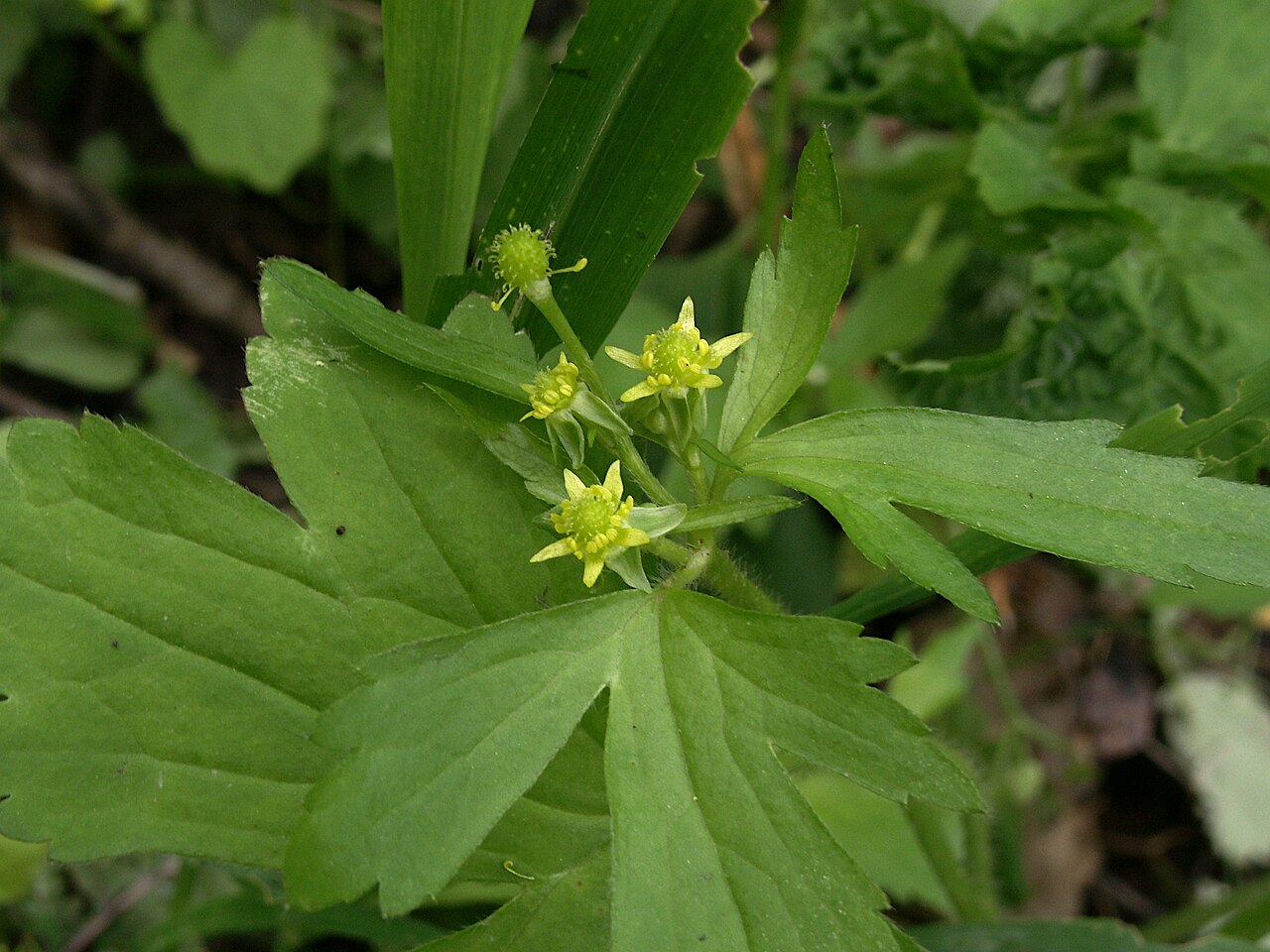
Ranunculus recurvatus, known as Hooked Buttercup, hooked crowfoot or blisterwort, is a native woodland buttercup of the eastern United States and eastern Canada. It is a loose, hairy plant usually 8 to 24 inches tall, with broad, deeply three-lobed leaves and small, pale yellow flowers in spring. Its name comes from its seeds: each one ends in a distinctly hooked beak, so the round seed heads look like tiny burs.
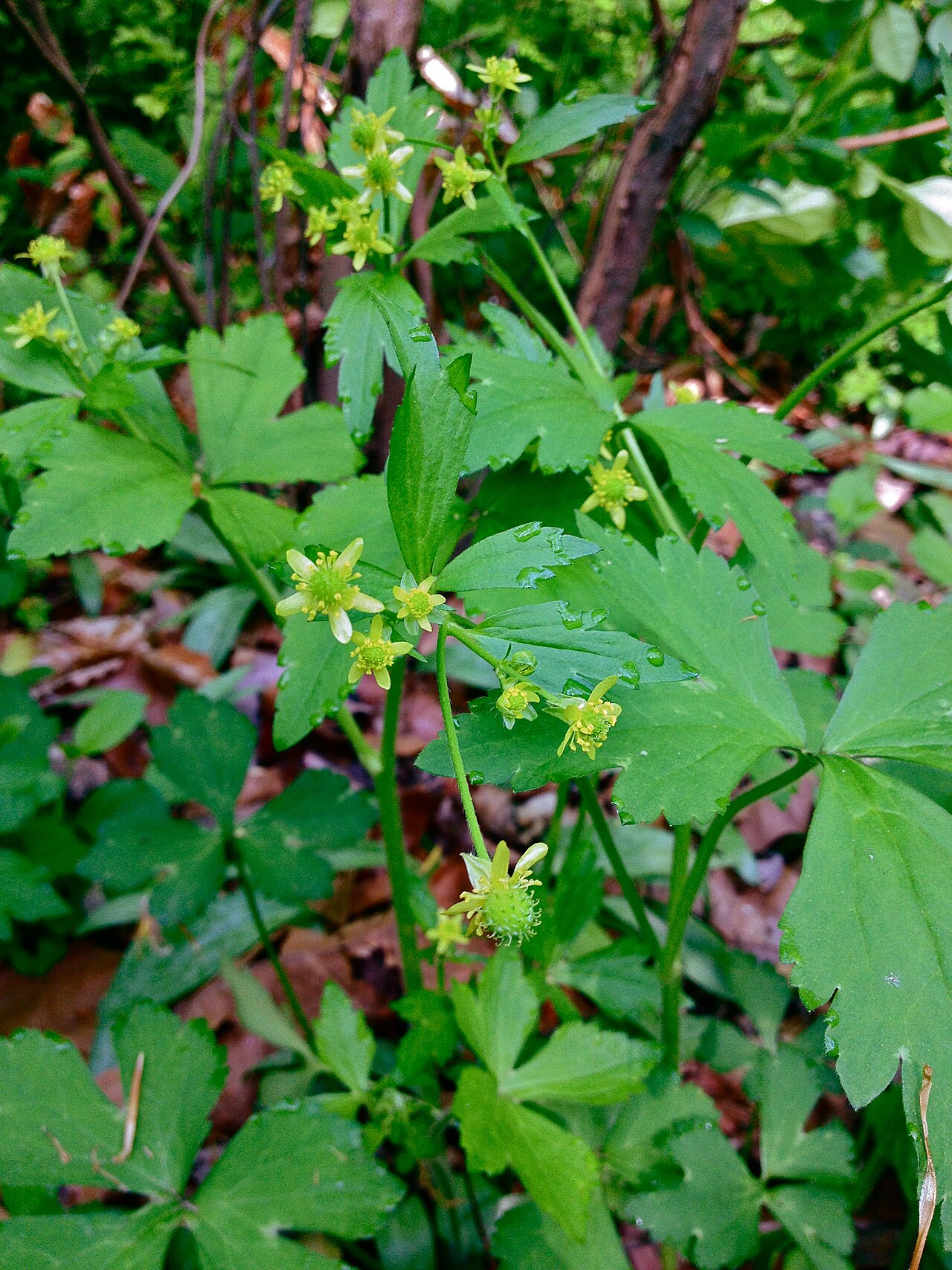
It belongs to the buttercup family (Ranunculaceae). Unlike the showy buttercups of sunny meadows, hooked buttercup is a plant of shady, moist, rich woods, floodplain forests, seepy slopes and the edges of swamps. Its flowers are small and easy to overlook, with narrow petals that are no longer than the green sepals, which bend sharply backward against the stalk.
Hooked buttercup is not a showy garden plant, but it is a common and characteristic member of the spring woodland flora and is easy to learn once you know its leaves. This guide covers how to identify it, where it grows natively, how it can be grown in a naturalistic shade garden, its toxicity, and its place in woodland ecosystems.
Identification
Hooked buttercup is best identified by the combination of broad, three-lobed, hairy leaves, tiny pale yellow flowers with bent-back sepals, and round seed heads made of seeds with strongly hooked beaks.
Growth Habit
It is a perennial (sometimes short-lived) that grows from a cluster of fibrous roots. One or a few branched, hairy stems rise 8 to 24 inches tall from a clump of basal leaves. It does not spread by runners, so it grows as scattered individual plants.
Leaves
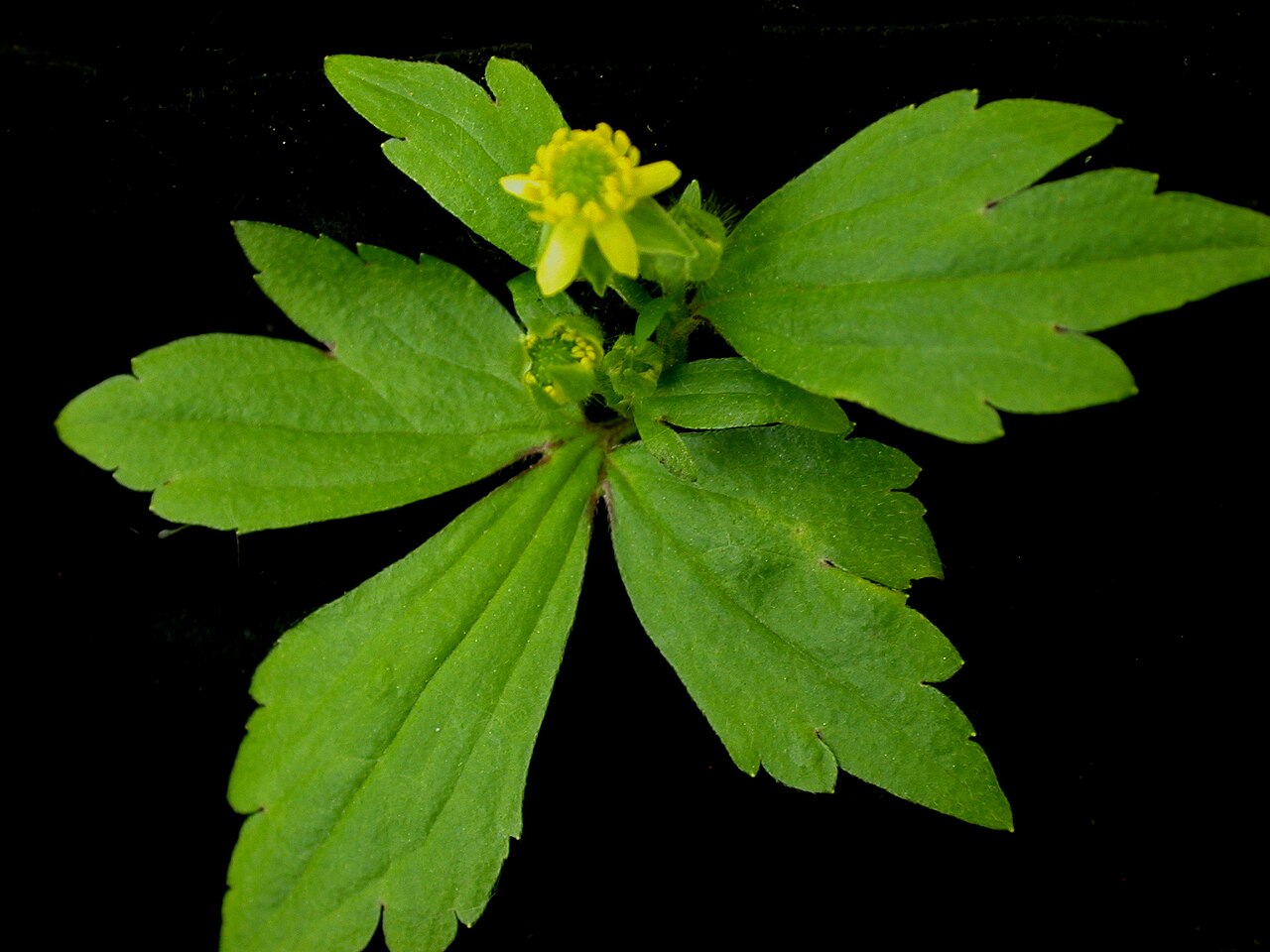
The basal leaves have long, hairy stalks and broad, roughly round blades 2 to 4 inches wide, divided about three-quarters of the way into three wedge-shaped lobes with coarse, rounded teeth. The stem leaves are similar but smaller and on shorter stalks. Both surfaces are softly hairy.
Flowers
The flowers are about ¼ to ½ inch across. They have five narrow, pale yellow petals that are shorter than or equal to the five green sepals, and the sepals are bent sharply backward (recurved). The center holds a dome of greenish pistils surrounded by yellow stamens. Flowers appear from about April to June.
Fruit & Seeds
After flowering, the center enlarges into a round head of flattened seeds (achenes), each about ⅛ inch long and ending in a slender, strongly hooked beak. The heads ripen in late spring and early summer.
Look-alikes
Kidneyleaf buttercup (Ranunculus abortivus) also has tiny yellow flowers, but its basal leaves are kidney-shaped and smooth, and its seeds have only tiny beaks. Swamp buttercup (Ranunculus hispidus) and other woodland buttercups have showy flowers with petals much longer than the sepals. Young plants can also resemble Wild Geranium, which has five-lobed, more deeply cut leaves and large pink flowers.
Quick Facts
| Scientific Name | Ranunculus recurvatus |
| Family | Ranunculaceae (buttercup family) |
| Plant Type | Herbaceous perennial (sometimes short-lived) |
| Mature Height | 8–24 in |
| Mature Spread | 6–12 in |
| Growth Rate | Moderate |
| Sun Exposure | Part shade to full shade |
| Water Needs | Medium to high; moist soil |
| Soil Type | Rich, moist loam; floodplain and seepy soils |
| Soil pH | About 5.5–7.5 |
| Bloom Time | April–June |
| Flower Color | Pale yellow |
| Fall Color | None |
| Fruit | Round head of achenes with hooked beaks |
| Deer Resistant | High (acrid, toxic foliage) |
| USDA Hardiness Zones | 3–9 |
Native Range
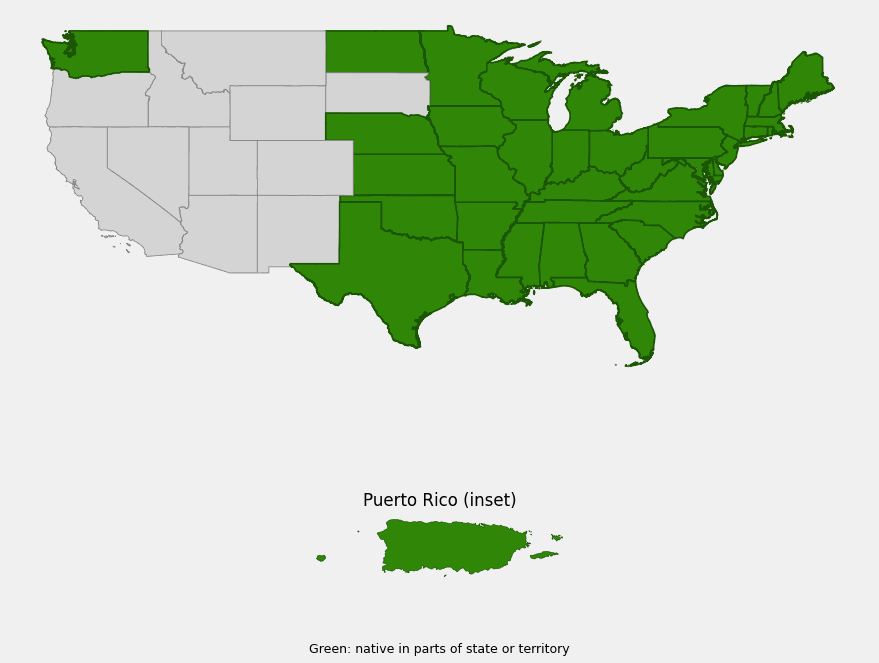
Hooked buttercup is widespread in eastern North America. USDA PLANTS records it as native in 37 states and Puerto Rico, from Maine, Vermont and New Hampshire south to Florida and west across the Great Lakes and Ohio Valley to Minnesota, the eastern Dakotas, Nebraska, Kansas, Oklahoma and eastern Texas. In Canada it is native in Ontario, Quebec and the Atlantic provinces.
It is most common in the Appalachians, the Piedmont, the Ohio and Mississippi valleys and the Great Lakes region, where it grows in moist, rich deciduous woods, floodplain forests, wooded ravines, seepy slopes and the edges of swamps and streams. It tolerates periodically wet soil and is often found on low, shaded ground along creeks.
USDA also lists an outlying record from Washington State, far from the main eastern range, and a record from Puerto Rico. At the edges of its range, such as on the Great Plains and in Florida, it is uncommon and confined to moist wooded valleys and stream bottoms.
📋 Regional plant lists featuring Hooked Buttercup: North & South Florida · Alabama, Georgia & Mississippi · North & South Carolina · Maryland, Virginia & West Virginia · Kentucky & Tennessee · Arkansas, Louisiana, Eastern Oklahoma & Eastern Texas · Illinois, Iowa & Missouri · Ohio & Indiana · Nebraska, Kansas & Eastern Colorado · North Dakota, South Dakota & Western Minnesota · Michigan, Wisconsin & Eastern Minnesota · New York, Pennsylvania & Northern New Jersey · Delaware, Southern New Jersey & Long Island · Connecticut, Massachusetts & Rhode Island · New Hampshire, Maine & Vermont · Puerto Rico
Growing & Care Guide
Hooked buttercup is rarely sold, but it can fit into a naturalistic shade or woodland garden with moist, rich soil, where it adds texture and a modest spring bloom. It often arrives on its own in shady, moist yards near woods. Grow it from seed rather than digging plants from the wild.
Light
It prefers part shade to full shade, such as under deciduous trees, which give it some spring sun before the canopy closes. It does not do well in hot, dry, sunny spots.
Soil & Water
Give it moist, humus-rich soil. It tolerates heavy, periodically wet soils along streams and in low spots, and does best where the soil stays damp through spring and early summer. A layer of leaf litter or shredded leaves helps keep the soil cool and moist.
Planting Tips
Sow seed outdoors in fall or early winter, or set out small plants in spring about 8 to 12 inches apart. Plant it with other woodland wildflowers and ferns, where its leaves can fill in between them.
Pruning & Maintenance
No pruning is needed. Let it set seed if you want it to persist, since individual plants may be short-lived. Wear gloves when handling it, because the sap can irritate skin.
Propagation
Grow it from seed. Collect the ripe seed heads in early summer and sow the seed fresh outdoors, where winter cold will help it germinate the next spring. Established clumps can also be divided carefully in early spring.
Landscape Uses
- Woodland and shade gardens: adds lobed foliage and small spring flowers among taller wildflowers
- Rain gardens and stream edges: tolerates moist to periodically wet, shaded soil
- Floodplain and woodland restoration: a typical herb of rich, moist eastern woods
- Naturalistic plantings: fills gaps between ferns and spring ephemerals
Wildlife & Ecological Value
Hooked buttercup is a small, easily overlooked plant, but it is one of many spring woodland herbs that feed early insects and help make up the forest floor community.
For Pollinators
The small, open flowers offer pollen and a little nectar to small bees, such as sweat bees, and to flies and small beetles, which are active on the forest floor in spring.
For Birds
Birds make little use of the seeds, although some ground-feeding birds may eat them.
For Mammals
The acrid, toxic foliage is avoided by deer, rabbits and livestock. The hooked seeds can catch on fur and clothing, which may help carry them to new spots.
Ecosystem Role
As a common herb of moist, rich woods and floodplains, hooked buttercup helps cover and hold the soil on the forest floor and contributes to the spring flora of eastern hardwood forests.
Cultural & Historical Uses
The French botanist Jean Louis Marie Poiret described Ranunculus recurvatus from North American material. The genus name Ranunculus means “little frog” in Latin, because many buttercups grow in damp places where frogs live. The species name recurvatus means “curved backward,” which suits both its bent-back sepals and the hooked beaks of its seeds.
The name blisterwort, used by USDA, reflects the acrid sap of buttercups, which can raise blisters on the skin. Many buttercups were once used in folk medicine as skin irritants (counterirritants), a practice that often caused more harm than good.
Safety note: All parts of hooked buttercup contain ranunculin, which breaks down into the irritant protoanemonin when the plant is crushed. Handling the plant can cause skin redness, burning and blisters, and eating it can cause burning of the mouth, stomach pain and vomiting. Do not eat any part of it, wear gloves when handling it, and keep children and pets away from it.
Frequently Asked Questions
Why is it called hooked buttercup?
Each of its seeds ends in a strongly hooked beak, so the round seed heads look like tiny burs. The species name recurvatus, meaning “curved backward,” also fits its bent-back sepals.
Is hooked buttercup poisonous?
Yes. Like other buttercups, it contains compounds that release the irritant protoanemonin. It can blister the skin and cause burning of the mouth and stomach upset if eaten. Wear gloves when handling it.
How is hooked buttercup different from kidneyleaf buttercup?
Hooked buttercup has broad, hairy, three-lobed leaves and seeds with long, hooked beaks. Kidneyleaf buttercup has smooth, kidney-shaped basal leaves and seeds with only tiny beaks.
Where does hooked buttercup grow?
It grows in moist, rich, shady woods, floodplain forests, ravines and along streams across most of the eastern United States and eastern Canada.
Can I grow hooked buttercup in my garden?
Yes, in a moist, shady woodland garden. It is rarely sold, so grow it from seed collected responsibly or let it establish naturally. It is modest in bloom but adds texture to shady spots.

Looking for a nursery that carries Hooked Buttercup?
Browse our native plant nursery directory: Alabama & Arkansas · Connecticut, Delaware, Florida & Georgia · Illinois, Indiana, Iowa & Kansas · Kentucky, Louisiana, Maine, Maryland, Massachusetts, Michigan, Minnesota, Mississippi & Missouri · Nebraska, New Hampshire, New Jersey, New York, North Carolina, North Dakota, Ohio & Oklahoma · Pennsylvania, Rhode Island, South Carolina, Tennessee, Texas, Vermont & Virginia · Washington · West Virginia & Wisconsin