
Snow-on-the-Mountain (Euphorbia marginata)
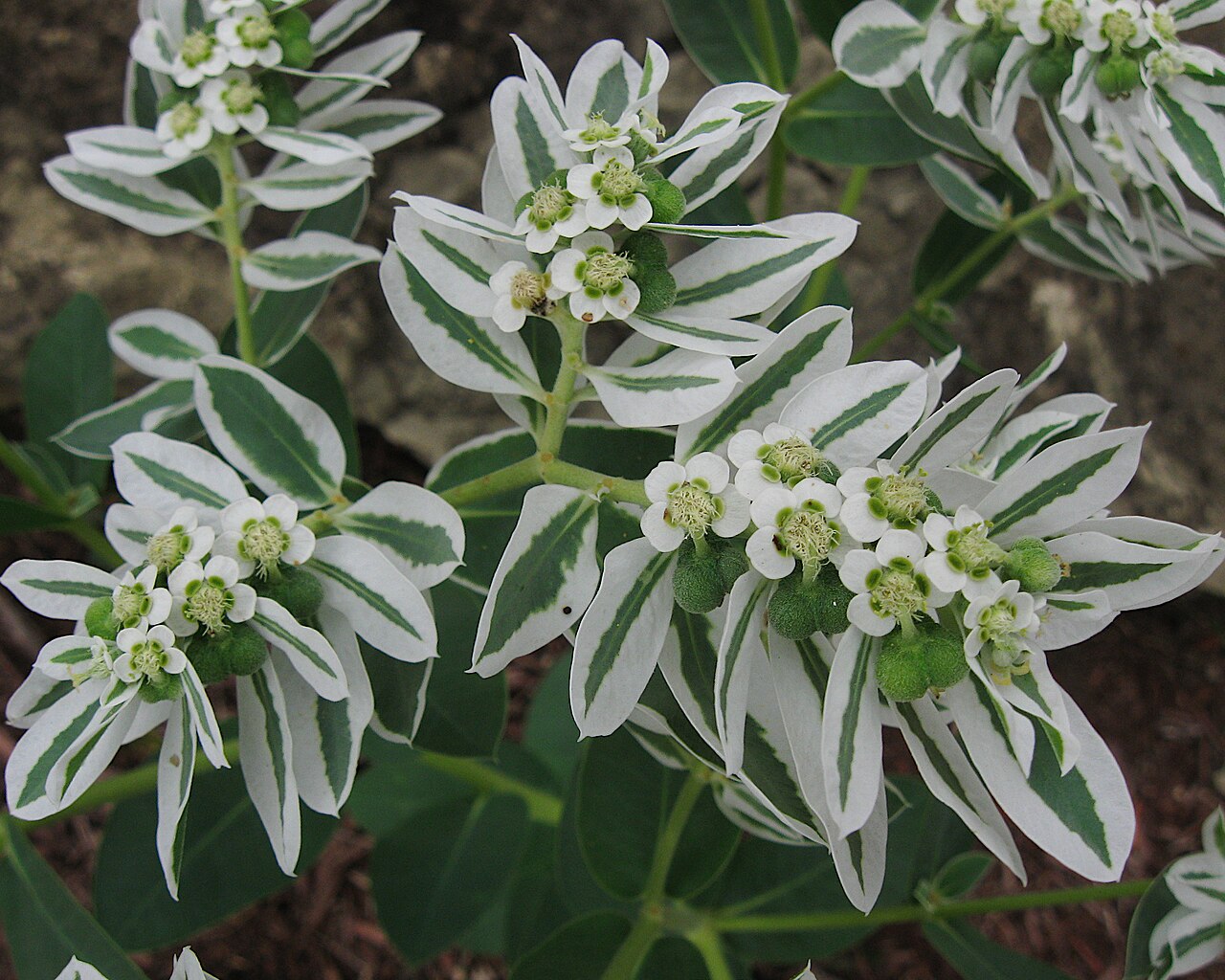
Euphorbia marginata, known as Snow-on-the-Mountain (USDA: snow on the mountain), is an annual wildflower of the Great Plains and is also called smoke-on-the-prairie, ghostweed and whitemargined spurge. It belongs to the spurge family (Euphorbiaceae). In late summer its upper leaves and bracts develop broad white margins, so the tops of the plants look as if they had been dusted with snow. On the open prairie, scattered plants stand out like white sparks among the grasses.
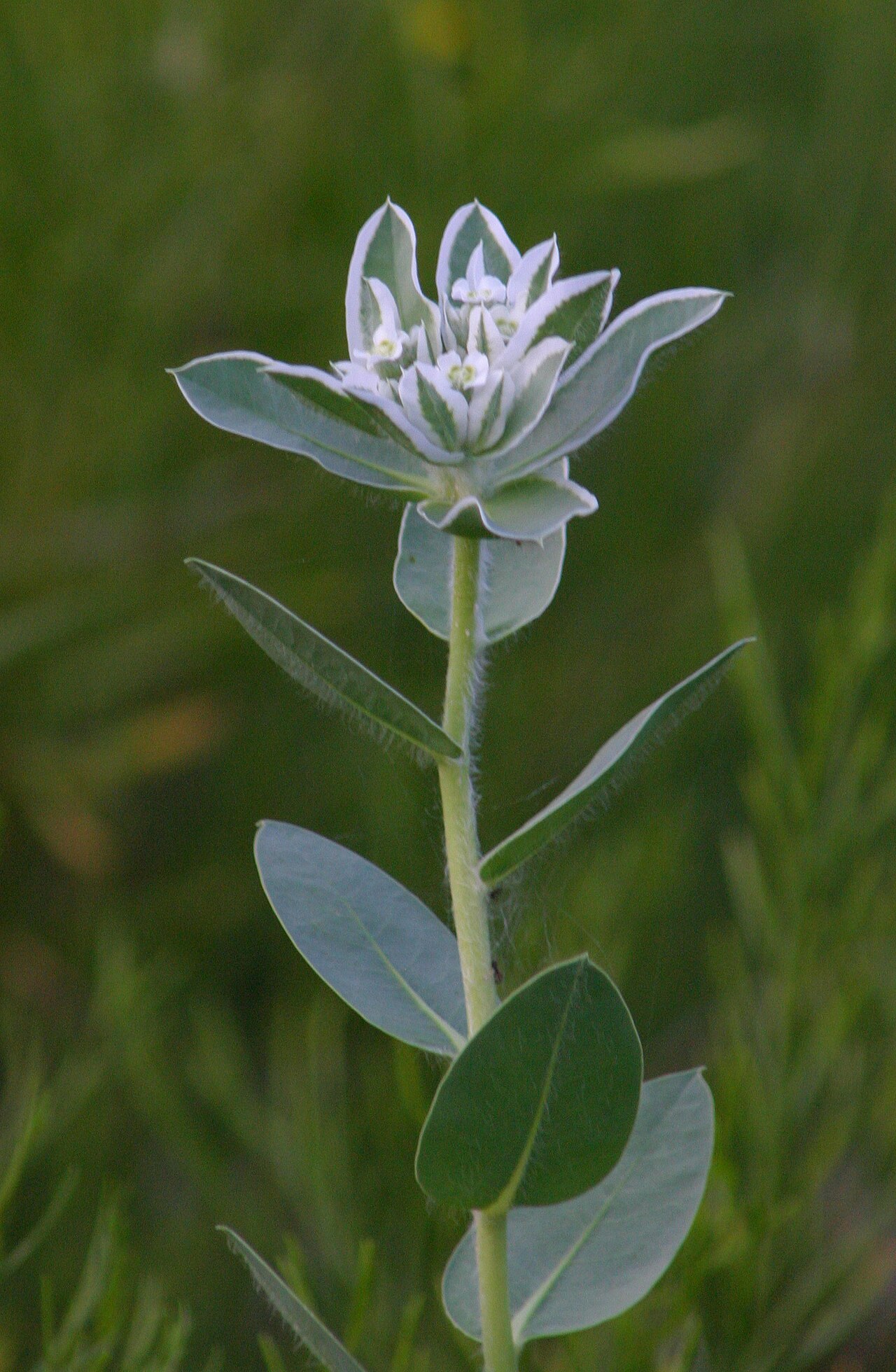
It grows 1 to 3 feet tall, with gray-green, oval leaves clasping the stem and a branched, umbrella-like top of white-edged bracts and tiny white flowers. Flowering runs from about July into October, when few other plants on the dry plains are blooming, and the flowers are an important late-season nectar source for bees and butterflies. It thrives on disturbed prairie, roadsides, overgrazed pastures and dry slopes.
Gardeners have grown snow-on-the-mountain since the 1800s for its striking variegated foliage, and it has escaped from gardens far beyond its native range. Like other spurges, it is toxic. Its milky sap can irritate skin and eyes, and all parts can cause severe irritation if eaten. It is easy to grow from seed in sunny, dry spots, but plant it where children and pets will not handle or chew it.
Identification
In bloom, snow-on-the-mountain is hard to mistake: no other common plains wildflower has such wide, clean white leaf margins. Before it blooms, look for the stiff, upright stems with clasping, gray-green oval leaves. Break a leaf and white, milky sap appears.
Stems & Growth Habit
Each plant is an annual with a single upright stem 1 to 3 feet tall from a taproot. The stem is smooth or slightly hairy and branches near the top into three or more forks, forming a flat or rounded, umbrella-like head. Like all spurges, every part contains a white, milky latex.
Leaves
The lower leaves are alternate, oval to oblong, 1 to 3 inches long, stalkless and pale gray-green. Toward the top of the plant the leaves become whorled and are joined by leafy bracts. These upper leaves and bracts develop broad white margins, and some are almost entirely white. The variegation is strongest in full sun and late summer.
Flowers
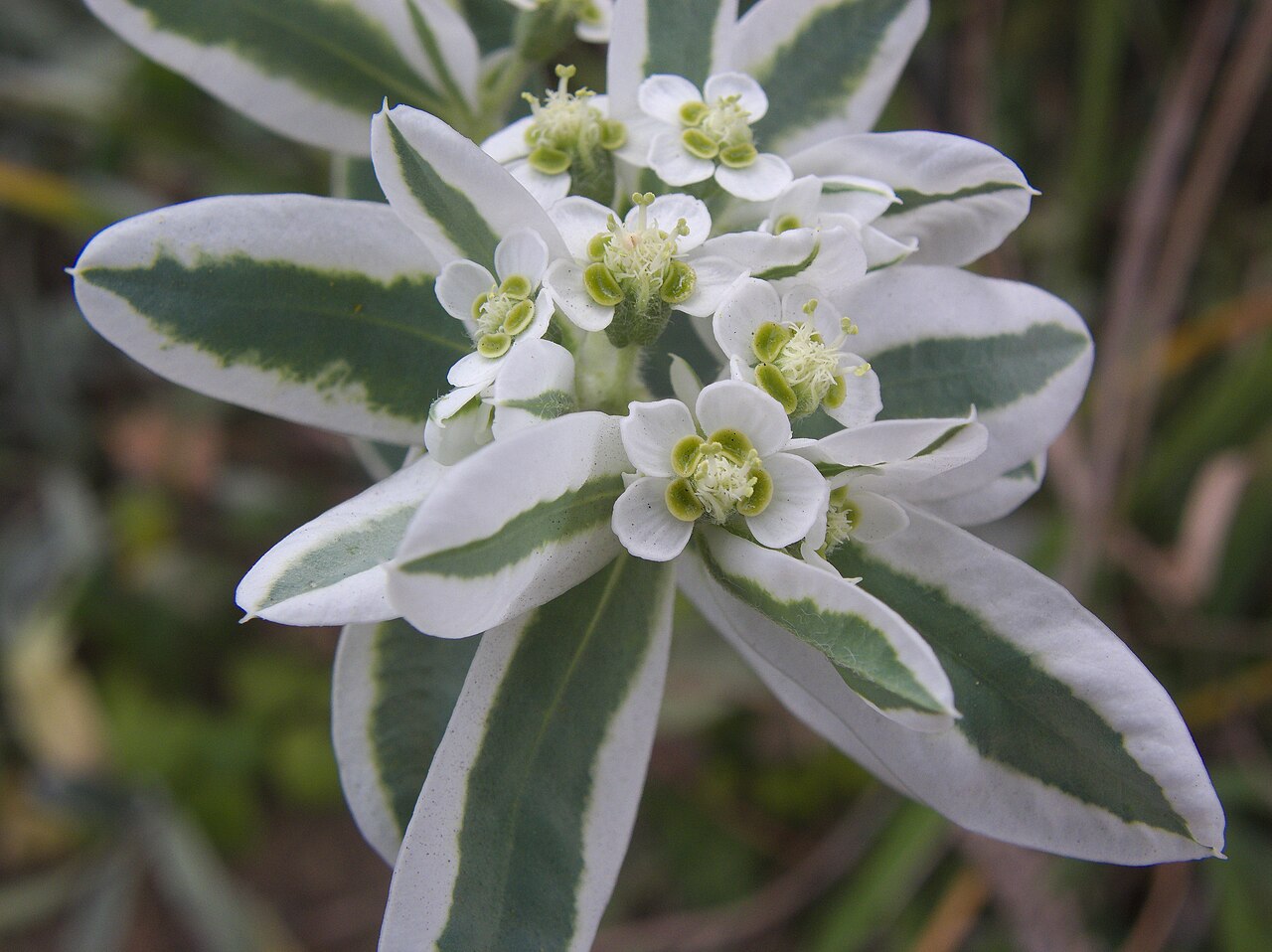
What looks like a small white flower is actually a cyathium, the special flower structure of spurges. It is a tiny cup holding many very small male flowers and one female flower, with nectar glands around the rim bearing white, petal-like appendages. The cyathia are clustered at the forks of the branches among the white bracts. Bloom time is about July to October.
Fruit & Seeds
The female flower develops into a three-lobed, hairy capsule about 1/4 inch wide on a stalk that hangs out of the cup. When ripe, the capsule splits explosively and throws its three round, gray-brown seeds a short distance. Mourning doves and other birds eat the seeds.
Look-alikes
Snow-on-the-prairie (Euphorbia bicolor) of Texas, Oklahoma, Arkansas and Louisiana is very similar but has narrower, hairier, lance-shaped leaves and blooms a little later. Flowering spurge (Euphorbia corollata) has white, petal-like cyathium appendages but plain green leaves without white margins.
Safety: Toxic Sap
Snow-on-the-mountain is poisonous. Its milky sap contains irritant compounds that can cause redness, blistering and rash on sensitive skin, and severe pain and inflammation if it gets into the eyes. Eating any part of the plant can cause burning and blistering of the mouth and throat, vomiting and diarrhea in people, pets and livestock. Wear gloves and eye protection when cutting or pulling plants, wash skin promptly if sap gets on it, and keep plants away from children and pets. If someone swallows part of the plant or gets sap in the eyes, contact Poison Control (1-800-222-1222 in the U.S.) or a veterinarian.
Quick Facts
| Scientific Name | Euphorbia marginata |
| Family | Euphorbiaceae (spurge family) |
| Plant Type | Annual wildflower |
| Mature Height | 1–3 ft |
| Mature Spread | 1–2 ft |
| Growth Rate | Fast |
| Sun Exposure | Full sun to part shade |
| Water Needs | Low to medium; drought tolerant |
| Soil Type | Clay, loam, sandy or rocky; tolerates poor soil |
| Soil pH | Neutral to alkaline |
| Bloom Time | July–October |
| Flower Color | White (white-margined bracts and petal-like appendages) |
| Fall Color | Bracts stay white into fall; plants die after frost |
| Fruit | Three-lobed hairy capsule with three seeds |
| Deer Resistant | Yes; toxic milky sap |
| USDA Hardiness Zones | Annual; grows in zones 3–10 |
Native Range
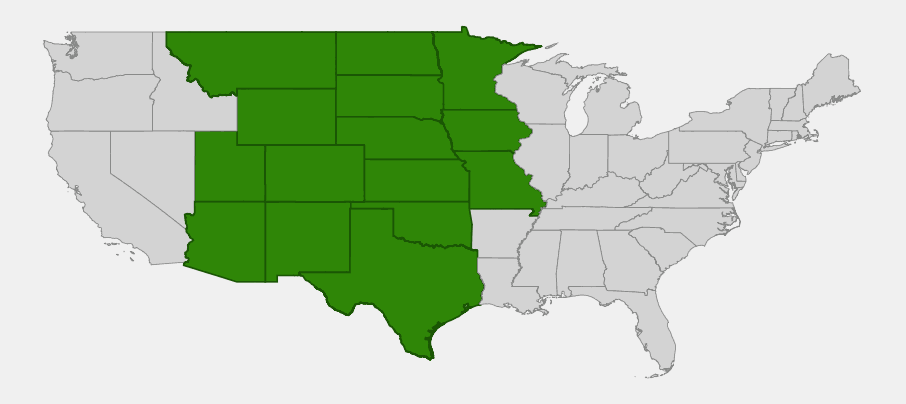
Snow-on-the-mountain is native to the Great Plains and adjacent parts of the Southwest. The Lady Bird Johnson Wildflower Center describes its native distribution as Montana to New Mexico, east to southern Minnesota, western Iowa, western Missouri and Texas, and naturalized in waste areas east to the Atlantic. USDA PLANTS lists it as native in the lower 48 states. In the United States it is native in Montana, Wyoming, North and South Dakota, Nebraska, Kansas, Colorado, New Mexico, Oklahoma, Texas, Minnesota, Iowa and Missouri, with outlying records in Arizona and Utah. Its range continues south into northern Mexico.
USDA PLANTS records it in 43 states, but most of the eastern records, and those from California, are escapes from gardens. The Lady Bird Johnson Wildflower Center treats it as naturalized east of the plains, Go Botany lists it as introduced in New England, and iNaturalist treats it as introduced in California. The range map shows only the native range. In Canada it is an introduced plant.
In its native range it grows on dry prairie, especially where the soil has been disturbed, along with overgrazed pastures, roadsides, railroad rights-of-way, dry slopes, stream terraces and old fields. It is often abundant in heavily grazed pastures because cattle avoid it. The type specimen was collected by William Clark in 1806 along the Yellowstone River in present-day Montana during the Lewis and Clark Expedition.
📋 Regional plant lists featuring Snow-on-the-Mountain: Idaho, Eastern Oregon & Eastern Washington · Montana & Wyoming · Nebraska, Kansas & Eastern Colorado · North Dakota, South Dakota & Western Minnesota · Illinois, Iowa & Missouri · Michigan, Wisconsin & Eastern Minnesota · Utah & Western Colorado · Arizona & New Mexico · Arkansas, Louisiana, Eastern Oklahoma & Eastern Texas · South & West Texas
Growing & Care Guide
Snow-on-the-mountain is one of the easiest native annuals to grow from seed. Seed is widely sold, and once you have it, it will usually reseed itself. Grow it in sun and lean soil for the best white variegation. Because of its irritating sap, wear gloves when handling it and place it away from play areas.
Light
Full sun gives the best color and sturdiest plants. It tolerates part shade, but the white margins are less pronounced and plants may lean.
Soil & Water
It grows in almost any well-drained soil, including clay, loam, sand and rocky soil, and prefers neutral to alkaline conditions. Rich soil and heavy watering produce tall, floppy plants. Once seedlings are growing, it needs little or no supplemental water except in long droughts.
Planting Tips
Sow seed outdoors in fall or early spring where you want the plants to grow, covering it lightly. It does not transplant well because of its taproot. Thin seedlings to about 12 inches apart. It looks best in drifts or in the middle of a border, where its white tops light up late-summer plantings of grasses and purple or blue flowers.
Pruning & Maintenance
No pruning is needed. Stake or pinch tall plants in rich soil if they flop. To limit reseeding, cut plants before the capsules ripen, wearing gloves and eye protection. If you use stems as cut flowers, dip or sear the cut ends to stop the sap from flowing, and keep the sap away from your eyes.
Propagation
Grow it from seed. Fall sowing outdoors works well; seed sown in spring germinates as the soil warms. Plants self-sow readily in open, disturbed soil. Remove unwanted seedlings while they are small.
Landscape Uses
- Prairie and meadow plantings: bright white accents in late summer
- Cottage and cutting gardens: long-lasting white foliage for borders and bouquets
- Pollinator gardens: late-season nectar for bees and butterflies
- Dry, lean sites: roadsides, slopes and poor soils where little else thrives
- Deer-resistant beds: browsers avoid its toxic sap
Wildlife & Ecological Value
Snow-on-the-mountain blooms late, when the plains are dry and many flowers have finished, so it is valuable for insects even though large animals avoid it.
For Pollinators
The nectar glands of the cyathia are easy to reach and attract many small bees, wasps, flies and butterflies. The Lady Bird Johnson Wildflower Center calls it an important late-summer nectar source for bees and butterflies.
For Birds
Mourning doves eat the seeds without apparent harm, and other seed-eating birds such as quail and sparrows may also take them. Insects visiting the flowers provide food for insect-eating birds.
For Mammals
Deer, rabbits and livestock generally avoid the plant because of its irritating latex, and it has little forage value. Its abundance in pastures is often a sign of heavy grazing, since cattle eat the grasses around it.
Ecosystem Role
As an annual that colonizes bare and disturbed ground, snow-on-the-mountain helps cover and stabilize soil after drought, fire, flooding or grazing, and provides late-season flowers for pollinators. It is part of the natural mosaic of plants that move in after disturbance in prairie ecosystems.
Cultural & Historical Uses
Snow-on-the-mountain entered science through the Lewis and Clark Expedition. William Clark collected it in July 1806 along the Yellowstone River in what is now Rosebud County, Montana, and the botanist Frederick Pursh named it Euphorbia marginata in 1814 for the white margins of its leaves.
By the mid-1800s it had become a popular annual in American and European gardens, grown for its cool, variegated foliage. It is still sold as a garden annual, sometimes as named seed strains, and is grown for the cut-flower trade. Garden escapes explain why it now turns up along roadsides far east of the plains and in parts of Europe and Asia.
Its names reflect its appearance on the prairie: snow-on-the-mountain, smoke-on-the-prairie and ghostweed all describe the pale glow of its white bracts among the grasses in late summer. Like many spurges, it has a long history of being treated with caution by ranchers, who knew it as a plant cattle would not eat.
Frequently Asked Questions
Is snow-on-the-mountain poisonous?
Yes. Its milky sap can irritate skin and seriously irritate eyes, and eating any part can cause burning of the mouth and throat, vomiting and diarrhea. Wear gloves when handling it and keep it away from children and pets.
Is snow-on-the-mountain native?
Yes, it is native to the Great Plains, from Montana and the Dakotas south to New Mexico and Texas and east to Minnesota, Iowa and Missouri. In the eastern United States and California it is a garden escape.
Does snow-on-the-mountain come back every year?
It is an annual, so each plant lives only one season. It usually returns from self-sown seed, often in large numbers in open soil.
What is the difference between snow-on-the-mountain and snow-on-the-prairie?
Snow-on-the-prairie (Euphorbia bicolor) grows mainly in Texas and neighboring states and has narrower, lance-shaped, hairier leaves. Snow-on-the-mountain has broader, oval leaves and a more northern and western range.
Can I use snow-on-the-mountain as a cut flower?
Yes, it lasts well in arrangements. Wear gloves, and sear the cut stems with a flame or dip them in boiling water to stop the milky sap from bleeding into the vase water. Keep the sap away from your eyes.

Looking for a nursery that carries Snow-on-the-Mountain?
Browse our native plant nursery directory: Arizona · Colorado · Iowa & Kansas · Minnesota, Missouri & Montana · Nebraska, New Mexico, North Dakota & Oklahoma · South Dakota, Texas & Utah · Wyoming