
Watershield (Brasenia schreberi)
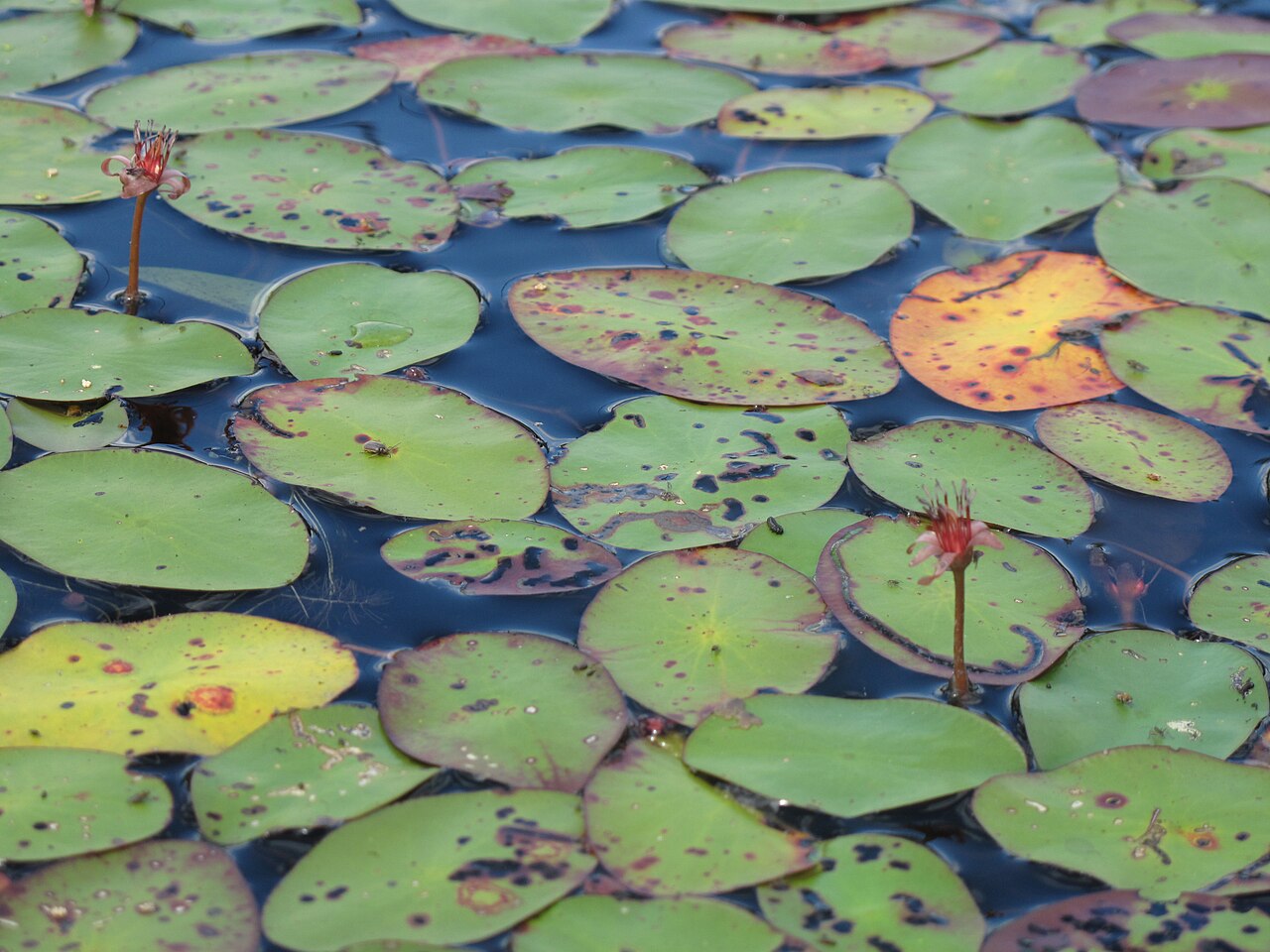
Brasenia schreberi, known as Watershield or water-shield, is a native perennial aquatic plant related to the water lilies. It belongs to the small fanwort family (Cabombaceae). Its oval, shield-like leaves, about 2 to 5 inches long, float flat on the surface of quiet ponds and lakes, attached to long stalks at their centers. Every underwater part of the plant, from the stems to the undersides of the leaves, is coated in a thick, clear jelly that makes it slippery to the touch.
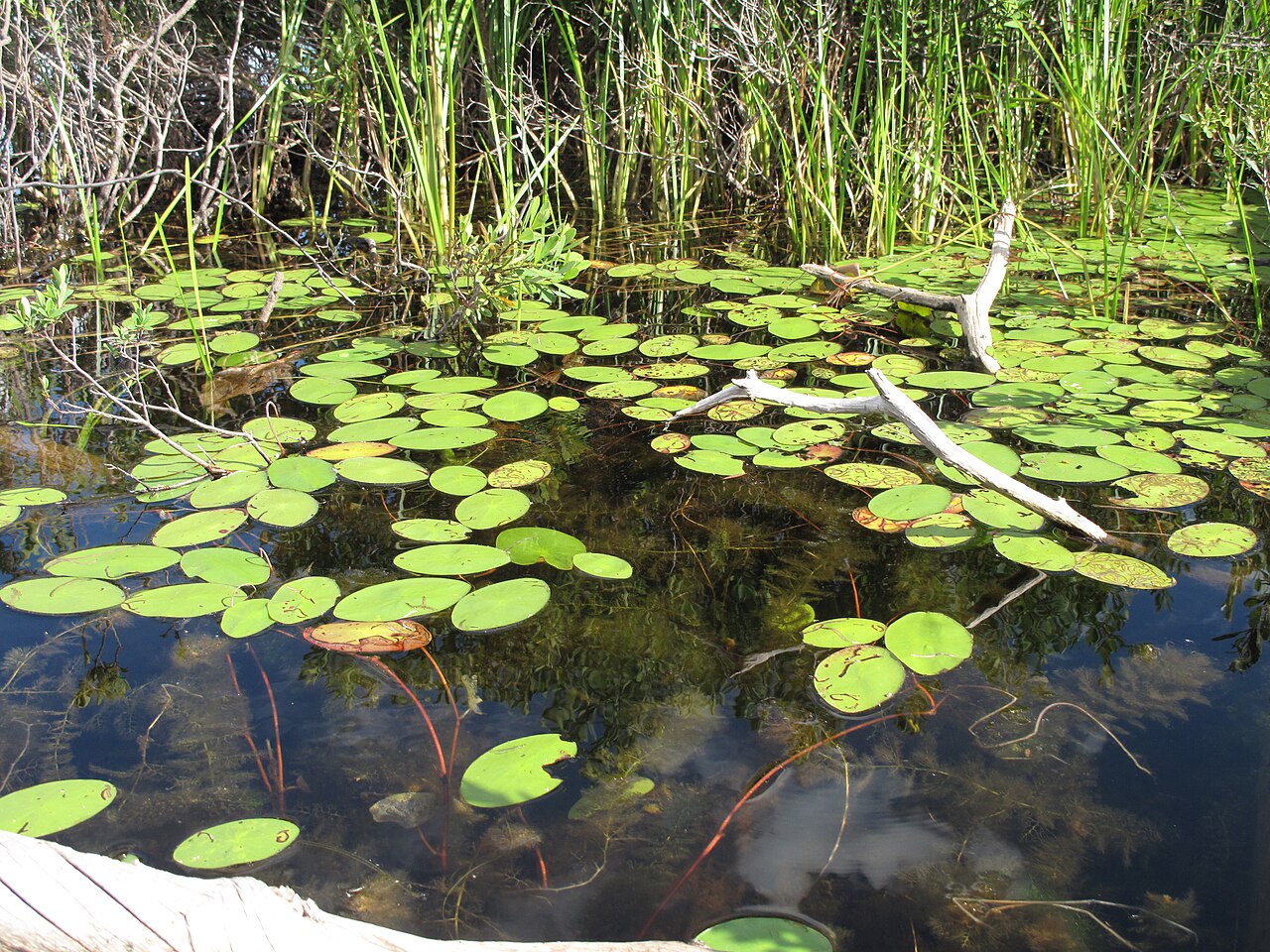
Watershield grows in still or slow-moving fresh water, usually 1 to 6 feet deep and often soft and slightly acidic: ponds, lakes, bog pools, beaver ponds and sluggish streams. It is found across most of the United States, from Alaska and the Pacific Northwest to New England and Florida, and it also grows in Canada, Central and South America, Africa, Asia and Australia, making it one of the most widespread aquatic plants in the world.
In summer, small, dull red-purple flowers rise just above the water. They are wind-pollinated, an unusual trait among water lily relatives. Watershield provides food and shelter for ducks, fish and aquatic insects, and in parts of Asia its jelly-covered young leaves are a prized food. This guide covers how to identify it, where it grows and how to manage it in a pond.
Identification
Watershield is easy to identify by its floating oval leaves with the stalk attached at the center, and above all by the jelly that coats its submerged parts. No other native floating-leaved plant is so slimy.
Rhizomes & Stems
The plant grows from creeping rhizomes buried in the mud. Long, slender, branching stems rise from them to the surface, often reddish and thickly coated with a clear, gelatinous mucilage. The stems can reach several feet in length, depending on water depth.
Leaves
The leaves are floating, alternate, oval to elliptic and 2 to 5 inches long, with smooth edges. They are peltate: the leaf stalk attaches to the center of the underside, so the leaf has no notch. This separates watershield from water lilies and spatterdock, whose leaves have a deep notch at the base. The upper surface is green and somewhat waxy, and the underside is usually purple to red. Young leaves and leaf stalks are wrapped in the same jelly as the stems.
Flowers
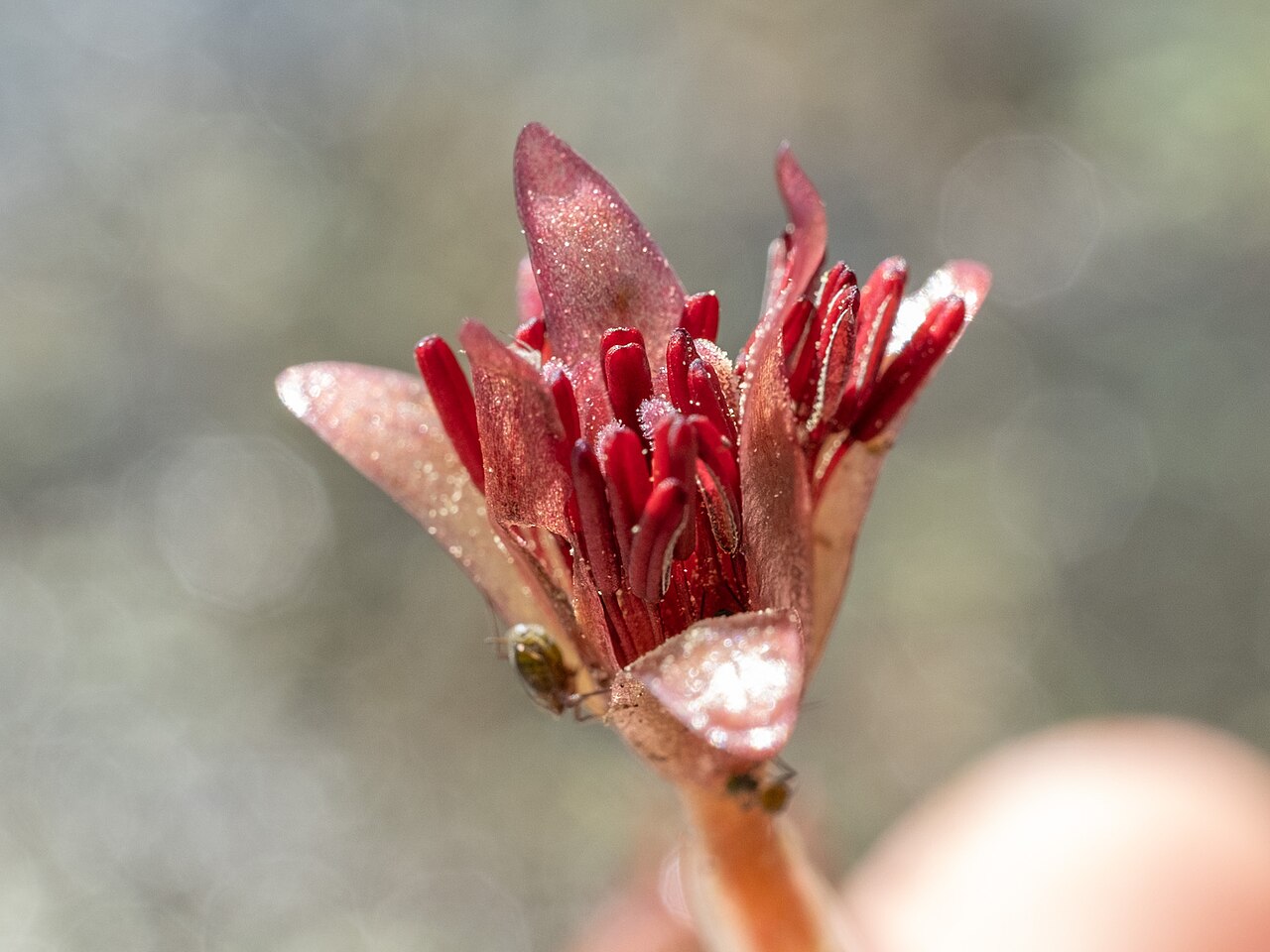
The flowers appear from late spring through summer, singly on short stalks that hold them just above the water. Each is about ¾ to 1 inch across, with three sepals and three narrow petals, all dull red to purple. Flowers usually open on two days. On the first day the female parts are receptive and the flower sits at the surface; on the second the flower rises a little higher and many long, dangling stamens shed pollen into the wind. Then the flower is pulled back under the water.
Fruit & Seeds
The fruits are small, leathery, club-shaped pods that ripen underwater, each holding one or two seeds. The plant also spreads by rhizomes and by fragments that break off and root elsewhere.
Quick Facts
| Scientific Name | Brasenia schreberi (syn. Brasenia peltata) |
| Family | Cabombaceae (fanwort family; water lily relatives) |
| Plant Type | Perennial aquatic plant with floating leaves |
| Mature Height | Leaves float at the surface; flowers rise 1–2 in above the water |
| Mature Spread | Spreads by rhizomes into colonies several feet to many yards across |
| Growth Rate | Moderate to fast |
| Sun Exposure | Full sun to light shade |
| Water Needs | Aquatic; still fresh water about 1–6 ft deep |
| Soil Type | Soft, organic muck or peat on pond and lake bottoms |
| Soil pH | Acidic to near neutral water, about 5.0–7.0 |
| Bloom Time | June–September |
| Flower Color | Dull red to purple |
| Fall Color | Leaves may turn yellow or orange before dying back |
| Fruit | Small leathery pods ripening underwater |
| Deer Resistant | Not a concern; it grows in open water |
| USDA Hardiness Zones | 3–10 |
Native Range
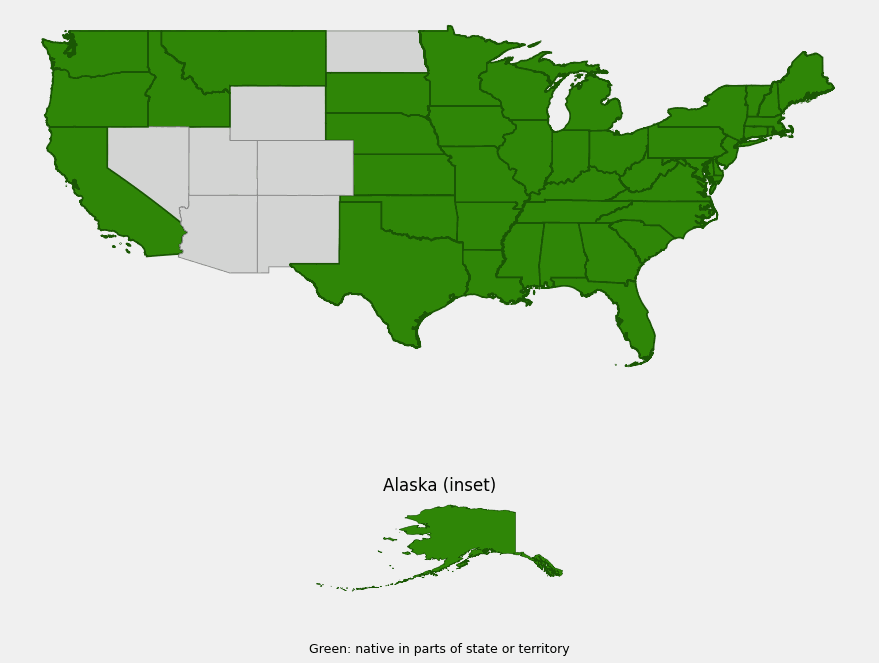
USDA PLANTS records watershield as native in 42 states and the District of Columbia, including Alaska. It grows throughout the East from Maine and the Great Lakes to Florida and Texas, across the Midwest to Minnesota, the eastern Dakotas, Nebraska and Kansas, and in the West in California, Oregon, Washington, Idaho and Montana. In Canada it ranges from British Columbia and Alberta east to Newfoundland.
It is absent or very rare in the dry interior West, including Nevada, Utah, Arizona, New Mexico, Colorado and Wyoming, where suitable soft-water ponds are scarce. It is most abundant in the lake country of the upper Midwest and New England and in the ponds and blackwater lakes of the Atlantic and Gulf Coastal Plain.
Worldwide, watershield grows in temperate and tropical parts of the Americas, Africa, Asia and Australia. It is extinct in Europe, where fossils show it once grew. Because its seeds and plant fragments can be carried by waterfowl, it tends to appear in scattered ponds across a landscape.
📋 Regional plant lists featuring Watershield: New York, Pennsylvania & Northern New Jersey · Idaho, Eastern Oregon & Eastern Washington · Ohio & Indiana · Montana & Wyoming · Michigan, Wisconsin & Eastern Minnesota · Kentucky & Tennessee · Nebraska, Kansas & Eastern Colorado · Connecticut, Massachusetts & Rhode Island · New Hampshire, Maine & Vermont · Maryland, Virginia & West Virginia · Delaware, Southern New Jersey & Long Island · Illinois, Iowa & Missouri · Alabama, Georgia & Mississippi · Alaska · North & South Florida · North & South Carolina · Arkansas, Louisiana, Eastern Oklahoma & Eastern Texas · North Dakota, South Dakota & Western Minnesota · Western Oregon & Western Washington · California & Nevada
Growing & Care Guide
Watershield is mainly a plant for natural or naturalized ponds, not small decorative water features. It can be planted in a larger garden pond with soft water, but in a pond it can spread over much of the surface in a few years. Buy plants from aquatic nurseries that sell native stock, and never move plants between water bodies, which can spread diseases and invasive species.
Light
Full sun to light shade on the water surface. Leaves are sparse in deep shade.
Soil & Water
It needs still or slow-moving water about 1 to 6 feet deep over soft, organic muck. It grows best in soft, slightly acidic water that is low to moderate in nutrients. Hard, alkaline or very nutrient-rich water favors other plants and algae. It tolerates gradual water-level changes but not drying out.
Planting Tips
Plant pieces of rhizome in late spring in a wide aquatic basket or pot filled with heavy garden loam or muck (not potting mix), topped with gravel, and sink it to a depth of 1 to 3 feet. In earthen ponds the rhizomes can be pressed directly into the bottom mud.
Pruning & Maintenance
Containers make it easier to keep watershield from spreading. Thin colonies by pulling up rhizomes and leaves if it covers more than about half the surface, which can reduce oxygen for fish. Check local rules before using any control method in natural water bodies.
Propagation
Divide rhizomes in spring and replant sections with a growing tip. Seed is slow and unreliable for home growers.
Landscape Uses
- Natural ponds and lakes: floating cover and shade for fish in soft-water ponds within its range
- Wildlife ponds: food and shelter for ducks, fish, frogs and aquatic insects
- Wetland restoration: a native floating-leaved plant for restored ponds and marshes
- Large water gardens: an unusual native water lily relative, best kept in containers
- Education: a good example of wind pollination and of mucilage in water plants
Wildlife & Ecological Value
Watershield is an important part of pond and lake communities, providing food, shade and shelter above and below the water.
For Pollinators
Unlike water lilies, which rely on insects, watershield is pollinated mainly by wind. Its long, dangling stamens shed pollen in the air on the second day of flowering. Some insects visit the flowers for pollen, but they are not its main pollinators.
For Birds
Ducks and other waterfowl eat the seeds and sometimes the leaves and stems. Wildlife biologists list watershield among the useful duck foods of northern and southern ponds. Herons and other wading birds hunt fish and frogs among the leaves.
For Mammals
Muskrats and beavers eat the stems and rhizomes, and moose and white-tailed deer sometimes feed on floating aquatic plants such as watershield.
Ecosystem Role
The floating leaves shade the water, keeping it cooler and limiting algae, and they give cover to fish, frogs and aquatic insects. Many invertebrates live on and under the leaves, and snails and insect larvae graze on them. The jelly may help protect the plant from grazing animals. Dense colonies, though, can lower oxygen levels in shallow, nutrient-rich ponds.
Cultural & Historical Uses
The genus name honors Christoph Brasen, an eighteenth-century Moravian missionary and physician in Labrador, and the species name honors the German naturalist Johann Christian von Schreber. Johann Friedrich Gmelin described the species in 1791. The older name Brasenia peltata refers to the peltate (shield-like) leaves, as does the common name.
In China and Japan, watershield has long been a delicacy. In Japan it is called junsai, and its tender young leaves and buds, still wrapped in their jelly, are served in clear soups and chilled dishes. In China it is used in a traditional soup associated with West Lake in Hangzhou. Commercial harvest there comes from cultivated ponds.
In North America, watershield is valued mainly for wildlife. Wildlife managers and lake associations see it as a native part of healthy soft-water lakes, even though it sometimes needs managing in small ponds.
Frequently Asked Questions
Why is watershield slimy?
All of its underwater parts, including stems, leaf stalks, buds and the undersides of the leaves, are covered with a clear, jelly-like mucilage. This coating may help protect the plant from grazing animals and from drying out if water levels drop.
Is watershield a water lily?
It is a close relative. It belongs to the fanwort family (Cabombaceae), which is closely related to the water lily family. Its leaves have no notch, unlike most water lilies, and its small flowers are wind-pollinated.
Is watershield invasive?
It is native across most of the United States and is not invasive. In small, shallow, nutrient-rich ponds it can spread over much of the surface, so containers or periodic thinning are wise in garden ponds.
Is watershield edible?
Its young shoots are eaten in Japan and China, where they are harvested from clean, cultivated ponds. Do not eat plants from wild ponds, which may contain pollutants or pathogens.
How deep should the water be?
Watershield grows best in still water about 1 to 6 feet deep. In a garden pond, set containers 1 to 3 feet below the surface.

Looking for a nursery that carries Watershield?
Browse our native plant nursery directory: Alabama, Alaska & Arkansas · California · Connecticut, Delaware, Florida & Georgia · Idaho, Illinois, Indiana, Iowa & Kansas · Kentucky, Louisiana, Maine, Maryland, Massachusetts, Michigan, Minnesota, Mississippi, Missouri & Montana · Nebraska, New Hampshire, New Jersey, New York, North Carolina, Ohio & Oklahoma · Oregon · Pennsylvania, Rhode Island, South Carolina, South Dakota, Tennessee, Texas, Vermont & Virginia · Washington · West Virginia & Wisconsin