
Calico Aster (Symphyotrichum lateriflorum)
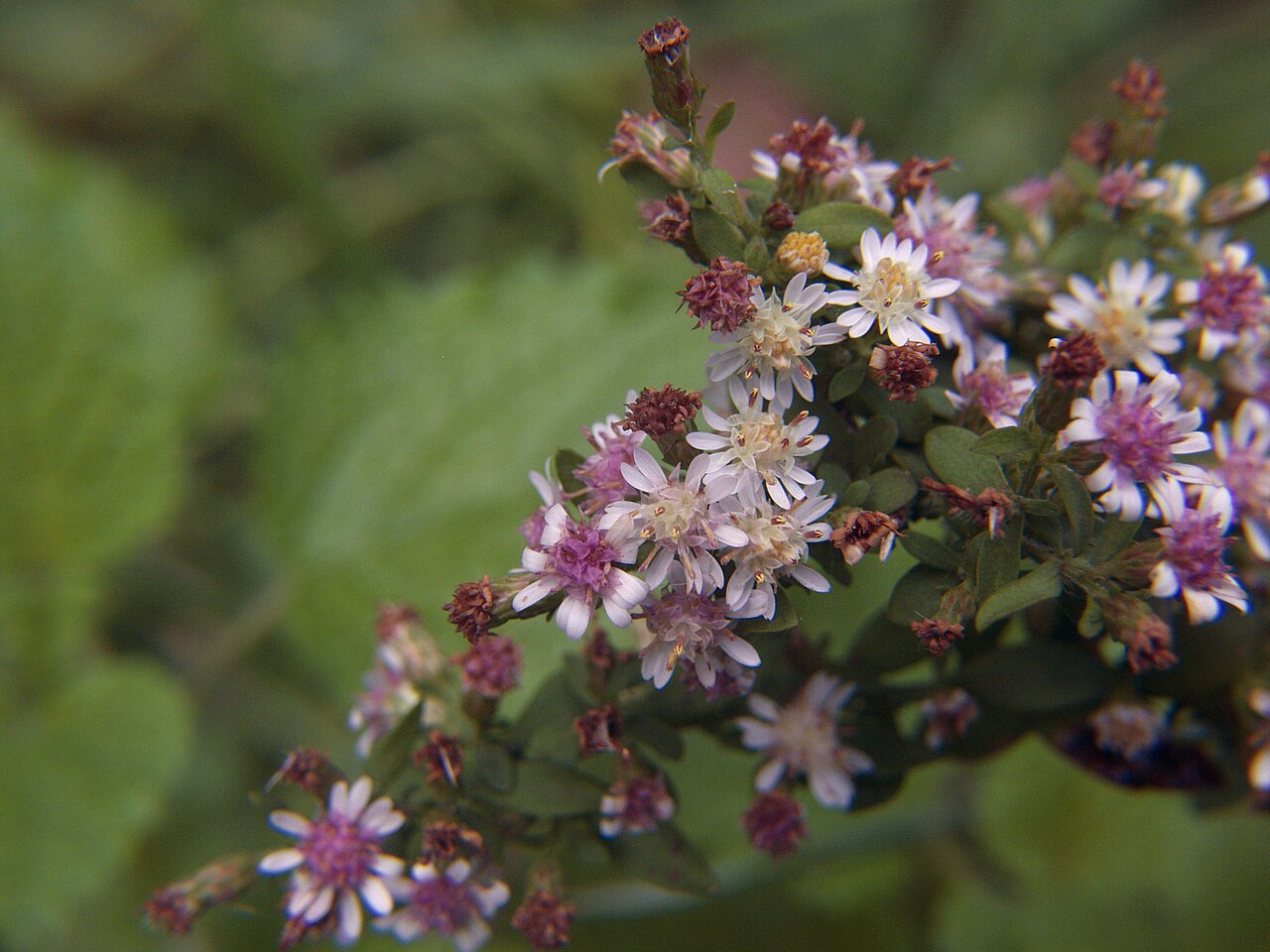
Symphyotrichum lateriflorum, known as Calico Aster or starved aster, and long published as Aster lateriflorus, is one of the most common and widespread asters of eastern North America. In late summer and fall it forms a bushy, many-branched plant 1 to 3 feet tall, covered with hundreds of small daisy-like flower heads only about half an inch across. Each has white or pale lilac rays around a central disk that begins pale yellow and turns purple-red as it ages, so a single plant shows a mix of yellow and red centers: the “calico” of its name.
Calico aster belongs to the aster family (Asteraceae). It grows almost anywhere with some moisture and light: woodland edges and openings, thickets, old fields, stream banks, the borders of swamps and marshes, and roadsides. It tolerates more shade than most asters, and its fine texture and long bloom make it a useful plant for informal and woodland-edge gardens.
Like other fall asters, calico aster is an important late-season food source for bees, flies and butterflies, and its seeds feed birds into winter. This guide covers how to recognize it, where it grows, how to grow it and how it supports wildlife.
Identification
Many white-flowered asters bloom in fall, and several are hard to tell apart. Calico aster is recognized by its small flower heads held along one side of spreading branches, the color change of its disk florets, and the hairy midrib on the underside of the leaves.
Stems & Growth Habit
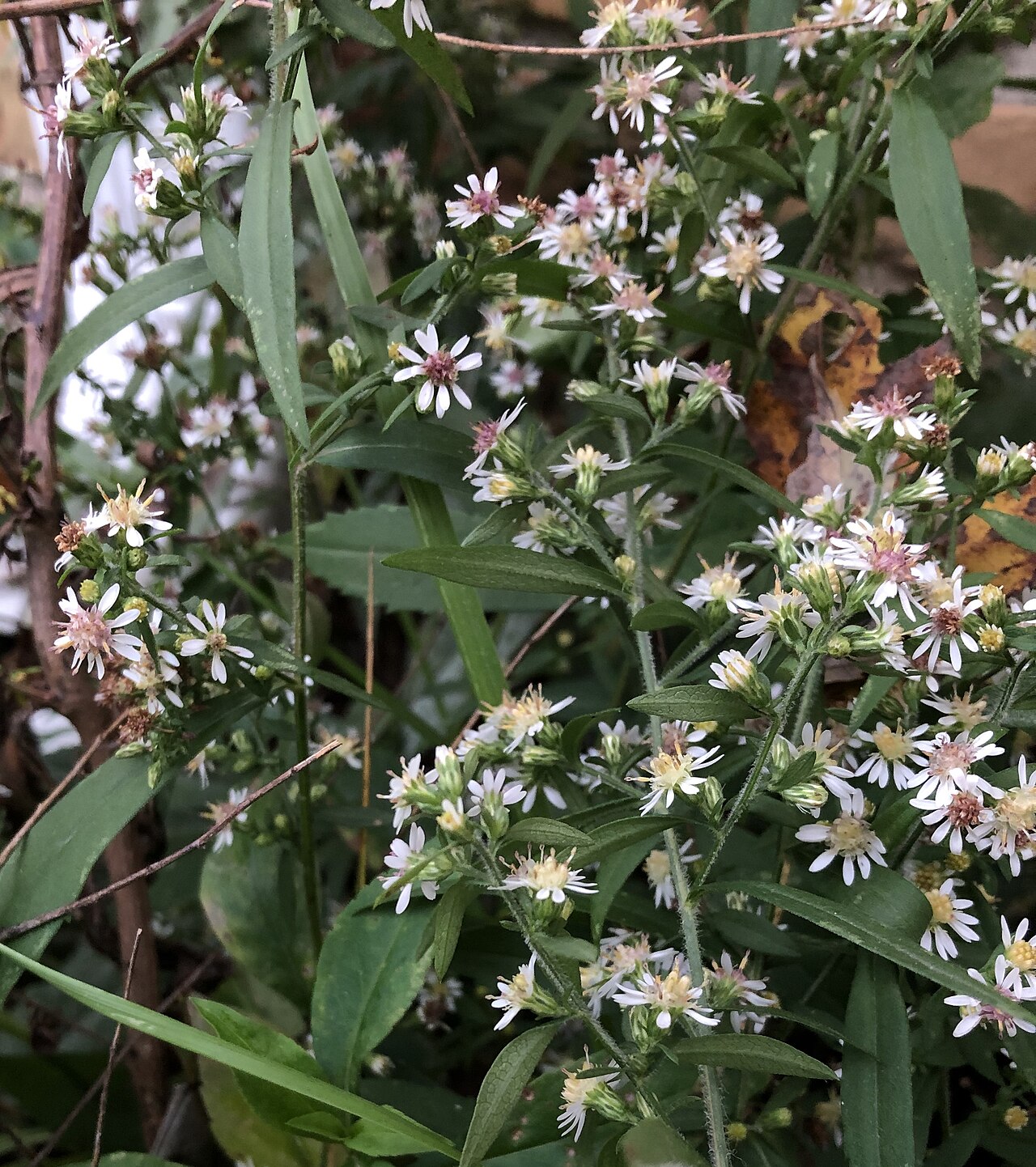
Calico aster usually grows 1 to 3 feet tall, occasionally to about 4 feet, from a short rhizome. The stems are slender, often purplish, and branch freely. The side branches often spread almost horizontally, which gives the plant an open, airy or bushy shape. Some forms are low and spreading, others more upright. Stems are smooth to finely hairy, often in lines.
Leaves
The stem leaves are narrow, lance-shaped to linear, about 2 to 6 inches long, with smooth or slightly toothed edges and no stalk. A good field mark is the underside of the leaf, where the midrib is usually lined with fine hairs. The leaves on the branches are much smaller. The lower leaves often wither and fall by flowering time.
Flowers
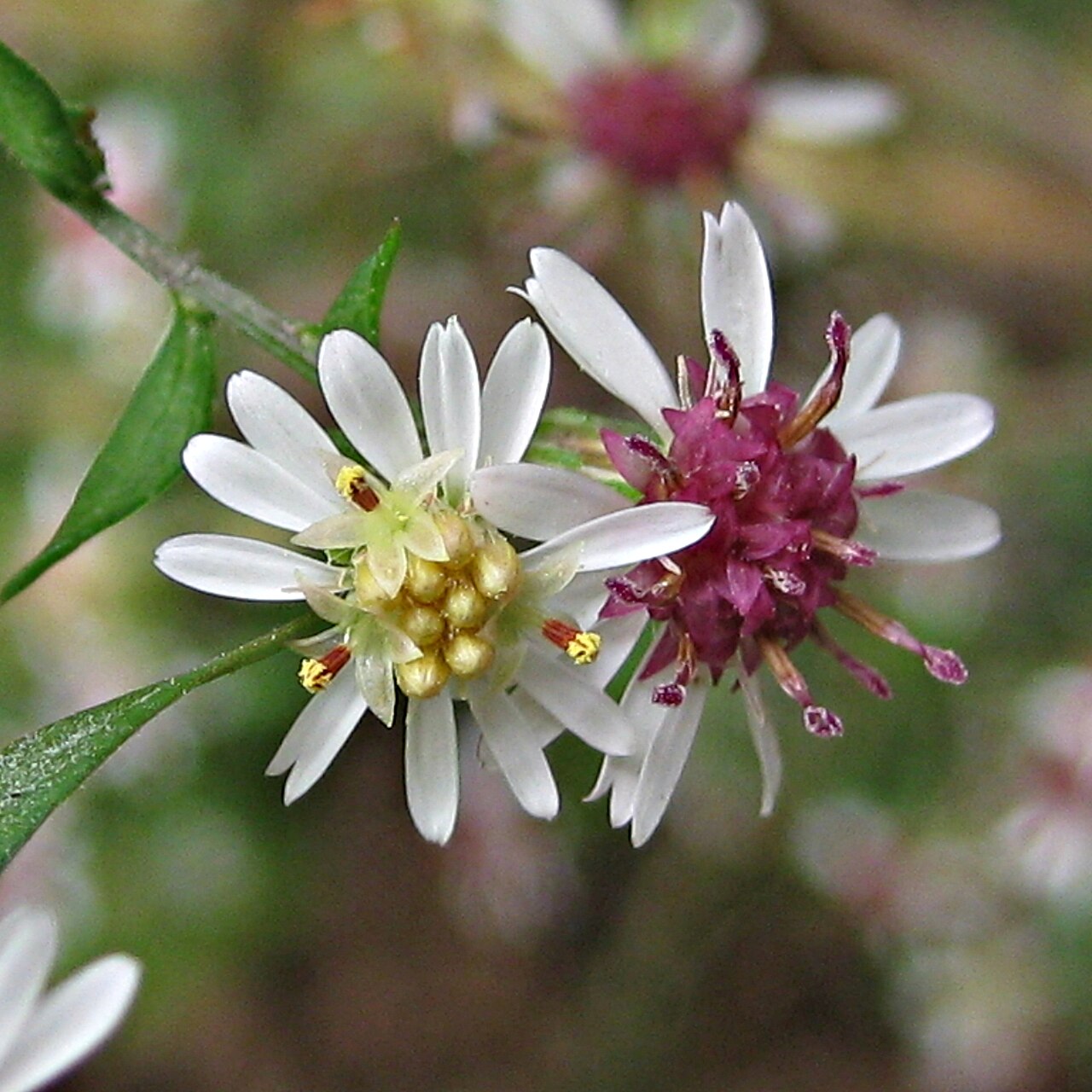
The flower heads are small, about a third to half an inch across, and very numerous. They are crowded along one side of the spreading branches, which explains the species name lateriflorum, “flowering on the side.” Each head has about 8 to 15 short white rays, sometimes tinged pink or lilac, around a disk of tiny tubular florets. The disk florets are pale yellow when they open and become magenta to purple-red after pollination, so most plants show both colors at once. The open disk florets have lobes that bend back sharply. Flowering lasts from about August to October, and into November in the South.
Fruit & Seeds
After flowering, each head produces small, dry, one-seeded fruits (cypselae), each with a tuft of fine, whitish bristles (pappus) that carries it on the wind. The seed heads remain on the plant into winter.
Quick Facts
| Scientific Name | Symphyotrichum lateriflorum (syn. Aster lateriflorus) |
| Family | Asteraceae (aster family) |
| Plant Type | Herbaceous perennial |
| Mature Height | 1–3 ft (occasionally to 4 ft) |
| Mature Spread | 1–2 ft |
| Growth Rate | Moderate to fast |
| Sun Exposure | Full sun to part shade |
| Water Needs | Moderate; tolerates both moist and fairly dry soils |
| Soil Type | Loam, clay or sandy soils; adaptable |
| Soil pH | About 5.5–7.5 |
| Bloom Time | August–October (to November in the South) |
| Flower Color | White to pale lilac rays; yellow disk aging to purple-red |
| Fall Color | Leaves sometimes bronze to purplish |
| Fruit | Small seeds with a tuft of bristles, wind-dispersed |
| Deer Resistant | No; deer and rabbits browse asters |
| USDA Hardiness Zones | 3–9 |
Native Range
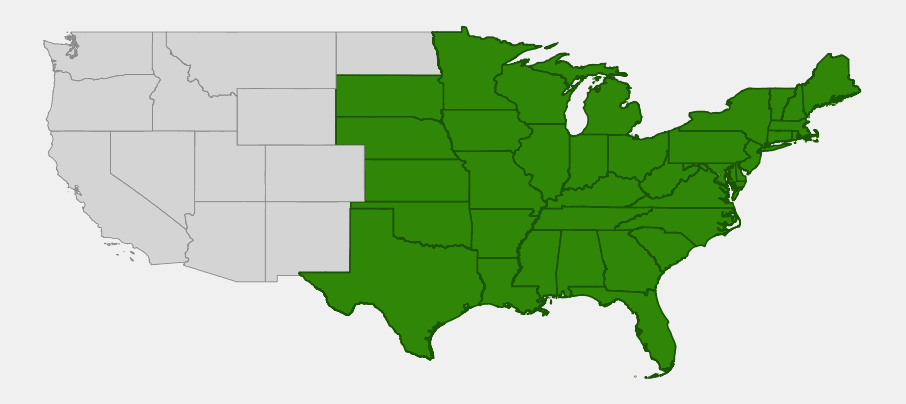
Calico aster has a very wide range in eastern North America. USDA PLANTS records it in 36 states and the District of Columbia, from Maine and Minnesota south to Florida and Texas, and west to the Dakotas, Nebraska, Kansas and Oklahoma. In Canada it grows from Manitoba and Ontario east through Quebec to New Brunswick, Nova Scotia and Prince Edward Island. A record from British Columbia is far outside the main range and is probably adventive.
It is common through most of the Northeast, the Great Lakes region, the Ohio Valley and the Appalachians. Farther south and west it becomes more scattered: in Florida it is mainly a plant of the Panhandle and the northern part of the state, in Texas it grows mainly in the eastern third, and on the Great Plains it is found in the eastern parts of the Dakotas, Nebraska, Kansas and Oklahoma, along rivers and woodland edges.
It grows in a wide variety of habitats with moist to somewhat dry soils: forest edges and openings, thickets, old fields, meadows, stream banks, lake shores, the edges of swamps and marshes, and disturbed ground such as roadsides and clearings. Several varieties are recognized, differing in leaf width, hairiness and growth habit.
📋 Regional plant lists featuring Calico Aster: New York, Pennsylvania & Northern New Jersey · Ohio & Indiana · Michigan, Wisconsin & Eastern Minnesota · Kentucky & Tennessee · Nebraska, Kansas & Eastern Colorado · Connecticut, Massachusetts & Rhode Island · New Hampshire, Maine & Vermont · Maryland, Virginia & West Virginia · Delaware, Southern New Jersey & Long Island · Illinois, Iowa & Missouri · Alabama, Georgia & Mississippi · North & South Florida · North & South Carolina · Arkansas, Louisiana, Eastern Oklahoma & Eastern Texas · North Dakota, South Dakota & Western Minnesota
Growing & Care Guide
Calico aster is one of the easiest native asters to grow. It adapts to sun or part shade and to most soils, blooms reliably in fall, and needs little care. It also grows well in the lighter shade at the edge of woods, where many other asters flower poorly. A few named selections are sold, including dark-leaved forms such as ‘Lady in Black’, but the wild form is just as valuable to wildlife.
Light
Plant in full sun to part shade. In full sun plants are denser and bloom more heavily. In part shade they are looser and taller but still flower well, so calico aster is a good choice for woodland edges and the light shade of open trees.
Soil & Water
Calico aster tolerates clay, loam and sandy soils, and it does well in average garden soil without fertilizer. It prefers moderately moist soil but tolerates dry periods once established. Rich soil and extra fertilizer make plants floppy and prone to disease.
Planting Tips
Plant container plants in spring or early fall, about 18 to 24 inches apart. Combine calico aster with goldenrods, other asters, grasses and sedges in meadows and borders, or with woodland plants such as white wood aster and zigzag goldenrod at the edge of shade. Its fine texture makes a good filler between bolder plants.
Pruning & Maintenance
If you want a shorter, bushier plant, cut the stems back by about a third to half in late May or June; this delays flowering slightly. Leave the stems standing through winter so birds can eat the seeds and insects can overwinter in the hollow stems, and cut them back in spring. Powdery mildew may appear on the leaves in late summer, especially in crowded or dry spots, but it does little harm. Plants self-sow readily in open soil.
Propagation
Calico aster is easy to grow from seed sown outdoors in fall or after a few weeks of cold, moist stratification in spring. Divide established clumps in early spring every few years to keep them vigorous. Stem cuttings taken in late spring also root easily.
Landscape Uses
- Woodland edge and shade gardens: one of the best asters for part shade
- Pollinator gardens: a long-blooming fall nectar source for bees, flies and butterflies
- Meadows and naturalized areas: mixes well with goldenrods, grasses and other asters
- Rain gardens and stream banks: tolerates periodically moist soils
- Fall borders: a fine-textured filler with hundreds of small flowers
Wildlife & Ecological Value
Fall asters are among the most important native plants for wildlife in eastern North America, and calico aster, with its enormous numbers of small flower heads and wide tolerance of habitats, is one of the most widespread of them.
For Pollinators
The small flower heads are visited by a wide variety of insects: honeybees, bumblebees, many small native bees such as sweat bees and mining bees, syrphid flies, wasps and butterflies. The color change of the disk florets from yellow to purple-red is thought to signal to insects which florets still offer nectar and pollen. Asters, including calico aster, are larval host plants for the pearl crescent butterfly and the caterpillars of many moths. Several specialist bees collect pollen only from asters and goldenrods in fall.
For Birds
American goldfinches, dark-eyed juncos, sparrows and other seed-eating birds eat the seeds in fall and winter. Insect-eating birds forage on the many insects that visit the plants.
For Mammals
White-tailed deer, rabbits and groundhogs browse the leaves and stems. Small mammals eat the seeds.
Ecosystem Role
Calico aster is a common member of forest-edge, old-field and floodplain communities. Because it tolerates disturbance and partial shade, it is often one of the first native wildflowers to colonize clearings and old fields, and it persists for many years as shrubs and trees move in. Its late bloom supplies nectar and pollen when few other flowers are open, including to migrating monarch butterflies and to queen bumblebees preparing for winter.
Cultural & Historical Uses
Carl Linnaeus first described this plant in 1753 as Solidago lateriflora, placing it among the goldenrods. Nathaniel Lord Britton later moved it to Aster, and for most of the twentieth century it was known as Aster lateriflorus, the name still found in many field guides. In 1982 the botanists Áskell and Doris Löve moved it to Symphyotrichum, the genus to which most American asters are now assigned.
The common names reflect its appearance. “Calico aster” refers to the mixture of yellow and purple-red centers on one plant. “Starved aster” probably refers to its small flower heads and slender, wiry branches. It has also been called side-flowering aster, after its scientific name.
Native peoples of eastern North America used several asters medicinally. Records of specific uses of calico aster are limited, and any medicinal use should be left to experts. Today the plant is valued mainly as a reliable, easy native wildflower for gardens, meadows and restoration projects.
Frequently Asked Questions
Why is it called calico aster?
Because a single plant carries flower heads with different colored centers. The disk florets start pale yellow and turn magenta or purple-red after pollination, so the plant shows a mix of colors like calico fabric.
Is calico aster the same as Aster lateriflorus?
Yes. Aster lateriflorus is the older name, still used in many books. Most botanists now place North American asters in the genus Symphyotrichum.
Does calico aster grow in shade?
It tolerates part shade better than most asters and is common along woodland edges. In deep shade it becomes thin and flowers poorly.
Is calico aster aggressive?
It self-sows in open, disturbed soil and can spread in gardens, but it is not invasive. Cut off some seed heads in fall or pull extra seedlings in spring if needed.
When does calico aster bloom?
From about August to October in most of its range, sometimes into November in the South. Each plant blooms for several weeks.

Looking for a nursery that carries Calico Aster?
Browse our native plant nursery directory: Alabama & Arkansas · Connecticut, Delaware, Florida & Georgia · Illinois, Indiana, Iowa & Kansas · Kentucky, Louisiana, Maine, Maryland, Massachusetts, Michigan, Minnesota, Mississippi & Missouri · Nebraska, New Hampshire, New Jersey, New York, North Carolina, Ohio & Oklahoma · Pennsylvania, Rhode Island, South Carolina, South Dakota, Tennessee, Texas, Vermont & Virginia · West Virginia & Wisconsin