
Bastard Toadflax (Comandra umbellata)
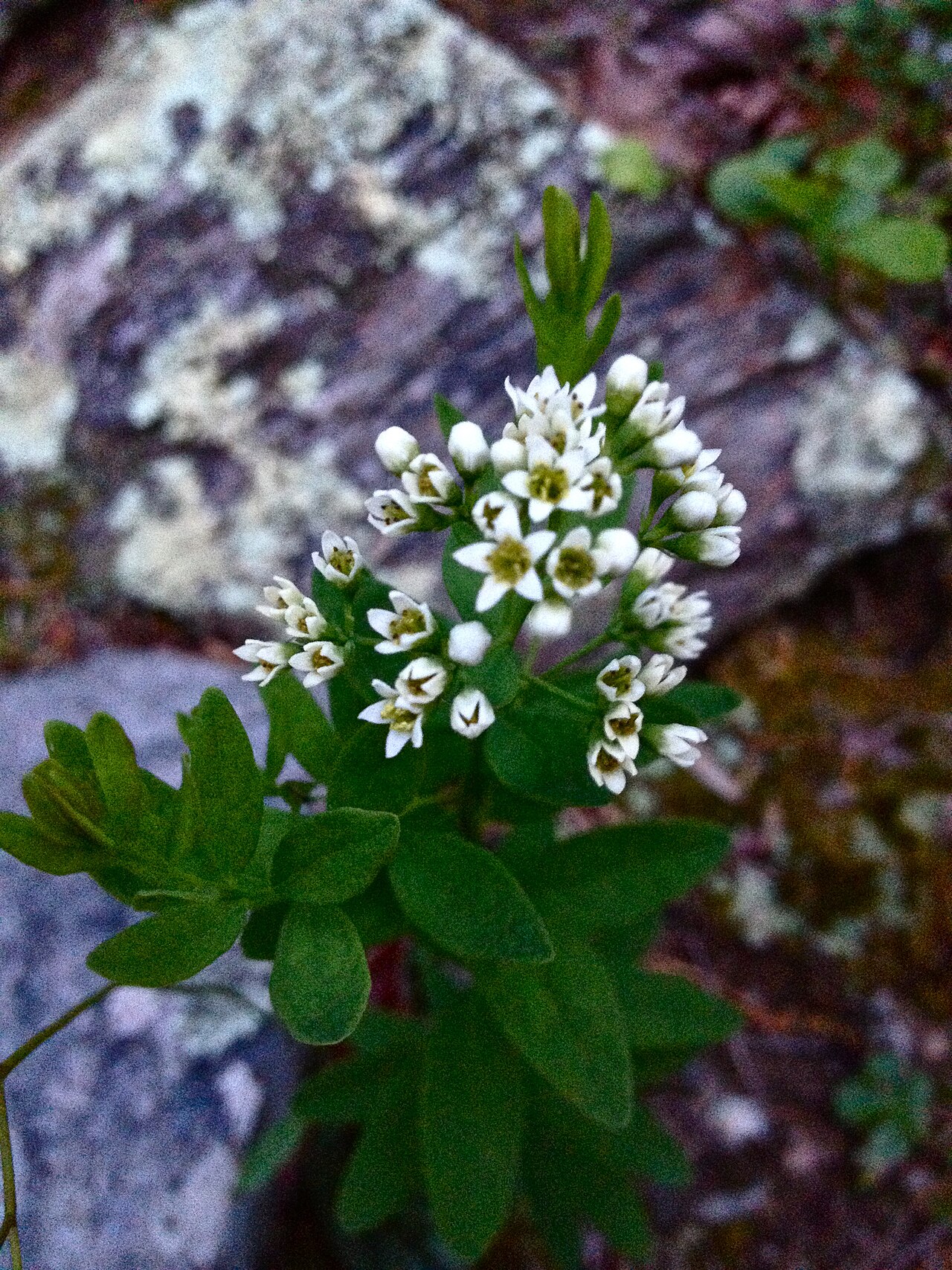
Comandra umbellata, known as Bastard Toadflax (also common comandra or star toadflax), is a low, native perennial wildflower found across most of North America, from Alaska and the Yukon to Newfoundland and south to Georgia, Texas, Arizona and California. It belongs to the sandalwood family (Santalaceae). Plants are usually only 4 to 16 inches tall, with pale, bluish-green, narrow leaves and small clusters of white, star-shaped flowers in spring and early summer.
Bastard toadflax is a root hemiparasite. It has green leaves and makes its own sugars, but its spreading rhizomes form small suckers (haustoria) that attach to the roots of nearby plants and draw water and minerals from them. It is not choosy: it parasitizes grasses, wildflowers, shrubs and trees in prairies, sagebrush, open woods and rocky barrens. The name “toadflax” refers to a superficial resemblance of its leafy stems to the true toadflaxes, which are unrelated, and “bastard” here simply means false.
This page is an identification and appreciation guide. Bastard toadflax is essentially unavailable as nursery stock, and plants should never be dug from the wild: they are connected to the roots of their hosts and almost always die when moved. It is best enjoyed where it grows naturally, in dry prairies, glades, barrens and open woods.
Identification
Bastard toadflax is easy to overlook until it flowers. Look for patches of short, unbranched or sparingly branched stems with pale, bluish-green leaves and flat-topped clusters of tiny white flowers on dry, open ground.
Growth Habit
Plants grow from long, creeping, whitish to bluish rhizomes and often form loose colonies of many stems. The stems are 4 to 16 inches tall, smooth, often somewhat zigzag, and leafy to the top. Underground, the rhizomes and roots form haustoria on the roots of neighboring plants.
Leaves
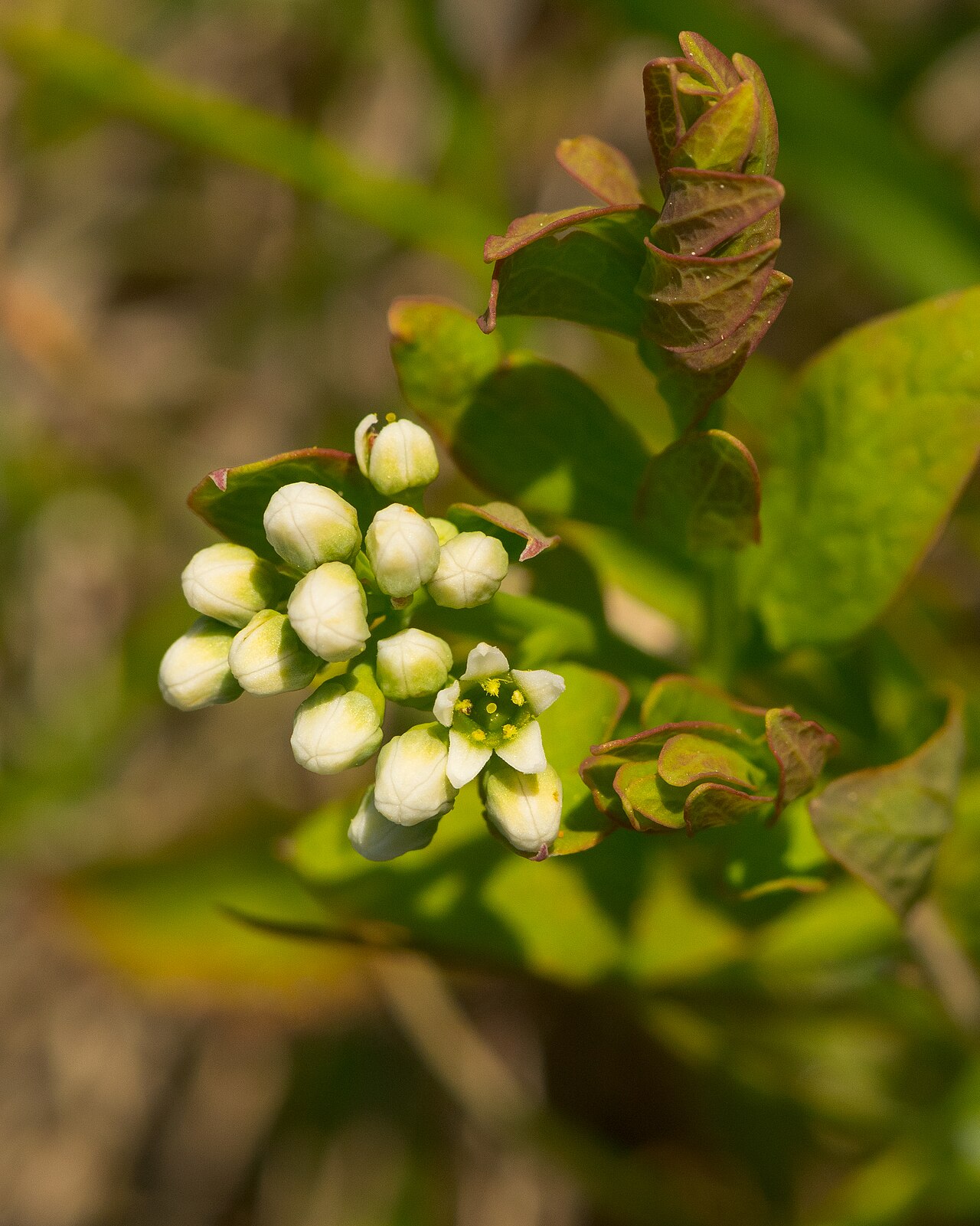
The leaves are alternate, simple and stalkless, lance-shaped to oblong or elliptic, about 1/2 to 1½ inches long, with smooth edges. They are thick, pale green to bluish-green and often have a waxy bloom. Western plants (subspecies pallida) tend to have narrower, grayer leaves than eastern ones.
Flowers
From April to July, depending on latitude and elevation, small rounded clusters of flowers appear at the tops of the stems. Each flower is about 1/4 inch across and has no petals; the five (sometimes four) white to pinkish, petal-like sepals form a star. Tufts of hair on the inner base of the sepals connect to the anthers, a distinctive feature seen with a hand lens.
Fruit
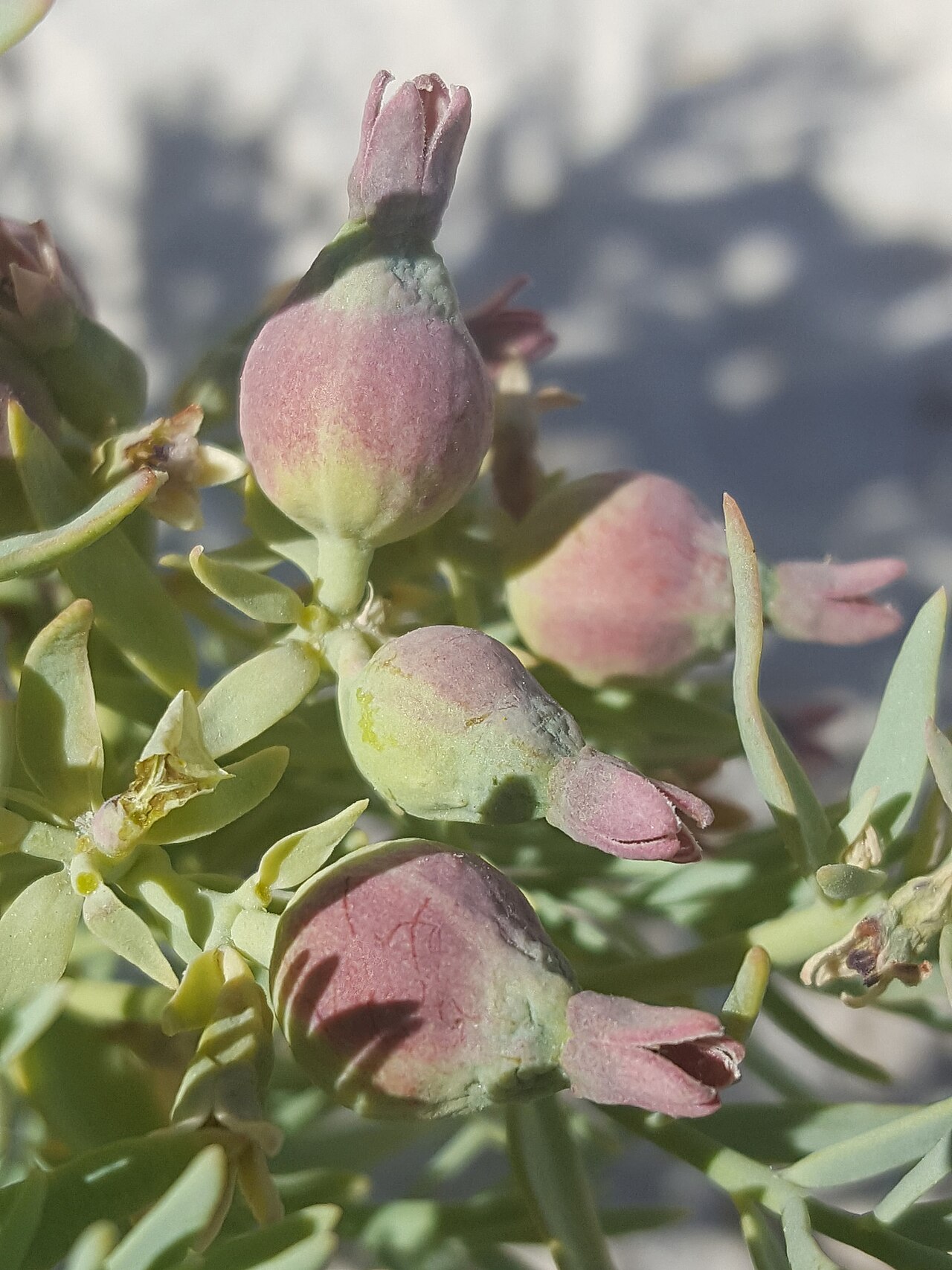
The fruit is a small, dry, urn-shaped drupe about 1/4 inch long, green at first and turning brown to purplish, crowned by the persistent sepals. Each holds one seed. Some Native American peoples reportedly ate the sweetish fruits, but they are small and not a significant food.
Look-alikes
Northern comandra (Geocaulon lividum) of boreal forests has greenish flowers and orange-red fruits. Toadflaxes (Linaria and Canada toadflax, Nuttallanthus canadensis) have similar narrow leaves but spurred, snapdragon-like flowers and belong to the plantain family. Flowering spurges such as Euphorbia corollata have milky sap and white “petals” that are actually bracts. Bastard toadflax has no milky sap and no spurs.
Subspecies
Three subspecies are commonly recognized. Subspecies umbellata grows in the East and Midwest. Subspecies pallida is widespread in the Great Plains, Rocky Mountains, Great Basin and Southwest and has narrower, paler leaves. Subspecies californica grows in California, Oregon and Washington.
Quick Facts
| Scientific Name | Comandra umbellata |
| Family | Santalaceae (sandalwood family; sometimes placed in Comandraceae) |
| Plant Type | Rhizomatous perennial; root hemiparasite |
| Mature Height | 4–16 in |
| Mature Spread | Spreads by rhizomes into loose colonies |
| Growth Rate | Slow to moderate |
| Sun Exposure | Full sun to part shade |
| Water Needs | Low; dry to medium soils |
| Soil Type | Sandy, gravelly or rocky soils, thin soil over rock |
| Soil pH | Acidic to alkaline (about 5.0–8.0) |
| Bloom Time | April–July (varies with latitude and elevation) |
| Flower Color | White, sometimes pinkish |
| Fall Color | Stems yellow and die back |
| Fruit | Small urn-shaped drupe, brown to purplish |
| Deer Resistant | Not well documented |
| USDA Hardiness Zones | About 3–9 |
Native Range
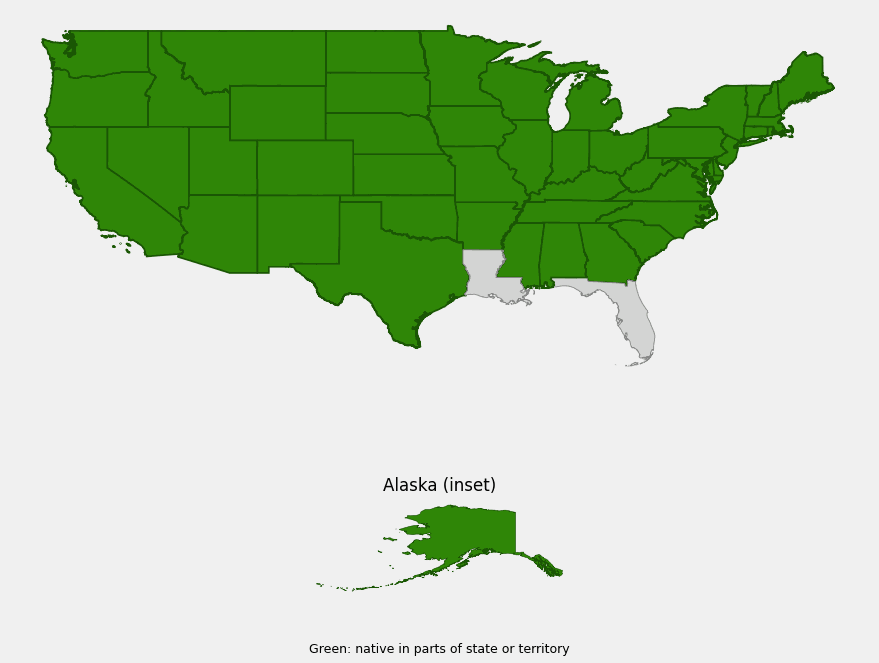
Bastard toadflax has one of the widest ranges of any North American wildflower. USDA PLANTS lists it as native in the lower 48 states, Alaska and Canada, and records it from 47 states and the District of Columbia. In Canada it grows in every province and in the Yukon and Northwest Territories. It is absent or nearly so from Florida, Louisiana and the Gulf Coast lowlands, and is scattered in Alaska.
In the East it grows mainly in dry, open places: sandy and rocky barrens, cedar glades, oak and pine woodlands, rock outcrops, shale barrens and dry prairies. In the Midwest and Great Plains it is a common plant of upland prairies and sand hills. In the West it is widespread in sagebrush steppe, pinyon-juniper woodland, ponderosa pine forest, mountain meadows and rocky slopes, from the Dakotas, Montana and Washington south to Texas, New Mexico, Arizona and California.
In Texas it grows mainly in the Panhandle and the Trans-Pecos mountains of the west. In Oregon and Washington it occurs both east of the Cascades and in drier prairies and oak woodlands west of them, where the subspecies californica grows.
📋 Regional plant lists featuring Bastard Toadflax: New York, Pennsylvania & Northern New Jersey · Idaho, Eastern Oregon & Eastern Washington · Ohio & Indiana · Montana & Wyoming · Michigan, Wisconsin & Eastern Minnesota · Kentucky & Tennessee · Nebraska, Kansas & Eastern Colorado · Utah & Western Colorado · Connecticut, Massachusetts & Rhode Island · New Hampshire, Maine & Vermont · Maryland, Virginia & West Virginia · Delaware, Southern New Jersey & Long Island · Arizona & New Mexico · Illinois, Iowa & Missouri · Alabama, Georgia & Mississippi · Alaska · North & South Carolina · Arkansas, Louisiana, Eastern Oklahoma & Eastern Texas · South & West Texas · North Dakota, South Dakota & Western Minnesota · Western Oregon & Western Washington · California & Nevada
Can You Grow It?
Not in the usual sense. Bastard toadflax is essentially unavailable as nursery stock, and it depends on attachments to the roots of other plants. Never dig it from the wild: its rhizomes are tangled with the roots of its hosts, and transplanted plants almost always die. Where it already grows on your land, protect it; in new plantings it may appear on its own over time if it grows nearby.
Light
In the wild it grows in full sun to light shade, in open prairies, barrens, glades and thin woodlands. It declines where trees and shrubs close in and shade it heavily.
Soil & Water
It favors dry to medium, well-drained soils: sand, gravel, thin soil over rock and dry prairie loams. It tolerates drought well, partly because it can draw water from host roots. It is rare in wet, heavy soils.
Planting Tips
Do not plant wild-collected plants. Specialist restoration projects occasionally sow fresh seed directly into established native prairie or barrens, where hosts are already present; seedlings must attach to host roots early to survive. In a home garden, the best approach is to preserve existing colonies in prairie or rock-garden areas and to avoid tilling or herbicides there.
Pruning & Maintenance
Colonies need no care beyond protection from soil disturbance, heavy shade and invasive plants. Prescribed fire or periodic mowing in late fall or winter, as used to maintain prairies and barrens, keeps its habitat open.
Propagation
It spreads by rhizomes and by seed. Seeds are reported to germinate slowly and erratically, and seedlings need a host, so propagation is mostly left to restoration specialists. Do not move rhizomes from wild colonies.
Where to See It
- Dry prairies and sand prairies: common in upland prairie remnants of the Midwest and Plains
- Barrens, glades and rock outcrops: eastern serpentine, shale and cedar barrens and dry, rocky ridges
- Open oak and pine woodlands: sunny openings and edges
- Sagebrush and pinyon-juniper country: widespread in the Great Basin and Rocky Mountain foothills
- Spring wildflower walks: look for its white clusters from April to July in sunny, dry places
Wildlife & Ecological Value
Bastard toadflax is a small but well-connected plant: through its roots it links to many other species, and above ground its flowers feed a wide range of small insects.
For Pollinators
The flowers produce nectar on an open disk and are visited by small bees, flies, wasps, beetles, ants and small butterflies.
For Birds
Small birds and rodents eat some of the fruits and seeds, but bastard toadflax is not a major food source for birds.
For Mammals
Small mammals eat the fruits. In the West, grazing animals browse the plant lightly. Its value to mammals is minor compared with its role in plant communities.
Ecosystem Role
As a generalist root hemiparasite, bastard toadflax can take resources from dominant grasses and shrubs, which may help other plants coexist. It is also the alternate host of comandra blister rust (Cronartium comandrae), a fungal disease that infects hard pines such as lodgepole, ponderosa and jack pine. The rust must pass between comandra and pines to complete its life cycle, which makes the plant important in western forest health.
Cultural & Historical Uses
The genus name Comandra comes from Greek words for “hair” and “man” (meaning stamen), a reference to the tufts of hair attached to the anthers. The species name umbellata refers to the umbrella-like flower clusters. Thomas Nuttall named the genus in 1818.
Several Native American peoples used bastard toadflax. The small fruits were eaten fresh by some Plains and western peoples, and other parts of the plant were used in traditional medicine. These uses are part of cultural history and are not recommendations.
Bastard toadflax is a good example of how common plants can be ecologically interesting. Long regarded as a minor weed of prairies, it is now studied as a widespread parasitic plant and as a key player in the life cycle of a forest disease.
Frequently Asked Questions
Is bastard toadflax a parasite?
Yes, a partial one. It has green leaves and makes its own food, but its roots attach to the roots of nearby plants and take water and minerals from them. It parasitizes many kinds of plants.
Can I buy bastard toadflax for my garden?
It is essentially unavailable from nurseries. Because it depends on host plants and transplants very poorly, it is best enjoyed where it grows naturally. Never dig it from the wild.
Is bastard toadflax related to toadflax or butter-and-eggs?
No. Despite the name, it belongs to the sandalwood family. True toadflaxes, including Canada toadflax and butter-and-eggs, have spurred, snapdragon-like flowers and belong to the plantain family.
Does bastard toadflax harm pine trees?
Indirectly. It is the alternate host of comandra blister rust, a fungus that also infects hard pines. The plant itself does not attack pines, but the rust cycles between the two.
Where can I see bastard toadflax?
Look in dry, sunny places such as prairies, sand barrens, rocky glades, open oak and pine woods and sagebrush country, from April to July.

Looking for a nursery that carries Bastard Toadflax?
Browse our native plant nursery directory: Alabama, Alaska, Arizona & Arkansas · California · Colorado, Connecticut, Delaware & Georgia · Idaho, Illinois, Indiana, Iowa & Kansas · Kentucky, Maine, Maryland, Massachusetts, Michigan, Minnesota, Mississippi, Missouri & Montana · Nebraska, Nevada, New Hampshire, New Jersey, New Mexico, New York, North Carolina, North Dakota, Ohio & Oklahoma · Oregon · Pennsylvania, Rhode Island, South Carolina, South Dakota, Tennessee, Texas, Utah, Vermont & Virginia · Washington · West Virginia, Wisconsin & Wyoming