
Small-Flowered Blue-Eyed Mary (Collinsia parviflora)
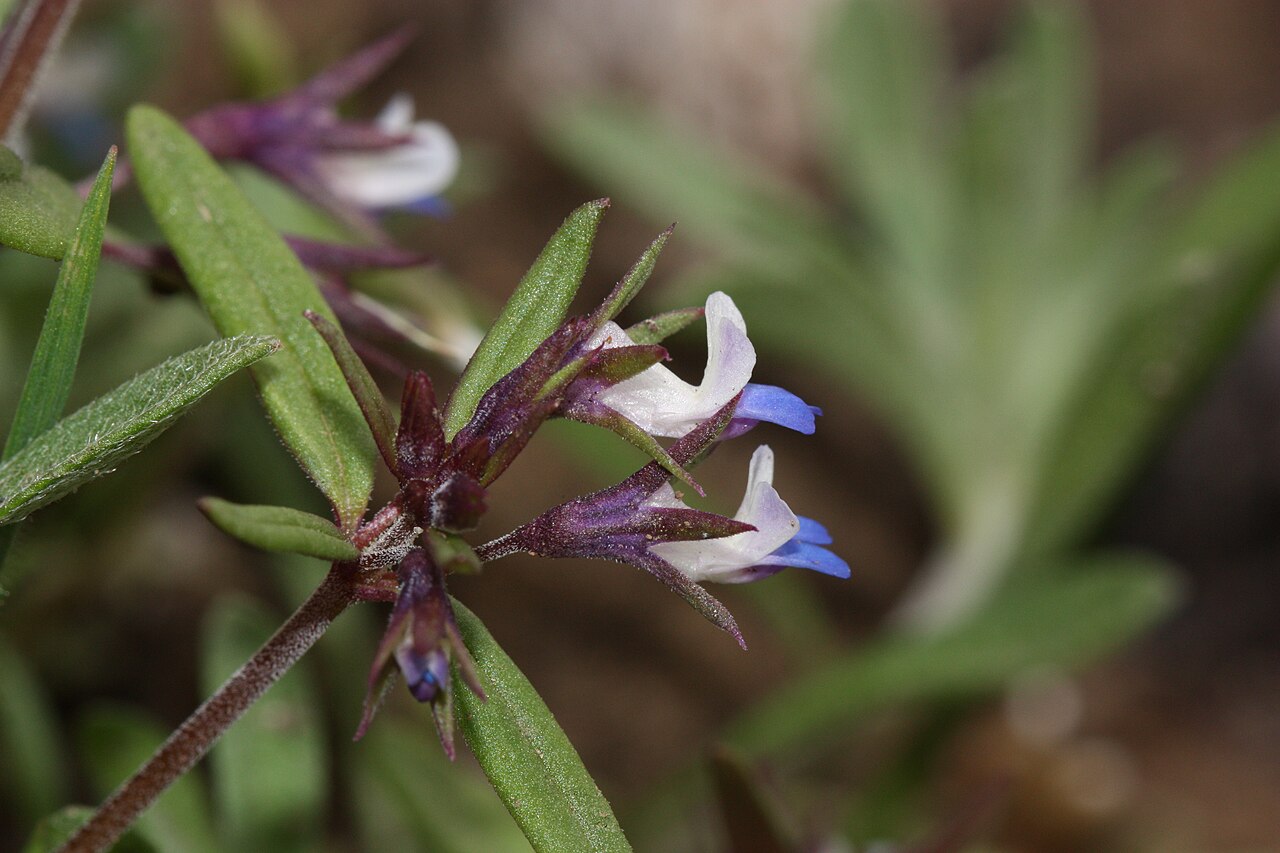
Collinsia parviflora, known as Small-Flowered Blue-Eyed Mary (USDA: maiden blue eyed Mary), is a tiny native annual wildflower of western North America. It belongs to the plantain family (Plantaginaceae; formerly placed in the figwort family, Scrophulariaceae). It is one of the first wildflowers of spring across much of the West, dotting mossy banks, rock outcrops, sagebrush and open woods with small blue-and-white flowers.
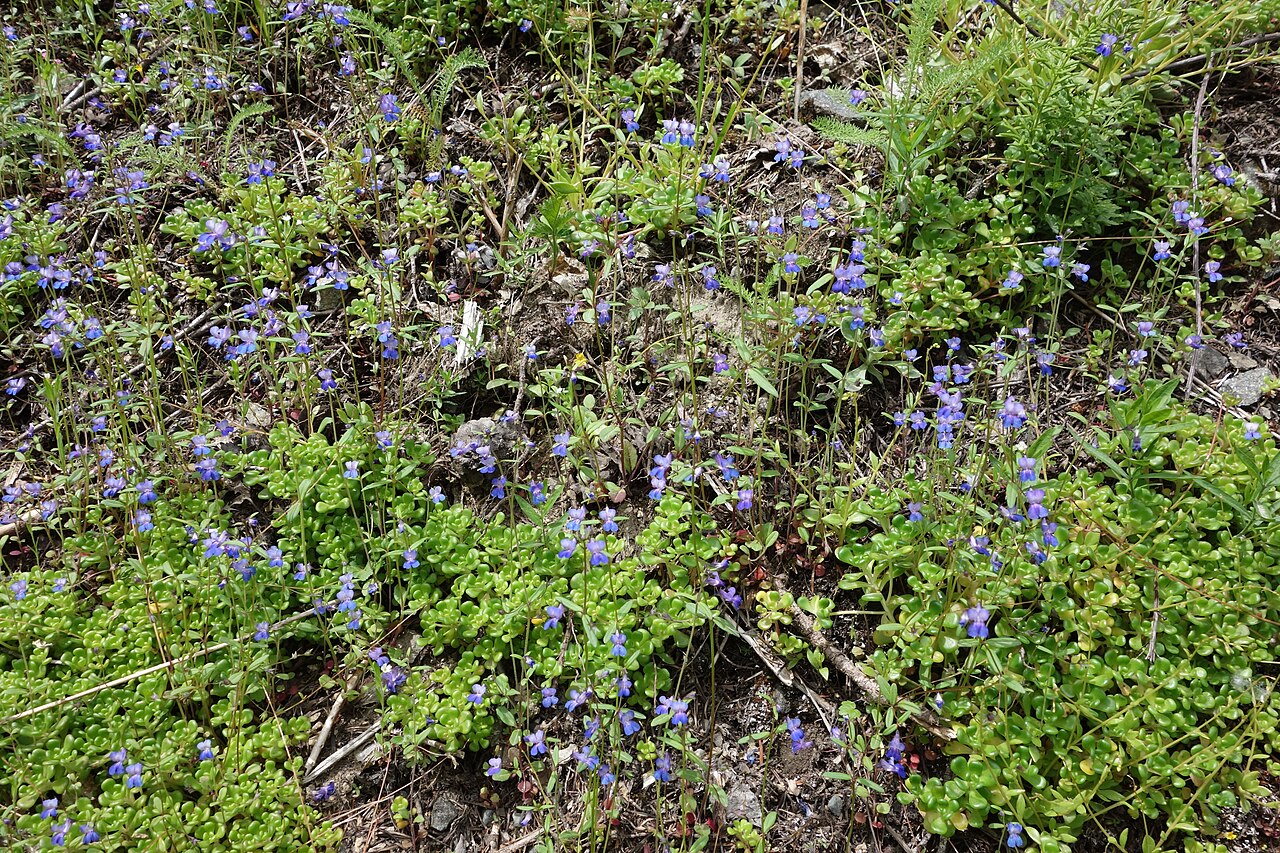
The plant is usually only 2 to 8 inches tall, with slender, often purplish stems and narrow leaves, the upper ones in whorls. Its two-lipped flowers are barely a quarter inch long, with a white upper lip and a bright blue lower lip, and they sit on thin stalks in the leaf axils. A single plant is easy to overlook, but in a good year thousands of them can tint a slope blue. Native bees visit the flowers, and it is a larval food plant for checkerspot butterflies in the Pacific Northwest.
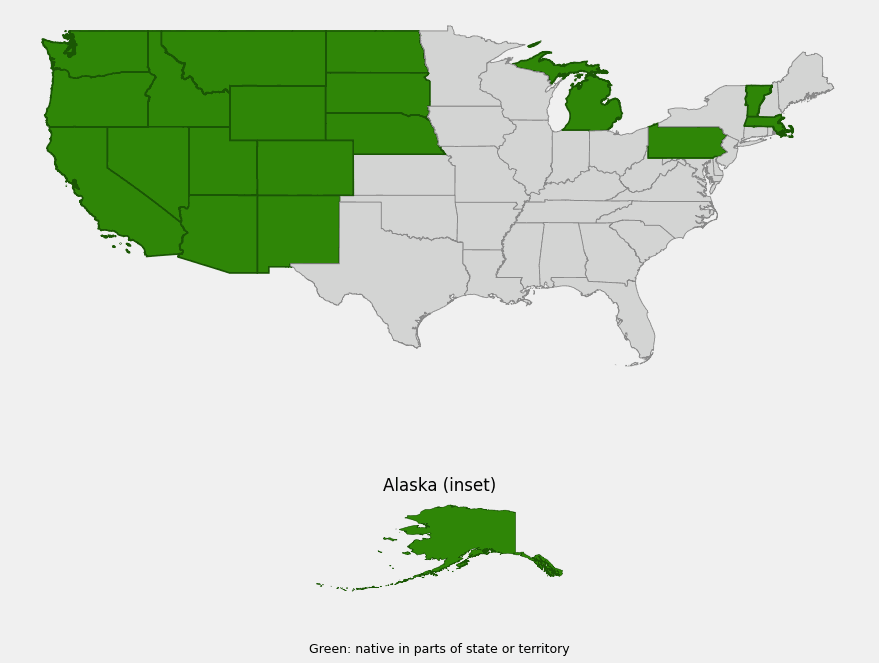
It is widespread from Alaska and British Columbia south to California and east to the Rocky Mountains, the northern Great Plains and the Great Lakes. Older records from Pennsylvania, Massachusetts and Vermont are scattered outliers far from the main range.
Identification
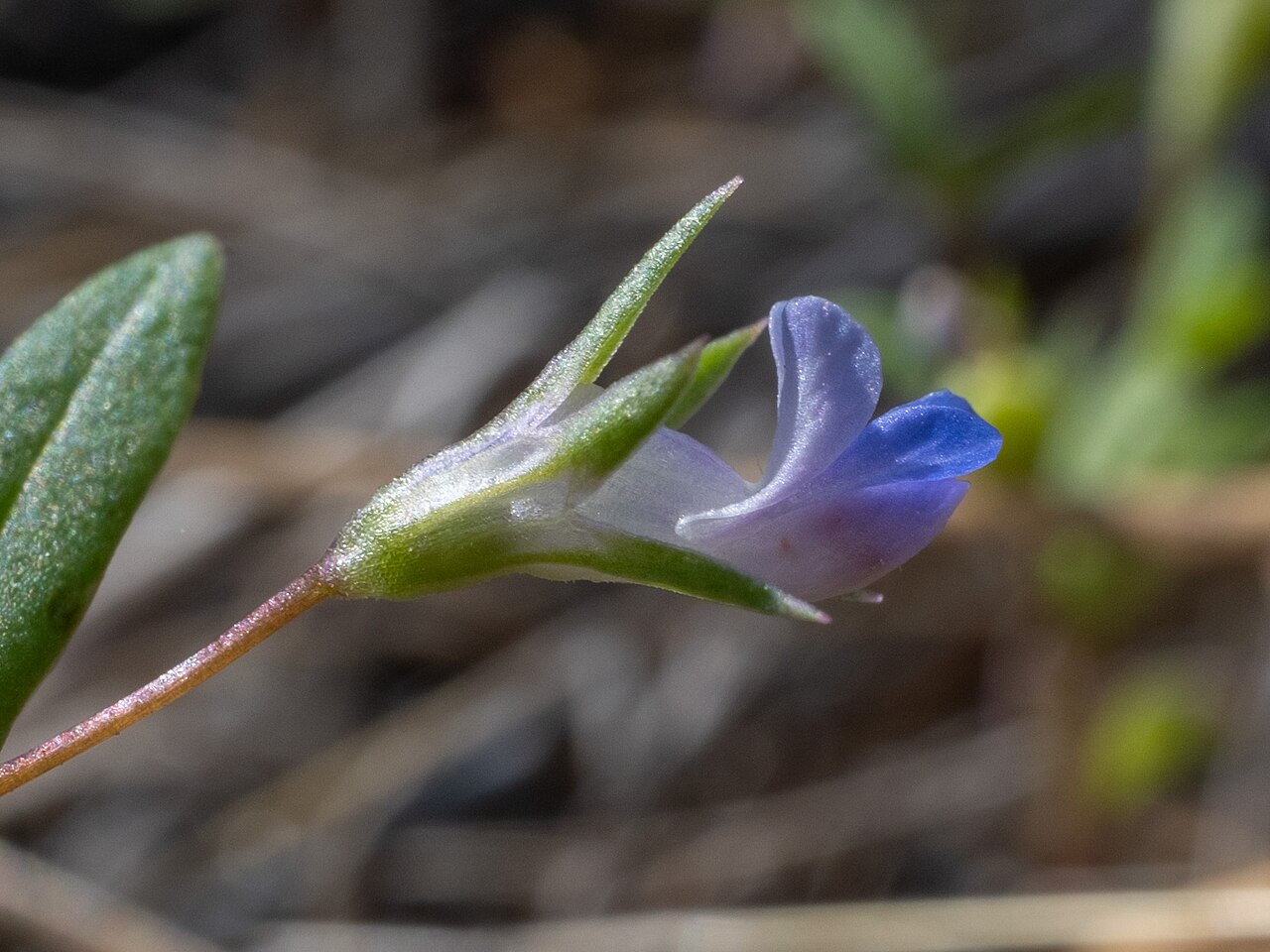
Look for a very small annual with narrow opposite or whorled leaves, often purplish stems, and tiny two-lipped flowers with a white upper lip and blue lower lip that bend sharply out of the calyx, on open, mossy or gravelly ground in early spring.
Stems & Habit
Small-flowered blue-eyed Mary is a slender winter or spring annual, usually 2 to 8 inches tall and occasionally up to about 16 inches in rich, moist sites. Plants may be single-stemmed or branched from the base. The stems are thin, finely hairy and often reddish purple, as are the lower leaves.
Leaves
The leaves are opposite on the lower stem and often in whorls of three to five higher up. They are narrow, lance-shaped to oblong, about 1/4 to 2 inches long, with smooth or slightly toothed edges. Lower leaves are smaller and often have short stalks; they commonly turn purple.
Flowers
The flowers grow singly or in small whorls on slender stalks from the upper leaf axils. Each is about 1/8 to 1/4 inch (4 to 7 mm) long and two-lipped: the upper lip has two white or pale blue lobes and the lower lip has three lobes, with the side lobes bright blue and the middle lobe folded around the stamens. The corolla tube bends at a sharp angle where it leaves the calyx. Bloom time runs from March at low elevations to July in the mountains.
Fruit & Seeds
The fruit is a small, rounded capsule about 1/8 to 1/5 inch (3 to 5 mm) long, held in the persistent calyx. It splits to release a few smooth seeds, which wait in the soil until fall or spring rains.
Look-alikes
Large-flowered blue-eyed Mary (Collinsia grandiflora) of the Pacific Northwest is very similar but has larger flowers, mostly over 1/4 inch long. Blue-eyed Mary of the East (C. verna) and Chinese houses (Chinese Houses, C. heterophylla) have bigger flowers in showy tiers. Blue-eyed grasses (Blue-Eyed Grass, Sisyrinchium) share the common name but are grass-leaved irises with six-tepaled flowers.
Conservation
The species is common across most of the West. It is rare at the edges of its range: NatureServe ranks it critically imperiled in Vermont and imperiled in Michigan and North Dakota. Go Botany notes that the few New England collections are historical and that its native status there is uncertain.
Quick Facts
| Scientific Name | Collinsia parviflora |
| Family | Plantaginaceae (plantain family); formerly Scrophulariaceae |
| Plant Type | Annual wildflower |
| Mature Height | 2–8 in (rarely to 16 in) |
| Mature Spread | 1–4 in |
| Growth Rate | Fast |
| Sun Exposure | Full sun to partial shade |
| Water Needs | Moderate in spring; dry after seeding |
| Soil Type | Thin, gravelly, sandy or mossy soils; rock outcrops and banks |
| Soil pH | About 5.5–7.5 |
| Bloom Time | March–July (by elevation) |
| Flower Color | Blue lower lip, white upper lip |
| Fall Color | None; annual, dies after seeding |
| Fruit | Small rounded capsule with a few seeds |
| Deer Resistant | Unknown; too small to be a target |
| USDA Hardiness Zones | Annual; grows where zones 3–9 occur |
Native Range
Small-flowered blue-eyed Mary is native across western North America. USDA PLANTS lists it in Arizona, California, Colorado, Idaho, Montana, Nebraska, Nevada, New Mexico, North Dakota, Oregon, South Dakota, Utah, Washington and Wyoming, east to Michigan, and in Alaska. In Canada it grows from the Yukon and British Columbia east across the Prairie Provinces to Ontario.
The heart of its range is the Pacific Northwest, California, the Great Basin and the Rocky Mountains, where it is one of the most common spring annuals. Eastward it reaches the Black Hills, northwestern Nebraska and the Lake Superior region of Michigan, where it is rare. USDA also lists outlying records in Pennsylvania, Massachusetts and Vermont, and USDA marks its status in Alaska as uncertain. The New England collections are historical, and Go Botany considers its native status there uncertain.
It grows in open places that are moist in spring and dry in summer: mossy rock outcrops and balds, grassy slopes, sagebrush steppe, open pine and oak woodland, meadows, cliff bases, talus, gravelly banks and roadsides, from sea level to above timberline.
📋 Regional plant lists featuring Small-Flowered Blue-Eyed Mary: New York, Pennsylvania & Northern New Jersey · Idaho, Eastern Oregon & Eastern Washington · Montana & Wyoming · Michigan, Wisconsin & Eastern Minnesota · Nebraska, Kansas & Eastern Colorado · Utah & Western Colorado · Connecticut, Massachusetts & Rhode Island · New Hampshire, Maine & Vermont · Arizona & New Mexico · Alaska · North Dakota, South Dakota & Western Minnesota · Western Oregon & Western Washington · California & Nevada
Growing & Care Guide
Small-flowered blue-eyed Mary is rarely sold as a garden plant, but it is easy to establish from seed in a rock garden, a meadow or a mossy, thin-soiled spot that mimics its natural habitat.
Light
Full sun to partial shade. In hot, dry areas it does best with some shade from trees or rocks.
Soil & Water
Give it thin, well-drained soil that is moist in fall, winter and spring and dries out in summer, such as gravel, sandy loam, or moss over rock. It needs no summer water; the plants finish their life cycle before the dry season.
Planting Tips
Scatter seed in fall on bare or mossy ground and press it in lightly. Avoid thick mulch, which smothers tiny seedlings. Sow it among other small spring annuals and bulbs, such as camas, woodland star and plectritis, for a natural meadow look.
Pruning & Maintenance
None needed. Leave plants until they have dropped their seed in early summer so the patch renews itself each year. Keep aggressive grasses and weeds from crowding it.
Propagation
Grow from seed only. Fall sowing outdoors gives the cool, moist period the seed needs to germinate. Seed of this and of the larger Collinsia grandiflora is offered by some Pacific Northwest native seed suppliers.
Landscape Uses
- Rock gardens: a tiny, self-sowing annual for gravel and outcrops
- Spring meadow plantings: early blue color among bulbs and grasses
- Butterfly habitat: larval food for checkerspot butterflies
- Pollinator gardens: early nectar and pollen for small native bees
- Habitat restoration: native annual for prairie and oak savanna restoration
Wildlife & Ecological Value
Despite its size, small-flowered blue-eyed Mary is an early-season resource for insects and an important host plant for some butterflies.
For Pollinators
The flowers are visited by small native bees, including mason bees and sweat bees, as well as bee flies. The Xerces Society lists it as having special value to native bees. The plant can also pollinate itself, which helps it set seed in cold, early spring weather. In the Pacific Northwest, caterpillars of Edith’s checkerspot and the endangered Taylor’s checkerspot feed on blue-eyed Marys, including this species, which makes it valuable in prairie and oak savanna restoration.
For Birds
Small seed-eating birds such as sparrows and juncos may pick up the seeds, and insect-eating birds forage among spring wildflower patches.
For Mammals
Small rodents may eat the seeds. The plants are too small to be important browse for deer or livestock.
Ecosystem Role
As a spring annual, it fills the gaps between perennial bunchgrasses and mosses, holds thin soils and provides food for insects early in the season before dying back for the dry summer.
Cultural & Historical Uses
The genus Collinsia honors Zaccheus Collins (1764–1831), a Philadelphia botanist and naturalist. The species name parviflora means “small-flowered,” and it has some of the smallest flowers in the genus.
The name blue-eyed Mary is shared by several Collinsia species and refers to the bright blue lower lip of the flower. USDA uses the name maiden blue eyed Mary for this species.
Botanists have used small-flowered blue-eyed Mary and its larger relative C. grandiflora to study how plants shift from cross-pollination by bees to self-pollination, a change linked to smaller flowers. On this site, a showy relative is Chinese Houses.
Frequently Asked Questions
Is small-flowered blue-eyed Mary an annual?
Yes. It germinates in fall or early spring, blooms in spring or early summer and dies after setting seed.
How big are the flowers?
Tiny: usually 1/8 to 1/4 inch long, with a white upper lip and a blue lower lip.
Where does it grow?
Across western North America from Alaska and British Columbia to California and the Rocky Mountains, east to the Dakotas, Nebraska and Michigan, with a few historical records farther east.
Is it good for wildlife?
Yes. Small native bees visit the flowers, and checkerspot butterfly caterpillars, including the endangered Taylor’s checkerspot, feed on blue-eyed Marys.
Can I grow it in my garden?
Yes, from seed. Sow it in fall on thin, well-drained or mossy ground in sun or part shade and let it reseed.

Looking for a nursery that carries Small-Flowered Blue-Eyed Mary?
Browse our native plant nursery directory: Alaska & Arizona · California · Colorado · Idaho · Massachusetts, Michigan & Montana · Nebraska, Nevada, New Mexico & North Dakota · Oregon · Pennsylvania, South Dakota, Utah & Vermont · Washington · Wyoming