
Dwarf Cinquefoil (Potentilla canadensis)
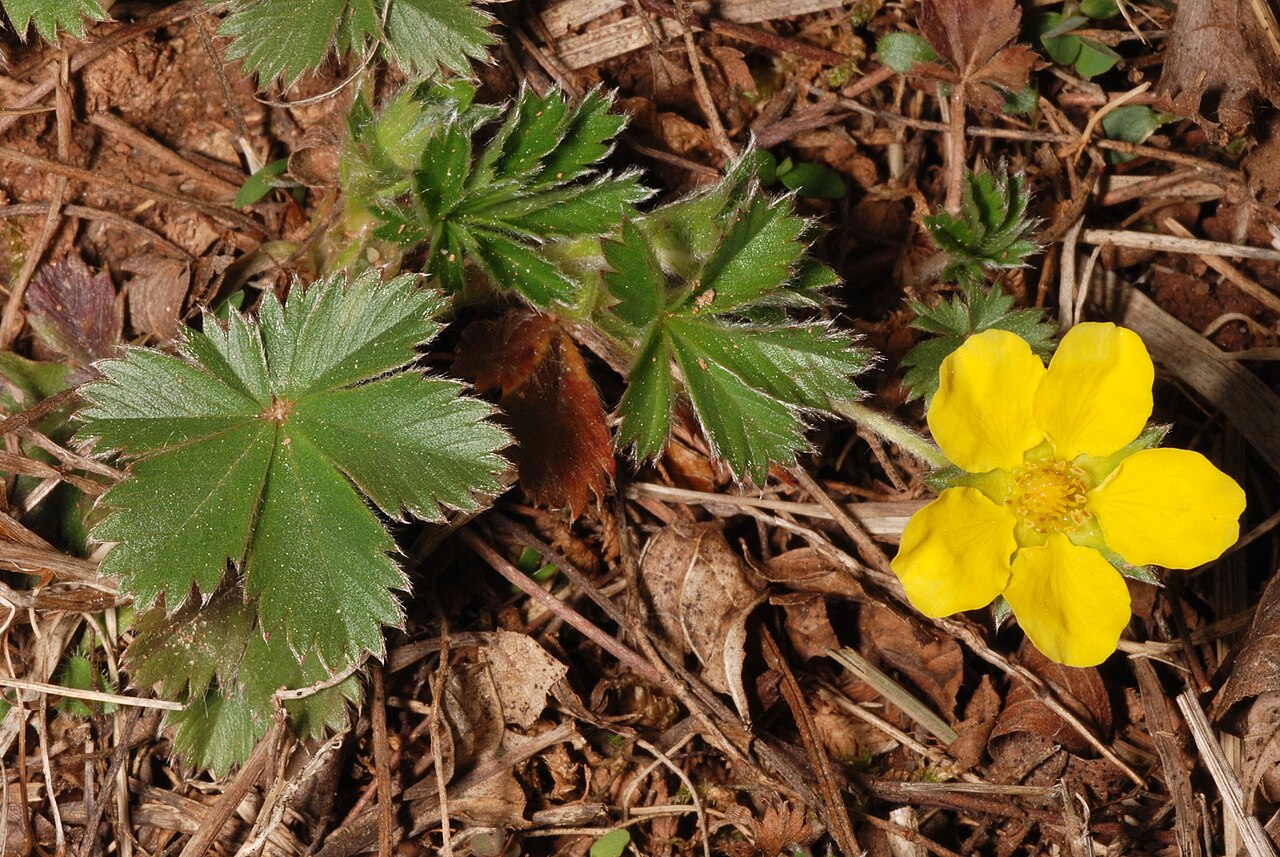
Potentilla canadensis, known as Dwarf Cinquefoil, is a small, low-growing native perennial of dry, open woods, fields and rocky slopes in eastern North America. A member of the rose family (Rosaceae), it forms loose mats of silky-hairy, fan-shaped leaves, each divided into five toothed leaflets, and spreads by slender runners that root at the tips like strawberry runners. From March to May it bears bright yellow, five-petaled flowers about 1/2 inch across, one at a time on slender stalks.
Dwarf cinquefoil is one of the first yellow wildflowers of spring in many areas, blooming a few weeks before its close relative and frequent companion, common cinquefoil (Potentilla simplex). The two are so similar that they are often confused; the clues are in the leaflet teeth and in where the first flower appears on the runner.
This tough little plant thrives in thin, poor, acidic soils where many other plants struggle, and it makes a useful native groundcover for dry, sunny to partly shaded spots, meadow edges and lawn alternatives. Its flowers feed small native bees and flies in early spring, and its leaves host the caterpillars of several native butterflies and moths.
Identification
Dwarf cinquefoil looks a lot like a small, wild strawberry with yellow flowers. Separate it from other cinquefoils by its five leaflets toothed only toward the tip, its early bloom and the position of its first flower.
Growth Habit
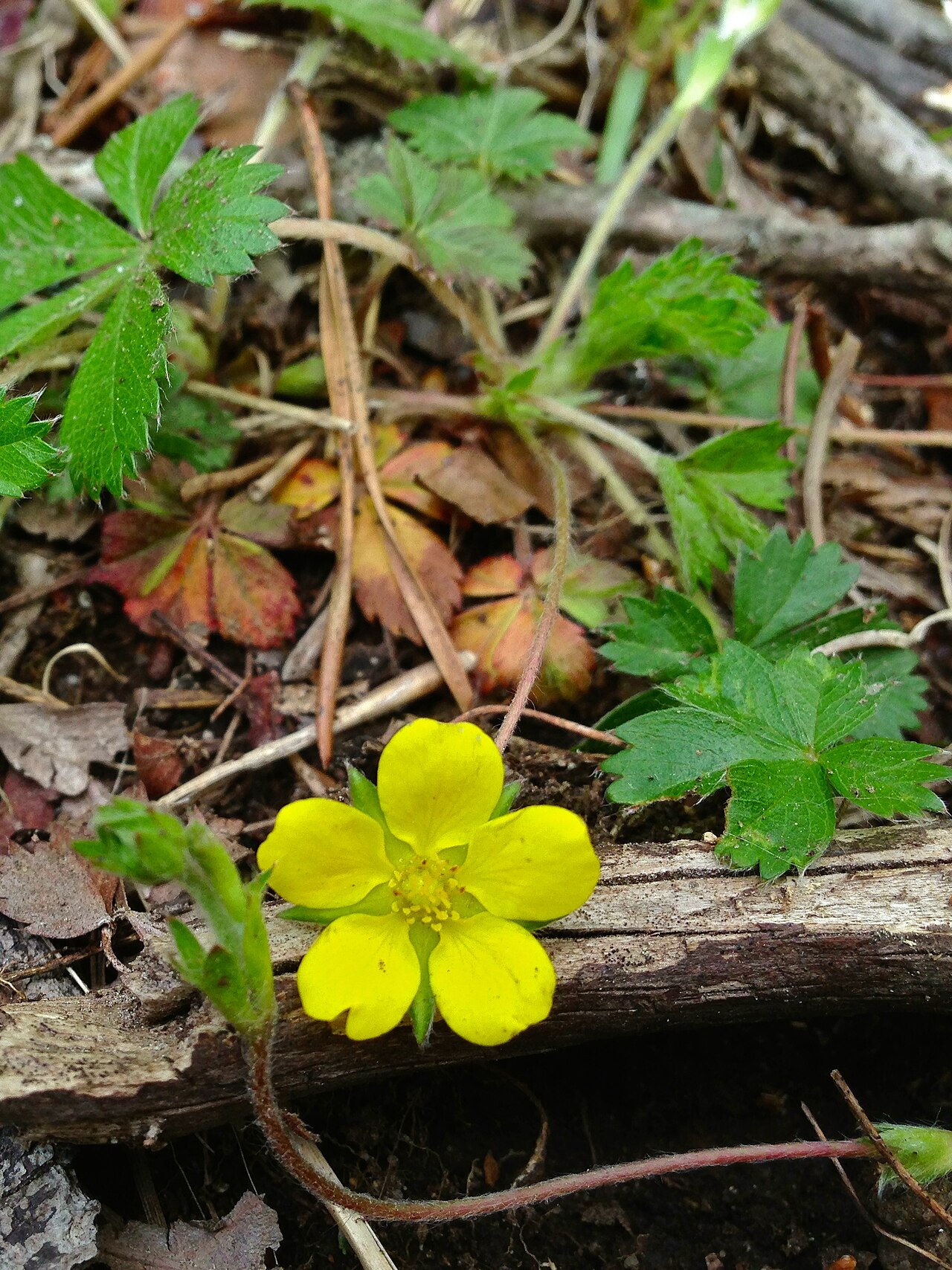
Plants grow only 2 to 6 inches tall from a short, thick rootstock. In spring, stems first grow upright, then lengthen into slender, arching or creeping runners up to about 20 inches long, covered in silky, silvery hairs. Runners root at the tips and form new plants, so dwarf cinquefoil can make loose mats over time.
Leaves
Leaves are palmately compound, with five leaflets that radiate like fingers from the top of the leaf stalk (the name cinquefoil means “five leaves”). Each leaflet is wedge-shaped to obovate, about 1/2 to 1 1/4 inches long, and toothed only on the outer half or less, with smooth edges toward the base. The undersides, and often the upper surfaces, are covered with silky hairs, giving the plant a silvery-green look.
Flowers
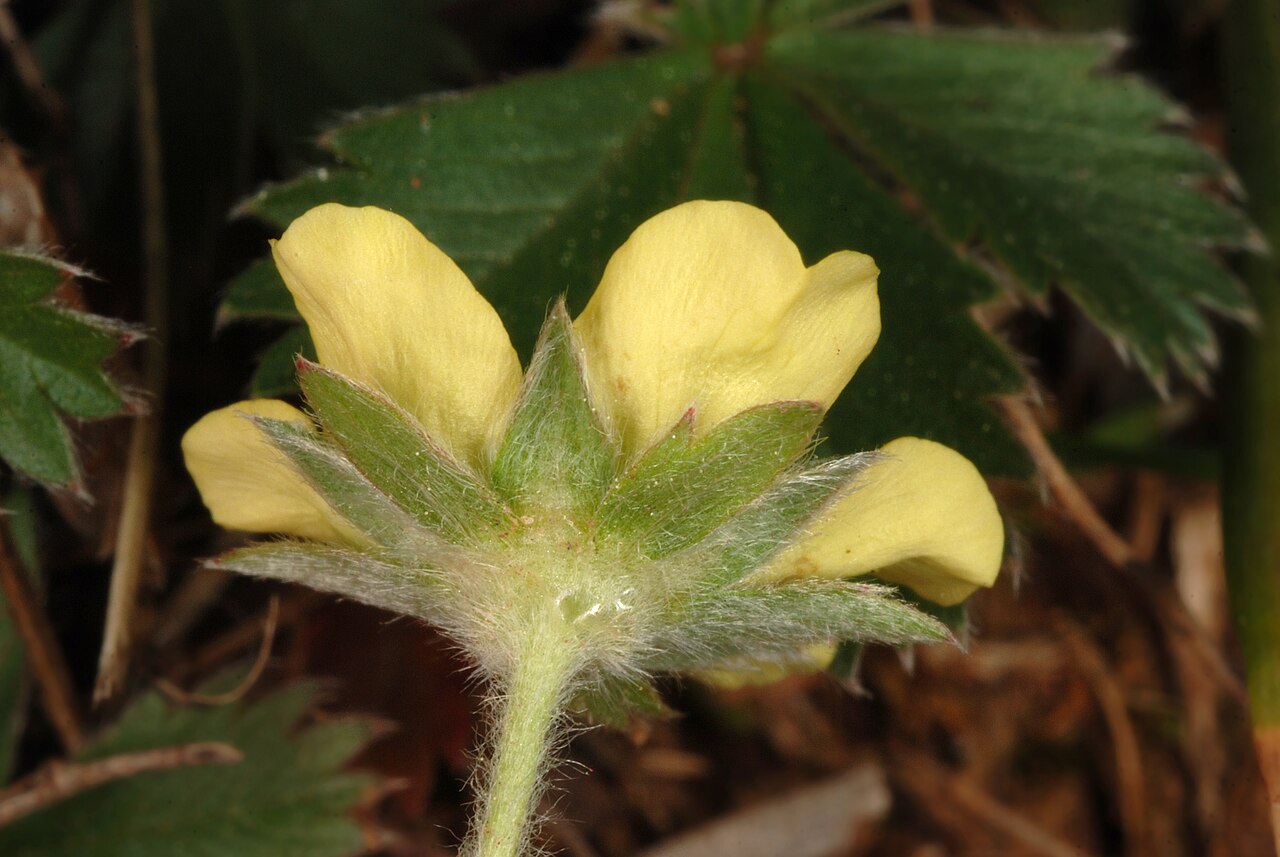
Flowers bloom from March to May, borne singly on slender stalks from the leaf axils. In dwarf cinquefoil, the first flower usually comes from the axil of the first well-developed stem leaf. Each flower is about 1/2 inch across, with five rounded, bright yellow petals, five pointed green sepals alternating with five narrow bracts beneath them, and many stamens around a central cluster of pistils.
Fruit & Seeds
After flowering, the flower develops into a small cluster of tiny, dry, seed-like achenes, held within the persistent sepals. The fruit is not fleshy and has no food value for people. Seeds fall near the plant or are carried short distances by rain and animals.
Look-alikes
Common cinquefoil (P. simplex) is very similar but blooms a little later, has larger leaflets toothed along more than half their length, and its first flower usually arises from the axil of the second stem leaf. Its stems are less hairy, without the silvery look. Wild strawberry has three leaflets and white flowers. Introduced sulphur cinquefoil (P. recta) is an upright plant 1 to 2 feet tall with pale yellow flowers in clusters. Barren strawberry (Geum fragarioides, also called Waldsteinia) has three leaflets and yellow flowers in clusters.
Safety
Dwarf cinquefoil is not known to be toxic to people or pets. Cinquefoils are high in tannins and were used in folk remedies, but the plant is not a food plant and should not be eaten in quantity.
Quick Facts
| Scientific Name | Potentilla canadensis |
| Family | Rosaceae (rose family) |
| Plant Type | Low herbaceous perennial; spreads by runners |
| Mature Height | 2–6 in |
| Mature Spread | 6–20 in; runners root at the tips |
| Growth Rate | Moderate |
| Sun Exposure | Full sun to part shade |
| Water Needs | Low to medium; tolerates dry soil |
| Soil Type | Dry, thin, sandy, gravelly or rocky soils; clay |
| Soil pH | About 4.5–6.5 (acidic) |
| Bloom Time | March–May |
| Flower Color | Bright yellow |
| Fall Color | Some leaves turn reddish in fall |
| Fruit | Small cluster of dry achenes |
| Deer Resistant | Moderate; low and hairy, seldom heavily browsed |
| USDA Hardiness Zones | 3–8 |
Native Range
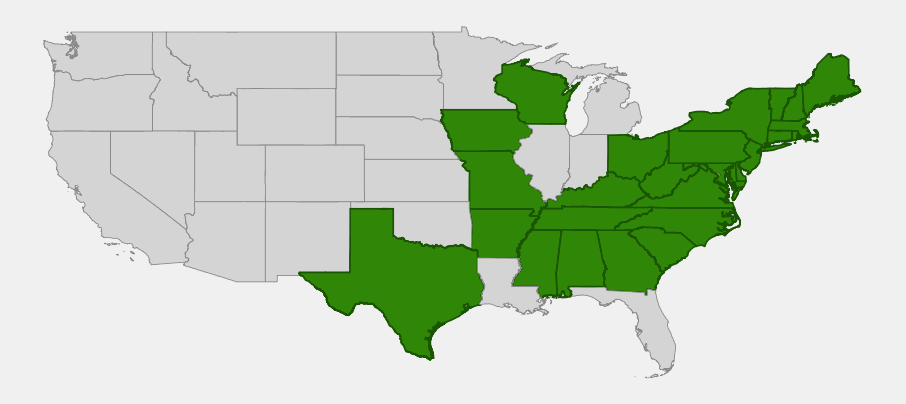
Dwarf cinquefoil is native to eastern North America, from Nova Scotia, New Brunswick, Prince Edward Island, Newfoundland, Quebec and Ontario south through the eastern United States. USDA PLANTS records it in 26 states plus the District of Columbia, from Maine and Vermont west to Wisconsin, Iowa and Missouri, and south to Georgia, Alabama, Mississippi and Arkansas.
It is most common in the Northeast, the mid-Atlantic, and the Appalachian Mountains and Piedmont, where it grows in dry, open woods and old fields. Toward the west it becomes more scattered, reaching the Ozarks of Missouri and Arkansas. USDA also lists Texas, an outlying record well beyond the main range; it is rarely if ever reported there today, and in the Gulf states it is confined mostly to the northern, upland parts.
Its habitats include dry, open oak and pine woods, woodland edges and clearings, old fields, pastures, rocky slopes and ledges, sandy barrens, roadsides and shale banks. It prefers acidic, low-fertility soils and tolerates both sun and light shade.
📋 Regional plant lists featuring Dwarf Cinquefoil: New York, Pennsylvania & Northern New Jersey · Ohio & Indiana · Michigan, Wisconsin & Eastern Minnesota · Kentucky & Tennessee · Connecticut, Massachusetts & Rhode Island · New Hampshire, Maine & Vermont · Maryland, Virginia & West Virginia · Delaware, Southern New Jersey & Long Island · Illinois, Iowa & Missouri · Alabama, Georgia & Mississippi · North & South Carolina · Arkansas, Louisiana, Eastern Oklahoma & Eastern Texas
Growing & Care Guide
Dwarf cinquefoil is one of the easiest native groundcovers for dry, poor, acidic soil. It needs almost no care once established and is best used where its spreading runners can fill in among other low plants. Buy nursery-grown plants or seed.
Light
Full sun to part shade. It flowers best in sun or light, dappled shade, such as at a woodland edge or under high, open trees. In deep shade it becomes sparse.
Soil & Water
Plant it in well-drained, lean soil: sandy, gravelly, rocky or thin clay soils, ideally acidic. It tolerates drought once established and does poorly in rich, wet or heavily fertilized soil, where taller plants crowd it out. Water new plants until they root in.
Planting Tips
Plant in spring or fall, 8 to 12 inches apart, for a loose groundcover. It works well between stepping stones, along dry paths, on sunny slopes, in rock gardens and as part of a low-mow or no-mow lawn mix with native grasses such as poverty oatgrass and with pussytoes and violets.
Pruning & Maintenance
Little maintenance is needed. It tolerates occasional mowing at a high setting. Pull out taller weeds that would shade it. Do not fertilize. If runners spread too far, simply pull or cut them.
Propagation
The easiest method is to pot up rooted runner tips in late summer or fall, or to divide plants in spring. Seed can be sown in fall outdoors or after a period of cold, moist stratification; seedlings grow slowly.
Landscape Uses
- Native groundcover: for dry, sunny to partly shaded spots with poor soil
- Lawn alternatives: a low, flowering addition to no-mow and low-mow areas
- Rock gardens and paths: between stones and along dry, rocky edges
- Early pollinator support: spring flowers for small native bees and flies
- Butterfly gardens: larval host for skippers and moths
Wildlife & Ecological Value
Dwarf cinquefoil is small, but its early flowers and its leaves support a surprising number of insects.
For Pollinators
The open, bowl-shaped flowers offer easy-to-reach nectar and pollen. They are visited mainly by small native bees, such as sweat bees and mining bees (Andrena), and by syrphid flies and bee flies, which are active in early spring when few other flowers are blooming.
For Birds
Birds make little direct use of the plant, though ground-feeding birds may eat some of the small seeds, and the insects it supports are food for birds.
For Mammals
Rabbits and deer occasionally nibble the leaves, but the low, hairy plants are rarely browsed heavily. Small mammals may eat the seeds.
Ecosystem Role
Cinquefoils are larval host plants for the grizzled skipper (Pyrgus centaureae wyandot), a rare butterfly of the Appalachians and Great Lakes region that relies heavily on dwarf cinquefoil in open, dry habitats. They are also hosts for several moths. As a low, spreading plant, dwarf cinquefoil helps cover and stabilize thin, bare soils on slopes and in old fields.
Cultural & Historical Uses
The genus name Potentilla comes from the Latin potens, “powerful,” referring to the medicinal properties that early herbalists attributed to some cinquefoils. The common name cinquefoil comes from the old French words for “five leaves,” and the five-leaflet design appears often in medieval heraldry and Gothic architecture.
Cinquefoils are rich in tannins, and several species, including European tormentil, were used in folk medicine as astringents, for example as a gargle or to treat diarrhea. Some Native American peoples also made medicinal use of cinquefoils. These are historical uses, not recommendations.
Dwarf cinquefoil was described by Linnaeus in 1753 from plants sent from “Canada,” a name then used for much of northeastern North America. For gardeners, it has become valued as a modest, tough native groundcover that blooms early and thrives where little else does.
Frequently Asked Questions
How do I tell dwarf cinquefoil from common cinquefoil?
Dwarf cinquefoil blooms earlier, has smaller leaflets toothed only on the outer half or less, has silvery-hairy stems, and its first flower usually comes from the axil of the first stem leaf. Common cinquefoil has leaflets toothed along more than half their length, and its first flower arises from the second stem leaf.
Is dwarf cinquefoil a weed?
It is a native wildflower that sometimes appears in lawns and fields on poor soil. It spreads by runners but is low and not aggressive, and it is a useful plant for pollinators and butterflies.
Will dwarf cinquefoil grow in shade?
It tolerates light or partial shade, but it flowers best in sun or bright, dappled shade. In deep shade it thins out.
Does dwarf cinquefoil tolerate mowing?
Yes. It is low enough that occasional mowing at a high setting does not harm it, which makes it suitable for low-mow lawns.
Is dwarf cinquefoil related to strawberries?
Yes. Both are in the rose family, and dwarf cinquefoil spreads by runners like a strawberry, but it has five leaflets, yellow flowers and dry, inedible fruits.

Looking for a nursery that carries Dwarf Cinquefoil?
Browse our native plant nursery directory: Alabama & Arkansas · Connecticut, Delaware & Georgia · Iowa · Kentucky, Maine, Maryland, Massachusetts, Mississippi & Missouri · New Hampshire, New Jersey, New York, North Carolina & Ohio · Pennsylvania, Rhode Island, South Carolina, Tennessee, Texas, Vermont & Virginia · West Virginia & Wisconsin