
Redring Milkweed (Asclepias variegata)
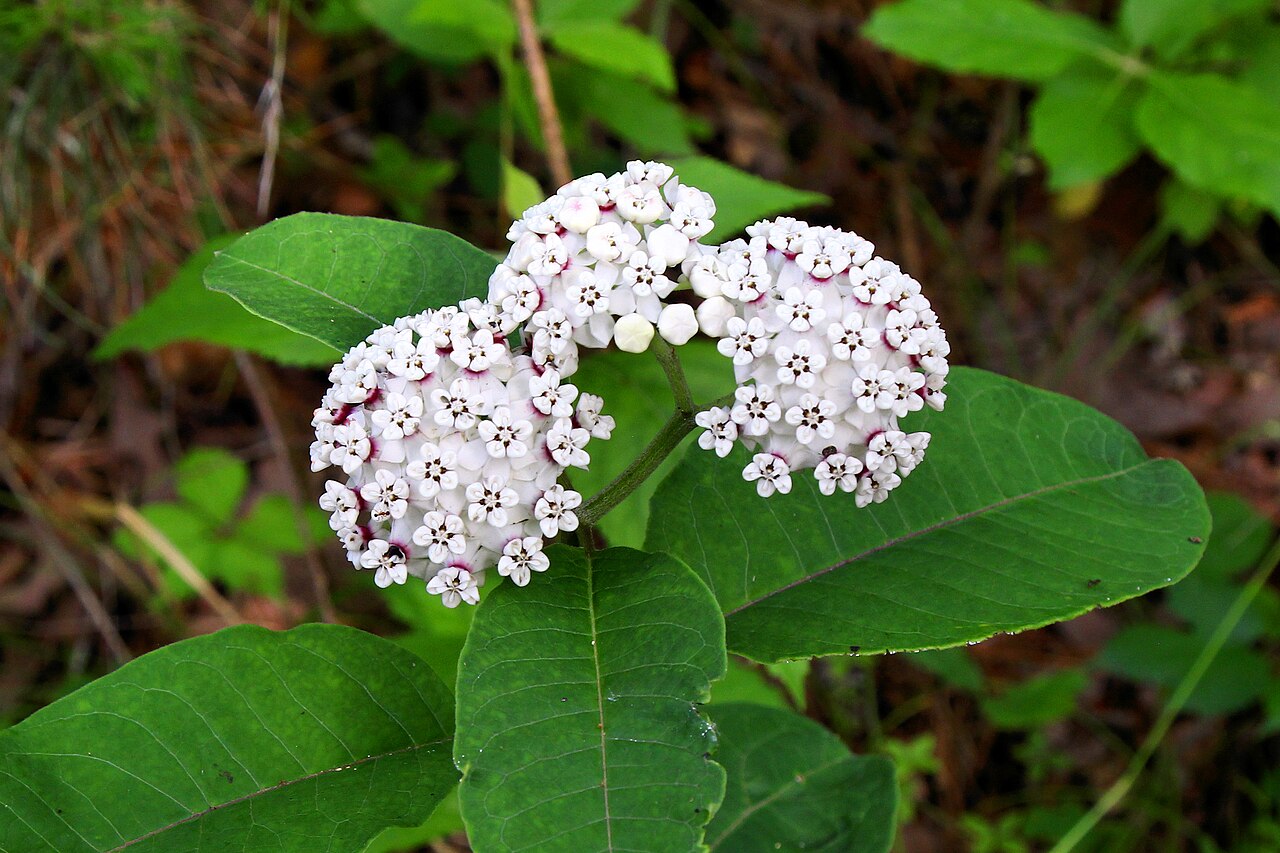
Asclepias variegata, known as Redring Milkweed (USDA: redring milkweed), is a beautiful woodland milkweed of the eastern and southern United States. It is also called white milkweed. It belongs to the dogbane family (Apocynaceae), in the milkweed subfamily. The plant is a perennial 1 to 3 feet tall, usually a single stout stem with two to five pairs of broad, oval, dark green leaves, and it has the milky sap typical of milkweeds.
In late spring and early summer it bears one to a few tight, rounded clusters of bright white flowers at the top of the stem. Each cluster can be 2 to 3 inches across and looks like a snowball. In the center of every flower is a small ring of purple-red, the feature behind the names redring milkweed and variegata (“variegated”). The flowers are fragrant and draw a crowd of butterflies, bees and beetles. Later, slender seed pods split to release silky-tufted seeds.
Redring milkweed grows in dry to moist open woods, woodland edges, rocky slopes and thickets, often in light shade, from New York and Connecticut south to Florida and west to Texas and Oklahoma. It is a host plant for monarch butterfly caterpillars and a great choice for shady pollinator gardens. Safety note: like all milkweeds, it contains toxic cardiac glycosides. Do not eat any part of the plant, and keep it away from livestock and pets.
Identification
Redring milkweed is one of the most striking white milkweeds. Look for the round white flower clusters with purple-red centers, the broad, opposite leaves and a woodland or woodland-edge setting.
Stems & Growth Habit
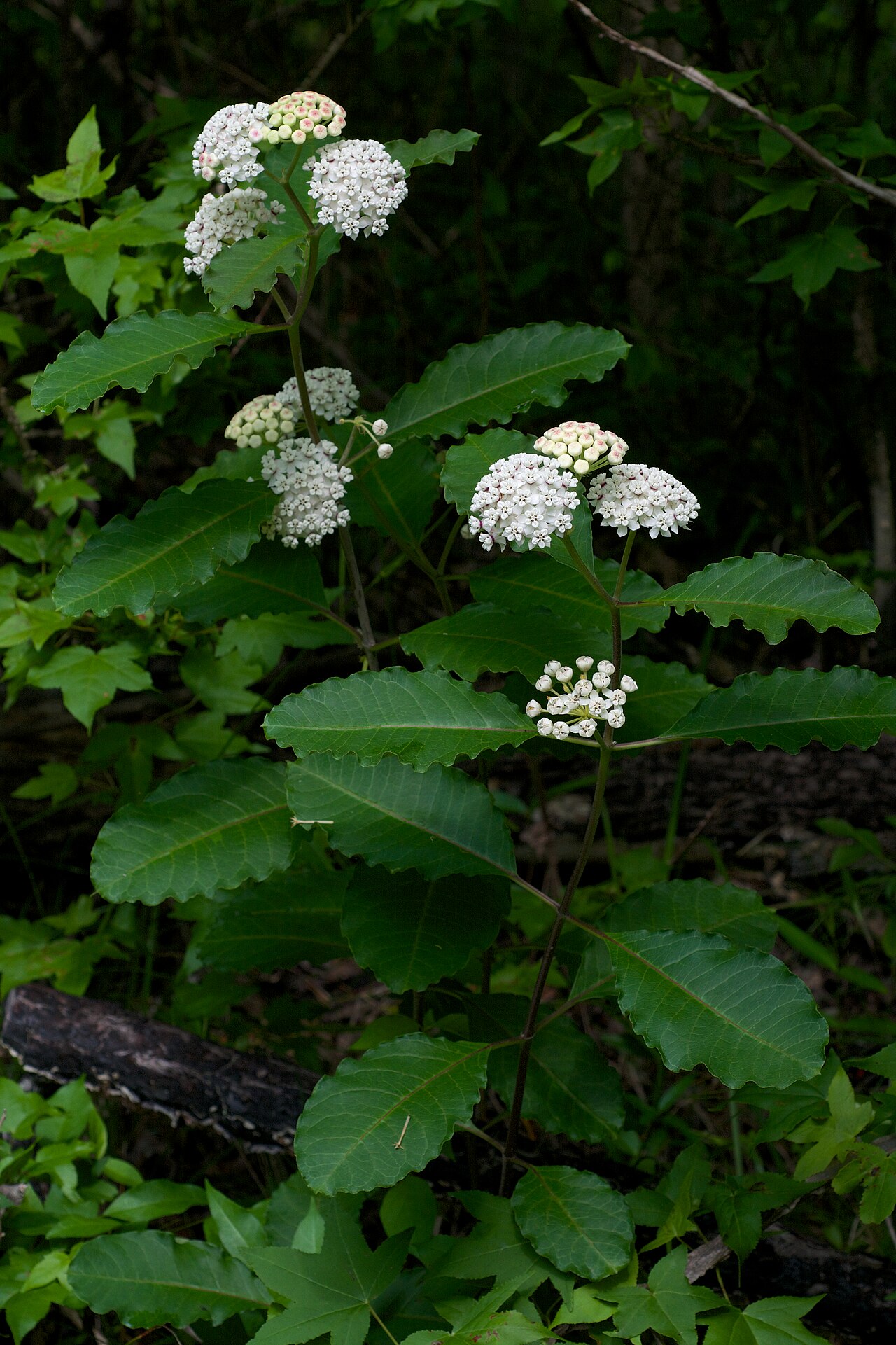
The plant grows from a thick, deep root and usually produces one unbranched stem, 1 to 3 feet tall, which may be smooth or slightly hairy and sometimes purplish. Like other milkweeds, the stem and leaves ooze white, milky latex when broken.
Leaves
The leaves are opposite, in two to five pairs, oval to elliptic, 3 to 6 inches long and 1 1/2 to 3 inches wide, with short stalks and a rounded or slightly pointed tip. They are dark green, smooth above and paler beneath, often with slightly wavy edges.
Flowers
From about May to July, one to four dense, globe-shaped umbels form at the top of the stem and in the upper leaf axils. Each umbel holds 20 to 50 flowers on fuzzy, often purplish stalks. Each flower is about 1/2 inch across, with five white petals bent backward and five white hoods forming a crown. At the base of the crown is a small purple-red ring, which gives the plant its name. The flowers are fragrant.
Fruit & Seeds
After flowering, a few flowers in each cluster develop into slender, smooth or slightly hairy pods (follicles) 4 to 6 inches long, usually held upright on curved stalks. In late summer or fall the pods split along one side, releasing flat brown seeds attached to tufts of silky white hairs that carry them on the wind.
Look-alikes
Whorled Milkweed also has white flowers but very narrow leaves in whorls. Poke Milkweed grows in similar woods but has loose, drooping clusters of greenish white flowers. Four-leaved milkweed (A. quadrifolia) has pink to white flowers and leaves in a whorl of four at mid-stem. No other eastern milkweed has the dense white balls with a red center.
Safety Note
All parts of redring milkweed contain cardiac glycosides (cardenolides), which are toxic to people, pets and livestock if eaten. Do not eat any part of the plant. The milky sap can irritate skin and is especially harmful in the eyes, so wear gloves when handling it and wash your hands afterward. Plant it away from pastures where livestock might graze it.
Quick Facts
| Scientific Name | Asclepias variegata |
| Family | Apocynaceae (dogbane family; milkweed subfamily) |
| Plant Type | Herbaceous perennial with a deep root |
| Mature Height | 1–3 ft |
| Mature Spread | 1–1.5 ft |
| Growth Rate | Slow to moderate |
| Sun Exposure | Part shade to full sun |
| Water Needs | Low to medium; well-drained soil |
| Soil Type | Sandy, rocky or loamy woodland soils |
| Soil pH | About 5.0–7.0 |
| Bloom Time | May–July |
| Flower Color | White with a purple-red center |
| Fall Color | Leaves turn yellow |
| Fruit | Slender pod (follicle) with silky-tufted seeds |
| Deer Resistant | Yes; toxic sap deters browsing |
| USDA Hardiness Zones | 5–9 |
Native Range
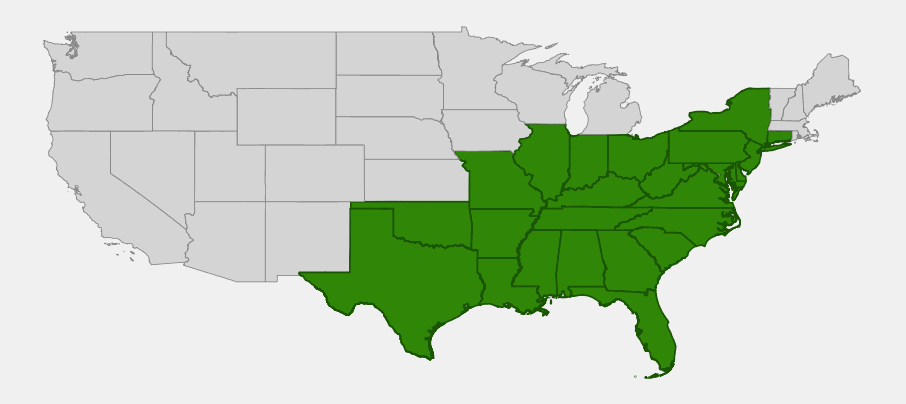
Redring milkweed is native to the eastern and south-central United States and formerly to southern Ontario. USDA PLANTS records it in 24 states and the District of Columbia. It ranges from southern New York and Connecticut south through New Jersey, Pennsylvania, Delaware, Maryland, Virginia, West Virginia and the Carolinas to Georgia and northern Florida, and west through Ohio, Indiana, Illinois, Kentucky, Tennessee and Missouri to Alabama, Mississippi, Louisiana, Arkansas, eastern Oklahoma and East Texas.
It is most common in the Southeast, the southern Appalachians, the Ozarks and the Ouachita Mountains. At the northern edge of its range it is rare: NatureServe lists it as known only from historical records in Connecticut and New Jersey and as critically imperiled in New York and Pennsylvania, and it is considered extirpated in Ontario.
It grows in dry to moist open woods, woodland edges, rocky slopes and ridges, oak-hickory and pine-oak forests, thickets, ravine bottoms and roadsides through woods, often in sandy or rocky soil and light shade. It benefits from openings created by fire, storms or light thinning.
📋 Regional plant lists featuring Redring Milkweed: New York, Pennsylvania & Northern New Jersey · Ohio & Indiana · Kentucky & Tennessee · Connecticut, Massachusetts & Rhode Island · New Hampshire, Maine & Vermont · Maryland, Virginia & West Virginia · Delaware, Southern New Jersey & Long Island · Illinois, Iowa & Missouri · Alabama, Georgia & Mississippi · North & South Florida · North & South Carolina · Arkansas, Louisiana, Eastern Oklahoma & Eastern Texas
Growing & Care Guide
Redring milkweed is less common in nurseries than butterfly weed or swamp milkweed, but native plant nurseries in the East and South sometimes offer it, and it can be grown from seed. It is slow to establish and dislikes being moved, so pick a permanent spot. Buy nursery-grown plants or seed; never dig wild plants, especially where it is rare.
Light
Plant it in part shade to filtered sun, such as at a woodland edge, under high oaks or pines, or on the east side of a building. It also grows in full sun if the soil does not dry out too much, but it is one of the best milkweeds for light shade.
Soil & Water
It prefers well-drained, sandy, rocky or loamy soil that is slightly acidic. It tolerates dry spells once established thanks to its deep root, but it does not tolerate poorly drained or waterlogged soil. Water young plants during their first summer.
Planting Tips
Plant small container-grown plants in spring or fall, disturbing the roots as little as possible. Space plants about 12 to 18 inches apart. Mark their location, since they emerge late in spring. Combine with woodland-edge wildflowers and grasses, such as green-and-gold, wild bergamot and little bluestem.
Pruning & Maintenance
No pruning is needed. Leave the stems and pods in place to let seeds disperse, and expect monarch and milkweed tussock moth caterpillars to eat the leaves; the plant will recover the next year. Avoid insecticides, which harm the insects that depend on milkweeds.
Propagation
Grow it from seed. Sow seed outdoors in fall, or give it 30 to 60 days of cold, moist stratification before sowing in spring. Seedlings form a deep taproot and may take two to three years to bloom. Established plants rarely survive being dug up and moved.
Landscape Uses
- Shade pollinator gardens: one of the few milkweeds that blooms well in light shade
- Monarch habitat: a host plant for monarch caterpillars in woodland settings
- Woodland edge plantings: showy white flowers under high trees and along paths
- Native restoration: oak-hickory and pine-oak woodland and savanna restoration
- Cutting and specimen plants: fragrant snowball flower clusters in late spring
Wildlife & Ecological Value
Like all milkweeds, redring milkweed is a powerhouse for insects, providing nectar for many pollinators and food for the specialized insects that eat milkweeds.
For Pollinators
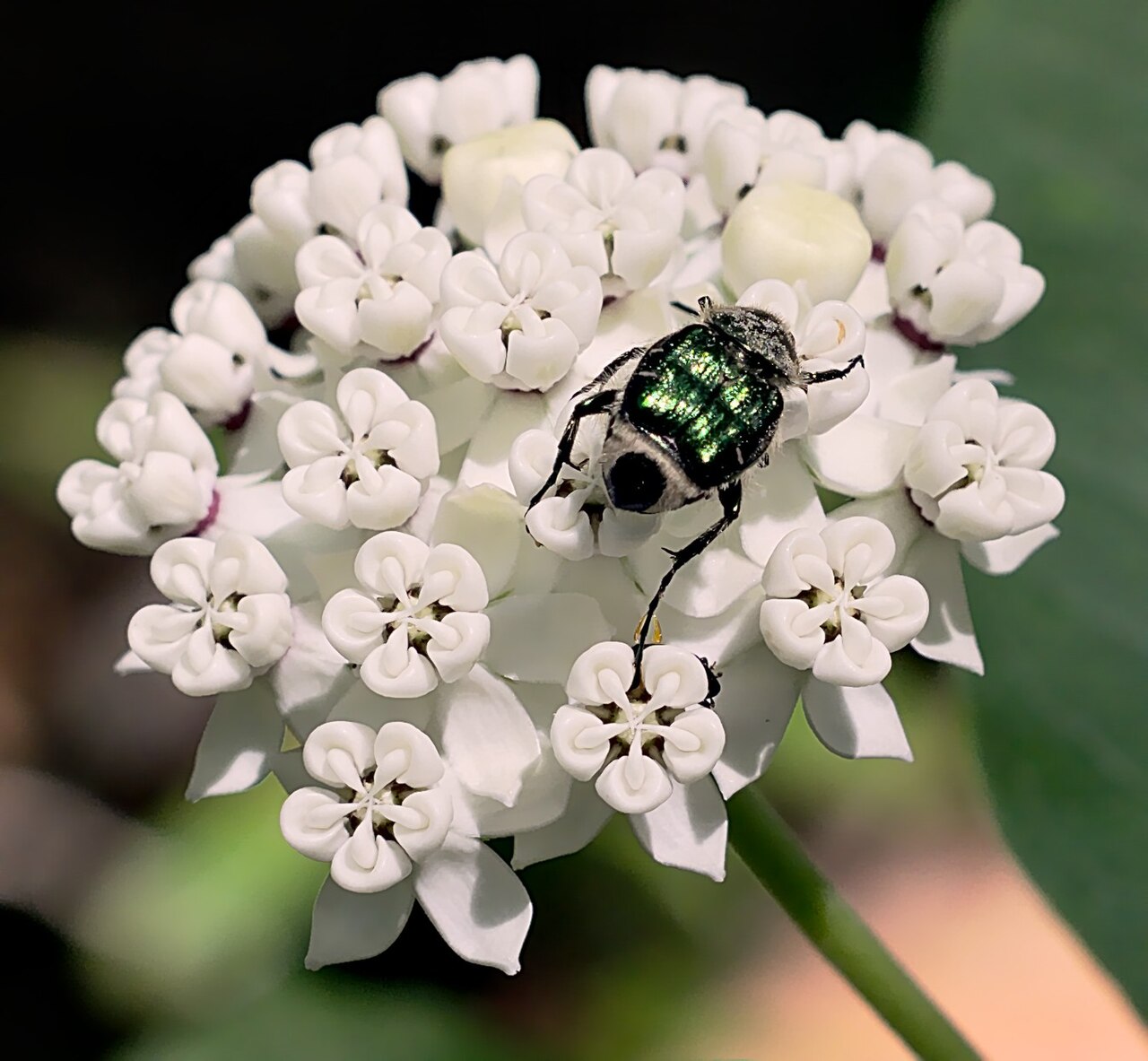
The fragrant flowers attract many butterflies, including swallowtails, fritillaries and hairstreaks, plus bumblebees and other native bees, wasps and flower scarabs. Milkweed pollen is packed in pairs of sacs (pollinia) that clip onto insect legs and are carried to the next flower.
For Birds
Birds rarely eat milkweeds, but some use the silky seed fluff to line their nests. The plants attract insects that birds feed to their young.
For Mammals
The toxic sap protects it from most browsing mammals, including deer and rabbits.
Ecosystem Role
Redring milkweed is a host plant for monarch butterfly caterpillars, which store the plant’s toxins and become distasteful to predators. It also feeds milkweed tussock moths, milkweed bugs and milkweed beetles. As a woodland milkweed, it extends monarch habitat into partly shaded areas where few other milkweeds grow.
Cultural & Historical Uses
The genus name Asclepias honors Asklepios, the Greek god of medicine, and many milkweeds were used in traditional medicine. The species name variegata refers to the two-colored flowers, white with a purple-red center. Carl Linnaeus named the species in 1753.
Milkweeds became a symbol of monarch conservation in recent decades, as monarch numbers fell. Gardeners in the East have been encouraged to plant a variety of native milkweeds, and redring milkweed is valued because it fills a niche in shady and woodland gardens where common milkweed and butterfly weed do poorly.
At the northern edge of its range, redring milkweed has become rare and is protected or listed as endangered in several states. It was once found in southern Ontario but is now considered extirpated there, making conservation of its remaining northern populations important.
Frequently Asked Questions
Is redring milkweed a host plant for monarchs?
Yes. Monarch butterflies lay eggs on redring milkweed, and the caterpillars eat its leaves. It is especially useful in partly shaded gardens.
Is redring milkweed poisonous?
Yes. Like all milkweeds, it contains cardiac glycosides that are toxic to people, pets and livestock if eaten. The milky sap can irritate skin and eyes, so wear gloves and wash your hands after handling it.
Can redring milkweed grow in shade?
Yes. It grows naturally in open woods and woodland edges and does well in part shade or filtered sun. It also tolerates full sun if the soil is not too dry.
How do I tell redring milkweed from other white milkweeds?
Look for dense, round white flower clusters with a purple-red ring in the center of each flower and broad, opposite, oval leaves. Whorled milkweed has narrow leaves, and poke milkweed has loose, drooping clusters.
Can I transplant redring milkweed?
It is difficult. Its deep taproot is easily damaged, and moved plants often die. Start with small nursery plants or seed and plant them in a permanent spot.

Looking for a nursery that carries Redring Milkweed?
Browse our native plant nursery directory: Alabama & Arkansas · Connecticut, Delaware, Florida & Georgia · Illinois & Indiana · Kentucky, Louisiana, Maryland, Mississippi & Missouri · New Jersey, New York, North Carolina, Ohio & Oklahoma · Pennsylvania, South Carolina, Tennessee, Texas & Virginia · West Virginia