
Littleleaf Rhatany (Krameria erecta)
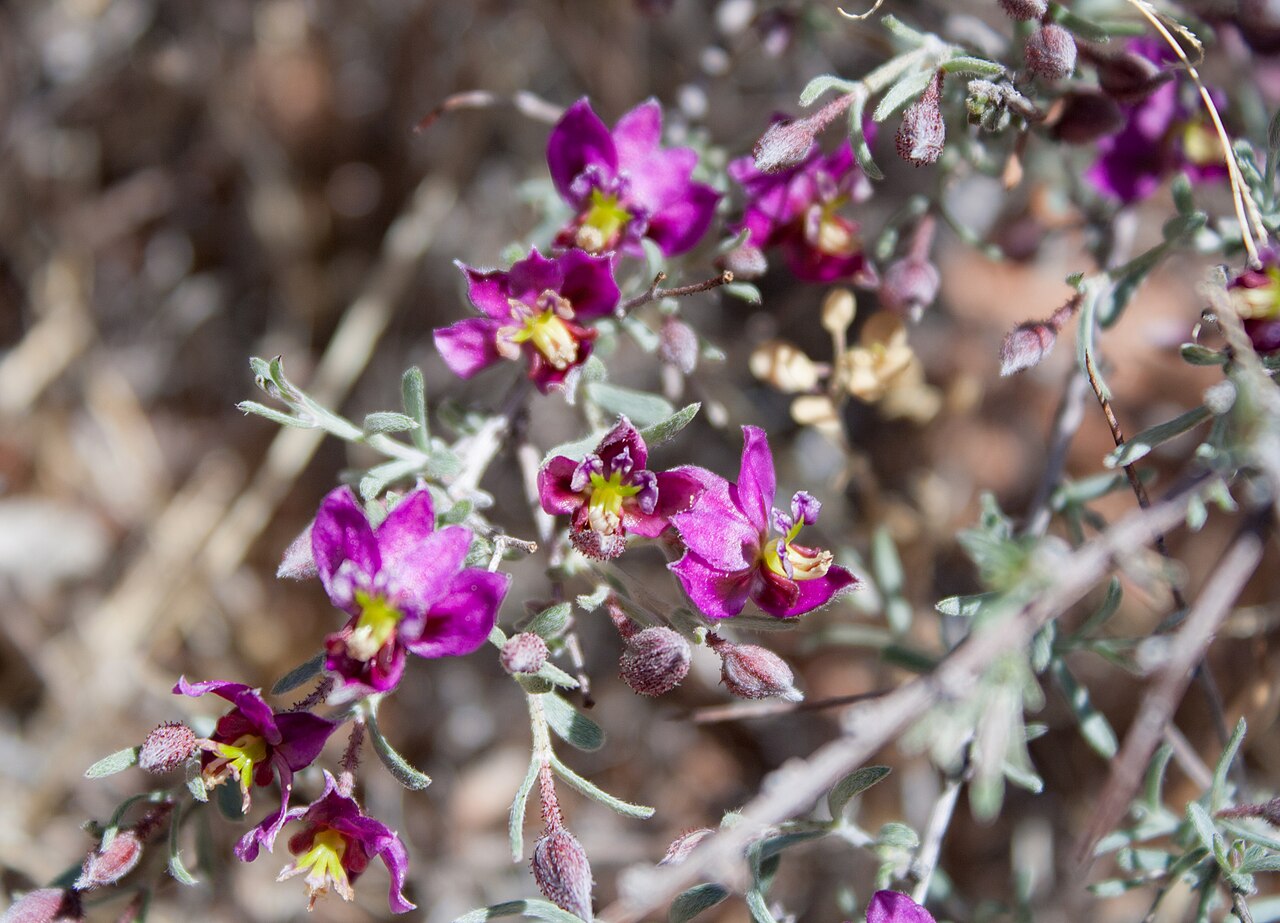
Krameria erecta, known as Littleleaf Rhatany, littleleaf ratany or range ratany, is a low, grayish desert shrub of the southwestern United States and northern Mexico. In spring, and again after summer rains, its tangled, gray-hairy branches are covered with striking magenta to reddish-purple flowers about 3/4 inch across. They are followed by round, spiny burs. It was formerly called Krameria parvifolia, a name still found in older references.
Littleleaf rhatany belongs to the small rhatany family (Krameriaceae), and it is a hemiparasite. It has green leaves and makes its own food by photosynthesis, but its roots attach to the roots of nearby plants, such as creosote bush and bursage, and draw water and nutrients from them. Its flowers are also unusual: instead of nectar, they offer floral oils, which are collected by specialized oil-collecting bees.
Because it depends on host plants, littleleaf rhatany is very difficult to grow and is almost never sold. This page is mainly a guide to identifying and appreciating it in the wild, where it is common on desert flats, slopes and washes from California to West Texas.
Identification
Look for a low, intricately branched gray shrub with tiny, narrow, hairy leaves, magenta flowers with five spreading sepals in spring, and round fruits covered with barbed spines.
Growth Habit
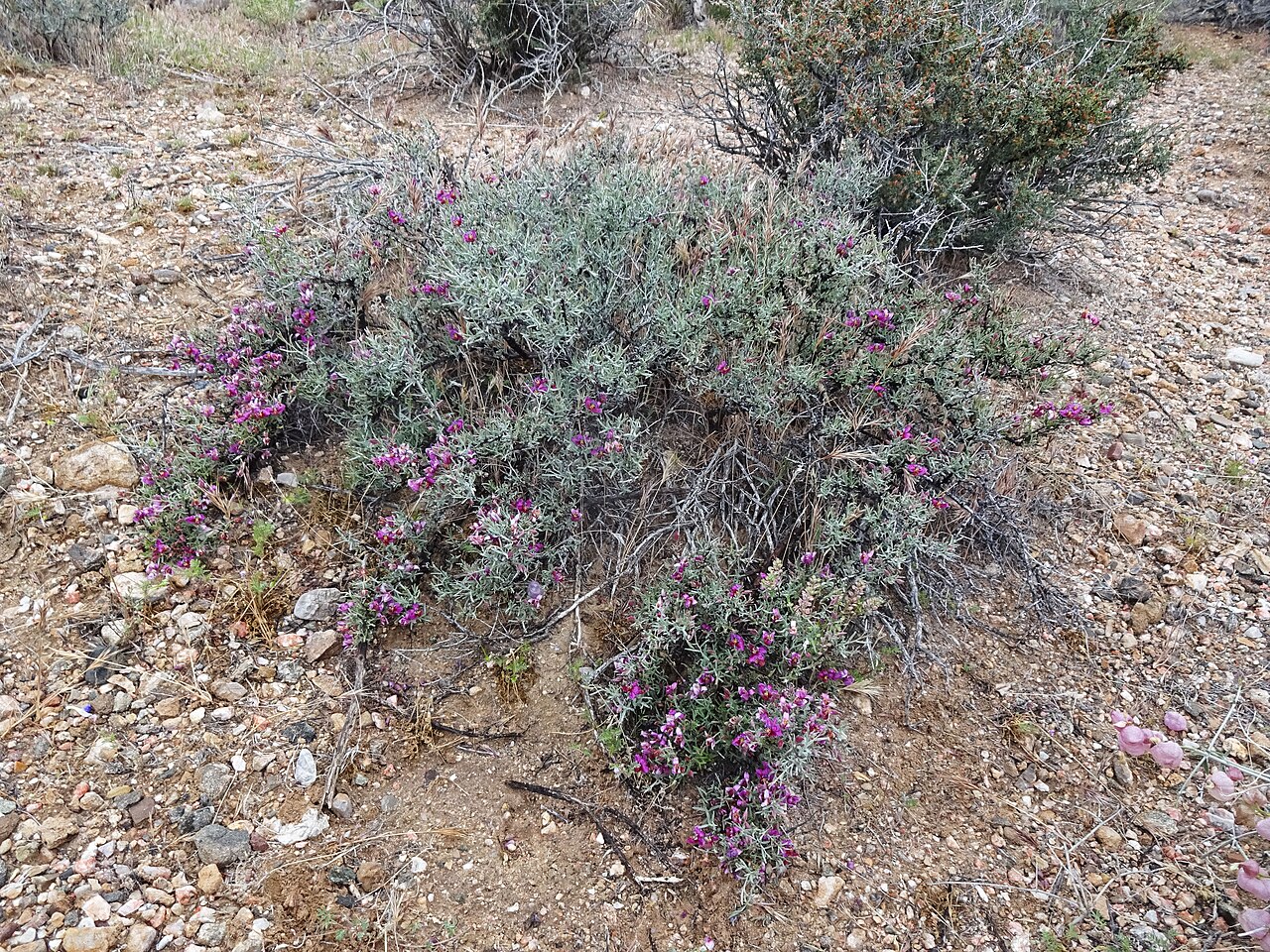
Littleleaf rhatany is a low, rounded, much-branched shrub, usually 1 to 2 feet tall (occasionally to 3 feet) and 2 to 3 feet wide. The stems are stiff and often tangled, and the whole plant is covered with fine gray hairs, giving it a silvery to gray-green look. It may lose many of its leaves in drought.
Leaves
The leaves are alternate, small and narrow, about 1/4 to 1/2 inch long, linear to narrowly oblong, pointed and densely hairy. They are stalkless and often look like small gray needles along the branches.
Flowers
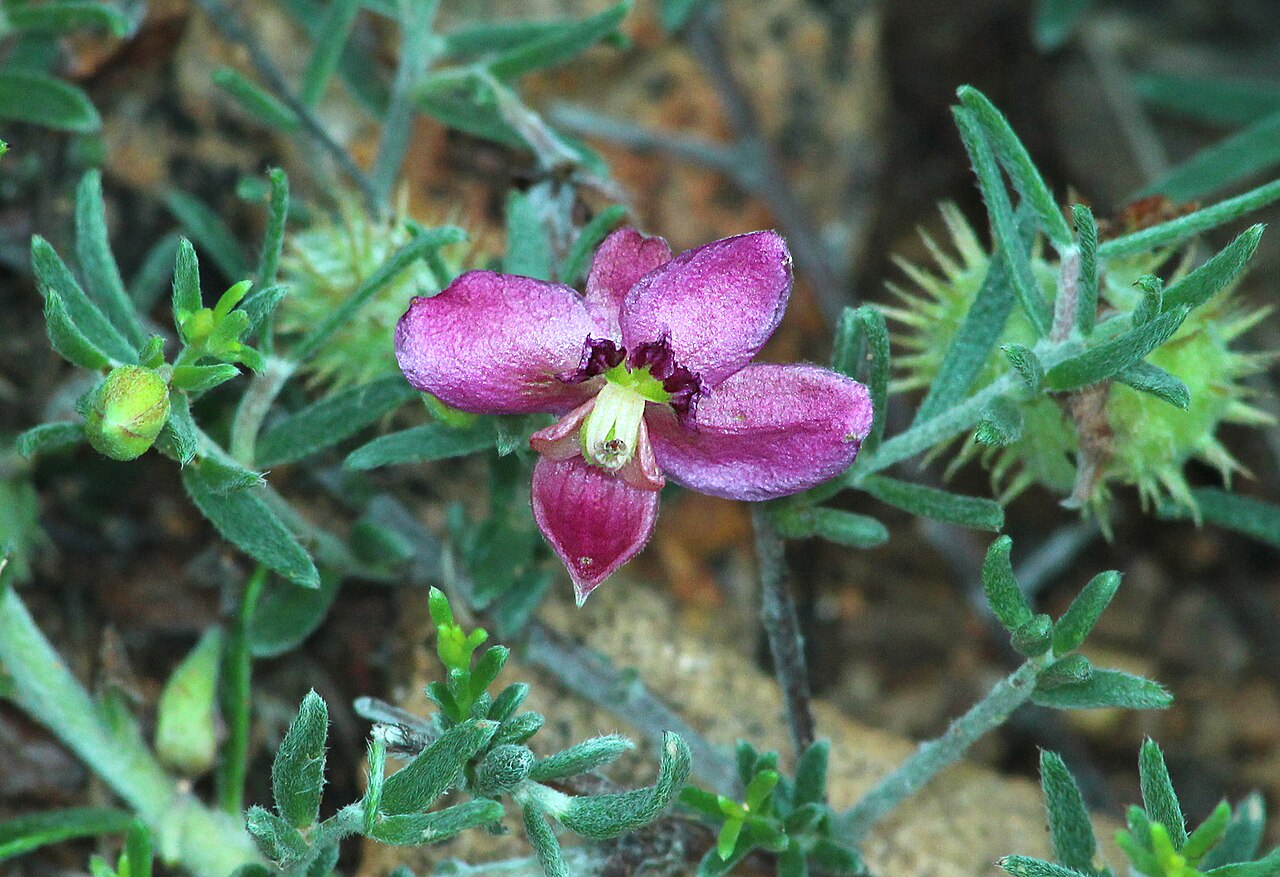
The flowers grow singly or a few together near the branch tips. Each is about 3/4 inch across, with five large, spreading, magenta to purple-red sepals that look like petals. The true petals are small and unequal: the three upper ones are narrow and clawed, and the two lower ones are reduced to thick, cushion-like glands (elaiophores) that produce oil. There are four stamens. Bloom time is mainly March to May, with another flush after summer rains.
Fruit & Seeds
The fruit is a round, one-seeded bur about 1/4 to 3/8 inch across, covered with slender spines. In this species, the spines carry small barbs along much of their length. The burs cling to animal fur, which spreads the seed.
Look-alikes
White ratany (Krameria bicolor, also called K. grayi) is a larger, more spiny-branched shrub with whitish bark and spines on its fruit that are barbed only near the tip. Trailing ratany (K. lanceolata) is a low, sprawling perennial with longer leaves, mainly in grasslands. From a distance, littleleaf rhatany can be mistaken for small legume shrubs such as dalea, but its flowers and spiny fruit are distinctive.
Quick Facts
| Scientific Name | Krameria erecta (formerly K. parvifolia) |
| Family | Krameriaceae (rhatany family) |
| Plant Type | Low hemiparasitic desert shrub |
| Mature Height | 1–2 ft (rarely 3 ft) |
| Mature Spread | 2–3 ft |
| Growth Rate | Slow |
| Sun Exposure | Full sun |
| Water Needs | Very low |
| Soil Type | Sandy, gravelly or rocky desert soils |
| Soil pH | Neutral to alkaline (about 7.0–8.5) |
| Bloom Time | March–May; again after summer rains |
| Flower Color | Magenta to reddish purple |
| Fall Color | None; often leafless in drought |
| Fruit | Round bur with barbed spines |
| Deer Resistant | Moderate; browsed by livestock and wildlife |
| USDA Hardiness Zones | 8–10 |
Native Range
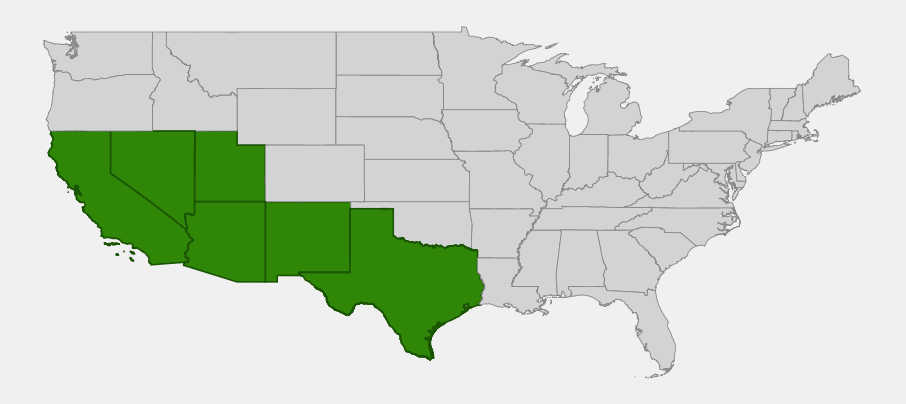
Littleleaf rhatany grows across the warm deserts of the southwestern United States and northern Mexico. USDA PLANTS lists it as native in Arizona, California, Nevada, New Mexico, Texas and Utah. In Mexico it grows in Baja California, Sonora, Chihuahua and other northern states.
It is common in the Mojave and Sonoran Deserts of southeastern California, southern Nevada and Arizona, and reaches its northern limit in southwestern Utah. Farther east it grows in the Chihuahuan Desert of southern New Mexico and West Texas, especially the Trans-Pecos and the Big Bend region.
Its habitats are open, dry desert plains, bajadas, rocky slopes, mesas and the edges of washes, usually in creosote bush scrub, desert grassland and the lower edge of pinyon-juniper woodland. It grows from near sea level to about 5,000 feet.
📋 Regional plant lists featuring Littleleaf Rhatany: Utah & Western Colorado · Arizona & New Mexico · South & West Texas · California & Nevada
Can You Grow It?
Honestly, littleleaf rhatany is not a practical garden plant. It is a root hemiparasite that needs to attach to the roots of host shrubs, its seeds are hard to germinate, and it does not tolerate transplanting. It is almost never offered by nurseries.
Light
In the wild it grows in full desert sun. It would need full sun in any garden setting.
Soil & Water
It grows in sandy, gravelly or rocky, very well-drained desert soils and gets by on natural rainfall alone. Regular garden watering and rich soil are harmful to it.
Planting Tips
If you live in the desert and already have it on your property, the best approach is to protect it and its host shrubs, such as creosote bush and bursage, rather than move it. Never dig plants from the wild: the roots are attached to their hosts and the plants almost always die when moved.
Pruning & Maintenance
None is needed. Leave existing plants and their neighbors undisturbed, and avoid clearing the native shrubs around them.
Propagation
Propagation is experimental. Seeds have hard coats and very low germination, and seedlings need a suitable host plant growing nearby to survive. Restoration projects sometimes sow seed among existing desert shrubs, but results are unpredictable.
Where to See It
- Desert parks and preserves: common in Joshua Tree, Saguaro, Organ Pipe and Big Bend National Parks, Red Rock Canyon and Anza-Borrego
- Spring wildflower walks: its magenta flowers stand out among gray desert shrubs from March to May
- Pollinator watching: look for oil-collecting Centris bees visiting the flowers
- Existing desert landscapes: protect plants already growing on your land, along with their host shrubs
- Natural desert restoration: part of the native shrub community that recovers on undisturbed land
Wildlife & Ecological Value
Littleleaf rhatany has one of the most specialized pollination systems among desert shrubs.
For Pollinators
The flowers produce no nectar. Instead, the two gland-like lower petals produce oil, which female Centris bees (and some other oil-collecting bees) scrape off with special combs on their legs and mix with pollen to feed their larvae and line their nests. In the process, they pollinate the flowers. These bees depend heavily on Krameria in the desert Southwest.
For Birds
It provides cover for small ground-dwelling birds. The spiny burs are not a major bird food.
For Mammals
Desert bighorn sheep, mule deer, jackrabbits and livestock browse it, and it is considered good forage in desert ranges. The burs catch in fur, which spreads the seed.
Ecosystem Role
As a hemiparasite it connects to the roots of many different host plants. It is part of the diverse shrub community of the warm deserts and supports the specialist oil-collecting bees that also visit a few other oil-producing plants.
Cultural & Historical Uses
The genus is named for Johann Georg Heinrich Kramer, an 18th-century Austrian physician and botanist. The common name “rhatany” (or “ratany”) comes from a South American name for the related Krameria lappacea, whose roots were traded as an astringent medicine.
Rhatany roots are rich in tannins and red pigments. Several Indigenous peoples of the Southwest used the roots of local Krameria species to make a reddish-brown dye for baskets and leather, and in traditional remedies. It should not be used as a home remedy.
The name Krameria parvifolia (“small-leaved Krameria”) was long used for this plant in the United States. Botanists now generally treat it as part of Krameria erecta, which was described earlier from Mexico.
Frequently Asked Questions
Is littleleaf rhatany a parasite?
It is a hemiparasite. It has green leaves and photosynthesizes, but its roots attach to the roots of other plants, such as creosote bush and bursage, and take water and nutrients from them.
Can I grow littleleaf rhatany in my garden?
Realistically, no. It needs host plants, its seeds rarely germinate, and it does not survive transplanting. If it already grows on your land, protect it and its host shrubs.
Why do the flowers produce oil?
The oil is the reward for pollinators. Specialized Centris bees collect it to feed their larvae and line their nests, and pollinate the flowers in the process.
Is Krameria parvifolia the same plant?
Yes. Krameria parvifolia is an older name now included in Krameria erecta.
When does littleleaf rhatany bloom?
Mainly from March to May, with another flush of flowers after summer monsoon rains.

Looking for a nursery that carries Littleleaf Rhatany?
Browse our native plant nursery directory: Arizona · California · Nevada & New Mexico · Texas & Utah