
Tall Thistle (Cirsium altissimum)
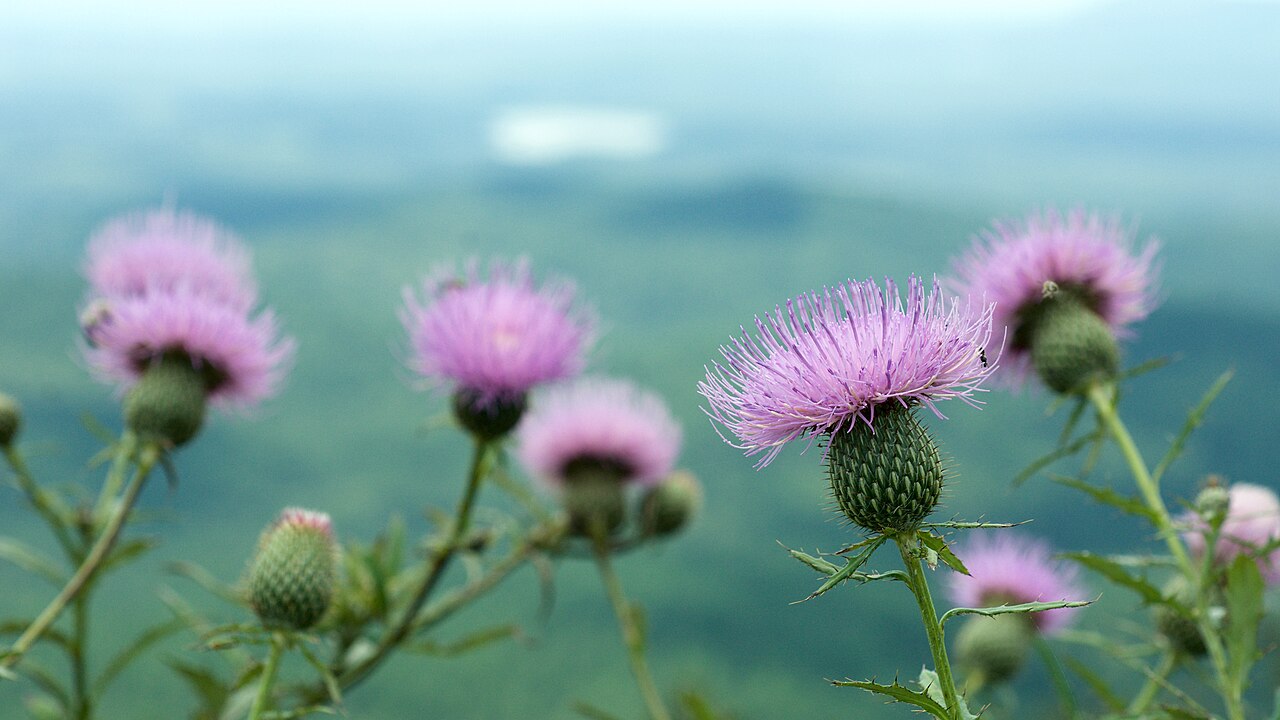
Cirsium altissimum, known as Tall Thistle or roadside thistle, is a native thistle of open woods, prairies, thickets and old fields across the eastern and central United States. It belongs to the aster family (Asteraceae) and usually lives two years or a little longer, forming a leafy rosette before sending up a tall flowering stem.
As the name says, it is tall: flowering stems usually reach 3 to 8 feet and sometimes more, branching near the top. From midsummer into fall each branch ends in a pink-purple to lavender, brush-like flower head about 1 1/2 to 2 inches across. Its leaves are green above and white with woolly hairs beneath, and they are much less spiny than those of the weedy, introduced thistles.
Native thistles like this one are some of the most valuable late-season wildflowers for wildlife. Bumble bees, butterflies and hummingbird moths visit the flowers, and goldfinches feed on the seeds and line their nests with the down. Tall thistle is often pulled up by mistake as a weed, but it is a native plant that is well behaved and worth keeping in meadows and wild gardens.
Identification
Look for a tall, branched thistle with soft-spined leaves that are white-woolly underneath, stems without spiny wings, and pink-purple heads from July to October.
Growth Habit
Tall thistle is a biennial or short-lived perennial. In its first year it forms a flat rosette of large leaves. In the second year (or later) it sends up a stout, ribbed, hairy stem, usually 3 to 8 feet tall and occasionally taller, that branches in the upper part. The stems are not winged and have no spines along them, an easy way to tell it from bull thistle. After flowering and setting seed, the plant usually dies.
Leaves
The leaves are alternate, lance-shaped to elliptic and up to about a foot long on the lower stem, smaller above. Most upper leaves are unlobed or only shallowly lobed, with small, weak spines along the edges. The upper surface is green and slightly rough, while the underside is covered with dense, white, felt-like hairs. Rosette leaves may be more deeply lobed.
Flowers
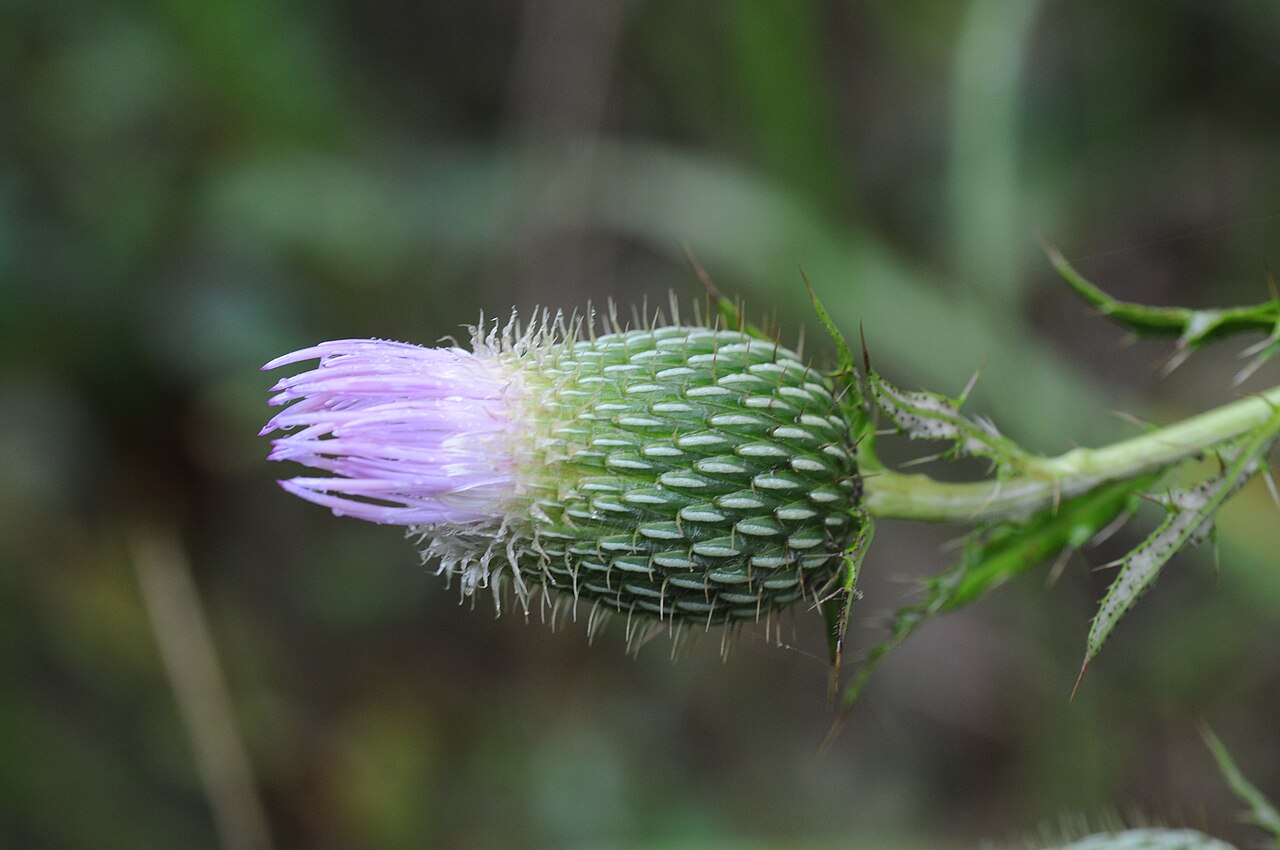
Flower heads appear from about July to October, one at the end of each branch. Each head is about 1 1/2 to 2 inches wide and made entirely of slender, pink-purple to lavender disk florets; there are no ray flowers. Below the florets is a cup of overlapping green bracts. The outer bracts end in short, weak spines, and most have a narrow, dark, sticky ridge running down the back.
Fruit & Seeds
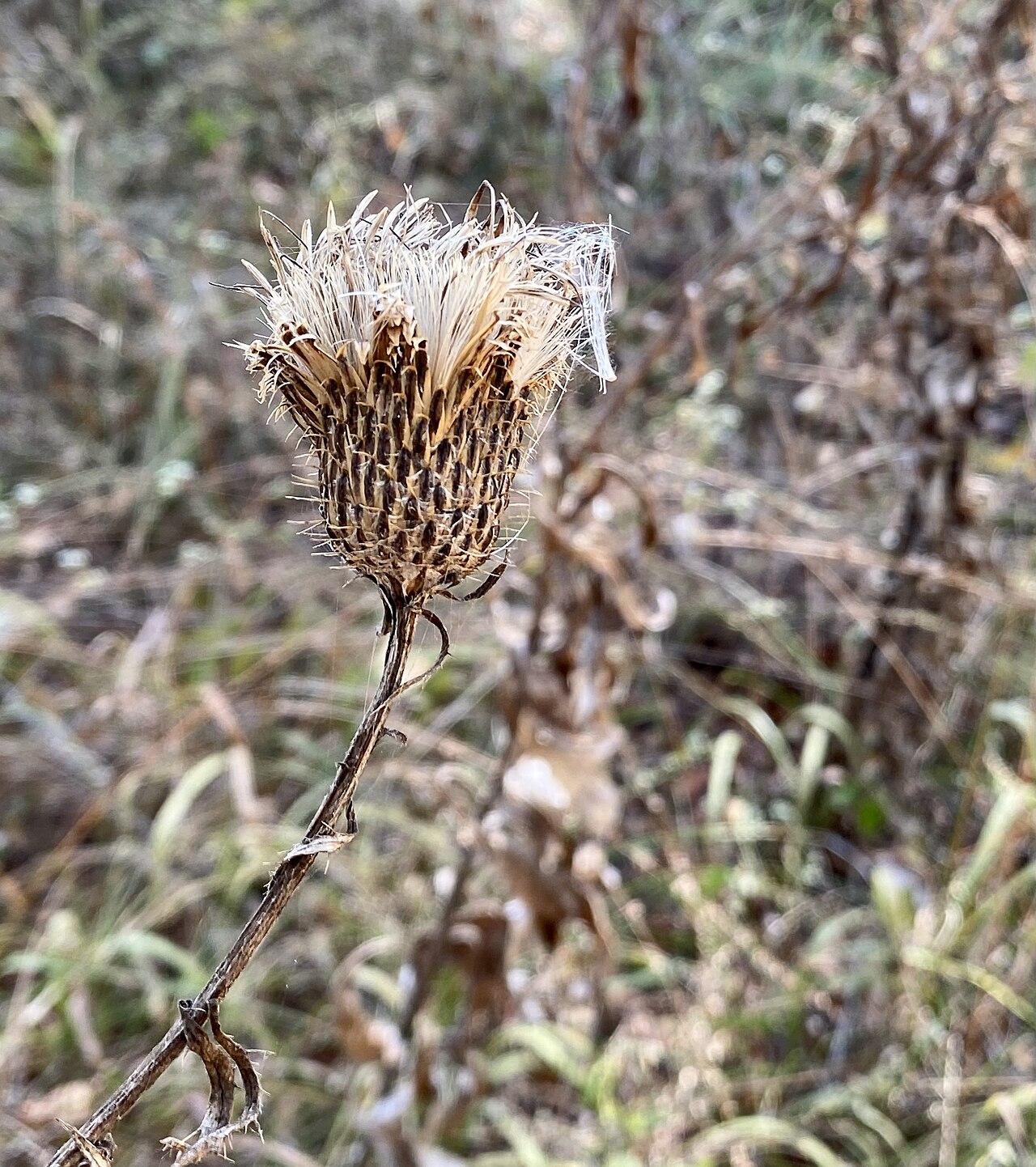
The fruits are small, light brown seeds (cypselae) about 1/4 inch long, each topped with a tuft of feathery white bristles. In late summer and fall the heads dry and open, and the seeds drift away on the wind.
Look-alikes
Field thistle (Cirsium discolor) is very similar, but its leaves are deeply cut into narrow, spiny lobes nearly to the midrib; tall thistle’s stem leaves are mostly unlobed or shallowly lobed. Bull thistle (Cirsium vulgare), an introduced weed, has spiny wings along the stem and very prickly, green-backed leaves. Canada thistle (Cirsium arvense), also introduced, spreads by creeping roots and has many small heads under 1 inch wide. Purple thistle (Cirsium horridulum) of the Southeast is very spiny and blooms in spring.
Safety Notes
Tall thistle is not toxic, but the leaf edges and bracts carry small spines. Wear gloves when handling it.
Quick Facts
| Scientific Name | Cirsium altissimum |
| Family | Asteraceae (aster family) |
| Plant Type | Biennial or short-lived perennial wildflower |
| Mature Height | 3–8 ft (occasionally taller) |
| Mature Spread | 1–3 ft |
| Growth Rate | Fast |
| Sun Exposure | Full sun to part shade |
| Water Needs | Low to moderate; dry to moist soil |
| Soil Type | Loamy, clay or rocky; adaptable |
| Soil pH | About 5.5–7.5 |
| Bloom Time | July–October |
| Flower Color | Pink-purple to lavender |
| Fall Color | Not significant |
| Fruit | Small seeds with feathery white down |
| Deer Resistant | Mostly; spiny foliage is seldom browsed |
| USDA Hardiness Zones | 4–9 |
Native Range
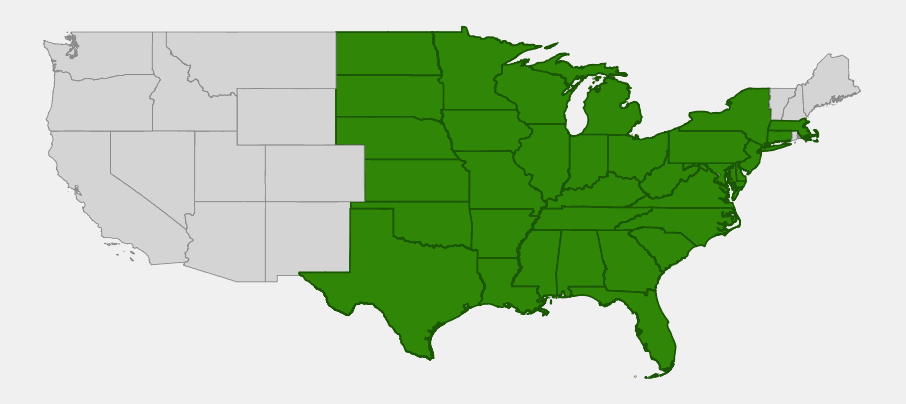
Tall thistle is native to the eastern and central United States. USDA PLANTS lists it as native in Alabama, Arkansas, Connecticut, Delaware, Florida, Georgia, Illinois, Indiana, Iowa, Kansas, Kentucky, Louisiana, Maryland, Massachusetts, Michigan, Minnesota, Mississippi, Missouri, Nebraska, New Jersey, New York, North Carolina, North Dakota, Ohio, Oklahoma, Pennsylvania, South Carolina, South Dakota, Tennessee, Texas, Virginia, West Virginia and Wisconsin, as well as the District of Columbia.
It is most common in the Midwest, the Ozarks and the southern interior, from Ohio and Michigan west to the eastern Great Plains and south to Arkansas and eastern Texas. It becomes scattered toward the Atlantic coast, in northern Florida and at the northeastern edge of its range in New York, Connecticut and Massachusetts.
Typical habitats are open, sunny to lightly shaded places with average soil: open oak and hickory woods, woodland edges and clearings, thickets, prairies and savannas, pastures, old fields, fencerows and roadsides. It often turns up in disturbed ground but rarely becomes abundant, because each plant flowers once and dies.
📋 Regional plant lists featuring Tall Thistle: North & South Florida · Alabama, Georgia & Mississippi · North & South Carolina · Maryland, Virginia & West Virginia · Kentucky & Tennessee · Arkansas, Louisiana, Eastern Oklahoma & Eastern Texas · Illinois, Iowa & Missouri · Ohio & Indiana · Nebraska, Kansas & Eastern Colorado · North Dakota, South Dakota & Western Minnesota · Michigan, Wisconsin & Eastern Minnesota · New York, Pennsylvania & Northern New Jersey · Delaware, Southern New Jersey & Long Island · Connecticut, Massachusetts & Rhode Island · New Hampshire, Maine & Vermont · South & West Texas
Growing & Care Guide
Tall thistle is rarely sold as a plant, but seed is sometimes available from native seed companies in the Midwest. It is best for meadows, prairie plantings, woodland edges and wildlife gardens where a tall, informal plant fits in.
Light
Full sun to partial shade. It grows and flowers well along sunny woodland edges and in light shade, and stays a little shorter in full sun on dry soil.
Soil & Water
It is adaptable to most average soils, from loam to clay and rocky ground, and tolerates dry spells once established thanks to its deep taproot. It does not need fertilizer or regular watering.
Planting Tips
Sow seed in fall or early spring where you want plants, or set out first-year rosettes. Give it space toward the back of a meadow or border, where its height and late flowers show well. Because each plant dies after flowering, allow some seed to fall so new rosettes replace the old plants.
Pruning & Maintenance
Little care is needed. Leave seed heads standing for goldfinches, then cut the dead stems in late winter. If you do not want seedlings, cut the flower heads after they fade but before the down appears. Wear gloves when handling.
Propagation
Grow it from seed. Collect seed heads as they turn tan and fluffy. A period of cold, moist stratification (outdoor fall sowing or about 30 to 60 days in the refrigerator) improves germination. Plants have a long taproot, so move them only as small rosettes.
Landscape Uses
- Pollinator gardens: late summer and fall nectar for bees, butterflies and moths
- Bird gardens: seeds and nesting down for American goldfinches
- Prairie and meadow plantings: tall, informal native accent
- Woodland edges: tolerates light shade along forest margins
- Restoration: old fields, savannas and open woods
Wildlife & Ecological Value
Native thistles are among the most important late-season plants for wildlife, and tall thistle is one of the most widespread in the East and Midwest.
For Pollinators
The nectar-rich flower heads attract bumble bees, long-horned bees and many other native bees, plus butterflies such as swallowtails, fritillaries and monarchs, and day-flying hummingbird clearwing moths. Thistles are also larval host plants for the painted lady butterfly.
For Birds
American goldfinches feed heavily on thistle seeds and use the soft down to line their nests, which is one reason they nest late in summer when thistles go to seed. Other seed-eating birds such as indigo buntings and sparrows also eat the seeds, and ruby-throated hummingbirds sometimes visit the flowers.
For Mammals
The spiny foliage is seldom browsed by deer or rabbits, though some animals eat young rosettes or flower buds.
Ecosystem Role
Tall thistle fills an open, sunny niche in woodland edges, prairies and old fields and supports a large community of insects, including seed-feeding flies and weevils, which in turn feed birds. Because it is not aggressive, it adds wildlife value without crowding out other native plants.
Cultural & Historical Uses
Carl Linnaeus first described this plant in 1753 as Carduus altissimus. John Hill moved it to Cirsium in 1768, the genus of the true plume thistles. Cirsium comes from the Greek kirsos, a swollen vein, for which thistles were once used as a remedy, and altissimum means “tallest.”
Many people think of all thistles as weeds, and native thistles are often removed along with the introduced bull thistle and Canada thistle. Conservationists and native plant groups encourage people to learn the difference, because native species like tall thistle rarely become a problem and are valuable to pollinators and birds.
In much of its range tall thistle is one of the latest-blooming wildflowers in woodland edges and old fields. Its tall stems topped with pink-purple heads are a familiar late-summer sight along country roads, which explains its other common name, roadside thistle.
Frequently Asked Questions
Is tall thistle invasive?
No. It is a native biennial or short-lived perennial that reproduces only by seed, and each plant dies after flowering. It does not form dense, spreading patches like the introduced Canada thistle.
How can I tell tall thistle from bull thistle?
Tall thistle has smooth, unwinged stems and leaves that are white-woolly underneath with only weak spines. Bull thistle has spiny wings running down the stem and very prickly leaves that are green on both sides.
What is the difference between tall thistle and field thistle?
They are close relatives with similar flowers. Field thistle has leaves deeply cut into narrow, spiny lobes, while tall thistle has stem leaves that are mostly unlobed or only shallowly lobed.
Why do goldfinches love thistles?
Goldfinches eat thistle seeds and use the soft thistle down to line their nests. They nest in mid to late summer, when native thistles are going to seed.
When does tall thistle bloom?
From about July to October, providing nectar late in the season when many other wildflowers have finished.

Looking for a nursery that carries Tall Thistle?
Browse our native plant nursery directory: Alabama & Arkansas · Connecticut, Delaware, Florida & Georgia · Illinois, Indiana, Iowa & Kansas · Kentucky, Louisiana, Maryland, Massachusetts, Michigan, Minnesota, Mississippi & Missouri · Nebraska, New Jersey, New York, North Carolina, North Dakota, Ohio & Oklahoma · Pennsylvania, South Carolina, South Dakota, Tennessee, Texas & Virginia · West Virginia & Wisconsin

