
Purple False Foxglove (Agalinis purpurea)
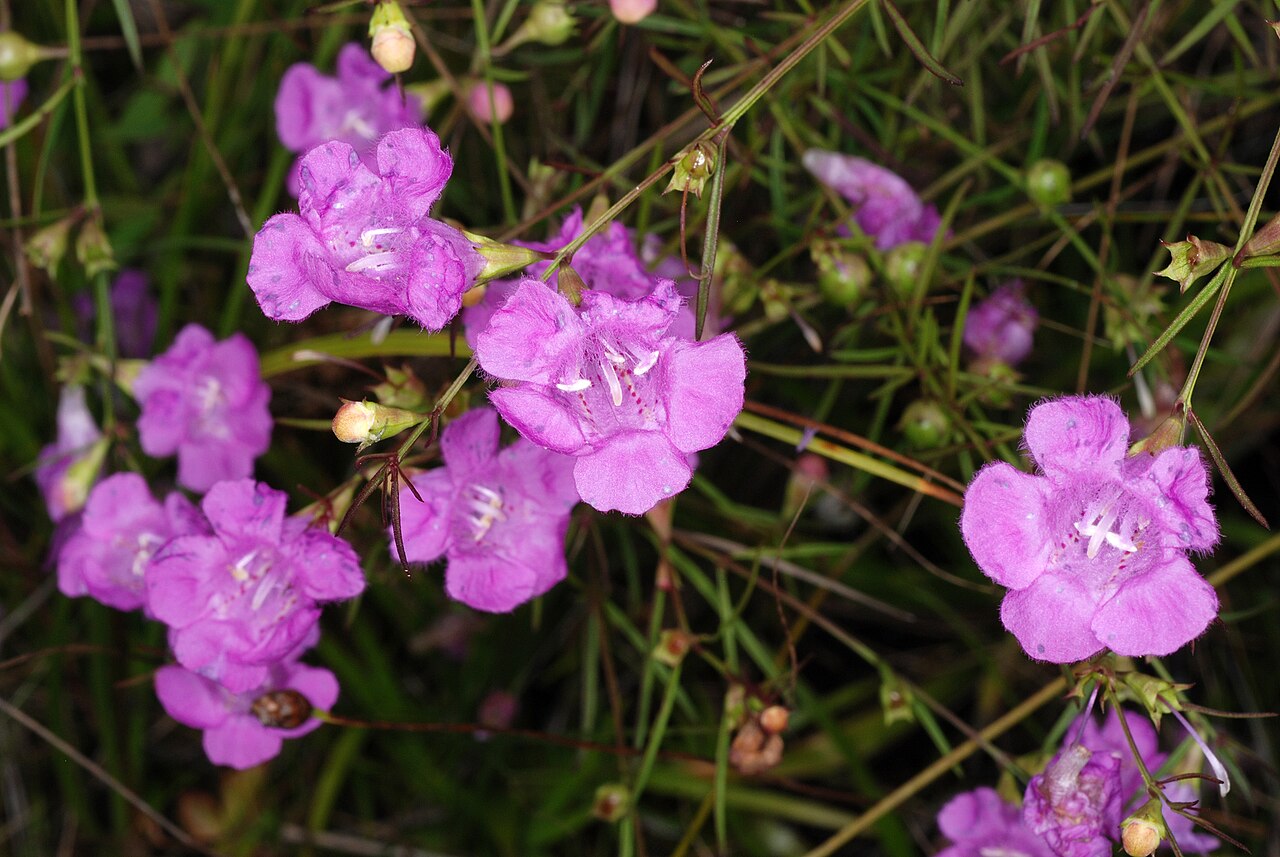
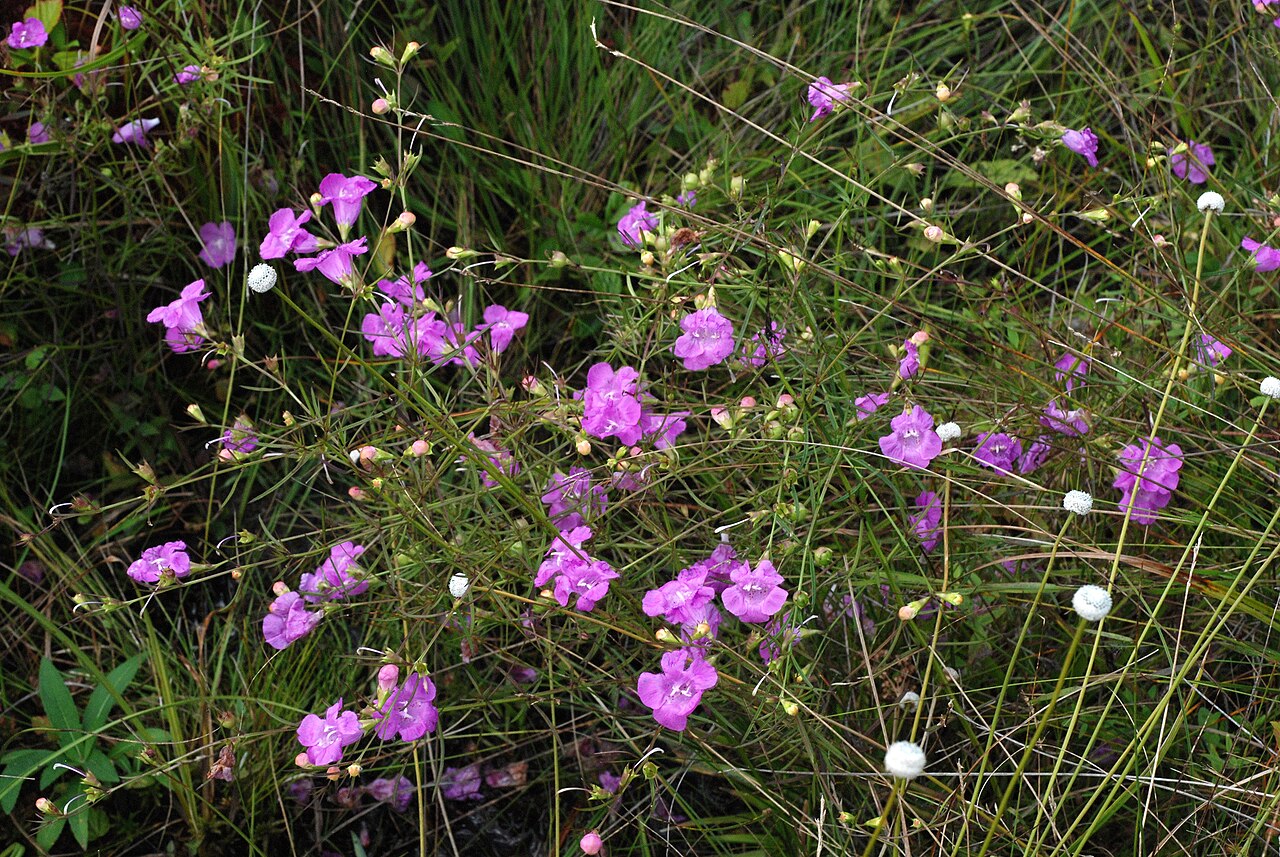
Agalinis purpurea, known as Purple False Foxglove or purple gerardia, is a native annual wildflower of the broomrape family (Orobanchaceae). In late summer and fall its slender, much-branched stems, 1 to 3 feet tall, are covered with bell-shaped, pink-purple flowers about an inch long. It grows in damp to moist sandy meadows, pine savannas, bog and pond margins, wet prairies and roadsides across most of the eastern and central United States and into southern Canada.
Purple false foxglove is a hemiparasite. It has green leaves and makes its own food by photosynthesis, but its roots also attach to the roots of nearby plants, especially grasses and sedges, and draw water and nutrients from them. It cannot grow well on its own in a pot or a bare garden bed; it needs host plants growing around it. That is why it is almost always grown from seed sown directly into a meadow or grassy planting rather than bought as a potted perennial.
It is also an important butterfly plant. The leaves are a larval food of the common buckeye butterfly, and the flowers are pollinated mainly by bumblebees. In a sunny, moist native meadow with grasses, a patch can reseed and return year after year.
Identification
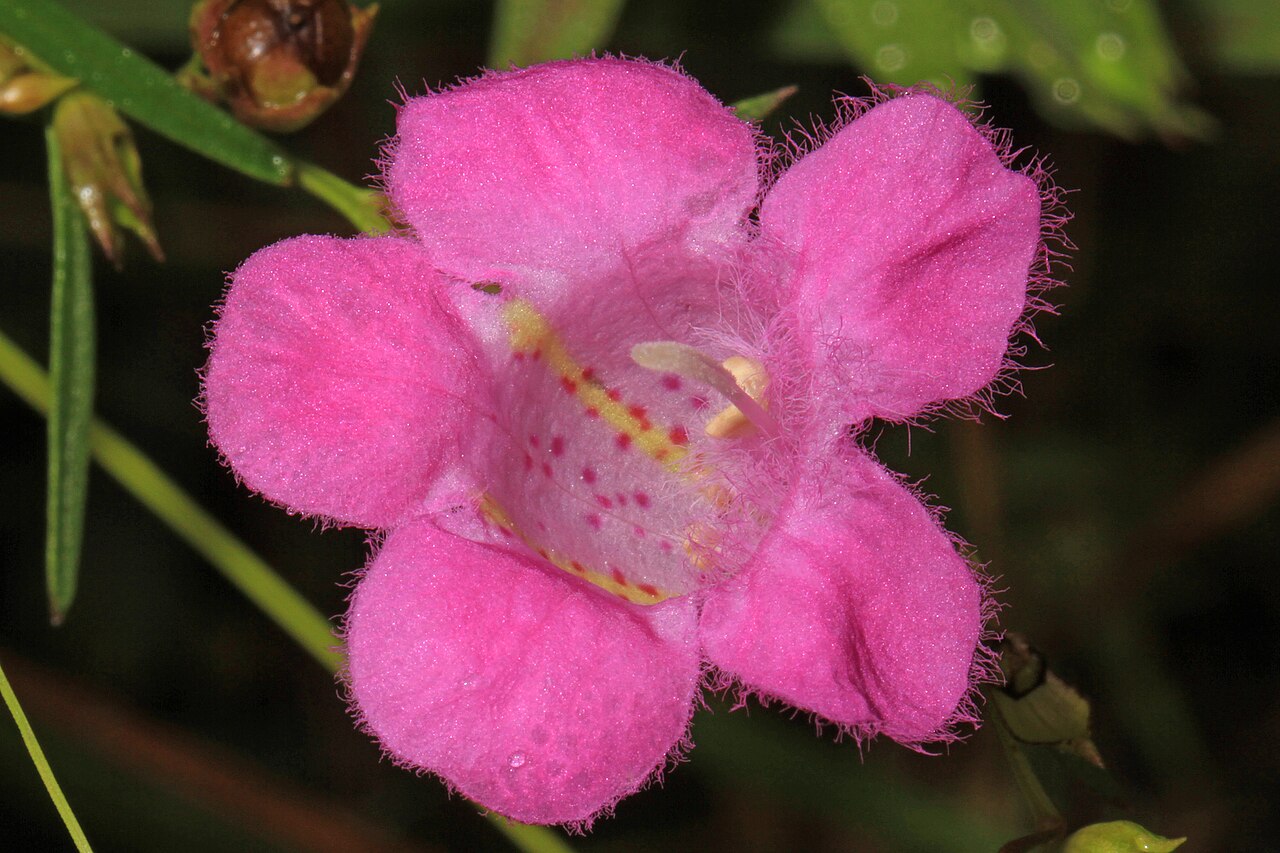
Look in late summer for a bushy, wiry annual with very narrow, almost needle-like leaves, bearing pink-purple, bell-shaped flowers with two yellow lines and dark spots inside the throat.
Growth Habit
Purple false foxglove is an annual that grows from seed each year. It forms an upright, open plant 1 to 3 feet tall (occasionally to 4 feet), with many slender, stiff, often purplish, four-angled branches. Plants growing in dense grass may be small and sparsely branched.
Leaves
The leaves are opposite, linear and very narrow, about 1/2 to 1 1/2 inches long and less than 1/8 inch wide, rough to the touch and stalkless. They often turn purplish or blacken when dried, as in many plants of this family.
Flowers
The flowers are borne on very short stalks, usually less than 1/4 inch long, in the upper leaf axils. Each is a bell- or funnel-shaped tube about 3/4 to 1 1/2 inches long, pink-purple to rose-pink, rarely white, flaring into five rounded, slightly unequal lobes that are finely hairy on the edges. Inside the throat are two yellow lines and darker purple spots. Each flower lasts only a day, but plants bloom for weeks, mostly from August to October.
Fruit & Seeds
The fruit is a small, round capsule about 1/4 inch wide that splits open to release many tiny, dark seeds. The seeds need light and host plants to establish.
Look-alikes
There are many similar Agalinis species. Beach false foxglove (A. fasciculata) of the coastal Southeast is coarser, with clusters of short leaves in the leaf axils. Prairie false foxglove (A. heterophylla) of the southern prairies has broader lower leaves. Slender false foxglove (A. tenuifolia) has smaller, paler flowers on long, slender stalks, and lacks the yellow lines in the throat. Small-flowered plants of northern bogs and shores, often called A. paupercula, are now usually included in purple false foxglove as variety parviflora.
Quick Facts
| Scientific Name | Agalinis purpurea |
| Family | Orobanchaceae (broomrape family); formerly Scrophulariaceae |
| Plant Type | Annual wildflower; root hemiparasite |
| Mature Height | 1–3 ft |
| Mature Spread | 6–18 in |
| Growth Rate | Fast |
| Sun Exposure | Full sun to light shade |
| Water Needs | Medium to high; moist soil |
| Soil Type | Moist sandy, peaty or loamy soils with host grasses |
| Soil pH | Acidic to neutral (about 4.5–7.0) |
| Bloom Time | August–October |
| Flower Color | Pink-purple to rose-pink, rarely white |
| Fall Color | Foliage often turns purplish |
| Fruit | Small round capsule with tiny seeds |
| Deer Resistant | Moderately |
| USDA Hardiness Zones | Annual; grows in zones 3–10 |
Native Range
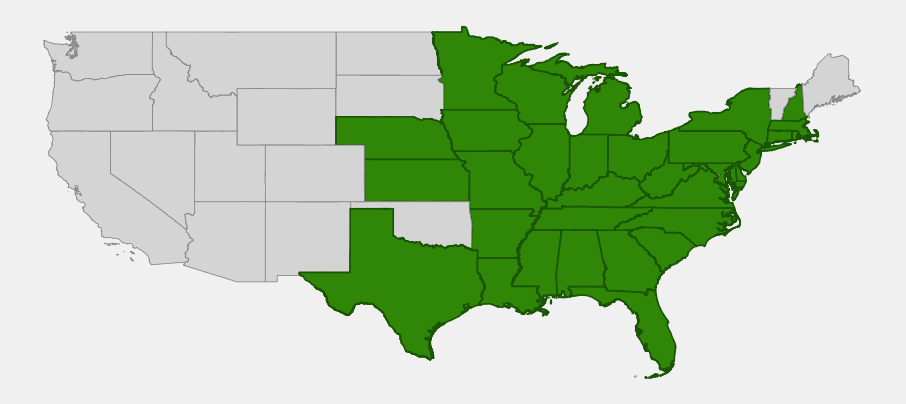
Purple false foxglove is native from southern New England and southeastern New York south to Florida and west to eastern Texas, and north through the Midwest to Nebraska, Minnesota, Wisconsin and Michigan. USDA PLANTS lists it in 32 states, and NatureServe also tracks small, rare populations in Maine and Vermont. In Canada it grows in southern Ontario and in a few places in Quebec, New Brunswick, Nova Scotia and Prince Edward Island.
It is most common on the Atlantic and Gulf Coastal Plains, where it grows in wet pine savannas, flatwoods and pond margins. Inland it is scattered in wet prairies, sand plains, fens and moist sandy meadows, including the sand prairies of the Midwest and the Great Lakes shorelines. In Texas it is confined to the eastern part of the state, and in Minnesota it grows in the east-central and southeastern counties.
It favors open, sunny, moist places with sparse vegetation, often where fire, mowing or flooding keeps taller plants from crowding it: wet meadows, savannas, bog edges, interdunal swales, ditches, powerline corridors and moist roadsides.
📋 Regional plant lists featuring Purple False Foxglove: New York, Pennsylvania & Northern New Jersey · Ohio & Indiana · Michigan, Wisconsin & Eastern Minnesota · Kentucky & Tennessee · Nebraska, Kansas & Eastern Colorado · Connecticut, Massachusetts & Rhode Island · New Hampshire, Maine & Vermont · Maryland, Virginia & West Virginia · Delaware, Southern New Jersey & Long Island · Illinois, Iowa & Missouri · Alabama, Georgia & Mississippi · North & South Florida · North & South Carolina · Arkansas, Louisiana, Eastern Oklahoma & Eastern Texas · North Dakota, South Dakota & Western Minnesota
Growing & Care Guide
Purple false foxglove is rewarding but unusual to grow. As an annual hemiparasite it needs host plants and fresh seed each year, so treat it as a meadow plant that you establish once and let reseed, not as a potted perennial. Buy seed from native seed suppliers and never dig wild plants; they do not survive transplanting.
Light
Full sun to light shade. It flowers best in open sun and fades out when taller plants shade it.
Soil & Water
It prefers moist to wet, sandy or peaty soils that are acidic to neutral and low in nutrients, though it tolerates average garden soil if it stays moist. Do not fertilize: rich soil favors the host grasses and other plants that would crowd it out.
Planting Tips
Sow fresh seed on the soil surface in fall or early winter, among established grasses, sedges or other meadow plants, in a spot that has some bare ground. The seeds need light to germinate, so do not bury them. In a bare bed or alone in a pot, seedlings usually stay tiny and die; some growers sow it into containers that already hold a small grass or sedge as a host.
Pruning & Maintenance
Leave the plants standing until the capsules have released their seeds in late fall. A late-winter mowing, burn or light raking of the meadow helps by opening up bare ground where the seeds can germinate.
Propagation
Only by seed. Collect the small capsules as they turn brown in fall and scatter the seed right away in a suitable spot. Once a patch is established, it maintains itself by reseeding.
Landscape Uses
- Wet meadows and rain gardens: late-season color among grasses and sedges
- Savanna and prairie restorations: add to seed mixes for moist sites
- Butterfly gardens: a larval host plant of the common buckeye
- Pond and bog edges: thrives in sunny, moist, acidic soils
- Powerline and roadside plantings: suits open, mowed, moist ground
Wildlife & Ecological Value
Purple false foxglove feeds both pollinators and butterfly caterpillars, and as a hemiparasite it plays a quiet role in shaping meadow plant communities.
For Pollinators
The flowers are pollinated mainly by bumblebees, which push into the tube to reach the nectar. Other bees and butterflies also visit. Its late bloom provides food when many other flowers have finished.
For Birds
It offers little direct food to birds, but the insects that feed on it, including buckeye caterpillars, are food for songbirds.
For Mammals
It is not a significant food for mammals, and deer browse it only lightly.
Ecosystem Role
Purple false foxglove is a larval host plant of the common buckeye butterfly (Junonia coenia), whose caterpillars eat the leaves. As a root hemiparasite it takes some resources from the grasses around it, which can help keep dominant grasses in check and leave room for other wildflowers.
Cultural & Historical Uses
The genus name Agalinis comes from the Greek agan, “very much,” and linon, “flax,” probably a reference to the narrow, flax-like leaves. Purpurea means “purple.” The plant was long known as Gerardia purpurea, a name honoring the English herbalist John Gerard, and “purple gerardia” is still a common name.
The common name “false foxglove” comes from the resemblance of the bell-shaped flowers to those of the European foxglove (Digitalis), although the two are not closely related. Other related plants of this family, such as Indian paintbrush and Canadian lousewort, are also hemiparasites.
In parts of its northern range, including Maine, Vermont, Nebraska and several Canadian provinces, purple false foxglove is rare and tracked by conservation agencies, because its wet, open habitats have declined with drainage and fire suppression.
Frequently Asked Questions
Is purple false foxglove a parasite?
It is a hemiparasite. It has green leaves and photosynthesizes, but its roots also attach to the roots of grasses and other plants to take water and nutrients. It does not usually harm its hosts seriously.
Can I grow purple false foxglove in my garden?
Yes, in a sunny, moist meadow or grassy planting. Sow fresh seed among established grasses and sedges in fall. It does not grow well alone in a pot or bare bed.
Is purple false foxglove an annual?
Yes. It lives for one season and returns from seed. A healthy patch reseeds itself.
What butterfly uses purple false foxglove?
The common buckeye uses it as a larval host plant. Bumblebees are its main pollinators.
Is purple false foxglove related to foxglove?
Not closely. It is named for the similar bell-shaped flowers, but true foxgloves (Digitalis) belong to a different family.

Looking for a nursery that carries Purple False Foxglove?
Browse our native plant nursery directory: Alabama & Arkansas · Connecticut, Delaware, Florida & Georgia · Illinois, Indiana, Iowa & Kansas · Kentucky, Louisiana, Maryland, Massachusetts, Michigan, Minnesota, Mississippi & Missouri · Nebraska, New Hampshire, New Jersey, New York, North Carolina & Ohio · Pennsylvania, Rhode Island, South Carolina, Tennessee, Texas & Virginia · West Virginia & Wisconsin

