
Dwarf St. John’s Wort (Hypericum mutilum)
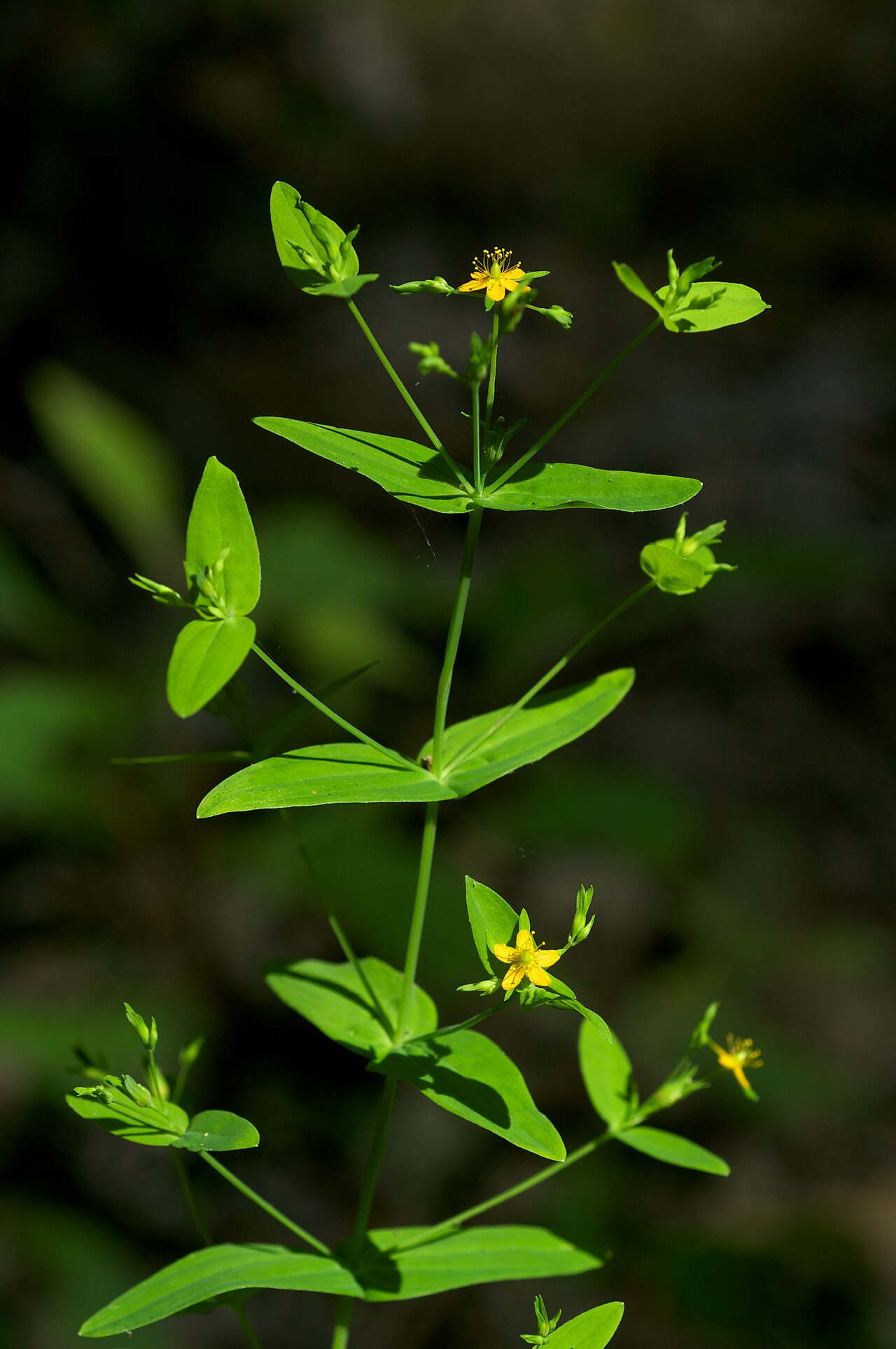
Hypericum mutilum, known as Dwarf St. John’s Wort or slender St. John’s wort, is a small, much-branched wildflower of wet, open places across eastern North America. It belongs to the St. John’s wort family (Hypericaceae) and is the most widespread of the small, wetland St. John’s worts in the East.
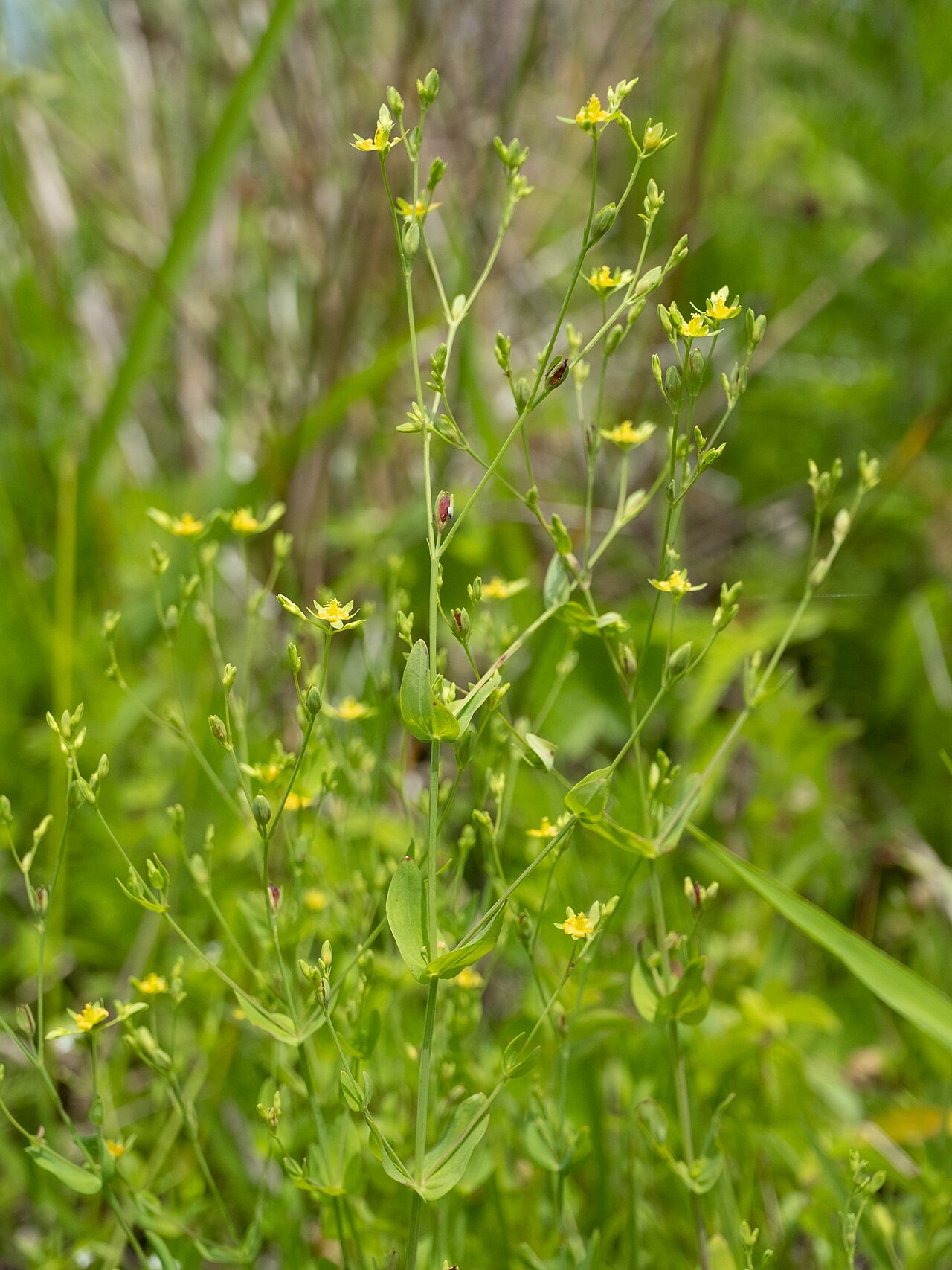
It is a slender annual or short-lived perennial, usually under 2 feet tall, with pairs of small, oval, clasping leaves and an airy spray of tiny, bright yellow, star-like flowers from early summer into fall. The flowers are only about 1/8 to 1/4 inch wide, but a single plant can carry dozens at once.
Dwarf St. John’s wort is easy to overlook, but it is a common and useful member of wet meadows, pond shores, ditches and marsh edges. It is a good small plant for rain gardens, pond margins and wet meadow plantings, where it adds fine texture and feeds small bees and flies.
Identification
Look for a low, slender, much-branched plant in wet soil with opposite, small, oval leaves that clasp the stem, and many tiny yellow, five-petaled flowers with small leafy bracts below them.
Growth Habit
Dwarf St. John’s wort is an annual or short-lived perennial, usually 6 to 24 inches tall, sometimes taller in rich, wet soil. The thin, four-angled stems branch freely, especially in the upper half, forming a loose, bushy plant. Plants sometimes root at the lower nodes and often turn reddish in sun and in fall.
Leaves
The leaves are opposite, oval to elliptic, about 1/4 to 1 1/2 inches long, without stalks, with a rounded or slightly clasping base and a blunt tip. They have three to five main veins from the base. Held up to the light, they show tiny, translucent dots, a feature of the genus.
Flowers
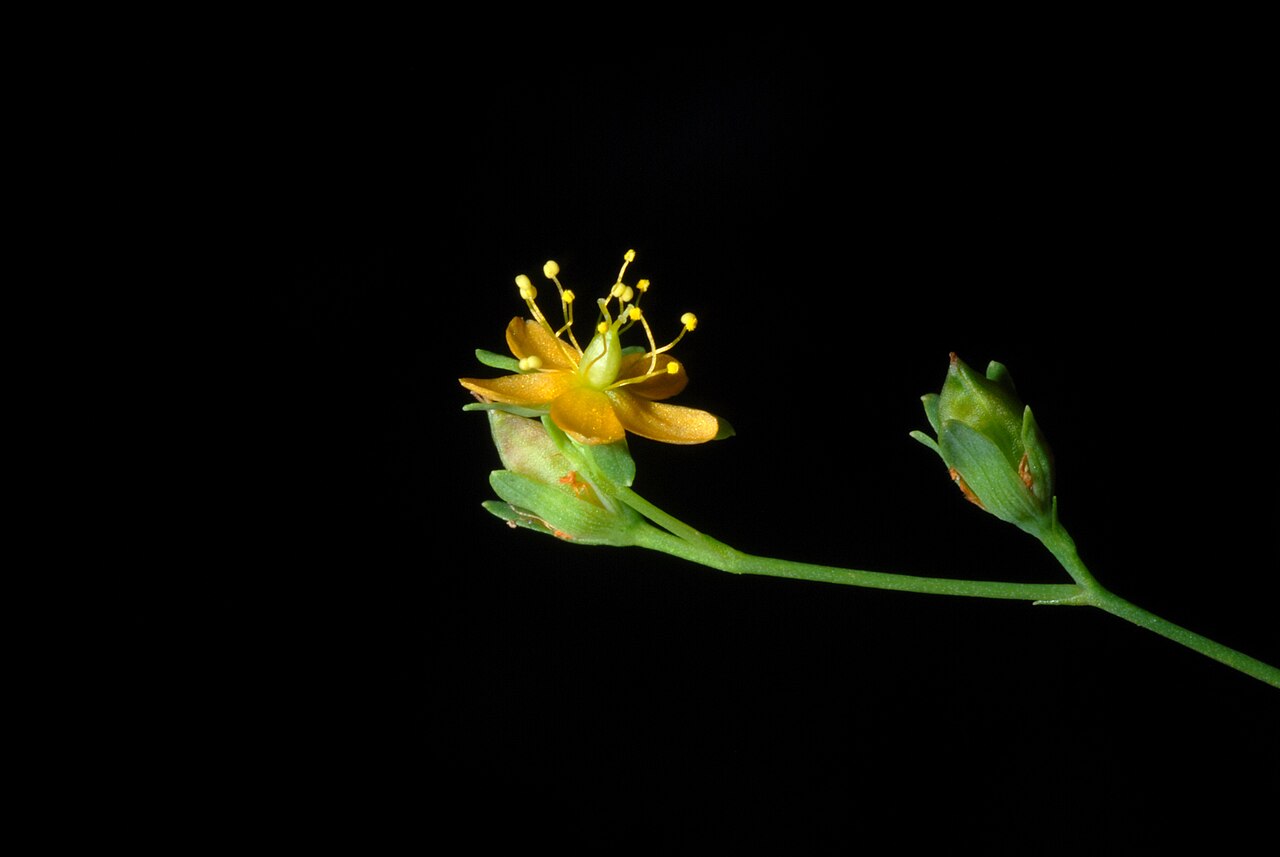
Flowers appear from about June to October in loose, forking clusters at the branch tips, with small, leaf-like bracts below each flower. Each flower is tiny, about 1/8 to 1/4 inch across, with five yellow to orange-yellow petals, five green sepals and a small cluster of stamens. The petals are about as long as or shorter than the sepals.
Fruit & Seeds
The fruit is a small, oval capsule about 1/8 to 1/4 inch long, often turning reddish to purplish brown as it ripens, holding many tiny, finely ridged seeds.
Look-alikes
Canadian St. John’s wort (Hypericum canadense) grows in similar places but has very narrow, linear leaves and narrower, more upright branches. Clasping-leaf St. John’s wort (Hypericum gymnanthum) has larger, clasping, triangular-ovate leaves and fewer flowers with no leafy bracts. Northern St. John’s wort (Hypericum boreale) is a northern plant with larger flowers. Larger species such as spotted St. John’s wort have much bigger flowers and leaves.
Safety Notes
Dwarf St. John’s wort is not a food plant. Some St. John’s worts contain compounds that can make grazing animals sensitive to sunlight, so do not eat it or use it as an herbal remedy.
Quick Facts
| Scientific Name | Hypericum mutilum |
| Family | Hypericaceae (St. John’s wort family) |
| Plant Type | Annual or short-lived perennial wildflower |
| Mature Height | 6–24 in |
| Mature Spread | 6–12 in |
| Growth Rate | Fast |
| Sun Exposure | Full sun to part shade |
| Water Needs | High; moist to wet soil |
| Soil Type | Sandy, loamy, clay or mucky; wet |
| Soil pH | About 4.5–7.0 |
| Bloom Time | June–October |
| Flower Color | Yellow |
| Fall Color | Stems and capsules often turn reddish |
| Fruit | Small oval capsules, reddish when ripe |
| Deer Resistant | Mostly; seldom browsed |
| USDA Hardiness Zones | 3–9 |
Native Range
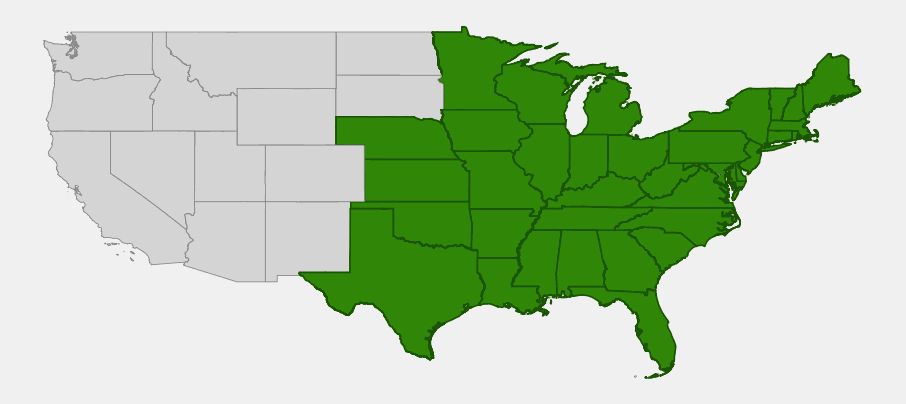
Dwarf St. John’s wort is native to eastern North America. USDA PLANTS lists it as native in Alabama, Arkansas, Connecticut, Delaware, Florida, Georgia, Illinois, Indiana, Iowa, Kansas, Kentucky, Louisiana, Maine, Maryland, Massachusetts, Michigan, Minnesota, Mississippi, Missouri, Nebraska, New Hampshire, New Jersey, New York, North Carolina, Ohio, Oklahoma, Pennsylvania, Rhode Island, South Carolina, Tennessee, Texas, Vermont, Virginia, West Virginia and Wisconsin, as well as the District of Columbia. In Canada it is native in Ontario, Quebec, New Brunswick and Nova Scotia.
It is common across much of the East, especially on the Atlantic and Gulf Coastal Plains and in the Southeast, becoming less frequent toward the eastern Great Plains and the northern edge of its range. USDA also lists California, Washington and Hawaii, but floras there (for example the Burke Herbarium for Washington) treat it as introduced, so those states are not shown as native range. It has also been introduced in British Columbia and in parts of Europe and Asia.
Typical habitats are open, wet or seasonally wet places: wet meadows, marsh and pond edges, lake and river shores, wet pine flatwoods and savannas, bogs and seeps, swales, ditches and moist trails. It often appears on bare, wet soil where competition is light and fades as taller plants take over.
📋 Regional plant lists featuring Dwarf St. John’s Wort: North & South Florida · Alabama, Georgia & Mississippi · North & South Carolina · Maryland, Virginia & West Virginia · Kentucky & Tennessee · Arkansas, Louisiana, Eastern Oklahoma & Eastern Texas · Illinois, Iowa & Missouri · Ohio & Indiana · Nebraska, Kansas & Eastern Colorado · Michigan, Wisconsin & Eastern Minnesota · New York, Pennsylvania & Northern New Jersey · Delaware, Southern New Jersey & Long Island · Connecticut, Massachusetts & Rhode Island · New Hampshire, Maine & Vermont · South & West Texas
Growing & Care Guide
Dwarf St. John’s wort is seldom sold, but it often appears on its own in wet, sunny spots and is easy to encourage. It is a fine-textured filler for wet gardens rather than a showy specimen.
Light
Full sun to partial shade. It flowers most heavily in sun.
Soil & Water
It needs moist to wet soil and tolerates short periods of flooding. It grows in sand, loam, clay or muck, and is tolerant of acidic soils. It does not do well in dry beds.
Planting Tips
Sow seed on bare, moist soil at the edge of a pond, in a rain garden or in a wet meadow, where it can fill gaps between rushes, sedges and taller wildflowers. Because it is short and slender, place it near the front where the tiny flowers can be seen.
Pruning & Maintenance
Little care is needed. Let plants set seed so new seedlings replace them, since individual plants are short-lived. Keep taller, aggressive plants from shading it out completely.
Propagation
Grow it from seed. Collect the small capsules as they turn reddish brown in late summer and fall, and scatter the tiny seeds on the surface of moist soil in fall or early spring without covering them. It often self-sows on bare, damp ground.
Landscape Uses
- Rain gardens and swales: thrives in wet, seasonally flooded soil
- Pond and stream edges: fine-textured filler among rushes and sedges
- Wet meadow plantings: long season of small yellow flowers
- Pollinator gardens: pollen for small bees and flies
- Wetland restoration: quickly colonizes bare, wet soil
Wildlife & Ecological Value
Dwarf St. John’s wort is a small but useful part of wet, open plant communities.
For Pollinators
Like other St. John’s worts, its flowers offer pollen rather than nectar. Small bees, such as sweat bees, and small flies visit the flowers to collect or feed on pollen. The plant can also pollinate itself, which helps it set seed even when few insects are about.
For Birds
Small seed-eating birds may take the tiny seeds, and the dense, low growth gives cover to small animals along wetland edges.
For Mammals
It is seldom browsed by deer or rabbits.
Ecosystem Role
Dwarf St. John’s wort is a pioneer of bare, wet soil on shores, drawdown zones and disturbed wet ground. By quickly covering open mud, it helps hold soil and is part of the diverse groundcover of wet savannas and meadows.
Cultural & Historical Uses
Linnaeus described the species in 1753. The genus name Hypericum comes from Greek words meaning “above an image,” from the old European custom of hanging St. John’s wort above religious images to ward off evil. The species name mutilum means “cut short” or “maimed,” probably for the plant’s small size and tiny flowers.
The common name St. John’s wort comes from the European species Hypericum perforatum, which blooms around the feast of St. John the Baptist in late June. “Wort” is an old word for plant. Dwarf St. John’s wort is a much smaller native relative.
Because it travels easily in mud and with seed, dwarf St. John’s wort has spread outside its native range to the West Coast, Hawaii and other parts of the world, usually on wet, disturbed ground.
Frequently Asked Questions
Is dwarf St. John’s wort the same as the herbal St. John’s wort?
No. Herbal St. John’s wort is the European Hypericum perforatum. Dwarf St. John’s wort is a small native wetland species and should not be used as a herbal remedy.
Is dwarf St. John’s wort an annual or a perennial?
It can be either. Many plants live just one season, while others survive a few years. It reseeds readily on bare, moist soil.
Where does dwarf St. John’s wort grow?
In wet, open places such as wet meadows, pond and lake shores, marsh edges, ditches and wet pine savannas across eastern North America.
How big are the flowers?
Very small, only about 1/8 to 1/4 inch across, but a plant can produce many at once from June to October.
Is dwarf St. John’s wort good for rain gardens?
Yes. It tolerates wet soil and short flooding, and fills gaps between larger rain garden plants.

Looking for a nursery that carries Dwarf St. John’s Wort?
Browse our native plant nursery directory: Alabama & Arkansas · Connecticut, Delaware, Florida & Georgia · Illinois, Indiana, Iowa & Kansas · Kentucky, Louisiana, Maine, Maryland, Massachusetts, Michigan, Minnesota, Mississippi & Missouri · Nebraska, New Hampshire, New Jersey, New York, North Carolina, Ohio & Oklahoma · Pennsylvania, Rhode Island, South Carolina, Tennessee, Texas, Vermont & Virginia · West Virginia & Wisconsin

