
Slender False Foxglove (Agalinis tenuifolia)
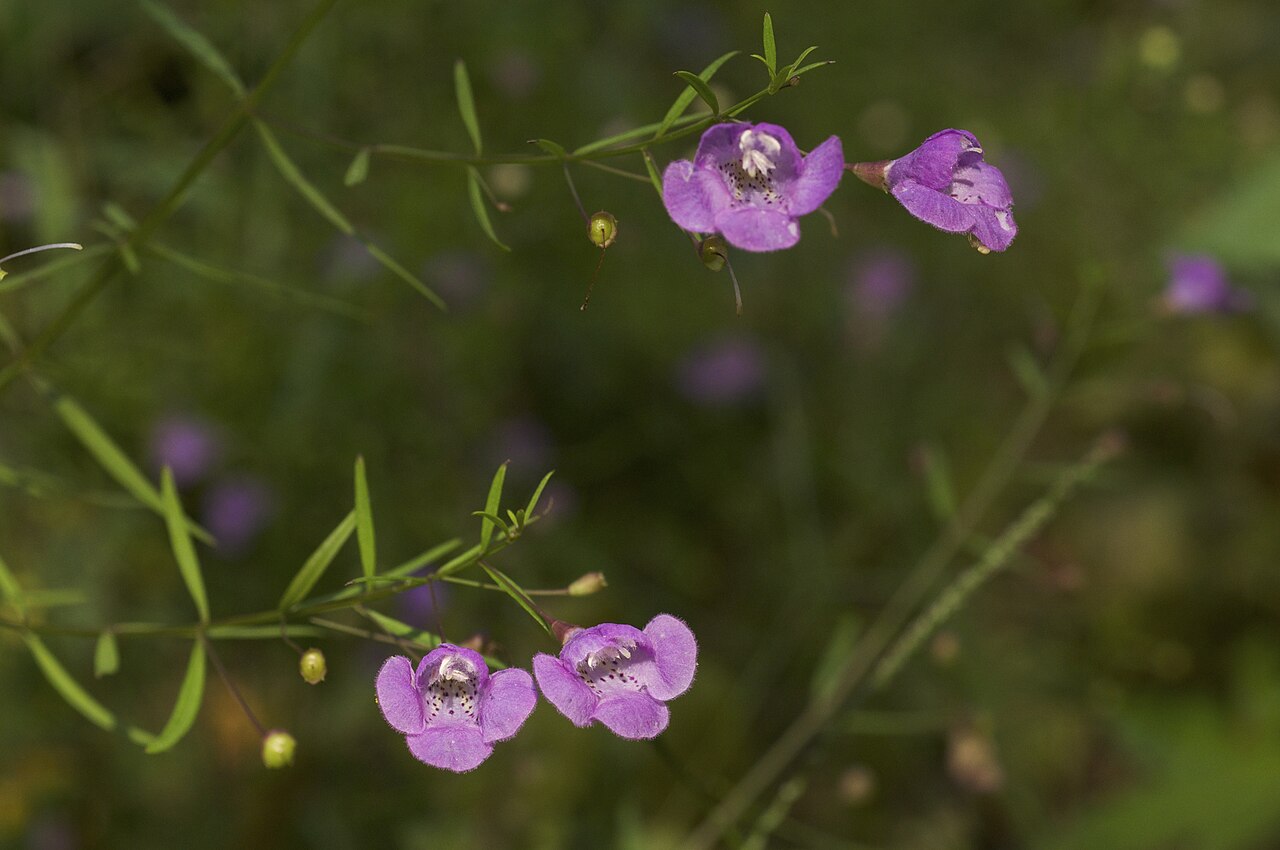
Agalinis tenuifolia, known as Slender False Foxglove, slenderleaf false foxglove or common gerardia, is a delicate annual wildflower of meadows, prairies, open woods and wetland edges across eastern and central North America. It belongs to the broomrape family (Orobanchaceae); older books place it in the figwort family under the name Gerardia tenuifolia.
In late summer and fall it forms a wiry, much-branched plant with thread-like leaves and small, pink-purple, bell-shaped flowers held on long, slender stalks. Each flower opens in the morning and drops by the next day, but a plant produces new blooms for weeks.
Slender false foxglove is a hemiparasite: it has green leaves and makes its own food, but it also taps the roots of nearby plants, mainly grasses, for water and nutrients. That makes it hard to grow in pots, but easy to establish from seed in a meadow or prairie. It is a larval host plant of the common buckeye butterfly.
Identification
Look for a thin, wiry, branching annual with very narrow leaves and small, pink to lavender, open bell-shaped flowers on stalks longer than the flowers themselves, from August to October.
Growth Habit
Slender false foxglove is a hairless annual, usually 6 to 24 inches tall, with a slender, four-angled main stem and many spreading, wiry branches. Plants often look airy and somewhat shrubby, and the stems may turn purplish late in the season.
Leaves
The leaves are opposite, linear and very narrow, about 1/2 to 2 inches long and less than 1/8 inch wide. Small clusters of leaves often grow in the leaf axils. Many leaves drop by flowering time on dry sites.
Flowers
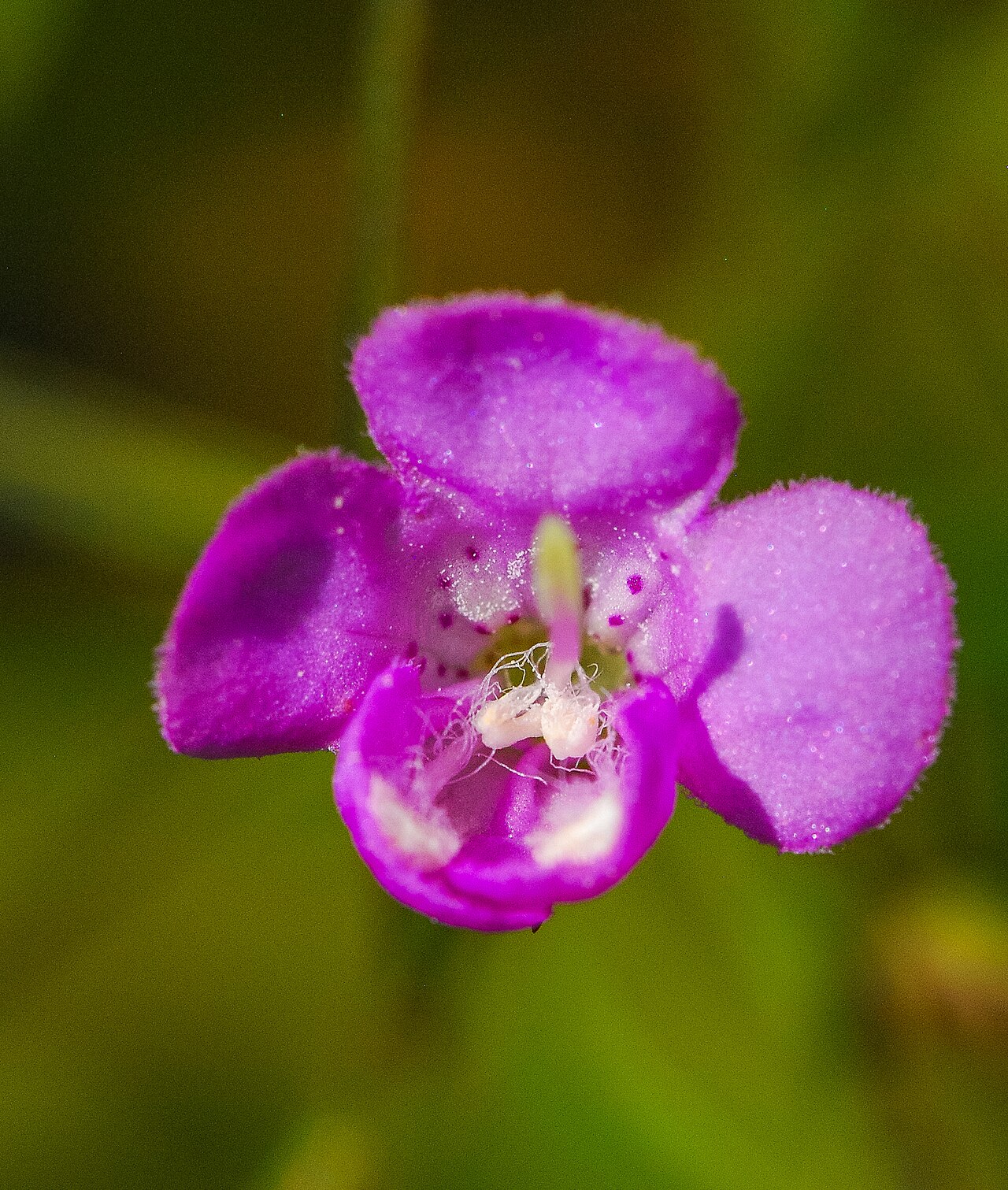
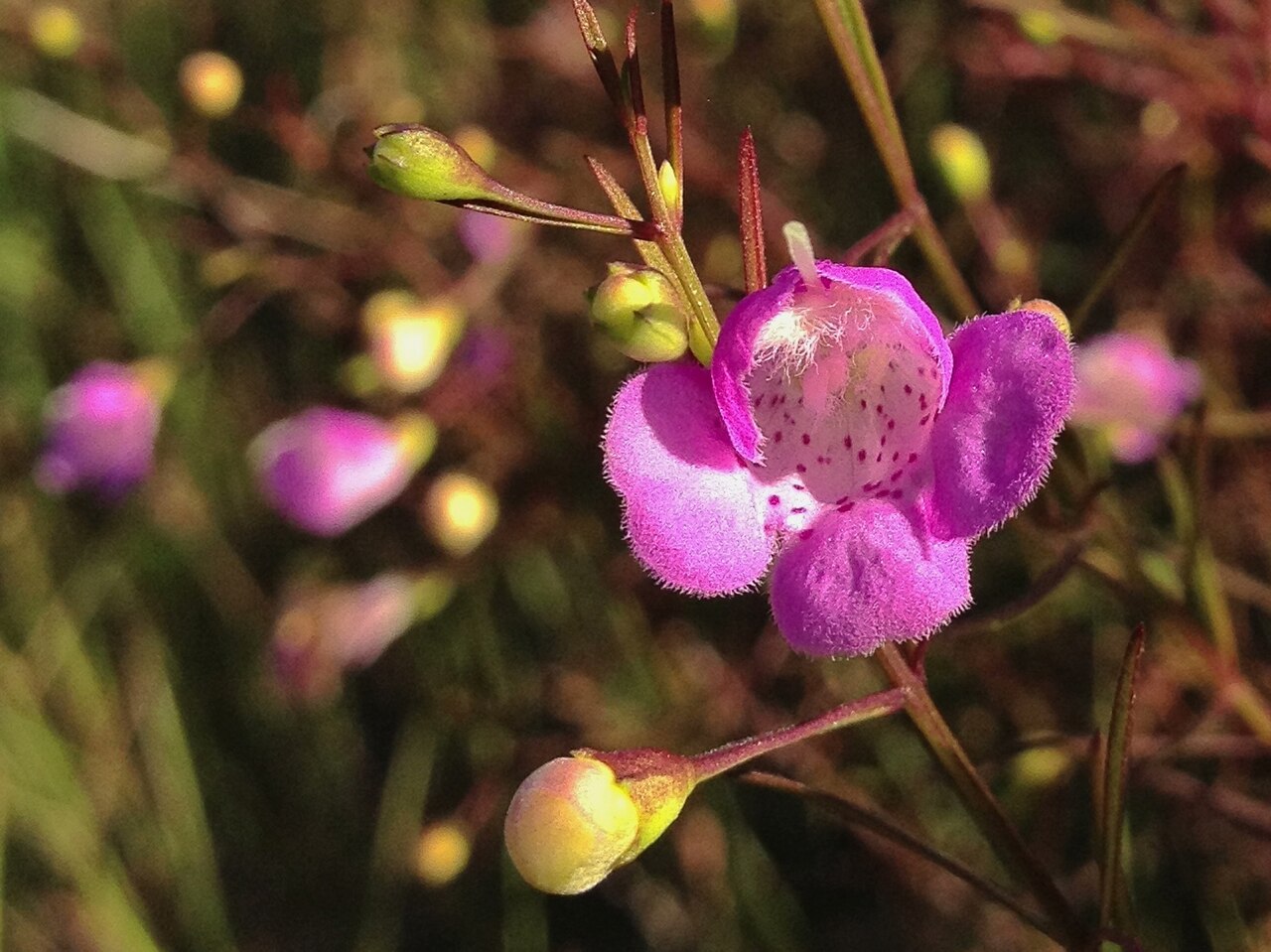
Flowers appear from about August to October, singly in the leaf axils along the upper branches, on slender stalks 1/4 to 1 inch long, usually longer than the flower. Each flower is about 1/2 inch long, an open, funnel- to bell-shaped tube with five rounded lobes, pink-purple to lavender or rarely white. The two upper lobes are shorter and arch forward over the stamens; the inside of the throat is hairy, often with two pale yellowish lines and small purple spots.
Fruit & Seeds
The fruit is a small, round capsule about 1/4 inch long that splits open in fall to release many tiny, dark seeds. The dry, branching plants with open capsules often stand into winter.
Look-alikes
Purple false foxglove (Agalinis purpurea) has larger flowers, about 1 inch long, on short stalks, and the upper lobes spread rather than arch forward. Prairie false foxglove (Agalinis heterophylla) has larger flowers and broader, often lobed lower leaves. Beach false foxglove (Agalinis fasciculata) is a coarse, rough-stemmed plant of the Southeast with larger flowers on short stalks. Slender false foxglove’s small flowers on long, thread-like stalks are the best field mark.
Safety Notes
Slender false foxglove is not a food plant and should not be eaten. It is not the true foxglove (Digitalis), but as a precaution keep it away from children and pets.
Quick Facts
| Scientific Name | Agalinis tenuifolia |
| Family | Orobanchaceae (broomrape family) |
| Plant Type | Annual wildflower (root hemiparasite) |
| Mature Height | 6–24 in |
| Mature Spread | 6–18 in |
| Growth Rate | Fast |
| Sun Exposure | Full sun to part shade |
| Water Needs | Moderate; moist to dry soil |
| Soil Type | Sandy, loamy or clay; adaptable |
| Soil pH | About 5.0–7.5 |
| Bloom Time | August–October |
| Flower Color | Pink-purple to lavender |
| Fall Color | Stems often turn purplish |
| Fruit | Small round capsules with tiny seeds |
| Deer Resistant | Mostly; seldom browsed |
| USDA Hardiness Zones | 3–9 (annual) |
Native Range
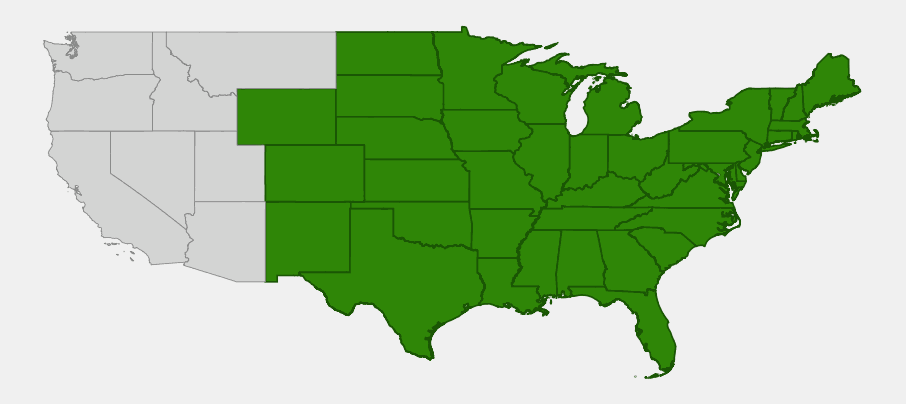
Slender false foxglove is native to much of eastern and central North America. USDA PLANTS lists it as native in Alabama, Arkansas, Colorado, Connecticut, Delaware, Florida, Georgia, Illinois, Indiana, Iowa, Kansas, Kentucky, Louisiana, Maine, Maryland, Massachusetts, Michigan, Minnesota, Mississippi, Missouri, Nebraska, New Hampshire, New Jersey, New Mexico, New York, North Carolina, North Dakota, Ohio, Oklahoma, Pennsylvania, Rhode Island, South Carolina, South Dakota, Tennessee, Texas, Vermont, Virginia, West Virginia, Wisconsin and Wyoming, as well as the District of Columbia. In Canada it is native in Manitoba, New Brunswick, Ontario and Quebec.
It is one of the most widespread and common false foxgloves, found throughout the East and Midwest and west across the Great Plains. Records from eastern Colorado, Wyoming and New Mexico are outlying populations at the western edge of its range.
It grows in a wide range of open habitats, from moist to fairly dry: prairies and old fields, wet meadows, fens and marsh edges, lake and river shores, open woods and woodland edges, glades, powerline cuts and roadsides. It needs host plants nearby, usually grasses and sedges, and plenty of light.
📋 Regional plant lists featuring Slender False Foxglove: North & South Florida · Alabama, Georgia & Mississippi · North & South Carolina · Maryland, Virginia & West Virginia · Kentucky & Tennessee · Arkansas, Louisiana, Eastern Oklahoma & Eastern Texas · Illinois, Iowa & Missouri · Ohio & Indiana · Nebraska, Kansas & Eastern Colorado · North Dakota, South Dakota & Western Minnesota · Michigan, Wisconsin & Eastern Minnesota · New York, Pennsylvania & Northern New Jersey · Delaware, Southern New Jersey & Long Island · Connecticut, Massachusetts & Rhode Island · New Hampshire, Maine & Vermont · Montana & Wyoming
Growing & Care Guide
Slender false foxglove is grown from seed, not from potted plants, because it needs to attach to the roots of host plants to thrive. Native seed suppliers in the Midwest and East sometimes sell it for prairie and meadow mixes.
Light
Full sun to light shade. It flowers best in open, sunny meadows and prairies.
Soil & Water
It adapts to sandy, loamy or clay soils from moist to moderately dry. It does well in average garden soil as long as host plants are present. No fertilizer is needed.
Planting Tips
Scatter seed in fall on the soil surface among established native grasses, such as little bluestem, switchgrass or other bunchgrasses, which serve as hosts. Do not cover the tiny seeds deeply. It is best in a meadow, prairie or the grassy edge of a rain garden rather than a formal bed.
Pruning & Maintenance
No care is needed. As an annual, it depends on reseeding each year, so leave the dry plants standing until the capsules have opened. Avoid mowing in late summer and early fall while it is flowering and setting seed.
Propagation
Grow it only from seed. Collect the small capsules in fall when they turn brown, and sow the seed outdoors in fall so it gets natural cold stratification over winter. Seedlings must find host roots soon after germinating, so sow where grasses are already growing.
Landscape Uses
- Prairie and meadow plantings: late-season pink flowers among grasses
- Butterfly gardens: larval host for the common buckeye
- Pollinator gardens: nectar and pollen for bumble bees in fall
- Restoration: prairies, wet meadows, fens and old fields
- Naturalistic rain garden edges: for grassy, moist margins
Wildlife & Ecological Value
Slender false foxglove is a small annual, but it plays several roles in open grassland communities.
For Pollinators
The flowers are visited mainly by bumble bees and other medium-sized bees, which crawl into the bell to reach nectar and pollen. Slender false foxglove is a larval host plant of the common buckeye butterfly (Junonia coenia), whose caterpillars feed on the leaves.
For Birds
Birds do not depend on the tiny seeds, but the insects using the plants feed grassland birds.
For Mammals
It is seldom browsed by deer or rabbits.
Ecosystem Role
As a root hemiparasite, slender false foxglove draws water and nutrients from host plants, especially grasses. By slightly weakening dominant grasses, hemiparasites like this one can help other wildflowers compete, increasing plant diversity in prairies and meadows.
Cultural & Historical Uses
The species was first described by the Danish botanist Martin Vahl as Gerardia tenuifolia and later moved to Agalinis by Constantine Rafinesque. For many years most American botanists used the name Gerardia, and “gerardia” is still a common name for these plants. Tenuifolia means “slender-leaved.”
False foxgloves were long placed in the figwort family (Scrophulariaceae). DNA studies showed that the hemiparasitic members of that family are more closely related to the broomrapes, and they are now placed in Orobanchaceae.
The name “false foxglove” refers to the bell-shaped flowers, which recall those of the true foxglove (Digitalis) of Europe, though the two are not closely related.
Frequently Asked Questions
Is slender false foxglove a parasite?
It is a hemiparasite. It has green leaves and makes its own food, but its roots also attach to the roots of nearby plants, mostly grasses, to take water and nutrients.
Can I grow slender false foxglove in a pot?
Not easily. It needs host plants, so it is best sown directly in a meadow or prairie among native grasses.
Is it related to true foxglove?
No. The flowers look a little like those of true foxglove (Digitalis), but slender false foxglove is in the broomrape family.
When does slender false foxglove bloom?
From about August to October. Each flower lasts only about a day, but new flowers open for weeks.
Which butterfly uses slender false foxglove?
The common buckeye uses false foxgloves, including this species, as larval host plants.

Looking for a nursery that carries Slender False Foxglove?
Browse our native plant nursery directory: Alabama & Arkansas · Colorado, Connecticut, Delaware, Florida & Georgia · Illinois, Indiana, Iowa & Kansas · Kentucky, Louisiana, Maine, Maryland, Massachusetts, Michigan, Minnesota, Mississippi & Missouri · Nebraska, New Hampshire, New Jersey, New Mexico, New York, North Carolina, North Dakota, Ohio & Oklahoma · Pennsylvania, Rhode Island, South Carolina, South Dakota, Tennessee, Texas, Vermont & Virginia · West Virginia, Wisconsin & Wyoming

