
Spotted Fritillary (Fritillaria atropurpurea)
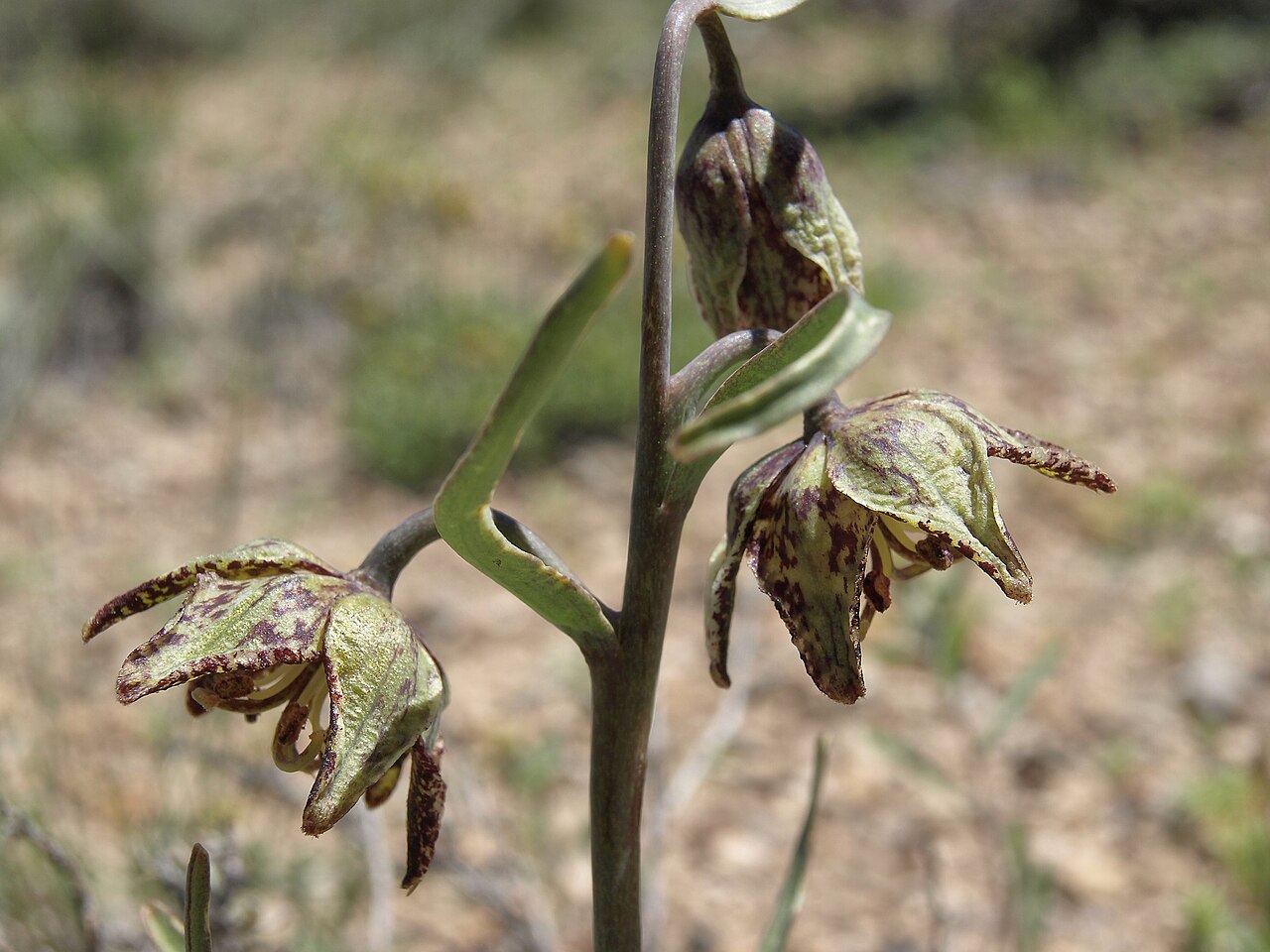
Fritillaria atropurpurea, known as Spotted Fritillary, leopard lily or purple fritillary, is a slender spring and early summer wildflower of the western mountains and high plains. It belongs to the lily family (Liliaceae). From a small bulb it sends up a single stem 6 to 24 inches tall with narrow leaves and one to four nodding, bell-shaped flowers that are mottled purple-brown, yellow and green.
It grows in sagebrush steppe, open ponderosa pine and aspen woods, mountain meadows and grassy slopes across the Great Basin and the Rocky Mountains, from the eastern Sierra Nevada and Oregon to Montana, the Black Hills and the Colorado Plateau. The flowers are well camouflaged and easy to walk past, but they are a treat for hikers who know where to look.
Spotted fritillary is best enjoyed in the wild. It is rarely available from nurseries and is difficult to grow outside its range. Never dig the bulbs of wild plants: they rarely survive transplanting, and digging destroys the small populations that depend on them.
Identification
Look for a slender stem with narrow, grass-like leaves crowded on the upper half and one to four nodding, purple-brown bells speckled with yellow or green.
Growth Habit
A perennial from a small, scaly bulb surrounded by many rice-grain-like bulblets. Each plant usually sends up a single, unbranched stem 6 to 24 inches tall. Young or non-flowering plants produce only a single leaf. The plant dies back to the bulb by midsummer.
Leaves
The leaves are narrow and linear, 2 to 4 inches long, and often bluish-green. There are usually 7 to 14 of them, scattered or in loose whorls along the upper half of the stem, below the flowers.
Flowers
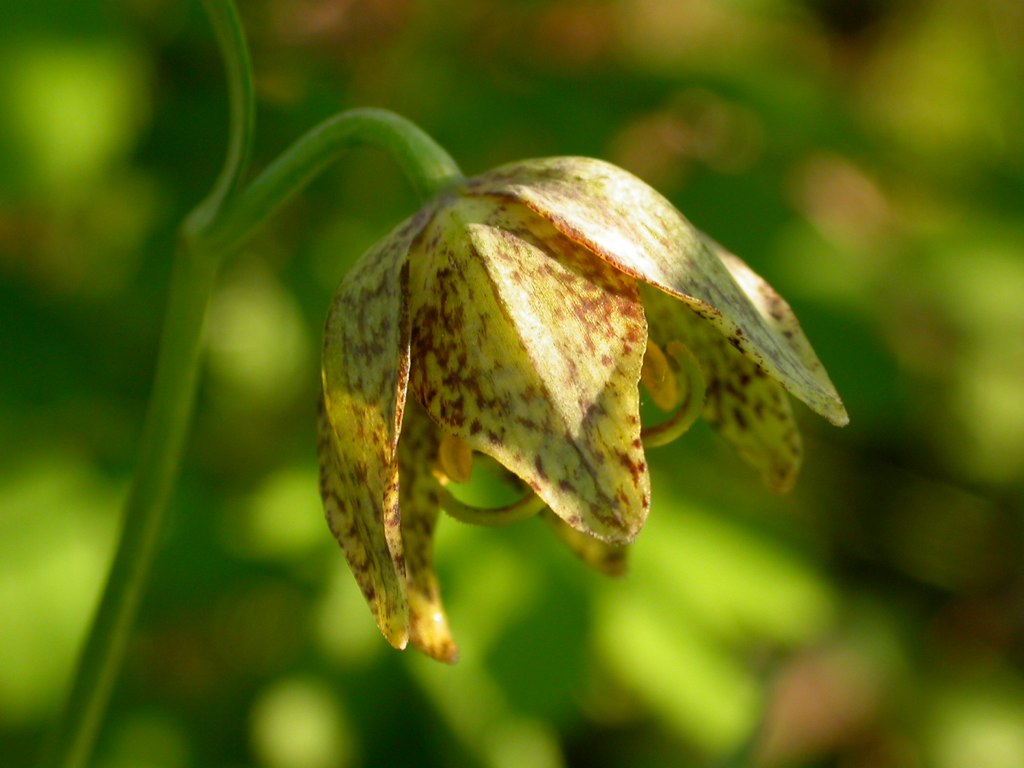
From April to July, depending on elevation, each stem carries one to four nodding flowers. Each flower is a shallow, open bell about 3/4 inch long, with six pointed tepals that are purple-brown, mottled and speckled with yellow, green or white. Inside are six stamens and a style that is split into three branches for more than half its length.
Fruit
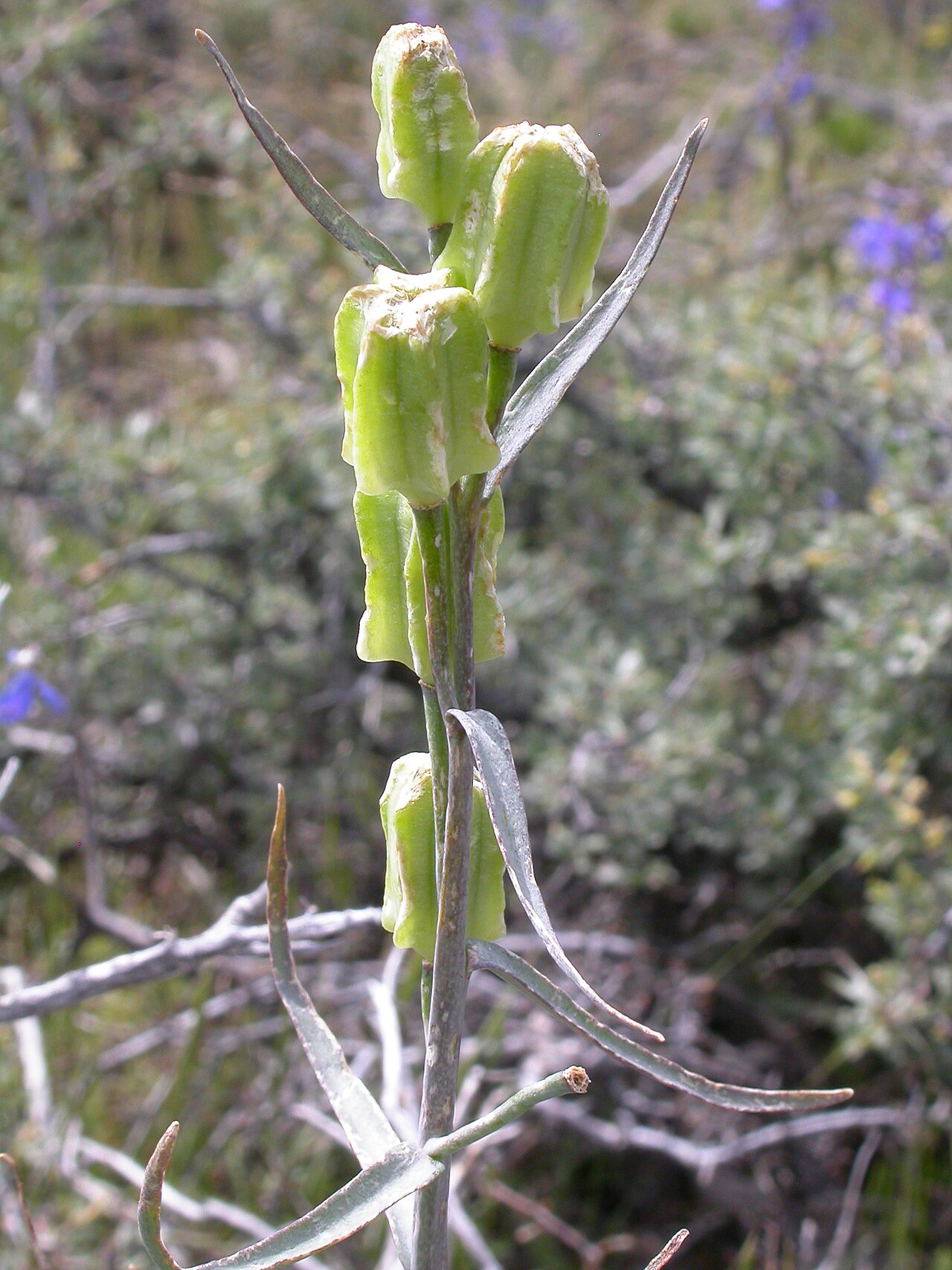
After flowering the stem straightens and the fruit, an upright, six-angled capsule about 1/2 to 1 inch long, ripens in early summer. It splits open to release many flat, papery seeds that are scattered by the wind.
Look-alikes
Yellow fritillary (F. pudica) blooms earlier and has smaller, plain yellow to orange bells. Checker lily (F. affinis) of the Pacific states has broader leaves in whorls and larger flowers. Chocolate lily (F. camschatcensis) of the Pacific Northwest coast and Alaska has dark, unspotted flowers.
Quick Facts
| Scientific Name | Fritillaria atropurpurea |
| Family | Liliaceae (lily family) |
| Plant Type | Bulbous herbaceous perennial |
| Mature Height | 6–24 in |
| Mature Spread | 3–6 in |
| Growth Rate | Slow |
| Sun Exposure | Full sun to part shade |
| Water Needs | Low; moist in spring, dry in summer |
| Soil Type | Well-drained loam, gravelly or rocky soils |
| Soil pH | Neutral to slightly alkaline (about 6.5–8.0) |
| Bloom Time | April–July |
| Flower Color | Purple-brown mottled with yellow, green or white |
| Fall Color | None; dormant by midsummer |
| Fruit | Upright, six-angled capsule |
| Deer Resistant | No; flowers and leaves are browsed |
| USDA Hardiness Zones | 4–8 |
Native Range
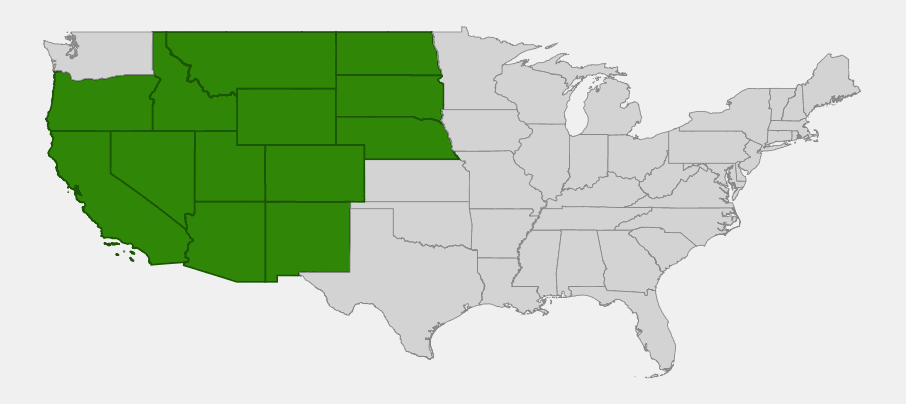
Spotted fritillary is native to the interior western United States. USDA PLANTS lists it as native in 13 states: California, Oregon, Idaho, Nevada, Utah, Arizona, New Mexico, Colorado, Wyoming, Montana, North Dakota, South Dakota and Nebraska. It is most widespread in the Great Basin and the Rocky Mountains, especially in Nevada, Utah, Idaho, Wyoming, Montana and Colorado.
In California it grows mainly on the east side of the Sierra Nevada and in the northeastern mountains, and in Oregon it is common east of the Cascades, with additional populations in the mountains and interior valleys of southwestern Oregon. On the eastern edge of its range there are outlying populations in the Black Hills and the badlands of western South Dakota and North Dakota and in the Pine Ridge and Wildcat Hills of western Nebraska. It reaches its southern limit on the Colorado Plateau in northern Arizona and New Mexico.
It grows in sagebrush steppe and grasslands, open ponderosa pine, Douglas-fir and aspen forests, mountain brush, meadow edges and rocky slopes, usually from about 4,000 to 10,000 feet. It often grows in the partial shelter of shrubs or trees, which hides its slender stems and dark flowers.
📋 Regional plant lists featuring Spotted Fritillary: Idaho, Eastern Oregon & Eastern Washington · Montana & Wyoming · Nebraska, Kansas & Eastern Colorado · Utah & Western Colorado · Arizona & New Mexico · North Dakota, South Dakota & Western Minnesota · Western Oregon & Western Washington · California & Nevada
Growing & Care Guide
Spotted fritillary is a wildflower to admire rather than a garden plant. It is rarely offered for sale and is difficult to keep alive outside the dry-summer climates of its range. Gardeners in the Intermountain West can sometimes grow it from seed in a rock garden or dry meadow.
Light
Full sun to light shade, such as the edge of shrubs or open pines.
Soil & Water
It needs very well-drained, gravelly or rocky soil that is moist in spring and dry in summer while the bulb is dormant. Summer watering usually causes the bulbs to rot. It does not do well in humid climates or heavy, wet soils.
Planting Tips
Use only seed or bulbs from a reputable nursery that propagates them, never bulbs dug from the wild. Plant bulbs about 3 to 4 inches deep in fall in a dry rock garden, scree bed or sagebrush planting, where they will not be watered in summer.
Pruning & Maintenance
Leave the foliage until it yellows and dies back, so the bulb can store energy for the next year. Mark the location, since the plant disappears by midsummer. Protect plants from deer, rabbits and rodents, which eat leaves, flowers and bulbs.
Propagation
Grow from fresh seed sown outdoors in fall, which needs winter cold to germinate. Seedlings take several years to reach flowering size. The small bulblets around the main bulb can also be separated and replanted in fall.
Landscape Uses
- Wildflower viewing: a subtle spring wildflower of sagebrush and pine country
- Dry rock gardens: for experienced growers in the Intermountain West
- Sagebrush and steppe restoration: part of the native spring wildflower layer
- Naturalistic plantings: among native bunchgrasses and shrubs in dry-summer climates
- Photography: its mottled, nodding bells reward a close look
Wildlife & Ecological Value
Spotted fritillary is part of the spring wildflower display of sagebrush steppe and open western forests.
For Pollinators
Its nodding flowers have nectar glands at the base of each tepal and are visited mainly by bees, such as bumblebees and solitary bees, as well as flies and wasps.
For Birds
It provides little direct food for birds, but it is part of the sagebrush and open forest habitats used by sage-grouse and many songbirds, which feed on the insects that visit spring wildflowers.
For Mammals
Deer, elk, pronghorn and livestock browse the flowers and leaves, and pocket gophers and other rodents eat the bulbs.
Ecosystem Role
Like other spring bulbs of the West, it completes its growth while soil moisture is available in spring and early summer, adding to the diversity of the plant community without competing for summer water. Its many small bulblets help it persist in places where it is grazed.
Cultural & Historical Uses
The genus name Fritillaria comes from the Latin fritillus, a dice box or game board, possibly referring to the checkered pattern of many fritillary flowers. The species name atropurpurea means “dark purple.”
Thomas Nuttall described the species in 1834 from plants collected on his journey across the West. It is known by many common names, including leopard lily, chocolate lily, purple fritillary and spotted mountain-bells.
Native peoples of the Great Basin and Plateau dug the bulbs of several fritillaries as a small seasonal food. Today wild populations are best left undisturbed; collecting bulbs harms them, and the bulbs should not be eaten.
Frequently Asked Questions
Why is it called spotted fritillary?
Its flowers are heavily speckled and mottled with purple-brown, yellow and green, which also gives it the name leopard lily.
Where can I see spotted fritillary?
Look in spring and early summer in sagebrush steppe and open pine or aspen woods of the Great Basin and the Rocky Mountains, from the eastern Sierra Nevada and eastern Oregon to Montana, Colorado and the Black Hills.
Can I dig up spotted fritillary bulbs for my garden?
No. Wild bulbs rarely survive transplanting and digging damages wild populations. Use seed or bulbs from a nursery that propagates them.
Is spotted fritillary hard to grow?
Yes, outside its native region. It needs very well-drained soil and a dry summer dormancy, and it takes several years to flower from seed.
How do I tell spotted fritillary from yellow fritillary?
Yellow fritillary has smaller, plain yellow to orange bells and blooms earlier. Spotted fritillary has larger, purple-brown flowers mottled with yellow and green.

Looking for a nursery that carries Spotted Fritillary?
Browse our native plant nursery directory: Arizona · California · Colorado · Idaho · Montana · Nebraska, Nevada, New Mexico & North Dakota · Oregon · South Dakota & Utah · Wyoming

