
Purple Rocket (Iodanthus pinnatifidus)
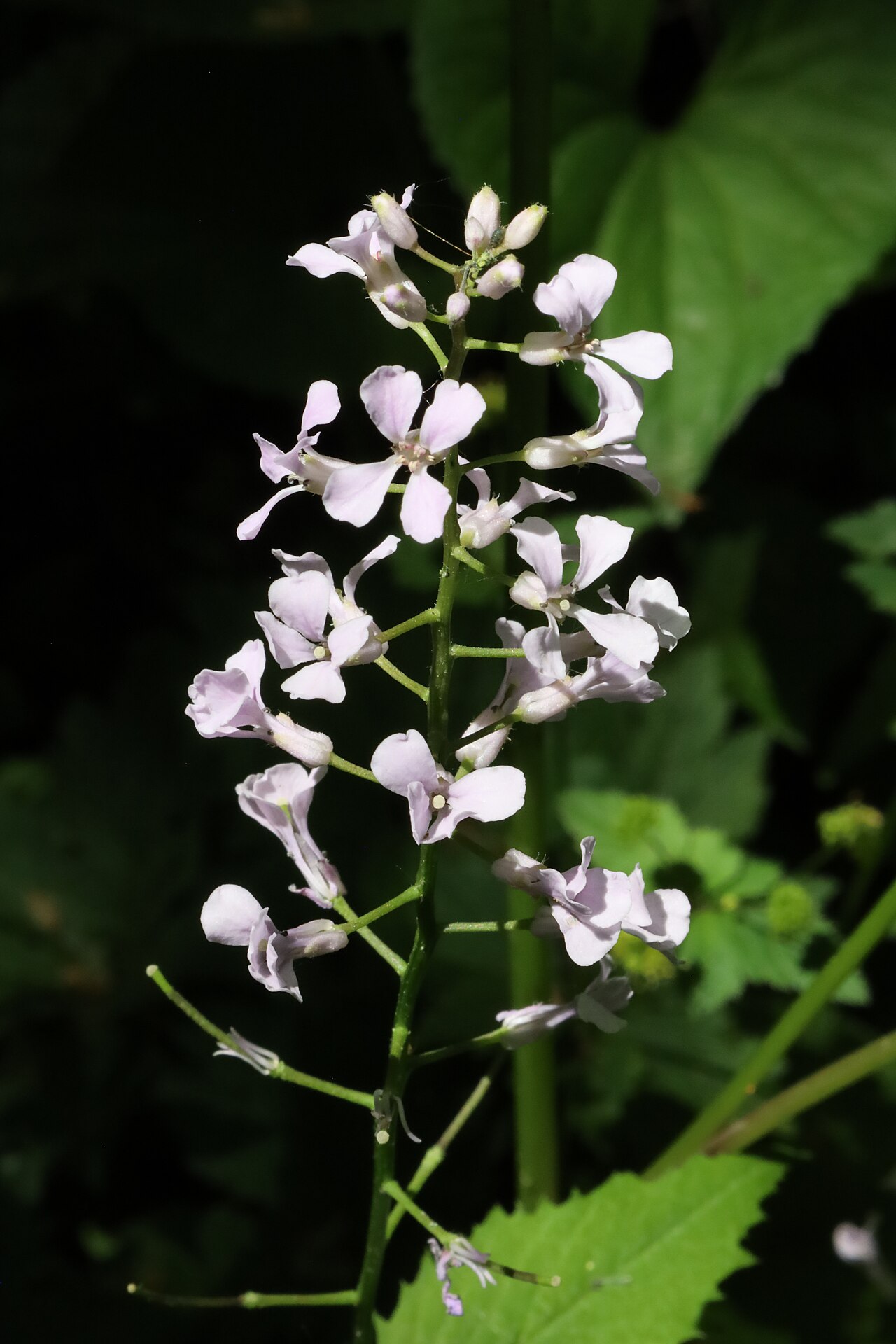
Iodanthus pinnatifidus, known as Purple Rocket or purplerocket, is a native wildflower of the mustard family (Brassicaceae) that grows in moist, shady bottomland woods, floodplains and stream valleys of the central and eastern United States. In late spring and early summer it sends up stems 1 to 3 feet tall topped with loose clusters of pale violet to nearly white, four-petaled flowers.
It is the only species in its genus, and the name Iodanthus means “violet flower”. Purple rocket is often confused with dame’s rocket (Hesperis matronalis), a showy invasive mustard from Europe that blooms at about the same time, but its flowers are smaller and paler, its leaves are smooth, and it grows mainly in moist forest rather than along roadsides and disturbed edges.
Its range is centered on the Ohio, Mississippi and lower Missouri River valleys, from Ohio and Kentucky west to Kansas, Oklahoma and Texas, with scattered populations at the edges, where several states track it as rare. This guide covers how to identify purple rocket, where it grows, how to grow it in a shady woodland or rain garden, and its value to pollinators.
Identification
Purple rocket is a fairly tall woodland mustard that blooms after most spring ephemerals have faded. Its pale violet, cross-shaped flowers, toothed leaves and slender seed pods are the key features.
Growth Habit
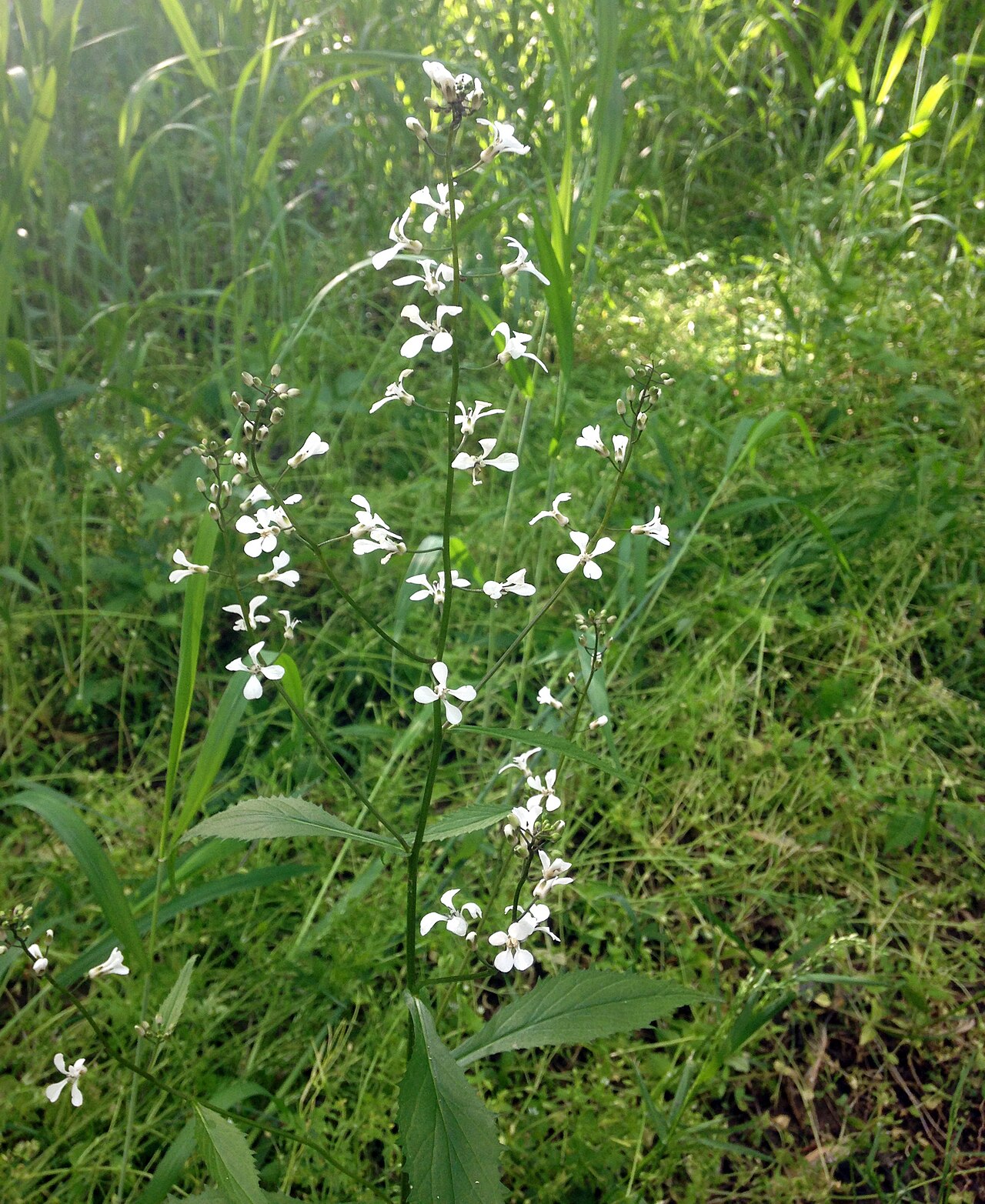
It is a perennial with a short, thickened root crown. Each plant usually produces one or a few erect, smooth stems 1 to 3 feet tall, unbranched below and branching in the flower cluster. Plants often grow in loose colonies on floodplains and lower slopes.
Leaves
The leaves are alternate, lance-shaped to narrowly oval, 2 to 6 inches long, with sharp, coarse teeth along the edges. They are smooth or nearly hairless. The upper leaves are stalkless and often clasp the stem with small ear-like lobes, while some lower leaves have one or more small, separate lobes at the base of the blade, the feature behind the species name pinnatifidus, meaning “cut like a feather”.
Flowers
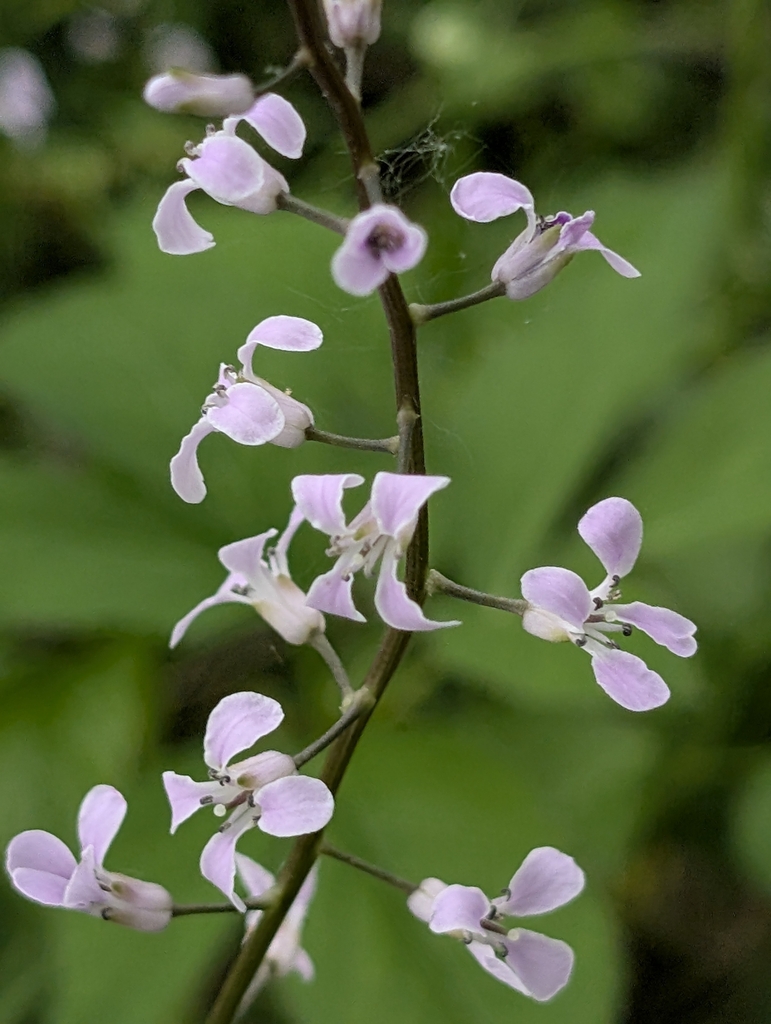
The flowers are borne in loose, branched clusters (panicles of racemes) at the tops of the stems. Each flower is about 1/2 inch across, with four spoon-shaped petals forming a cross, in shades of pale lavender, violet or almost white, and six stamens, four long and two short, as in other mustards. Bloom time is mainly May and June, sometimes into July.
Fruit & Seeds
After flowering, each flower develops a long, slender, cylindrical seed pod (silique) 1 to 1.5 inches long that spreads or curves upward from the stem. The pods ripen in summer and split open to release small brown seeds.
Look-alikes
Dame’s rocket (Hesperis matronalis), an invasive European mustard, has larger, brighter purple, pink or white flowers with a strong evening fragrance, and hairy leaves with fine teeth. It grows in large stands along roadsides and in disturbed woods. Some native toothworts and bittercresses, such as cut-leaved toothwort, have similar four-petaled flowers but bloom earlier in spring, are shorter and have divided leaves.
Quick Facts
| Scientific Name | Iodanthus pinnatifidus (Michx.) Steud. |
| Family | Brassicaceae (mustard family) |
| Plant Type | Herbaceous perennial |
| Mature Height | 1–3 ft |
| Mature Spread | 1–1.5 ft |
| Growth Rate | Moderate |
| Sun Exposure | Part shade to full shade |
| Water Needs | Moderate to high; moist soil |
| Soil Type | Moist, rich loam or alluvial soils; floodplains, streambanks and wooded ravines |
| Soil pH | About 6.0–7.5; often over limestone |
| Bloom Time | May–June (sometimes into July) |
| Flower Color | Pale violet to lavender or nearly white |
| Fall Color | None of note |
| Fruit | Slender, cylindrical seed pods (siliques) 1–1.5 in long |
| Deer Resistant | Moderately |
| USDA Hardiness Zones | 4–8 |
Native Range
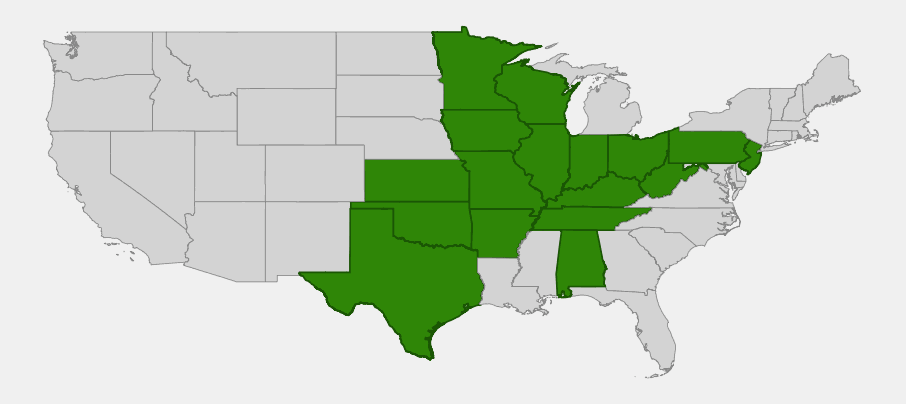
Purple rocket is native to the central and eastern United States. USDA PLANTS lists it in Ohio, Indiana, Illinois, Kentucky, Tennessee, West Virginia, Pennsylvania, New Jersey, Alabama, Missouri, Iowa, Minnesota, Wisconsin, Arkansas, Kansas, Oklahoma and Texas. It does not occur in Canada.
It is most common in the lowlands of the Ohio and middle Mississippi River valleys, especially in Kentucky, Indiana, Illinois, Missouri and Tennessee. Toward the edges of its range it becomes scattered: it reaches southeastern Minnesota and southern Wisconsin to the north, eastern Kansas and northeastern Oklahoma to the west, and eastern and central Texas to the southwest. Populations in Pennsylvania, West Virginia, Minnesota and Wisconsin are few, and those states track it as rare. USDA also lists a record from Connecticut, but regional New England floras do not treat it as part of the native flora there, so Connecticut is not shown on the map.
Typical habitats are moist bottomland and floodplain forests, wooded stream terraces and creek banks, thickets, the bases of wooded bluffs and moist ravines, often on rich, limestone-derived soils. It tolerates brief flooding and often grows with spring wildflowers that are dormant by the time it blooms.
📋 Regional plant lists featuring Purple Rocket: New York, Pennsylvania & Northern New Jersey · Ohio & Indiana · Michigan, Wisconsin & Eastern Minnesota · Kentucky & Tennessee · Nebraska, Kansas & Eastern Colorado · Maryland, Virginia & West Virginia · Delaware, Southern New Jersey & Long Island · Illinois, Iowa & Missouri · Alabama, Georgia & Mississippi · Arkansas, Louisiana, Eastern Oklahoma & Eastern Texas
Growing & Care Guide
Purple rocket is an easy native perennial for moist, shady gardens, and a good native alternative to the invasive dame’s rocket. It is offered by some native plant nurseries and seed suppliers in the Midwest. Plants are fairly short-lived but self-sow in suitable conditions.
Light
Grow it in part shade to full shade, such as under deciduous trees or on the shady side of a building. It tolerates morning sun if the soil stays moist, but in hot, dry, sunny sites the leaves yellow and the plant declines.
Soil & Water
It prefers moist, fertile, loamy soil rich in organic matter, like the alluvial soil of a floodplain. It tolerates occasional flooding and heavy soil, and it does well in shady rain gardens and along streams. Water during droughts, since it does not tolerate prolonged dry soil.
Planting Tips
Plant nursery-grown plants in spring or fall, about 12 to 18 inches apart, in groups so the flowers make a show. It pairs well with spring ephemerals such as Virginia bluebells, which go dormant just as purple rocket begins to bloom, and with ferns, sedges and woodland phlox.
Pruning & Maintenance
No pruning is needed. Leave some stems to ripen seed if you want it to self-sow, or cut back the stalks after flowering for a neater look. Pull dame’s rocket and garlic mustard if they appear nearby, since they compete for the same moist, shady ground.
Propagation
Grow it from seed. Collect the slender pods when they turn tan in summer and sow the seed outdoors in fall, or give it about 60 days of cold, moist stratification before spring sowing. Seedlings form a rosette the first year and usually flower in the second. Mature plants can also be divided carefully in early spring.
Landscape Uses
- Shade and woodland gardens: late-spring flowers after spring ephemerals fade
- Rain gardens and stream banks: tolerates moist soil and brief flooding
- Native alternative to dame’s rocket: similar flowers without the invasive habit
- Floodplain restoration: a native wildflower of bottomland forests
- Pollinator gardens: nectar and pollen for native bees and butterflies
Wildlife & Ecological Value
Purple rocket blooms in the gap between spring ephemerals and summer wildflowers in floodplain forests, so its flowers fill a useful niche for insects.
For Pollinators
The flowers provide nectar and pollen for bumble bees, other long- and short-tongued bees, small butterflies, skippers and flies. As a native mustard, it belongs to a plant family used as larval food by white and orangetip butterflies.
For Birds
Birds make little direct use of purple rocket, although small seed-eating birds may take some seeds, and insect-eating birds forage among the foliage.
For Mammals
Deer and rabbits browse the foliage at times, but mustard-family plants contain sharp-tasting compounds that make them less favored than many woodland wildflowers.
Ecosystem Role
Purple rocket is part of the diverse herbaceous layer of bottomland and floodplain forests in the Midwest. In many of these forests, native mustards are being crowded out by invasive garlic mustard and dame’s rocket, so planting and protecting native species such as purple rocket helps keep that layer diverse.
Cultural & Historical Uses
The genus name Iodanthus comes from the Greek ion, violet, and anthos, flower. The species name pinnatifidus refers to the small, deeply cut lobes found at the base of some lower leaves. It was first described by André Michaux as a species of Hesperis, the same genus as dame’s rocket, and later placed in its own genus.
The common name “rocket” is an old name for several mustard-family plants with tall flower spikes, such as dame’s rocket, and purple rocket is sometimes also called violet rocket. Because the two plants look superficially similar, purple rocket is sometimes mistakenly pulled as an invasive. Checking for smooth, sharply toothed leaves and smaller, paler flowers helps avoid that mistake.
Purple rocket is not widely known in gardens, but it is common enough in Midwestern floodplain woods that hikers in Kentucky, Indiana, Illinois and Missouri often meet it on late-spring walks along creeks and rivers.
Frequently Asked Questions
How do I tell purple rocket from dame’s rocket?
Purple rocket has smaller, paler violet flowers without a strong scent, smooth leaves with sharp teeth, and it grows in moist native woods. Dame’s rocket, an invasive from Europe, has larger, brighter, fragrant flowers and hairy leaves, and it forms large stands along roadsides and disturbed edges.
When does purple rocket bloom?
Mainly from May to June, after most spring ephemerals have finished, and sometimes into July.
Where does purple rocket grow?
It grows in moist bottomland forests, floodplains and stream valleys of the central and eastern United States, most commonly in the Ohio and middle Mississippi River valleys.
Can I grow purple rocket in my garden?
Yes. It does well in part to full shade in moist, rich soil, including shady rain gardens. It is short-lived but self-sows in good conditions.
Is purple rocket rare?
It is common in the core of its range but scarce at the edges, and Pennsylvania, West Virginia, Minnesota and Wisconsin track it as rare.

Looking for a nursery that carries Purple Rocket?
Browse our native plant nursery directory: Alabama & Arkansas · Illinois, Indiana, Iowa & Kansas · Kentucky, Minnesota & Missouri · New Jersey, Ohio & Oklahoma · Pennsylvania, Tennessee & Texas · West Virginia & Wisconsin

